


Quick Answer
Drawing and specification conflicts are disagreements between what the drawings show and what the written specifications require for the same work, such as a different product, size or rating, and they become the contractor's risk when nobody raises them before the price is fixed. This guide sets out the conflict types plan reviewers reject most often, the federal rule on which document governs, a worked example of one conflict caught at three different stages, and a review checklist for bid day and permit submittal.
What you'll find below:
- A table of the common conflict types, where to look for each and which document usually governs
- The exact federal contract language on drawings versus specifications
- A worked example of one partition conflict caught at bid, at submittal and after install
- A conflict review checklist for before bid and before permit submittal
- What to look for in a document review tool
Why Do Drawing and Spec Conflicts Slip Through Manual Review?
Conflicts slip through because drawings and specifications are written by different people, at different times, and read by estimators in a different order from the one they were produced in. The architect revises a partition type on the drawings in week ten. The specification section was finished in week six. Nobody is wrong on their own page, and the bid set still disagrees with itself.
Reading harder does not fix it. A set with hundreds of sheets and dozens of spec sections cannot be held in one person's head on a bid deadline. The conflicts that get caught are the ones a reviewer happened to read side by side.
Much of the review happens too late. Navigant Construction Forum's 2013 report on RFIs warned that "errors, conflicts, omissions and ambiguities may survive the design quality control review process", and that with compressed bid times "it seems this review is most often performed after bidding, not before."
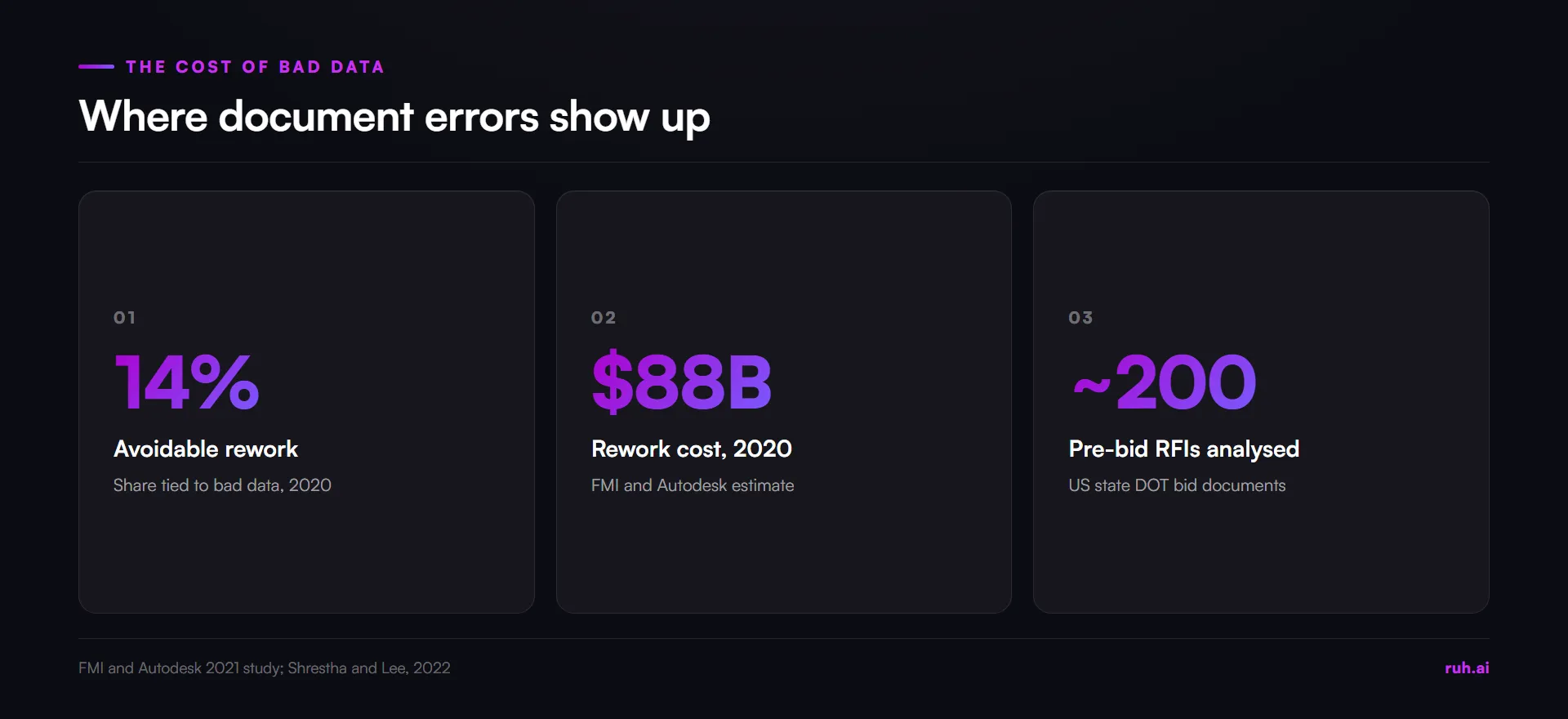
The research points to the same places every time. Shrestha and Lee of the University of Nevada analysed around 200 pre-bid RFIs from US state departments of transportation in a 2022 study, and found errors in the bill of quantities were the most frequent, followed by errors in the drawings.
What Does a Conflict Cost Once It Leaves Bid Day?
A conflict costs more at every stage it survives, because each stage adds material ordered, labor spent and people who must agree on the fix. On bid day it is a question. After award it is an RFI and a pricing argument. After installation it is rework.
Each question has a cost of its own. Navigant Construction Forum's 2013 study of 1,362 projects in Aconex data found an average of 796 RFIs per project and a median reply time of 9.7 days, and estimated $1,080 to review and answer each one, about $859,680 per project.
Bad information shows up in the rework numbers. An FMI and Autodesk study published in 2021 and reported by Construction Dive estimated that bad data may have been responsible for 14% of avoidable rework, about $88 billion, in 2020, based on a survey of 3,900 construction professionals.
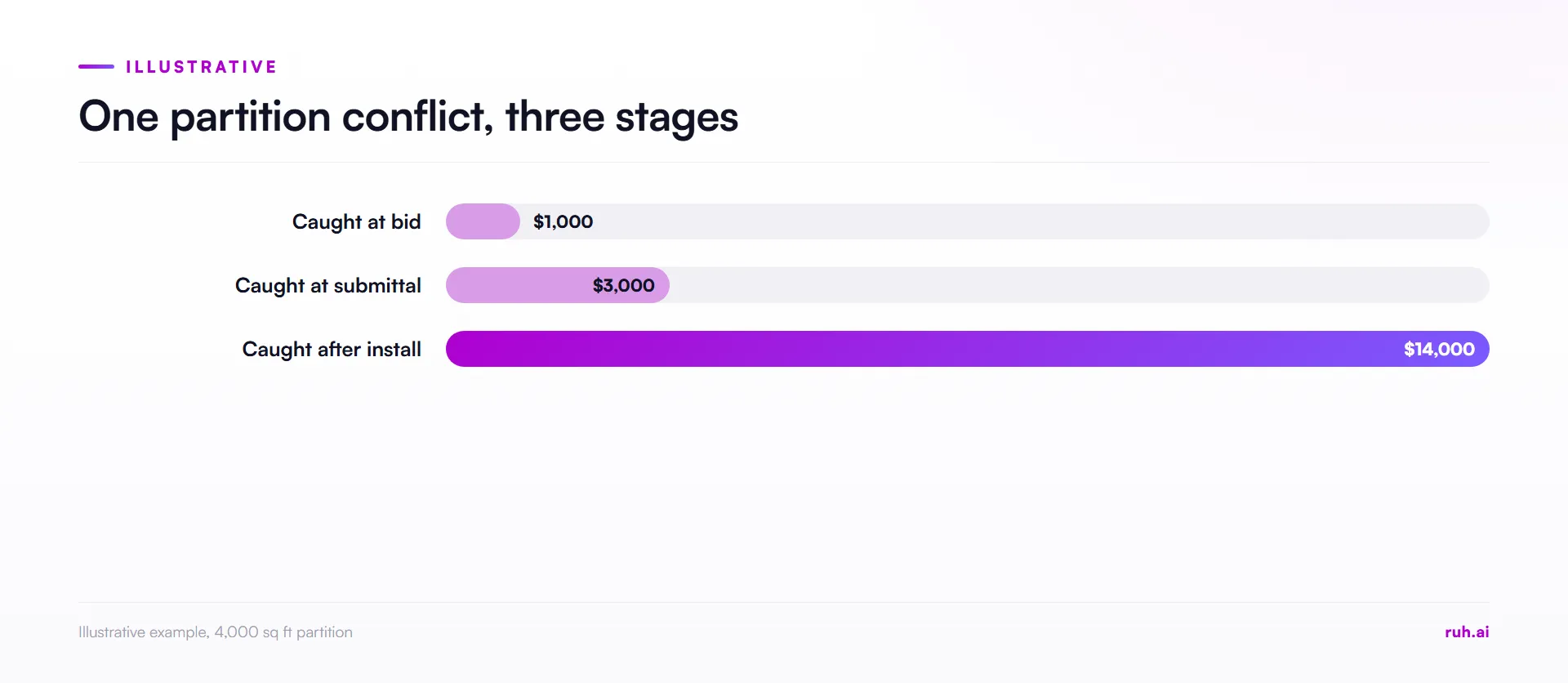
The worked example below shows the size of it. The wall area and unit costs are illustrative, chosen to show the shape of the cost, not any market price.
- The conflict. A 4,000 sq ft corridor partition. The specification calls for 5/8 in Type X fire-rated gypsum board. The partition schedule on the drawings shows 1/2 in regular board.
- Caught at bid. The estimator prices to the specification and notes the conflict. The extra cost is about $0.25 per sq ft: 4,000 × $0.25 = $1,000.
- Caught at submittal. The board was bought to the schedule and must be reordered. About $0.75 per sq ft: 4,000 × $0.75 = $3,000.
- Caught after install. The wall fails inspection and is torn out and replaced. About $3.50 per sq ft: 4,000 × $3.50 = $14,000.
The same conflict costs 14 times more in the field than on bid day. That ratio is the whole case for reviewing documents before the number goes out.
What Are the Common Drawing and Spec Conflict Types?
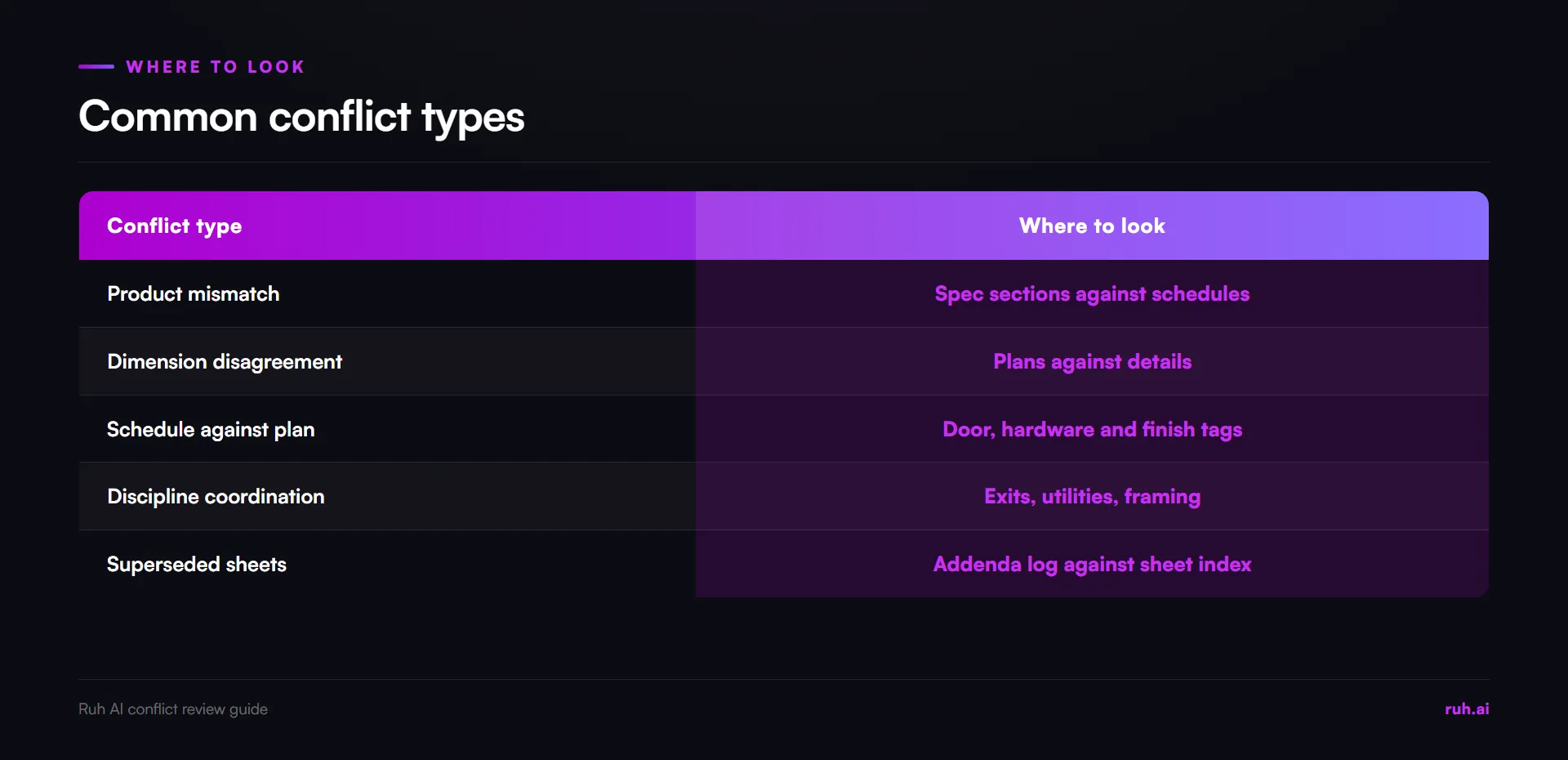
The common conflict types are product mismatches, dimension disagreements, schedules that disagree with plans, disciplines that are not coordinated, and sheets that were superseded but not removed. Building departments see the same ones at plan check. The City of Dayton's guide to common plan review problems, revised in 2011, lists "Civil, landscape and architectural site plans do not match", "Truss layout plan not consistent with framing plan" and "Door hardware/schedule not correct or consistent with drawings" among the most frequent reasons plans are rejected.
Common drawing and spec conflict types, where to look and what to do:
| Conflict type | What it looks like | Where to look | What to do |
|---|---|---|---|
| Product or material mismatch | The spec names one product, rating or finish, the drawing another | Spec sections against schedules and wall types | Price to the governing document, send a question, note it in the bid |
| Dimension disagreement | A plan dimension and a detail disagree, or figures do not add up | Plans, enlarged plans and details | Do not scale to settle it. Ask in writing |
| Schedule against plan | Door, hardware or finish schedules do not match the plans | Schedules against plan tags | Log every mismatch by tag |
| Discipline coordination | Electrical, plumbing or structural sheets disagree with architectural | Exits and egress lighting, utility locations, framing and truss layouts | Overlay or compare discipline sheets for the same area |
| Site plans | Civil, landscape and architectural site plans differ | Site plan set | Confirm which site plan governs before pricing sitework |
| Superseded sheets | An addendum replaces a sheet and both get priced | Addenda log against the sheet index | Remove superseded sheets before takeoff |
Which Governs, Drawings or Specifications?
On US federal construction contracts, the specifications govern when they differ from the drawings, and any discrepancy in figures goes to the Contracting Officer for a written decision. The Federal Acquisition Regulation clause FAR 52.236-21, Specifications and Drawings for Construction, says: "In case of difference between drawings and specifications, the specifications shall govern."
The same clause puts the risk on the contractor who settles a conflict alone. A discrepancy "shall be promptly submitted to the Contracting Officer", and "any adjustment by the Contractor without such a determination shall be at its own risk and expense." It also says anything shown on one document and not the other is "of like effect as if shown or mentioned in both", so leaving out the item on the sheet you did not read is not a defence.
Other owners rank them the other way. The California Department of Transportation's 2025 Standard Specifications, section 5-1.02, rank special provisions first, then project plans, then standard specifications, so the plans outrank the standard specifications. The same section says written numbers on a drawing govern over graphics, a detail drawing governs over a general drawing, and "If a discrepancy is found or confusion arises, submit an RFI."
Private contracts set their own order of precedence too. Some put specifications first, some put the drawings or the agreement first, and some say the documents are complementary with no ranking. Read the general conditions before bid day, not after the first dispute. When the contract is silent or unclear, ask before you price.
How Do You Pre-Check Plans Before Permit Submittal?
A permit plan review pre-check means checking your own set for the mismatches a plan reviewer will reject, before you submit it. Most rejections are avoidable, and each round of corrections costs schedule.
The review queue is long before the first comment arrives. Clark County, Nevada reported for April 2026 an average of 37.13 days to first review for complex and phased projects across 78 reviews, and 14.47 days for commercial architectural reviews. A correction cycle sends the set back into that queue.
Plan reviewers expect specific answers. The County of San Diego's residential plan check correction list, revised in 2017, says resubmittals must indicate "where and how each correction item has been addressed", and that "vague responses, such as 'Done' or 'See plans,' are unacceptable." Treat your own pre-check the same way: every item answered with the sheet and detail.
A pre-check before submittal covers five things:
- Site plans agree across civil, landscape and architectural sheets.
- Schedules match the plans, door by door and fixture by fixture.
- Disciplines are coordinated, with exits, egress lighting and utility locations shown the same way on every sheet.
- Every sheet is drawn to scale, with the scale stated. Dayton's guide lists plans "not drawn to scale" among submittal problems.
- Code information is complete: occupancy, construction type, allowable area and height.
What Should a Drawing and Spec Conflict Review Include?
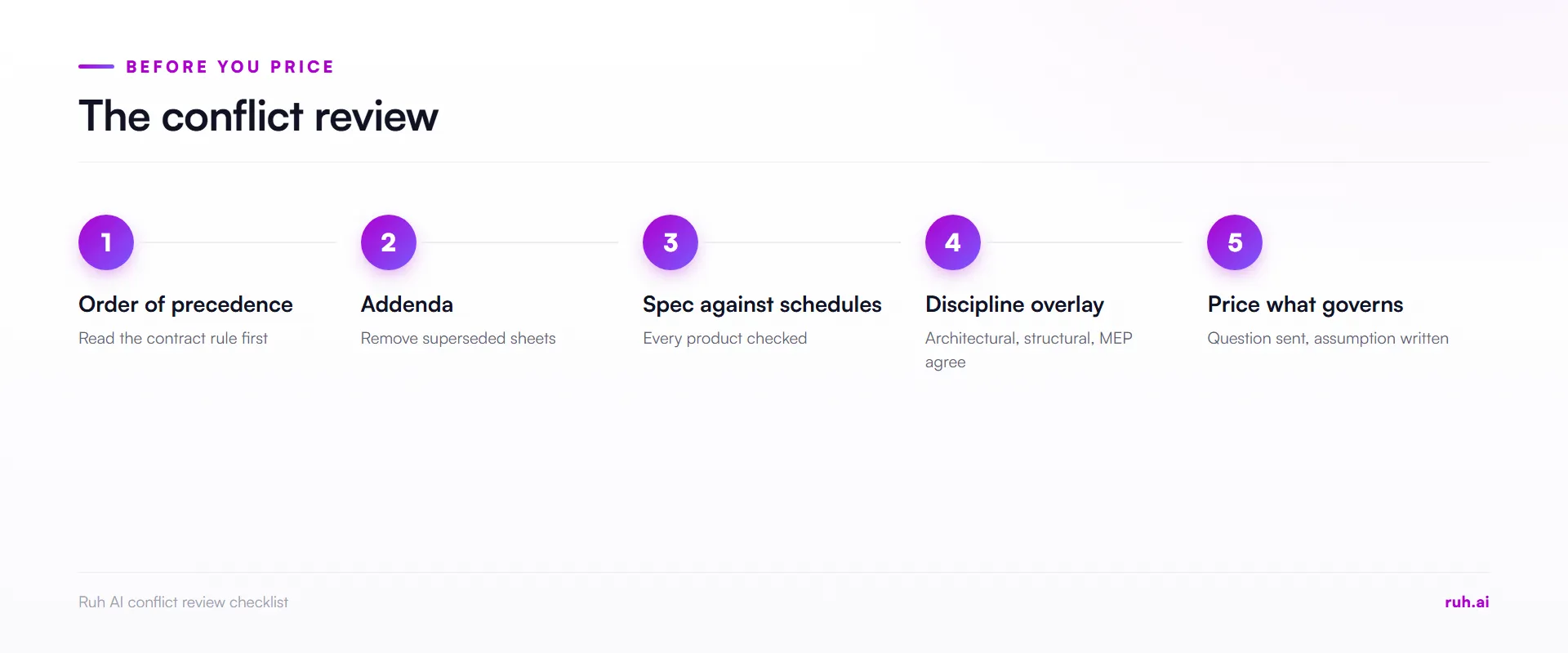
A drawing and spec conflict review should run the same checks on every bid, in the same order, and record every conflict with the question sent and the assumption priced. Copy the checklist below into your bid process.
| # | Check | Done when |
|---|---|---|
| 1 | Order of precedence | The contract's rule is read and noted at the top of the conflict log |
| 2 | Addenda | Every addendum is logged and every superseded sheet removed |
| 3 | Spec against schedules | Every scheduled product is checked against its spec section |
| 4 | Plans against details | Key dimensions match between plan and detail |
| 5 | Schedules against plans | Door, hardware and finish tags match |
| 6 | Discipline overlay | Architectural, structural and MEP agree for the same area |
| 7 | Questions sent | Every conflict has a pre-bid question, or a written assumption |
| 8 | Priced to the governing document | The bid prices what governs, and states the assumption |
The construction bid process guide shows where document review sits in the bid timeline, and the guide to RFIs, RFPs and RFQs covers how to write the question.
What Should You Look For in a Document Review Tool?
A useful document review tool puts the drawing and the spec text side by side for the same item, and keeps a log of every conflict, question and answer. Speed matters less than whether the reviewer can see both documents and record the decision.
- Side-by-side view. The sheet and the spec section for the same product, on one screen.
- Scale safety. It refuses to measure a sheet with no scale instead of guessing.
- A conflict log. Every conflict, the question sent, the answer and the assumption priced.
- Addenda handling. Superseded sheets drop out of the set automatically, with a record of what changed.
- Traceability. Every quantity links back to the sheet it came from.
What Estimators Get Wrong About Drawing and Spec Conflicts
In Ruh's opinion, estimators get four things wrong about drawing and spec conflicts. These are our positions, not survey findings.
Reading harder is not a method. The conflicts you find depend on which pages you read together. A fixed order of checks finds more than a careful read.
"Specs govern" is not a universal rule. It is the federal rule, and Caltrans ranks the plans higher. Private contracts vary, and assuming the wrong order of precedence is how a priced conflict becomes an unpriced one.
Silence is not a strategy. Pricing the cheaper reading and hoping nobody notices puts the whole difference on you once it is found.
The conflict log is a pricing document. Every assumption in it is part of the bid, and the log is what you point to when the question comes back after award.
The Honest Assessment: What a Conflict Review Cannot Fix
A conflict review finds disagreements in the documents, and it cannot make a late answer arrive on time. Four limits are worth stating.
- It cannot fix an unanswered question. If the design team does not reply before bid day, the risk stays in your number.
- It cannot settle the contract for you. Which document governs is a contract question, and some contracts do not answer it.
- It takes time on a tight deadline. A full review costs hours. Decide in advance which checks always happen.
- It does not catch errors that agree. If the drawing and the spec are both wrong in the same way, a conflict check will not flag it.
How Ruh AI Fits Into This
Ruh AI's Takeoff Agent withholds a figure when a sheet has no scale instead of guessing, so a sheet that cannot be measured shows up as a gap to resolve rather than a quantity nobody checked.
The Estimating Agent then prices from your company's own rate book and history. Your estimator can change any price or add their own costs, and a person approves the budget before the next stage.
Frequently Asked Questions
Q: What is a drawing and specification conflict in construction? A: It is a disagreement between what the drawings show and what the specifications require for the same work, such as a different product, size or rating. It becomes the contractor's risk if it is not raised before the price is fixed.
Q: Which governs, the drawings or the specifications? A: It depends on the contract. On US federal contracts the specifications govern under FAR 52.236-21, while Caltrans ranks project plans above its standard specifications. Private contracts set their own order in the general conditions, so check before bid day.
Q: What happens if a contractor finds a conflict after bid? A: Raise it in writing straight away and do not settle it alone. Under the federal clause, an adjustment made without the Contracting Officer's decision is at the contractor's own risk and expense.
Q: How do you review drawings and specs for conflicts? A: Run the same checks every time: order of precedence, addenda, specs against schedules, plans against details, schedules against plans and a discipline overlay. Log every conflict with the question sent and the assumption priced.
Q: Why do plans fail plan check? A: Plans most often fail for incomplete or unscaled drawings, missing code information and sheets that disagree with each other, such as site plans that do not match or schedules that conflict with the plans.
Q: What should a permit plan review pre-check include? A: Check that site plans agree, schedules match the plans, disciplines are coordinated, every sheet is to scale and code information is complete. Answer every item with the sheet and detail.
The Bottom Line
Drawing and spec conflicts are cheapest on bid day. Read the order of precedence, remove superseded sheets, check specs against schedules and disciplines against each other, and price what governs with the assumption written down. Every conflict you raise before the number goes out is one you do not pay for in the field.
The same discipline protects margin across the whole bid, as the guide on why winning bids still lose margin shows, and so does closing scope gaps before signature.
See how Ruh AI supports the estimating team. Explore Ruh AI for estimators and precon.
Sources
- US Federal Acquisition Regulation, FAR 52.236-21 Specifications and Drawings for Construction: acquisition.gov
- City of Dayton, Division of Building Inspection, Contractors and Design Professionals Guide #101, Common Plan Review Problems, revised 2011: daytonohio.gov
- County of San Diego Planning & Development Services, PDS 498 Residential Building Code Plan Check, revised 2017: sandiegocounty.gov
- Shrestha and Lee, "Investigation on Uncertainty in Construction Bid Documents", ICCEPM, 2022: koreascience.kr
- Navigant Construction Forum, "Impact & Control of RFIs on Construction Projects", April 2013: cmaanet.org
- California Department of Transportation, 2025 Standard Specifications, section 5-1.02: dot.ca.gov
- Clark County, Nevada, Building Plan Review Timeliness Report, April 2026: clarkcountynv.gov