
Quick Answer
Lead generation for contractors is the repeatable work of finding general contractors, owners and developers who will invite you to bid, then turning those contacts into bid invitations and meetings, so new work arrives on a schedule instead of only through referrals. For a commercial subcontractor, that means getting on GC bid lists, watching public bid boards and private bid networks, and running steady outreach to the estimators and precon managers who build your kind of work.
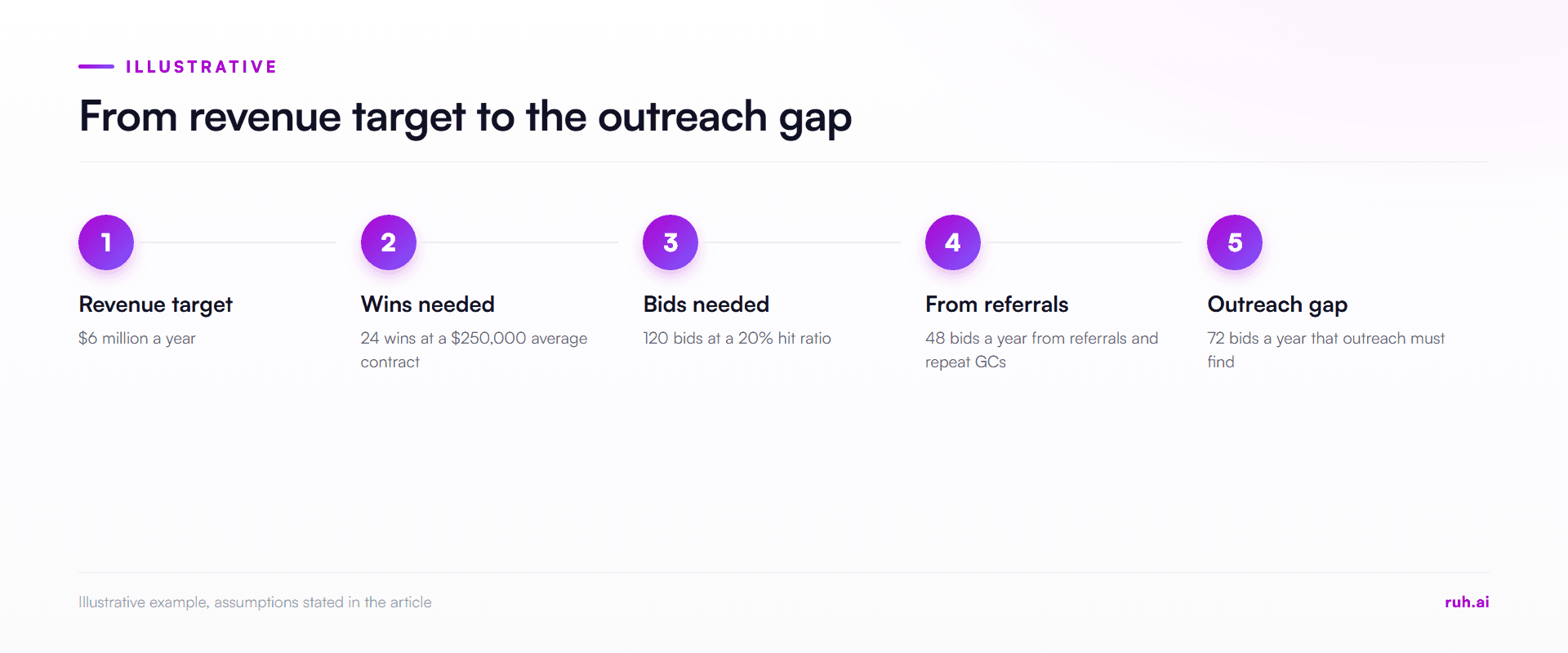
The method is arithmetic. Work out how many bids your revenue target needs, subtract what referrals already bring in, and the gap is what outreach has to fill. In the illustrative worked example below, a subcontractor needs 120 bids a year, and referrals cover only 48 of them. The rest of this guide covers where to find the other 72, how to qualify them, and what to track each week.
Why Referrals Alone Leave a Commercial Subcontractor Exposed
Referrals bring trusted work, but they arrive when someone else decides to call, not when your backlog needs them. A subcontractor that depends on them cannot plan the next quarter, because the pipeline goes quiet with no warning.
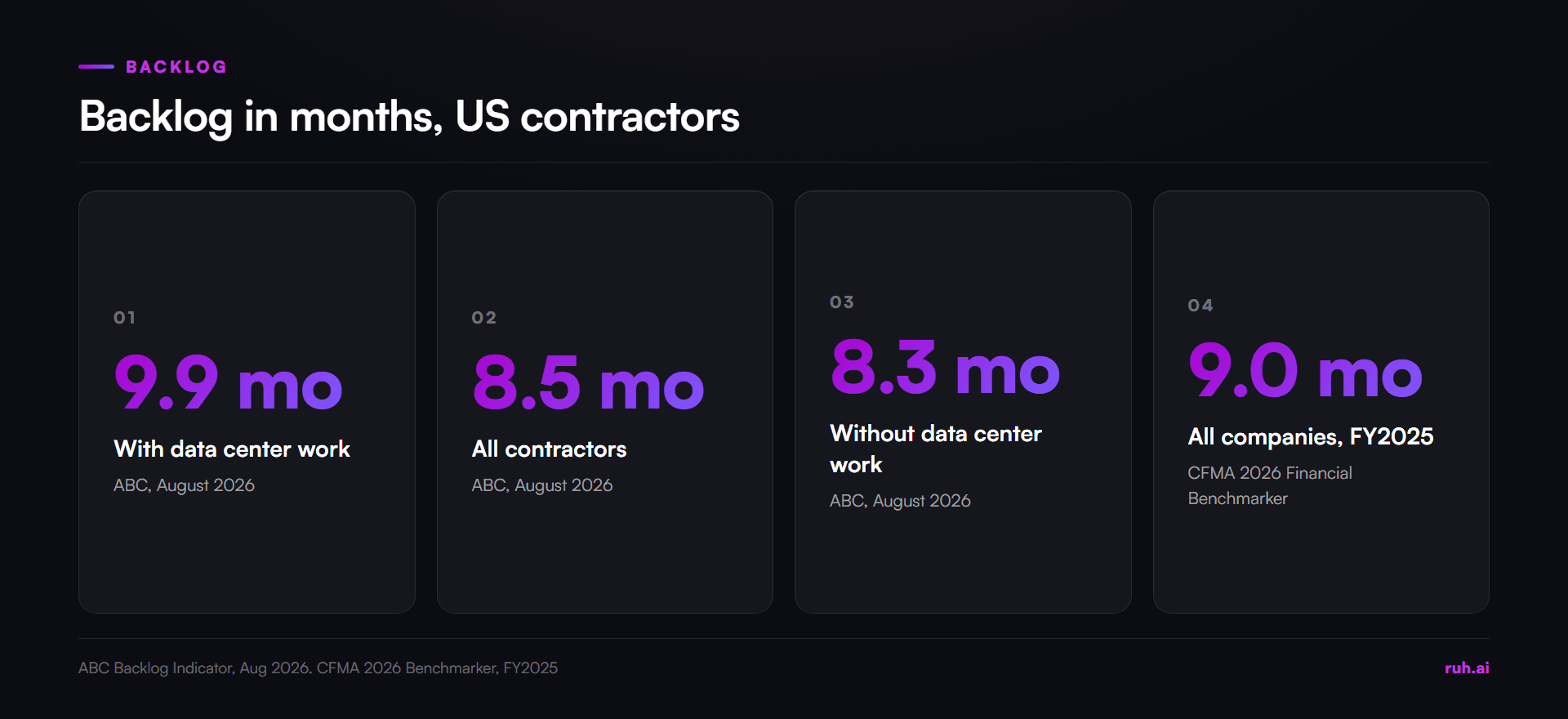
Backlog is the early signal. Associated Builders and Contractors reported on 15 September 2026 that its Construction Backlog Indicator stood at 8.5 months in August 2026, with contractors doing data center work at 9.9 months and those without it at 8.3 months. ABC Chief Economist Anirban Basu said in the same release: "Data centers continue to keep contractors busy even as activity softens in other segments."
Healthy averages say nothing about your own book. CFMA's 2026 Financial Benchmarker reports that contractors held 9.0 months of backlog across all companies in fiscal 2025, against 9.1 months in fiscal 2024, and that specialty trade backlog has lengthened over the decade from under six months to more than eight. A sub with eight months under contract still has to send the bids that fill month nine now, while the crews are busy and nobody feels the gap.
The Bid Math Behind Your Revenue Target
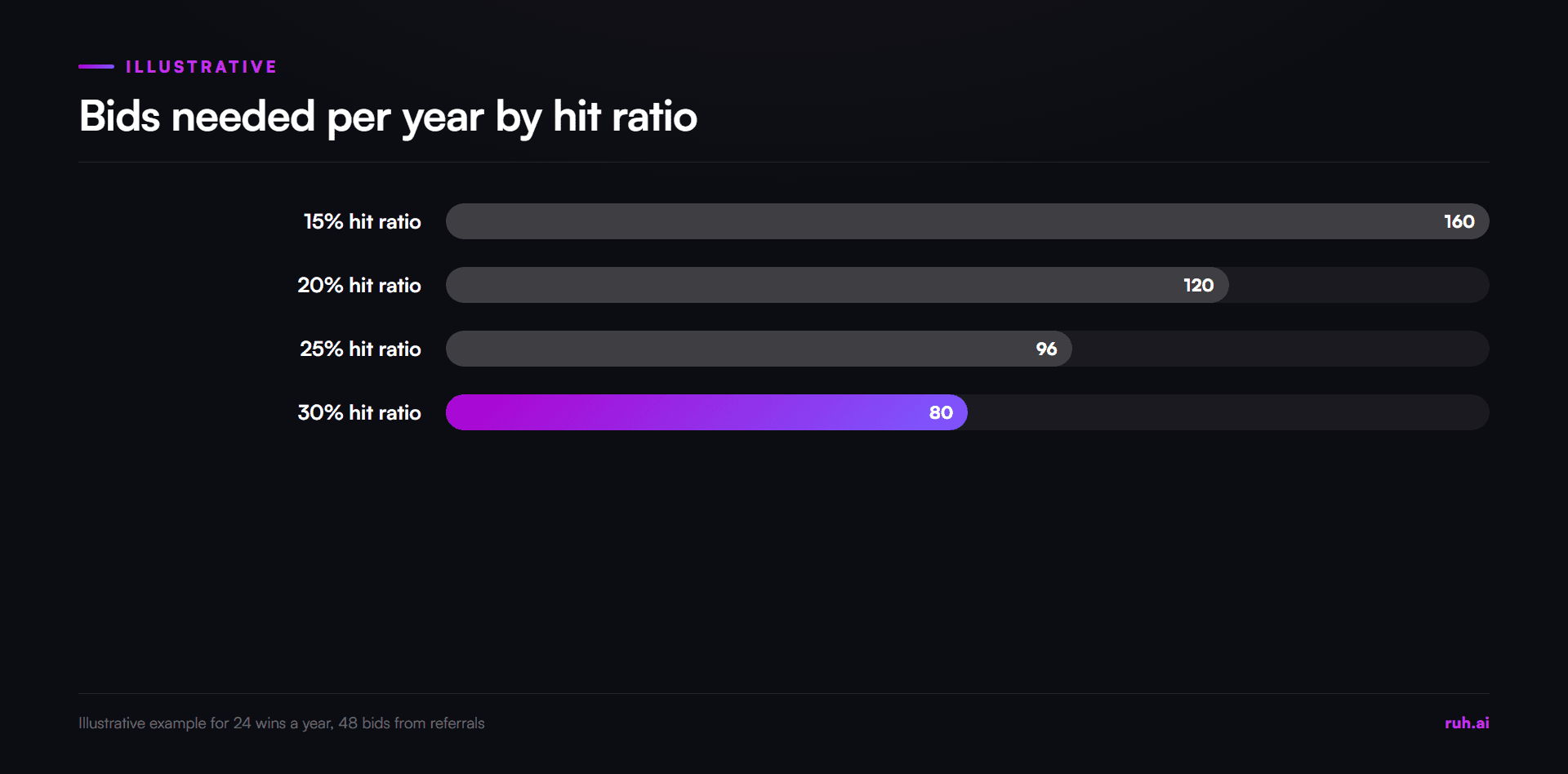
Divide your revenue target by your average contract value to get the jobs you need, then divide by your hit ratio to get the bids you must send. Take an illustrative commercial subcontractor with a $6 million revenue target, a $250,000 average contract and 4 bid invitations a month from referrals and repeat GCs. The target needs 24 wins.
| Hit ratio | Bids needed per year | Per month | From referrals per year | Gap outreach must fill per year |
|---|---|---|---|---|
| 15% | 160 | 13.3 | 48 | 112 |
| 20% | 120 | 10.0 | 48 | 72 |
| 25% | 96 | 8.0 | 48 | 48 |
| 30% | 80 | 6.7 | 48 | 32 |
At a 20% hit ratio, referrals cover 48 of the 120 bids and outreach has to find the other 72, about 6 a month. Raising the hit ratio shrinks the gap faster than sending more bids, which is why bid selection matters as much as bid volume.
Run it on your own numbers: the bid pipeline velocity calculator works from bids out, hit ratio, contract value and cycle time.
Where Commercial Subcontractors Find Projects to Bid
Commercial subcontractors find projects through five channels, and each one gives a different kind of lead. Referrals and repeat GCs are the warmest. The rest have to be worked on purpose.
| Channel | What you get | What it takes |
|---|---|---|
| General contractor bid lists | Invitations to bid on the GC's projects | A prequalification package: safety record, insurance, bonding capacity, references |
| Public bid boards | Public projects open to any qualified bidder | Monitoring SAM.gov for federal work, plus state, county and city procurement sites |
| Plan rooms and bid networks | Private projects with plans and bid dates | A subscription or a free listing on networks such as Dodge Construction Network, ConstructConnect, BuildingConnected or PlanHub |
| Associations and builders exchanges | Introductions to GCs and owners, and local plan rooms | Membership and showing up, for example at ABC or AGC chapter events |
| Owners and developers | Early sight of projects before the GC is chosen | Long relationships, and a track record on the owner's kind of building |
Most subcontractors lean on one or two of these. A pipeline that draws from three or more keeps working when one channel goes quiet, such as when a favorite GC loses a string of bids or a public agency pauses spending.
Getting on General Contractors' Bid Lists
A GC bid list is the most direct route to steady invitations, and the entry ticket is a complete prequalification package. Estimators send invitations to subcontractors they already trust to show up, carry the right insurance and finish the work. A sub they have never vetted is a risk they will avoid on a tight bid day.
Keep the package current and in one PDF:
- Safety record, including your experience modification rate and recent OSHA logs
- Insurance certificates with the limits commercial GCs typically require
- Bonding letter from your surety, stating single-job and aggregate capacity
- Three project references on work that looks like the GC's pipeline
- Licenses and certifications for each state you work in
The prequalification guide for subcontractors lists what GCs ask for in detail, and the construction bid process guide covers what happens after the invitation arrives.
Turning a GC Contact Into a Bid Invitation
A GC contact turns into a bid invitation when you reach the right person, about a real project, with your prequalification already done. Generic introductions get filed. A message about the hospital job they are bidding next month gets read.
- Build a target list. GCs who build your project types in your region, with the name of the estimator or precon manager who sends invitations.
- Have the package ready. The prequalification PDF above, attached or one click away.
- Open with a project. Name a job they are pursuing and say what your crew has built that looks like it.
- Ask for one thing. A place on the bid list for that project, or a 20-minute meeting.
- Follow up on a schedule. A second note a week later, then one when their next project goes out to bid.
- Log every touch. Outreach that lives in someone's memory stops the first busy bid week.
The tracker below is the minimum record for each target. Copy it into a spreadsheet or your CRM.
| Field | Example |
|---|---|
| Company and contact | Regional GC, chief estimator |
| Project types and region | Healthcare and schools, within 150 miles |
| Prequalified | Yes, March 2026 |
| Last touch and next step | Emailed about clinic expansion, follow up 20 October |
| Invitations received | 3 this year |
| Bids sent and won | 3 sent, 1 won |
Deciding Which Invitations Are Worth Bidding
Bid the invitations you have a real chance of winning and can build profitably, and decline the rest early. Every bid costs estimating hours, and a bid you were never going to win lowers your hit ratio and widens the gap outreach has to fill.
Ask six questions before committing an estimator:
- Fit: is it a project type and size your crews have built before?
- Relationship: do you know this GC, and have they awarded to you before?
- Capacity: does your bonding capacity cover it, and do your crews have room in the schedule?
- Competition: how many subcontractors are bidding the same scope?
- Payment: what is this GC's record for paying on time?
- Clarity: are the drawings and specifications complete enough to price?
The bid go/no-go scorer weighs these kinds of criteria before you spend the estimating hours. A clear no on bid day is cheaper than a vague yes that loses.
Referrals Are a Channel You Can Manage
Referrals work best when you ask for them on purpose, at the moments a client is happiest with your work. Treating them as luck leaves the warmest channel to chance.
Three habits keep referrals coming:
- Ask at closeout. When a project finishes clean, ask the GC's project manager which other GCs or owners would value your trade.
- Stay in touch between projects. A short note to the GC's estimators when you finish similar work keeps your name on the next invitation.
- Track repeat GCs. Count how many of this year's invitations came from GCs who awarded to you before. A falling number is an early warning.
The Five Numbers to Track Every Week
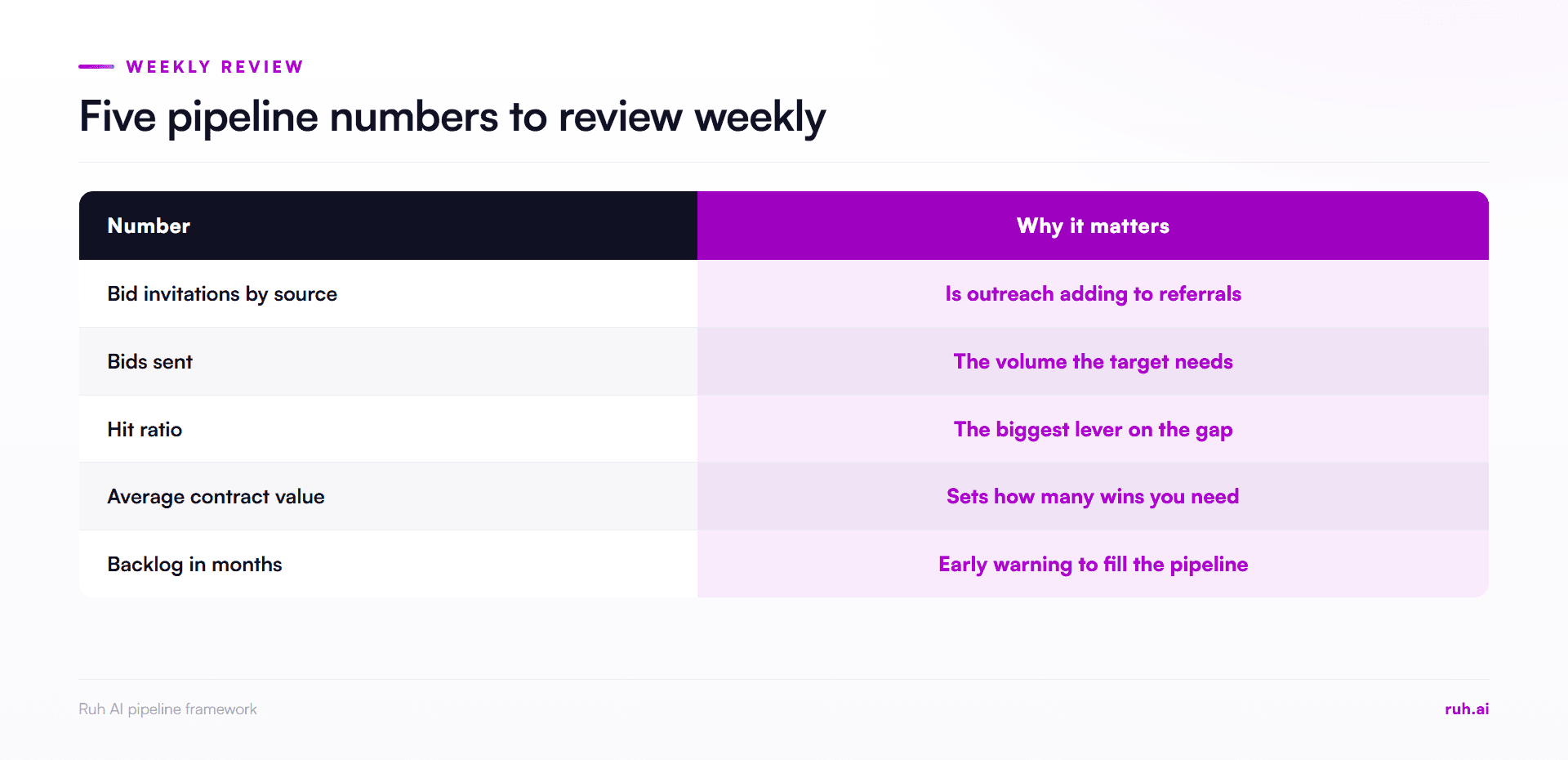
Track the numbers that predict revenue, not just activity. Five numbers tell you whether next quarter is filling up.
| Number | Why it matters |
|---|---|
| Bid invitations received, by source | Shows whether outreach is adding to referrals or only replacing them |
| Bids sent | The volume the revenue target needs |
| Hit ratio | Bids won divided by bids sent, the biggest lever on the gap |
| Average contract value | Changes how many wins the target needs |
| Backlog in months | The early warning that the pipeline needs filling now |
Review them in the same 15 minutes each week. The trend matters more than any single week, and a falling backlog with flat invitations is the signal to step up outreach before the crews feel it.
What Contractors Get Wrong About Lead Generation
In Ruh's opinion, contractors get four things wrong about lead generation, and each one is fixable without hiring a sales team. The positions below are argued from the pipeline arithmetic above, not taken from any survey.
More bids is not the goal, the right bids are. Every bid costs estimating hours. Bidding work you rarely win lowers the hit ratio and widens the gap you are trying to close.
Referrals are a channel to manage, not luck. Ask for an introduction at every closeout. A referral you asked for is still a referral.
Residential tactics do not fit commercial work. Home-services directories and homeowner ads bring homeowners. A commercial subcontractor's buyers are GC estimators, precon managers and owners, and they are reached by name.
Outreach dies when nobody owns it. When the estimator does prospecting between bids, prospecting stops in the busiest weeks, which are the weeks the next quarter is decided. Give it an owner and a weekly slot.
The Honest Assessment: What Outreach Cannot Do
Outreach opens doors, and it does not change what the GC finds behind them. Four limits are worth knowing before you invest in it.
- It cannot replace prequalification. A GC that cannot see your safety record, insurance and bonding capacity will not invite you, however good the message.
- It cannot create demand. When activity softens outside segments such as data centers, outreach competes for fewer projects.
- It takes months. A new GC relationship often needs several projects before the first invitation, and the first win can take longer.
- It does not win the bid. Price, scope coverage and track record still decide the award.
How Ruh AI Fits Into This
Ruh AI's Takeoff Agent and Estimating Agent work from your drawings and your company's own rate book and price files, with approval gates between stages, so more of the invitations you win can be priced. The subcontractor page shows how the pieces work together for trade contractors. The Takeoff Agent refuses to measure areas and lengths on a sheet with no scale, so a missing quantity shows up as a gap rather than as a zero in the bid.
Frequently Asked Questions
Q: What is lead generation for contractors? A: For a commercial contractor, lead generation means producing a steady flow of bid invitations and meetings with general contractors and owners. Referrals are one source, and bid lists, bid boards and direct outreach are the others.
Q: How do subcontractors get commercial construction projects? A: Subcontractors get commercial projects by prequalifying with general contractors, watching public bid boards and private bid networks, joining local associations, and reaching out to GCs about specific projects they are bidding.
Q: How many bids should a subcontractor send each month? A: Divide the revenue target by the average contract value, then divide by your hit ratio, then by 12. The illustrative subcontractor in the worked example above needs 10 bids a month.
Q: What is a good hit ratio for a subcontractor? A: The useful number is your own, tracked by trade and project type, because it varies with how selective you are. Raising it shrinks the outreach gap faster than sending more bids.
Q: Do online ads work for commercial subcontractors? A: Online ads aimed at homeowners rarely reach commercial buyers. Commercial subcontractors do better with GC bid lists, bid networks and direct outreach to named estimators and precon managers.
Q: How long does it take to get on a new GC's bid list? A: Prequalification itself can be quick when your package is ready. The first invitation depends on when the GC's next matching project goes out to bid, which is why the outreach tracker logs a next step for every contact.
Q: Should a small subcontractor hire a salesperson? A: Give outreach an owner and a weekly slot first. Hiring makes sense once the tracker shows that steady outreach produces invitations faster than one person can follow up.
The Bottom Line
A commercial subcontractor that runs only on referrals is planning its next quarter on other people's timing. Work out the bid gap, prequalify with the GCs who build your work, give outreach an owner, and review five numbers every week. The referrals keep coming, and the rest of the pipeline stops depending on them.
Stop waiting on the next referral and give outreach a system. See how Ruh AI works for subcontractors.