

TL;DR / Summary
The gap between what you estimate and what you sign is costing contractors $50K-$150K per bid cycle. This "pre-signature scope gap" happens because RFIs arrive late, specifications stay ambiguous, and clarifications never make it back into the binding contract. Most teams rely on email chains and assumptions instead of structured scope review, leaving field operations to patch the holes.
What you'll learn:
- Why scope gaps are invisible until they hit the field
- The exact mechanics of how $50K-$150K disappears between estimate and signature
- How RFI delays and specification ambiguity compound the problem
- A 5-step framework for closing the gap before ink dries
- How AI agents eliminate RFI lag and automate scope verification
- Real numbers: GCs using structured pre-signature review report 18-22% cost variance reduction
The stakes are simple: every dollar in ambiguity becomes a dollar in margin loss or change order dispute post-signature. Contractors who structure their scope review before signing are winning tighter margins and fewer field surprises.
What Is a Scope Gap in Construction?
A scope gap is work the contractor is obligated to deliver under the signed contract but did not fully price in the estimate, with the mismatch discovered after signature.
Because the work was already promised, scope gaps land as margin loss rather than the revenue event of a legitimate change order.
Scope Gap vs. Scope Creep
Scope creep is scope that expands after signature; a scope gap is scope already promised in the contract but never priced before signature.
The timing is the tell: a gap is missed in the pre-signature window and surfaces once the contract binds you, while creep starts only after signature.
The Pre-Signature Window Is Where Margin Dies
Here's what most contractors don't realize: your estimate and your signed contract are almost never the same thing.
You submit a bid based on a complete set of plans and specs. The owner requests clarifications. The architect issues addenda. RFIs come in asking for material substitutions or accessibility details you assumed a certain way. Somewhere in that loop, between your bid date and the day you sign the contract, scope gets reinterpreted, re-estimated, and then... sometimes not re-documented at all.
By the time both parties sign, the estimate has shifted. But the contract didn't always follow. Or the contract says one thing while the SOV (Schedule of Values) reflects a compromise made in week three. Or the addendum was never formally incorporated into the scope baseline.
Most teams catch these gaps in week four on the job site, when the crew is already mobilized. That's when the finger-pointing starts: "We never agreed to that cost." And the contractor almost always loses, because the evidence is scattered across emails and old revisions.
The gap doesn't exist to be clever. It exists because scope review between estimate and signature is still manual, slow, and incomplete.
Where the Scope Gap Actually Hides
Scope gaps don't announce themselves. They hide in three places:
1. RFI lag. You submit a bid Tuesday. Friday, the architect sends an RFI asking whether the MEP scope includes testing and balancing. You respond Monday. They clarify Thursday. Meanwhile, you've already estimated the job without T&B and quoted a price. By the time the clarification lands, the estimate is stale. Do you revise the SOV? Email the owner an updated price? Most teams don't. They carry the original price forward and hope field ops figures it out.
2. Addenda visibility. The owner issues an addendum changing the structural system or adding a phase. It lands in your inbox, gets marked "reviewed," and then... where does it live in your estimate? Did the estimator incorporate the new quantities? Did the cost get updated in Procore or your takeoff? Three days later, you sign the contract under the new system but your SOV still reflects the old one.
3. Specification ambiguity. You estimated finish material costs based on the "Finishes" section of the specs. But the interior design addendum, issued two weeks later, changes the spec from builder-grade drywall to high-performance gypsum in certain areas. Your estimate didn't update because nobody flagged that the addendum changed the baseline specification. Field ops discovers the discrepancy when the materials show up at the gate.
Each of these happens dozens of times per bid cycle in larger firms. Most slip through unsigned because they're treated as minor clarifications, not scope changes. Until they're not.
The $50K-$150K Question: Where Does It Go
Let's quantify what the scope gap costs.
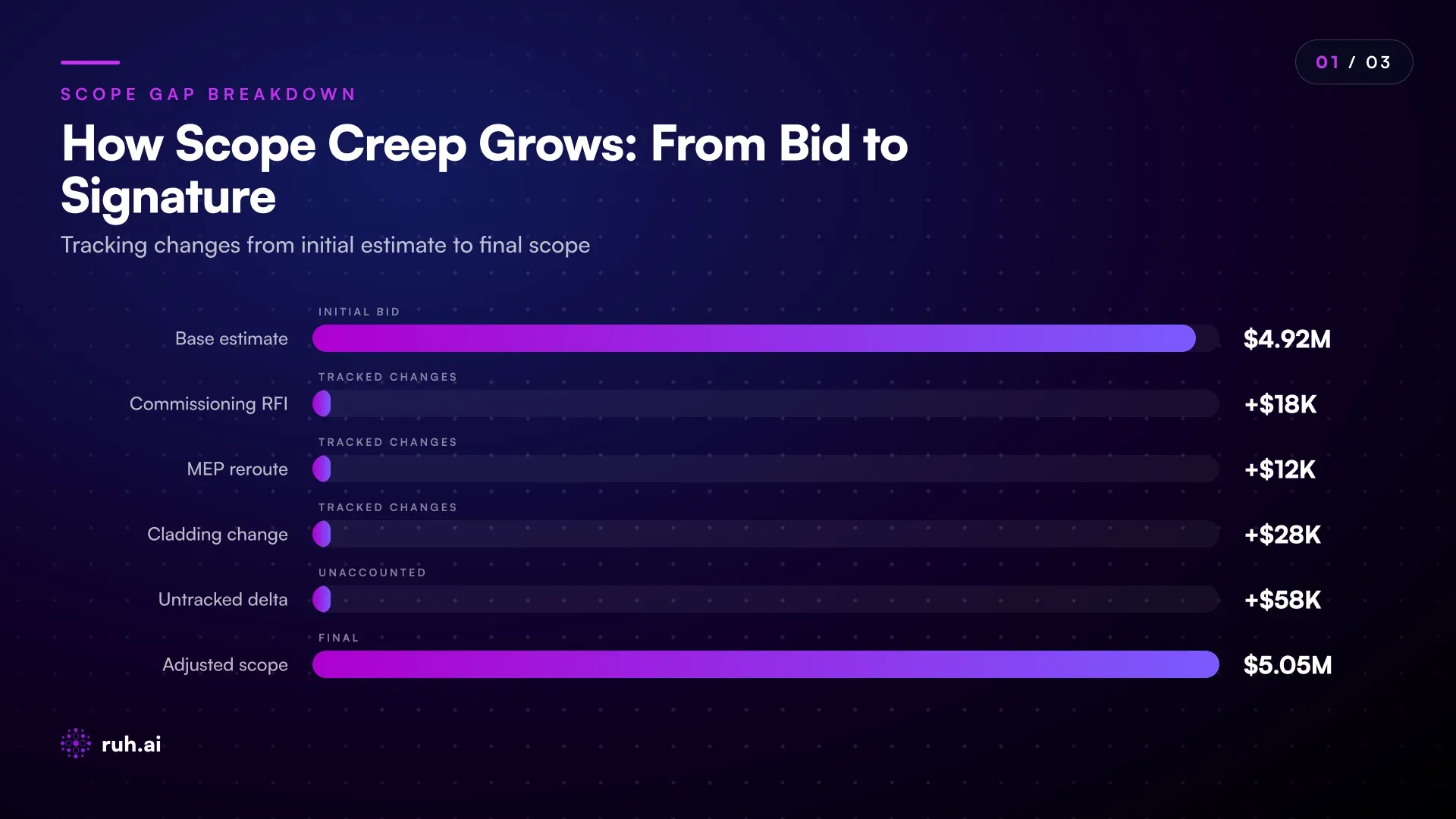
Take a $5M commercial construction project. The bid estimate gets finalized at $4.92M. In the pre-signature window, between your bid and the signed contract, three things shift:
- An RFI clarifies that commissioning scope was originally misread. That's a $18K add.
- An addendum moves the mechanical room location, requiring 80 linear feet of ductwork reroute. That's $12K you didn't price.
- A specification change on exterior cladding (from composite to true metal panel) adds material cost and labor complexity. $28K swing.
You get a new addendum price from the MEP contractor but never update your takeoff. You know the cladding has changed but you don't formally revise the SOV. The commissioning RFI response lands at 4:55 PM on Friday, two hours before the contract signs, so you mark it "acknowledged" in the system but don't recalculate.
Grand total: ~$58K in untracked scope adjustment.
Now the job starts. When the crew begins demolition, they find structural conditions that weren't visible on the plans, common on renovation work. The scope gap you buried has left you with zero buffer. What should have been negotiated under Option A (pre-contract) becomes Option B (post-contract change order at 30% markup). The $58K problem becomes a $74K cost and a contract dispute.
Scale that across a dozen bid cycles per year, and a mid-market GC is leaving $600K-$1.8M on the table annually. Most don't see it because it's buried in cost variance reports that get sorted by project, not by root cause.
How Scope Gaps Turn Into Change Orders
When a scope gap survives the pre-signature window, work that could have been reconciled in the contract gets pushed into a post-signature change order and dispute.
- Option A: Identify the $58K problem before contract and negotiate it into scope before signature.
- Option B: Find the same problem after signing, submit it as a change order at 30% markup, and turn $58K into $74K plus a contract dispute.
- Across a dozen bid cycles, that pattern leaves a mid-market GC $600K on the table each year.
Why Traditional Bid Management Can't Close the Scope Gap
The problem isn't that contractors don't know scope is shifting. The problem is that the tools they use, Procore, Bluebeam, email, and spreadsheets, were designed to manage projects, not to track pre-signature scope drift.
Here's how it breaks down:
Procore tracks execution, not bid evolution. RFIs, documents, and ASIs all land in Procore. But Procore doesn't flag that a new RFI response changed a baseline assumption in your original estimate. You have to manually cross-reference the estimate, the RFI response, the addendum, and the SOV. Most teams don't. Procore has great visibility after you sign; it has almost no visibility before.
Email has no memory. Clarifications come via email. "Per your question on ductwork sizing, we're confirming the 36-inch main." That email answers the RFI. It might land in Outlook with a flag, but it doesn't auto-update the estimate. It doesn't queue a scope-review task. It just sits there until someone remembers to chase it down.
Spreadsheet-based takeoffs don't auto-update. You have a .xlsx takeoff. An addendum changes the scope. Does your takeoff auto-refresh? No. You have to manually paste in the new quantities, recalculate, and re-price. That's a 2-4 hour manual job. Most teams do it once, at estimate time. For scope revisions? They wing it or build a buffer that nobody tracks.
The SOV and the estimate are separate documents. You estimate the job in one system (Bluebeam, Touchplan, an internal takeoff system). You build the SOV for the contract in Procore or a spreadsheet. The two don't sync. A change to the estimate doesn't automatically flow to the SOV. A change to the SOV doesn't trigger a scope-impact review. They're islands.
The human workaround is usually a project manager or senior estimator who keeps a manual tracking sheet, chasing down RFIs and addenda and manually marking whether they've been "incorporated" into the estimate. That works until you have 15 concurrent bids. Then it breaks.
Scope Clarity Starts at Specification Review
The first line of defense is a structured scope baseline before you even submit the bid.
When you open the RFP, the first step is spec review. Not "read the specs." A formal review where you mark every assumption: What am I assuming about MEP scope? What am I assuming about lead times? What am I assuming about code compliance testing? Write those assumptions down and flag the specs where they're exposed.
A good spec review catches 40-60% of the gaps that will come back as RFIs. You identify weak or missing information upfront and ask clarifying questions in your bid questions, not after you submit.
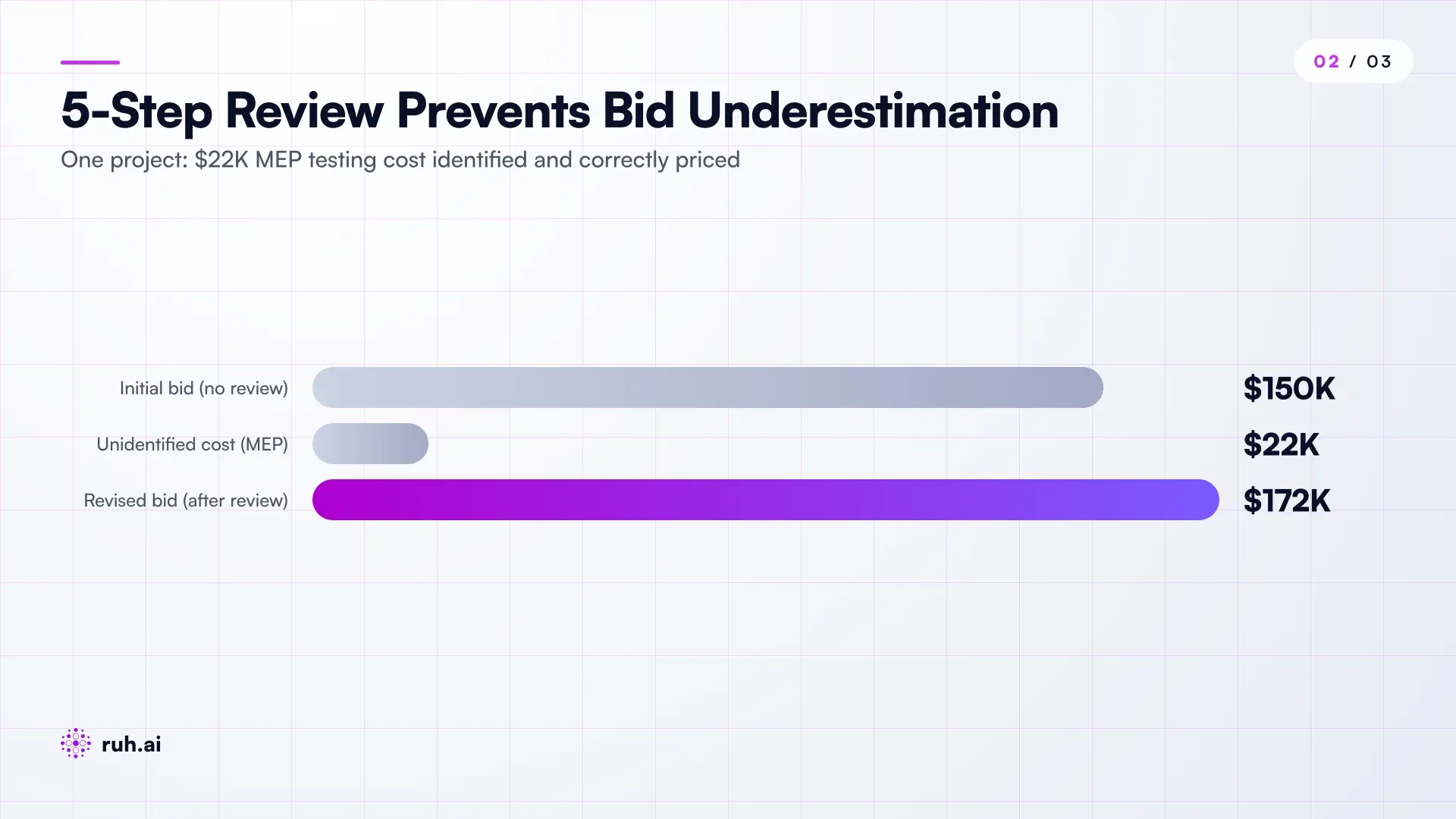
Example: You're bidding a commercial retrofit. The structural drawings show existing conditions but don't specify testing requirements for existing concrete. The specs say "verify suitability per ACI." That's vague. You write it down: Assumption: Owner will provide structural testing results. If not, we'll need to include $22K for testing. You then ask in your bid questions: "Will existing structural testing be provided, or should we budget for independent verification?"
Now, when the architect responds with the test results or confirms that testing is the contractor's responsibility, you have a record of that clarification. If your estimate assumed the owner provided testing and the clarification says it's your scope, you revise the SOV before signing. The adjustment is documented and traceable.
Structured scope review eliminates the assumption that kills you later.
The RFI Lag Problem: From Days to Minutes
Here's the mechanical problem that compounds every scope gap: RFI response lag.
You submit bid questions Monday. The architect responds Thursday. That's a 72-hour lag in a critical window. During those three days:
- Your estimator has moved on to the next bid. Context is cold.
- The owner's team is negotiating your price, not waiting for your "final final" estimate.
- Clarifications stack up, one today, another tomorrow, a third the day before contract signing.
By the time you have all the clarifications in hand, you don't have time to re-estimate the full job. You do a quick mental adjustment, maybe a phone call to your MEP partner, and you move forward with a "good enough" estimate. The SOV reflects it, but the detail trail is gone.
Compare that to a workflow where RFI responses are automated:
RFI Responder Agent (like Ruh AI's) ingests your bid questions, pulls the relevant specs and drawings, drafts responses, and gets them back to the architect in 18-25 minutes instead of 72 hours. The response is grounded in your actual specifications, not a generic architect template. And critically, it flags scope assumptions in writing, creating a clear record.
More RFI cycles fit into the pre-signature window. You ask a clarification question, get a response same day, update your estimate, move to the next question. By signing day, you've had time to iterate and get to confidence. The scope baseline is solid.
This matters because the gap doesn't close if you don't have time to see it. Speed isn't a feature; it's the thing that lets clarity happen.
Structured Scope Review as a Mandatory Gate
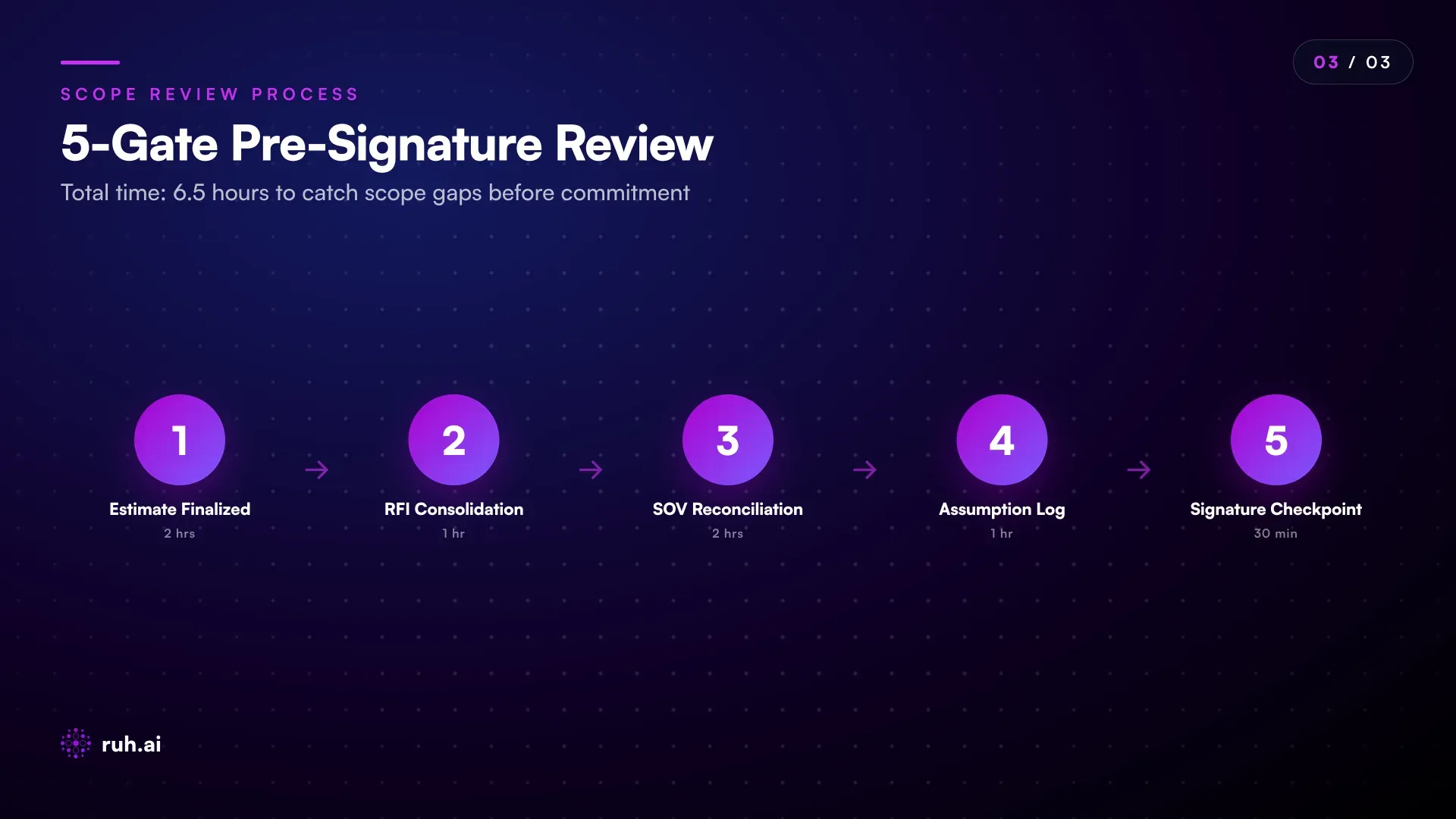
The simplest fix is also the hardest to implement: make pre-signature scope review a mandatory gate before the contract signs.
Here's what that looks like:
- Estimate sign-off. Estimator confirms that the estimate is final and includes all known scope clarifications to date.
- RFI consolidation. All RFIs, addenda, and architect responses are listed in a single document. No emails. No "I think we discussed this." Every clarification is dated and documented.
- SOV reconciliation. Someone (usually a project manager or senior estimator) walks the SOV line-by-line against the estimate. If the SOV reflects a different quantity or cost than the estimate, you flag it and resolve it before you sign.
- Assumption log. A separate document listing every major assumption: MEP testing is owner-provided. Structural system is as-drawn. Finish materials are per spec addendum #3. This becomes part of the contract records.
- Signature checkpoint. Before the contract goes to the principal for signature, a second set of eyes reviews the SOV, the estimate, and the assumption log. Mismatches stop the signature process.
That sounds bureaucratic. It's not. It's the difference between a 15-minute structured review and a 6-week post-contract investigation into who promised what.
Most mid-market GCs don't have a formal scope-review gate because they don't have the tools to make it fast. They rely on a smart PM to mentally track everything. That works at 3-5 concurrent bids. At 12-15 concurrent bids, it collapses.
The Honest Assessment: What Precision Alone Can't Fix
Here's where the honest part comes in: closing the pre-signature scope gap doesn't guarantee a profitable job.
Scope clarity is table stakes. But execution risk, supply chain volatility, labor availability, and design refinement during construction all happen after you sign. A watertight contract that gets blown up by an RFI-driven design change in month three is still a contract that's wrong.
What scope clarity does do is eliminate the gap between what you estimated and what you signed. Everything else, build cost increases, schedule impacts, field conditions, are contractually different arguments. You can negotiate a change order for unexpected underground utilities. You can't negotiate a change order for scope you already promised.
Additionally, some scope gaps are genuinely unsolvable pre-signature because the information doesn't exist yet. Utility locates on a site with poor records, subsurface conditions on a renovation, or coordination issues that only surface when MEP and structural get into detail design. Those require contingency, not process.
The real value of scope clarity is not that it eliminates all project surprises. It's that it eliminates surprises about what you promised.
How Ruh AI Fits Into This
Ruh AI's agents address the pre-signature scope gap at two critical points: speed and documentation.
RFI Responder Agent cuts RFI response time from 72 hours to 18-25 minutes. That speed means more clarification cycles fit in the pre-signature window. More cycles means better scope confidence at signature. The agent drafts responses rooted in your actual plans and specs, not templates, so clarifications are specific and traceable. Every response is a record.
Takeoff Agent refreshes your takeoff when scope shifts. An addendum changes the mechanical system. Instead of a 2-4 hour manual re-takeoff, the agent extracts new quantities from the revised plans in 20-30 minutes. You see the cost impact immediately. The new numbers can be incorporated into the SOV before signature.
Both agents create a clear audit trail. When someone asks "why is the SOV different from the estimate?", you have documented RFI responses and timestamped takeoff updates. That trail is your defense in a dispute.
The larger point: scope review stops being a bottleneck when you have agents doing the mechanical work of consolidating specs, responding to RFIs, and re-quantifying scope. Your PM can focus on decision-making, not chase work.
You can explore both agents at Ruh Work-Lab, which lets you build and customize scope-review workflows without writing code.
Frequently Asked Questions
Q: What counts as a scope gap vs. a legitimate change order? A: A scope gap is something you promised in the contract but underestimated in the estimate. A legitimate change order is work that wasn't in the original scope. The distinction matters because a scope gap is a margin loss; a change order is a negotiated price. If the contract says "provide testing and balancing per ASHRAE Guideline 1.1" but your estimate didn't include T&B labor, that's a gap. If the owner later adds a new system that wasn't in the original specs, that's a change order.
Q: How much time does a structured pre-signature review actually take? A: A solid review (specification deep-dive, RFI consolidation, SOV reconciliation, assumption log) typically takes 4-6 hours on a $3-5M project. That's split across 3-4 people (estimator, PM, senior tradesperson, controller). For a team bidding 2-3 jobs per month, that's roughly 1-2 hours per person per job. The break-even is one avoided scope gap per 12-15 bids. Most mid-market GCs clear that threshold.
Q: Can AI agents replace a human scope review? A: No. AI agents automate the mechanical parts, consolidating RFIs, re-quantifying scope, flagging inconsistencies, but the decision to approve a scope change still requires human judgment. An agent can extract new quantities from a revised plan; it can't decide whether your crew is capable of executing a new method in the timeline. The agent accelerates the review, not replaces it.
Q: What's the financial impact of a scope gap for a $2M job? A: It depends on the size of the gap. A small gap (3-5%) costs $60K-$100K in margin loss or change-order disputes. A large gap (8-12%) costs $160K-$240K. Gaps typically cluster in mechanical/electrical scope (lead times and testing requirements), structural assumptions (existing conditions, testing), and specification ambiguity (finish materials, performance standards). Most impact comes from three gaps per job, not ten small ones.
Q: When should I ask for clarifications in bid questions vs. assuming and pricing a buffer? A: Ask upfront if the answer materially changes your cost (more than 3-5% of the line item) or if you're genuinely uncertain. Buffers are a tax on every bid, not just the gap bids. If you price a 10% contingency to cover specification ambiguity and it turns out you need 3%, you've left money on the table on every other bid. Ask the question, get clarity, price it once.
Q: How do I know if my team has a scope-gap problem? A: Pull your cost-variance reports for the last 12 months. If variance is consistently 4-8%, check how much is attributable to pre-contract scope shifts (compare the original estimate to what actually got built, then to the signed contract). If pre-contract misalignment accounts for more than 40% of the variance, you have a scope-clarity process problem, not an estimation problem.
Close the Gap Before It Costs You
The pre-signature scope gap is invisible until it hits the field. Then it's a cost variance, a change order dispute, or a margin shortfall on your financials.
Closing it doesn't require new software or a larger team. It requires a structured scope-review gate and the tools to make that gate fast. RFI response speed, automated re-quantification, and clear documentation are the difference between a process that breaks under load and one that scales.
Explore Ruh Work-Lab and automate your pre-signature scope review →
See how Ruh AI's RFI Responder and Takeoff Agents work end-to-end →
Talk to the Ruh AI team about scope clarity for your bidding process →