Construction glossary · Process and contract terms
What is RFI (request for information) in construction?
An RFI (request for information) is a formal written question a contractor submits to the architect or engineer of record to resolve a gap, conflict, or ambiguity in the construction documents. Each RFI is numbered, logged, and answered in writing, and the response becomes part of the contract record. RFIs show up both during bidding (as pre-bid questions answered by addendum) and during construction, where the answer can drive cost and schedule changes.
Updated June 2026 · Reviewed by the Ruh construction team
How an RFI flows to an answer
Estimating process and contract terms scope this week? Watch Ruh take off a real plan in 30 minutes.
Book a walkthroughAn RFI is the contract mechanism for getting a binding written answer when the documents do not tell you what to build. The general contractor (or a sub routing through the GC) submits the question on a numbered form, the architect or engineer of record answers it, and both go into the RFI log that follows the project. You will see RFIs referenced in clouded drawing revisions, meeting minutes, change order backup, and claims files when a job goes sideways. Estimators meet RFIs in two places: bid RFIs, where pre-bid questions get answered by addendum, and construction RFIs, where answers can change scope and price. The classic new estimator mistake is treating an RFI as free clarification. Every RFI consumes response time, and an answer that adds work is the trigger for a change order, so write the question to document the cost and schedule exposure, not just to ask it. The second mistake is skipping the RFI log on a negotiated job; it tells you exactly where the documents are weak before you price them.
RFIs are counted, not measured in physical units. They live in the RFI log, a numbered register with the date submitted, the question, the referenced sheet and detail, the date answered, and cost or schedule impact flags. The working metrics are turnaround time in calendar or working days (contracts commonly allow 7 to 10 working days for a response), open versus closed counts, and the dollar value of change orders that trace back to RFI answers. Estimators apply them two ways. During bidding, unanswered questions become bid RFIs and the answers arrive as addenda that must be priced before bid day. During budgeting, a document set generating heavy RFI counts is a signal to carry design contingency, often an illustrative 1 percent to 3 percent of cost depending on drawing completeness.
Worked example
Say the structural framing plan shows top of steel for a second floor beam at elevation 124 ft 0 in, but the building section shows 122 ft 6 in, a 1 ft 6 in conflict. You issue an RFI before releasing the steel for fabrication. The architect takes 10 working days to answer and confirms 122 ft 6 in. The lower steel forces rerouting 60 linear feet of supply duct at an illustrative $48 per linear foot, so 60 LF x $48 = $2,880. Add 12 hours of drafting and coordination rework at $95 per hour, so 12 hours x $95 = $1,140. Direct cost of the answer: $2,880 + $1,140 = $4,020. The 10 working day response also held the fabrication release, sliding erection 5 working days. At illustrative general conditions of $2,200 per day, that exposure is 5 days x $2,200 = $11,000, which is why the RFI log matters as much as the answer itself.
Try Ruh on a real bid. 100% money-back guarantee if you are not satisfied.*
*Scoped delivery, terms apply. Read the guarantee terms
How Ruh handles RFI (request for information)
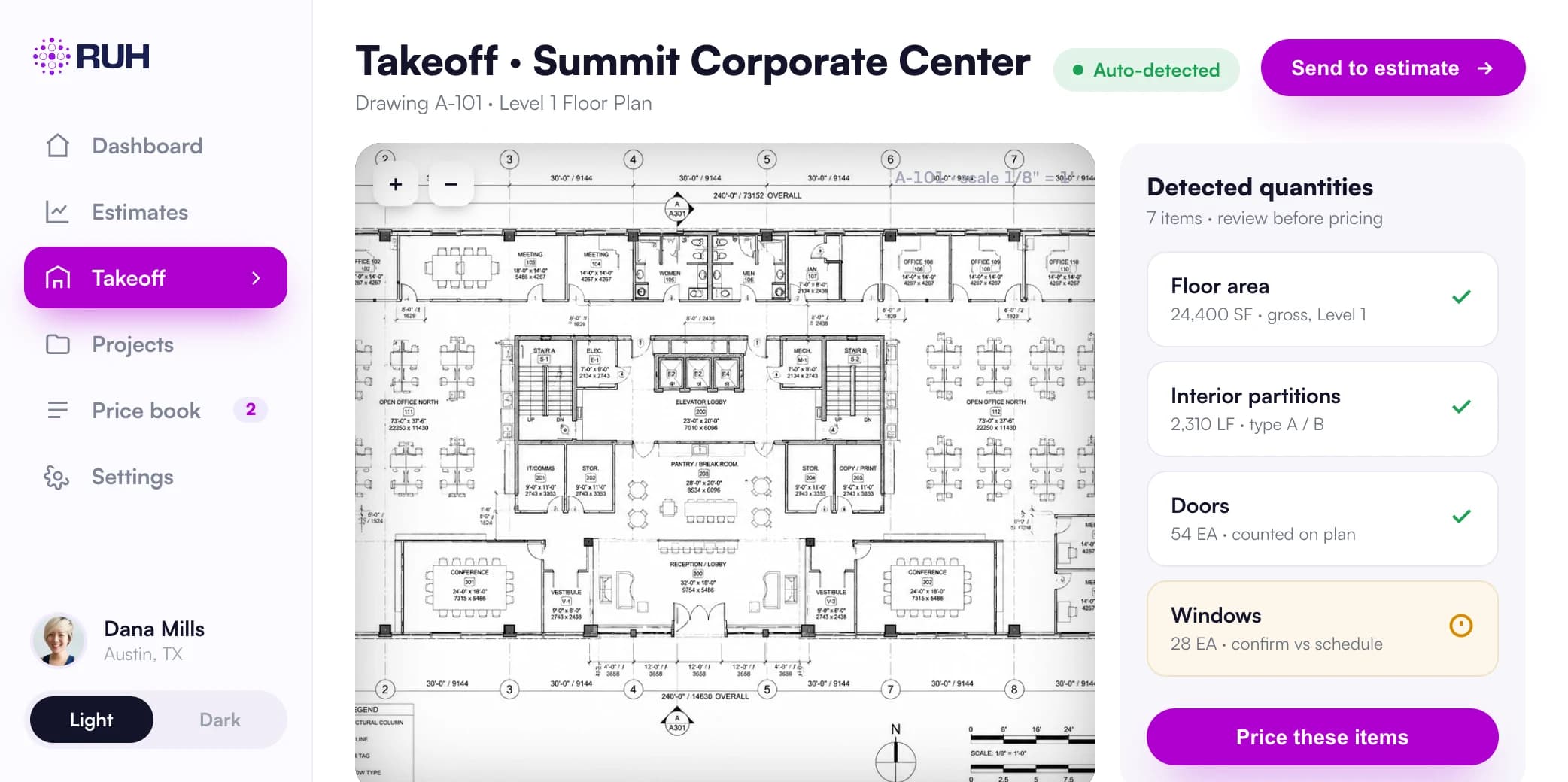
Ruh reads the contractor's drawings, performs the takeoff, and prices the quantities against the contractor's own price book, then hands the estimator a line-item draft tied back to specific sheets. When two sheets disagree (the seed of an RFI, like a conflicting beam elevation) that line-item trail makes the discrepancy easy to trace and write up as a bid RFI or qualification before sign-off. Ruh drafts and flags; the estimator's judgment decides what gets questioned, carried, or excluded.
See construction invoice and pay app softwareRFI (request for information): frequently asked questions
What is the difference between an RFI and a submittal?+
A submittal shows the design team what you intend to furnish (shop drawings, product data, samples) for approval against the specifications. An RFI asks the design team a question the documents do not answer. Submittals flow on a planned schedule tied to procurement; RFIs are triggered by gaps and conflicts as they are found.
Who is allowed to issue an RFI?+
On most US commercial contracts, subcontractors send RFIs to the general contractor, and the GC formally submits them to the architect or engineer of record. The design team answers in writing and the GC distributes the response to every affected trade. Owners are typically copied but do not answer technical RFIs unless they hold the design contract directly.
Can an RFI change the contract price?+
The RFI itself does not, but the answer can. If the response adds, deletes, or changes work beyond what a reasonable bidder could infer from the documents, the contractor prices the impact and submits a change order request citing the RFI number. That is why a well written RFI states the assumed condition and reserves the right to claim cost and time.
Still measuring by hand? Your next takeoff can run while you review this one.
See it on your plansRelated terms
Keep going: read the full guide or explore construction invoice and pay app software.
See Ruh price a bid from your own drawings.
AI takeoff and estimating on your price book, your estimator signs off.
Figures on this page are illustrative. Construction estimates depend on project-specific conditions, source documents, market pricing, and professional judgment. Ruh's AI assists the estimator and does not replace professional review: your team reviews, validates, and approves every estimate, bid, and pricing decision.