
Quick Answer
Construction bid accuracy is how closely a contractor's bid reflects the full scope, quantities and risk in the bid documents, judged not by whether the bid wins but by whether the job still earns its planned margin at closeout. This guide works through how much profit one missed scope item takes at real industry margins, then gives a table of where bid errors start, a pre-submission review you can copy and our view on what estimators get wrong.
What you'll find below:
- A worked example of one missed scope item on a commercial job, with the arithmetic in the open
- A table of the profit share that miss takes at three published margin levels
- A table of where bid errors start, when you find them and the check that catches them
- What pre-bid RFI research says about which bid documents go wrong most often
- An eight-point pre-submission review to run before every number goes out
Why Is Bid Accuracy a Margin Problem, Not Just a Win-Rate Problem?
A bid that wins with a scope gap often costs more than a bid that loses, because the gap is paid out of a thin margin. A lost bid costs the estimating hours. A won bid with a missing scope item costs real money for the life of the job, and it hides in the cost report until the work is half done.
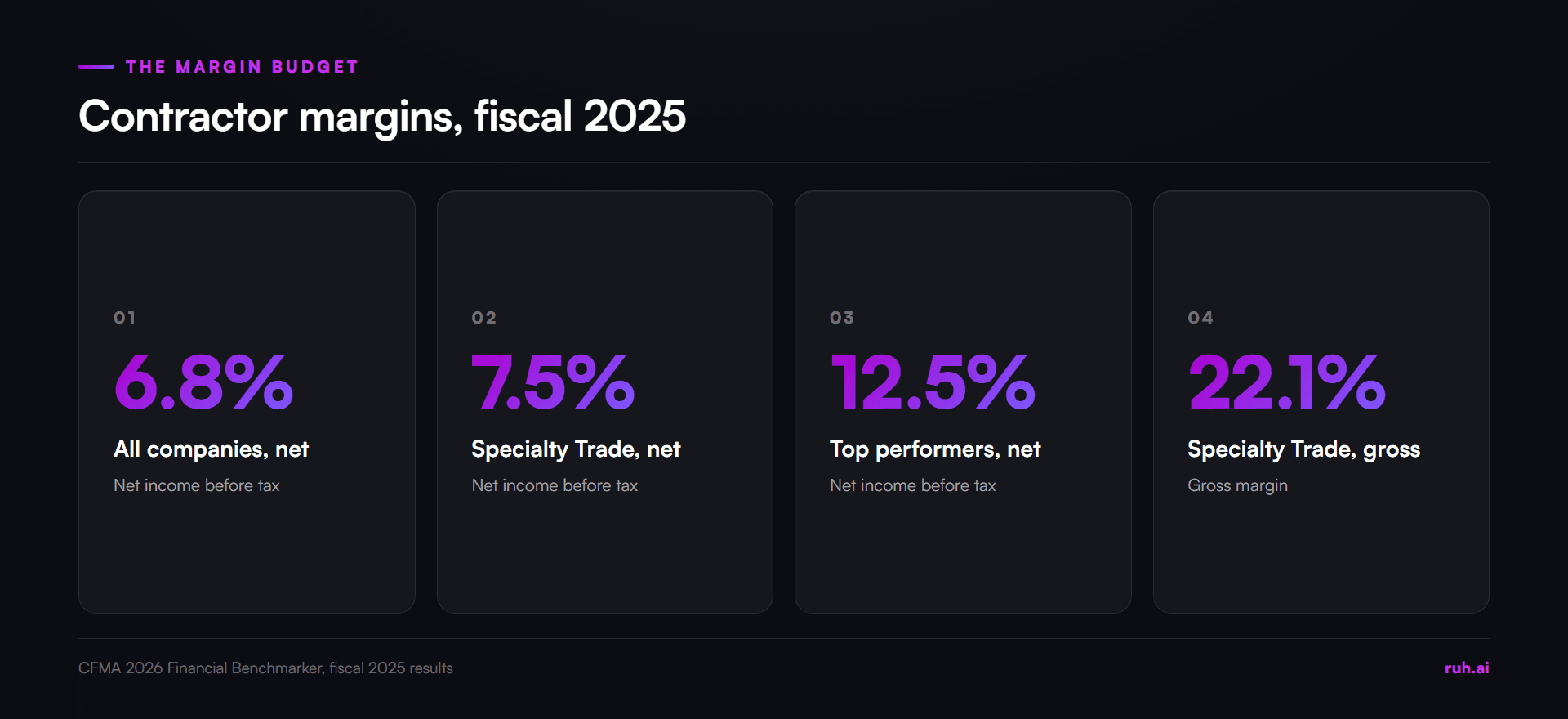
The margin that absorbs those errors is small. CFMA's 2026 Financial Benchmarker reports that responding contractors averaged a 6.8% net income before tax margin in fiscal 2025, the highest in a decade apart from 2021. The same 2026 report puts Specialty Trade contractors at 7.5% net, on a 22.1% gross margin, and the top-performing firms at 12.5% net.
Read those numbers as a budget for mistakes. On most commercial work, the profit line is a single-digit percentage of the contract, so a scope miss worth a few percent of the bid does not trim the margin. It takes a large share of it.
What Are the Two Ways an Inaccurate Bid Costs You?
An inaccurate bid costs you in one of two ways: it loses work you should have won, or it wins work that gives its margin back after award. Most estimators track the first and underrate the second.
| Failure | What happened in the bid | What you see | What it costs |
|---|---|---|---|
| Priced too high | Quantities padded, scope double counted, markup set by habit | A lost bid, often with no feedback | The estimating hours, and the job |
| Priced too low | Scope missed, documents misread, sub scopes that do not meet | A win, then a job that underruns its margin | Part or all of the profit, plus the crew time to recover it |
The second failure is the expensive one, and it feels like success on bid day. The award arrives, the backlog grows, and the gap only shows up once crews reach the missing scope.
Where Do Scope Gaps in a Bid Come From?
Scope gaps start in the documents: quantities that do not match the drawings, drawings that conflict, specs and addenda that were not read, and sub scopes that do not meet. Each one has a point where it is cheap to catch and a point where it is expensive.
Where bid errors start, when they surface and the check that catches them:
| Source of error | How it shows up | When you find out | The pre-bid check |
|---|---|---|---|
| Bill of quantities and takeoff errors | Quantities that do not match the drawings | When material orders or crew hours run over | Check quantities against the drawings, and measure only on scaled sheets |
| Drawing errors and conflicts | Two sheets or a sheet and a detail that disagree | During coordination or installation | Log every conflict and send a pre-bid RFI |
| Missed specs and addenda | A spec section or an addendum that changes the scope | At submittals, or at the first inspection | Log every spec section and acknowledge every addendum |
| Sub scope gaps | Work that falls between two sub quotes | When neither sub will do it | Match every scope to a quote and read every exclusion |
| Markup that ignores risk | The same markup on a clean job and a messy one | At closeout | Set markup against the risk in the documents |
The construction bid process guide walks through document review, sub coverage and markup in the order a bid team does them. For the gaps that open between sub quotes and the signed contract, see how scope gaps slip through before signature.
What Do Pre-Bid RFIs Tell You About Bid Document Risk?
Pre-bid RFIs show where the documents are uncertain before any price is fixed, and the research points to quantities and drawings first. Shrestha and Lee of the University of Nevada analysed around 200 pre-bid RFIs from US state departments of transportation in a 2022 study, and found errors in the bill of quantities were the most frequent, followed by errors in drawings.
Treat your own pre-bid RFIs as a risk register. Every question you send is a place where the documents left room for two prices. If the answer arrives after bid day, or not at all, that uncertainty is now inside your number.
Two habits turn RFIs into accuracy:
- Log every RFI with the answer, or the assumption you priced. An assumption written into the bid is a scope boundary. An assumption in someone's head is a future argument.
- Count the open ones before you submit. A package with many unanswered RFIs carries more risk than a clean one, and the markup discussion later in this guide should reflect that.
Why Do Estimates Lose Margin After the Bid Is Won?
Estimates lose margin after award because competitive bidding rewards the bid that missed the most, so the jobs you win carry your largest errors. Economists call it the winner's curse, a term coined in 1971 by Atlantic Richfield engineers Ed Capen, Robert Clapp and William Campbell in the Journal of Petroleum Technology. Their point, made about oil lease auctions, holds for construction: when several bidders price the same work, the lowest number is the one most likely to have left something out.
The worked example below shows the size of it. The job size and the miss are illustrative, and the margin is CFMA's published average.
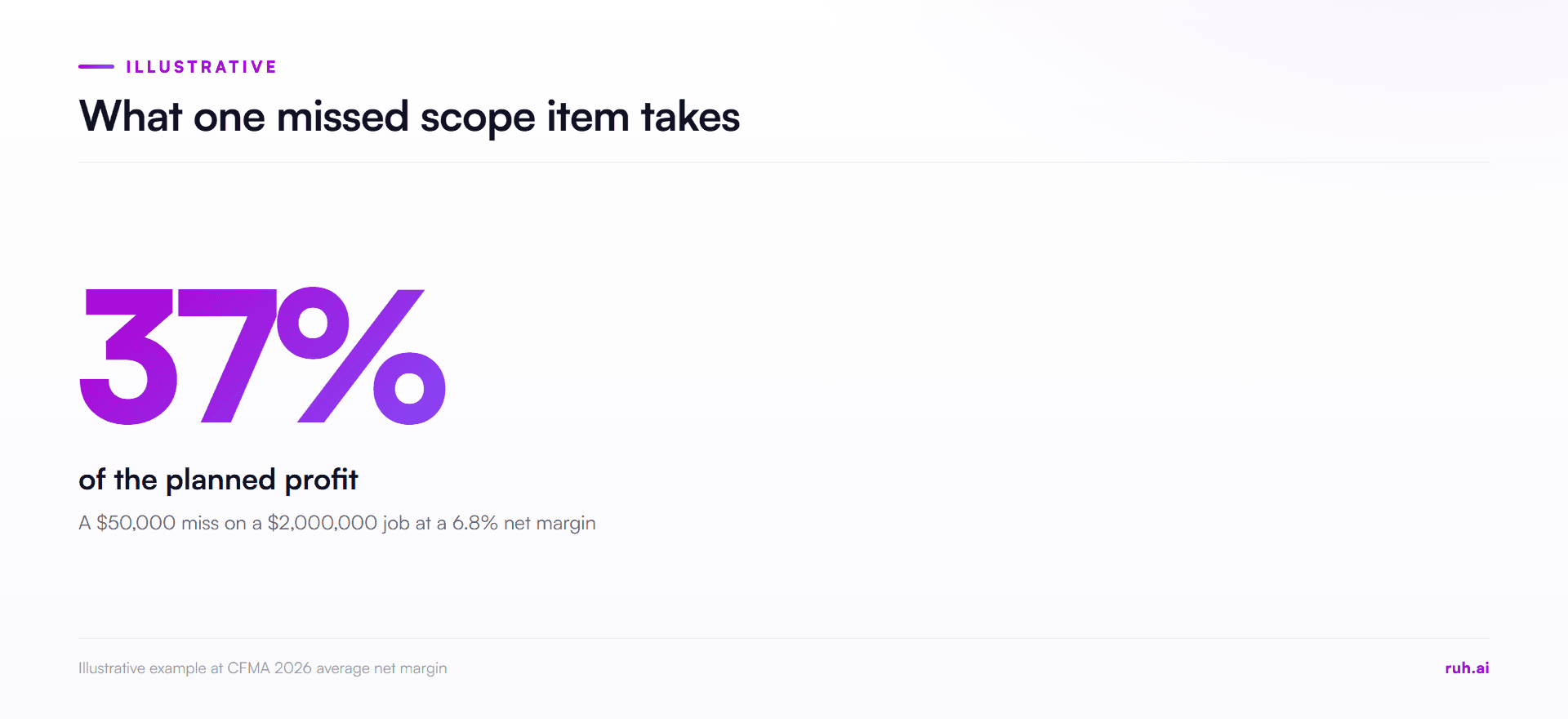
- The job. A $2,000,000 commercial contract, priced at the 6.8% average net margin CFMA reported for fiscal 2025 in its 2026 report.
- The planned profit. $2,000,000 × 6.8% = $136,000.
- The miss. A $50,000 scope item is missed in the bid and absorbed after award. That is 2.5% of the contract.
- The result. Profit falls from $136,000 to $86,000, a 4.3% margin.
- The share. $50,000 ÷ $136,000 = 0.368, so the miss takes 37% of the planned profit.
Pricing that item in would have raised the bid by 2.5%. Whether that loses the job depends on the competition, but the trade is plain: a 2.5% higher number against more than a third of the profit.
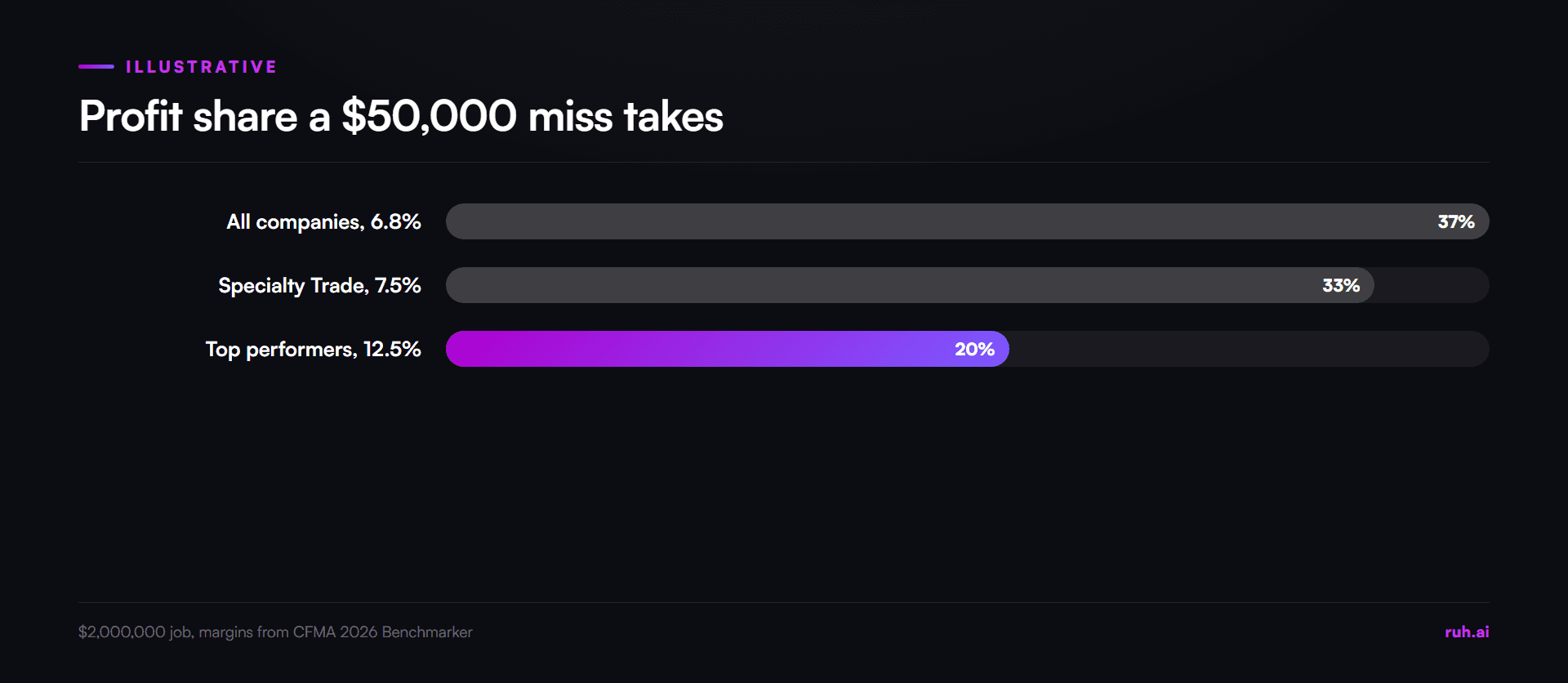
The same miss lands harder the thinner your margin. The table applies one $50,000 miss on a $2,000,000 job to each of CFMA's 2026 margin levels.
Share of profit a $50,000 scope miss takes on a $2,000,000 job, at CFMA's fiscal 2025 net margins (miss and job size illustrative):
| Margin group (CFMA 2026 report) | Net margin | Planned profit on $2,000,000 | Share a $50,000 miss takes |
|---|---|---|---|
| All companies | 6.8% | $136,000 | 37% |
| Specialty Trade | 7.5% | $150,000 | 33% |
| Top performers | 12.5% | $250,000 | 20% |
Run it on your own numbers. Replace the contract value, your net margin and the value of the scope item you are least sure of. The share it takes is the cost of not checking it.
How Should Markup Reflect the Risk in the Documents?
Markup should rise with the risk left in the documents, yet research shows workload and the need for work set it more often. A 2022 study by Zaqout, Islam, Hadidi and Skitmore, published in Engineering Applications of Artificial Intelligence, weighted the views of 31 construction experts and ranked the critical markup factors as current workload, project size, need for work, availability of labor and staff, the project owner and duration.
Markup is a percentage of cost and margin is a percentage of the selling price, so check which one your team quotes before comparing it with CFMA's margins. The markup vs margin guide converts one into the other.
Document quality is not on that list, and that is the gap. A busy contractor raises markup and a hungry one cuts it, while the drawings, the open RFIs and the sub coverage get less say. A 2012 study by Lan Oo, Lo and Lim in Engineering, Construction and Architectural Management found the same pattern over time: bidders priced lower in the periods before a winning bid and less competitively after it, as their capacity changed.
Three questions set markup against risk:
- How many pre-bid RFIs are still open, and what did you assume for each?
- Which scopes rest on a single sub quote, or on none?
- Which quantities came from sheets you could not measure with confidence?
Before cutting price to win, test what the cut does to profit. The bid price-cut simulator models a price reduction against your hit ratio, gross margin and bid cycle, and shows the hit ratio you would need to break even.
How Do You Make Bid Accuracy Repeatable?
Bid accuracy becomes repeatable when every number goes through the same review before it goes out, whoever estimated it. A review that depends on one senior estimator stops when that person is on vacation or buried in three bids at once.
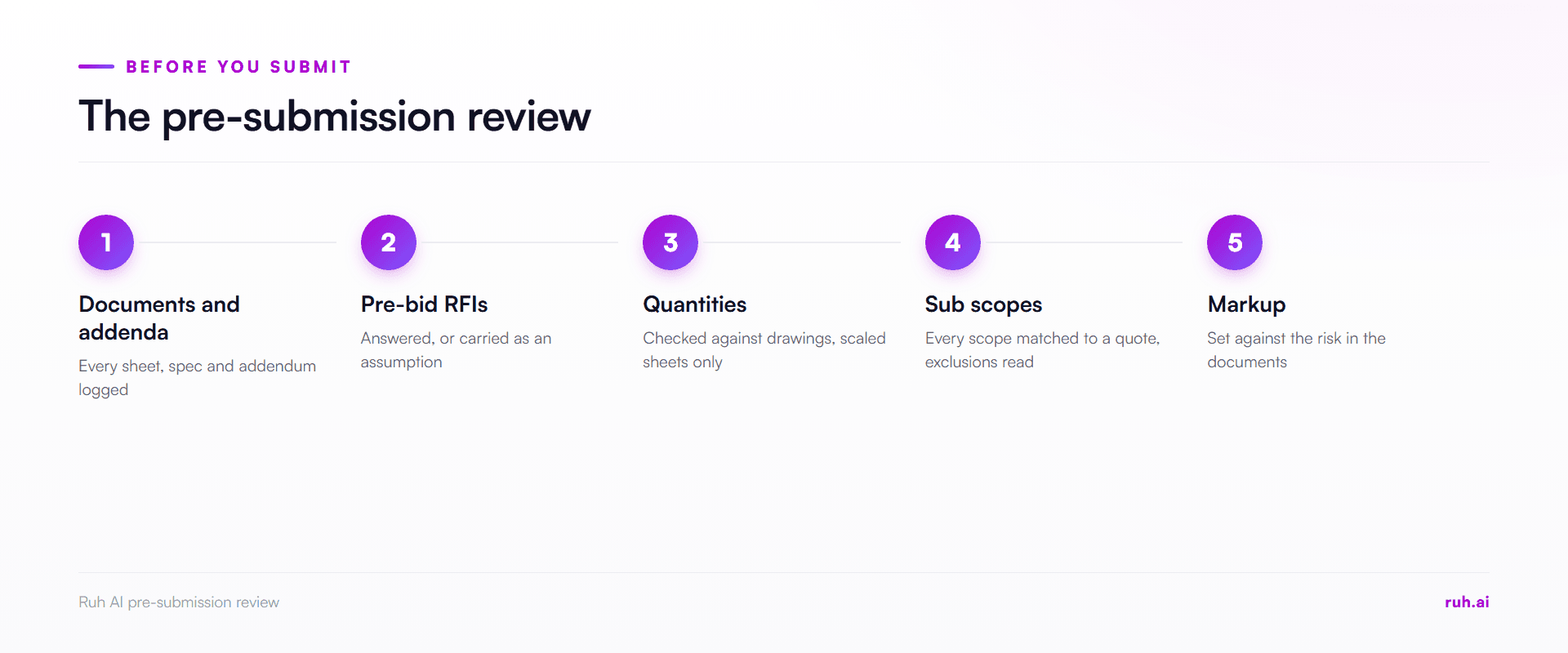
The pre-submission review below is the minimum. Copy it into your bid checklist and give one person the job of signing it off.
| # | Check | Done when |
|---|---|---|
| 1 | Documents and addenda | Every sheet, spec section and addendum is logged and acknowledged |
| 2 | Pre-bid RFIs | Every RFI is answered, or carried as a written assumption |
| 3 | Quantities | Quantities are checked against the drawings and any bill of quantities |
| 4 | Scaled sheets | Every measured quantity comes from a sheet with a known scale |
| 5 | Sub scopes | Every scope is matched to a quote, and every exclusion is read |
| 6 | Exclusions and assumptions | They are written into the bid, not kept in notes |
| 7 | Markup | It is set against document risk and workload, not habit |
| 8 | Second review | A second estimator has checked the largest cost items |
Keep the record after the bid. When a job closes, compare the actual cost of each major scope to the estimate. The scopes that run over most often are where your review needs a harder check.
What Estimators Get Wrong About Bid Accuracy
In Ruh's opinion, estimators get four things wrong about bid accuracy, and none of them needs new software to fix. These are our positions, argued from the margin arithmetic above, not survey findings.
Win rate is the wrong scoreboard. A team that tracks only hit ratio is rewarded for the bids that missed the most. Track margin at closeout against margin at bid, by scope, and the errors show up where they started.
The low number deserves suspicion, not celebration. When your bid comes in well under the next one, the first question is what you left out, not how good your pricing is. That is the winner's curse in practice.
Contingency is not a substitute for reading the documents. A contingency line covers the risk you know about. It does not cover the addendum nobody opened.
Accuracy is a process, not a talent. The best estimator on the team still misses scope on a tired Friday. A standard review catches what talent alone does not.
The Honest Assessment: What a Better Review Cannot Fix
A tighter review reduces the errors you control, and it does not remove the risk you do not. Four limits are worth stating plainly.
- It cannot fix bad documents. If the drawings conflict and the RFI goes unanswered, the risk stays in the price. The review only makes sure you know it is there.
- It cannot beat a competitor who is wrong. A rival that misses a scope can still underbid an accurate number, and win the job you priced correctly.
- It takes time on a tight bid day. Eight checks cost hours, and some bids will go out with a shorter review. Decide in advance which checks are never skipped.
- It does not control the field. Productivity, weather and late owner decisions move the margin after award, whatever the estimate said.
How Ruh AI Fits Into This
Ruh AI's Estimating Agent prices from your company's own rate book and history, so every bid starts from the costs your jobs have actually carried. Your estimator can change any price, add their own costs, and approves the budget before a proposal goes out.
On quantities, the Takeoff Agent withholds a figure when a sheet has no scale instead of guessing, so a missing quantity shows up as a gap in the review rather than as a number nobody checked.
Frequently Asked Questions
Q: What is construction bid accuracy? A: Construction bid accuracy is how closely a bid reflects the full scope, quantities and risk in the documents. It is judged by whether the job still earns its planned margin at closeout, not only by whether the bid wins.
Q: Why am I losing construction bids? A: Bids are usually lost on price, and a high price often comes from padded quantities, double counted scope or a markup set by habit. Check those first, then ask whether the work fits your crews and your relationship with the GC or owner.
Q: Why do construction jobs go over the estimate? A: Jobs go over the estimate most often because scope was missed or misread at bid time, then surfaced once crews reached it. Field productivity, weather and late owner decisions add to it after award.
Q: How much does a missed scope item cost a contractor? A: A missed scope item costs its full value out of profit, which is far more than its share of the contract. In the worked example above, a miss worth 2.5% of the contract takes more than a third of the planned profit.
Q: How can I improve construction bid accuracy? A: Run the same pre-submission review on every bid: log every document and addendum, answer or assume every RFI, check quantities against the drawings, match every sub scope to a quote and set markup against the risk in the documents.
Q: What is the winner's curse in construction bidding? A: The winner's curse is the tendency for the winning bid to be the one that most underestimated the cost. When several contractors price the same work, the lowest number is the most likely to have left something out.
The Bottom Line
Bid accuracy is measured at closeout, not on bid day. Price the documents you have, write down what you assumed, set markup against the risk you can see, and run the same review before every number goes out. The bids you lose on price cost you hours. The scope you miss on the bids you win costs you the job's profit.
See how Ruh AI supports the estimating team. Explore Ruh AI for estimators and precon.
Sources
- Construction Financial Management Association, CFMA's 2026 Financial Benchmarker, Executive Summary, fiscal year 2025 results: cfma.org
- Shrestha and Lee, "Investigation on Uncertainty in Construction Bid Documents", International Conference on Construction Engineering and Project Management, 2022: koreascience.kr
- Zaqout, Islam, Hadidi and Skitmore, "Modeling bidding decisions and bid markup size for construction projects: A fuzzy approach", Engineering Applications of Artificial Intelligence, 2022: bond.edu.au
- Lan Oo, Lo and Lim, "The effect of bidding success in construction bidding", Engineering, Construction and Architectural Management 19(1), 2012, Emerald Publishing