
Every project a general contractor or sub wins started as a number on a bid form, and that number is only as good as the process behind it. Bidding is not one task. It is a chain of decisions and handoffs that runs from the first time you see an invitation to the day you write the first purchase order. Break any link and the job either slips away to a competitor or, worse, you win it at a price that loses money. This guide walks the full lifecycle as a senior estimator or PM actually runs it, names where time and risk concentrate, and shows where AI earns its keep without taking the pen out of your hand.
Where does a bid actually start?
The pipeline starts well before a takeoff. For a GC, opportunities arrive through plan rooms, private invitations from owners and developers, public solicitations on state and municipal portals, and relationships with architects who recommend the shortlist. For a sub, the flow is mostly GC invitations through services like a plan room or an ITB email blast. The first real work is triage. You are not deciding whether to bid yet, you are deciding whether to spend an hour reading the documents to decide whether to bid.
The signal you want early: project type, size, location, delivery method (design-bid-build, design-build, CM at risk), bid date, bond and insurance requirements, and who else is likely chasing it. If the bid date is eight days out, the documents are 40 percent complete, and you already have two jobs going to bid that week, the answer may be no before you open the drawings.
What goes into document and site review?
Once an opportunity clears triage, you read the package the way it will be enforced, not the way it reads in marketing. That means the instructions to bidders, the bid form, the agreement, the general and supplementary conditions, Division 01, the technical specs, the drawings, and every addendum. The drawings tell you what to build. The front-end documents tell you what it will cost you in risk: liquidated damages, retainage, payment terms, warranty length, and the schedule you are signing up to.
The site visit is not optional on anything with sitework or an existing structure. You are looking for access, laydown area, soil and water conditions, the condition of anything you are tying into, and the gap between what the drawings show and what is actually there. The phrase that costs the most money in this business is "the drawings did not show that."
This is also where you log every assumption and exclusion. A clean bid is built on a clean list of what you are and are not carrying.
How do you make the bid/no-bid call?
Bid/no-bid is the cheapest risk control you have, because saying no costs you nothing but the review time. A disciplined call weighs: do we have the right work backlog and the crews to staff it, do we have the bonding capacity, is the schedule realistic, is the owner and design team known to be reasonable, how complete are the documents, and how many bidders are we up against.
The math behind this is simple and worth doing out loud.
Worked example, illustrative: your shop wins roughly 1 bid in 5 on hard-bid work, and a full estimate on a mid-size commercial job costs you about 60 hours of estimator and PM time. At a loaded rate of 95 dollars per hour, that is 60 hours times 95 dollars equals 5,700 dollars per bid. To win one job you bid five, so the cost of winning one job is 5 times 5,700 dollars equals 28,500 dollars in estimating cost. If you chase work where your real win rate is 1 in 10 instead of 1 in 5, that number doubles to 57,000 dollars per win. Bid/no-bid discipline is the difference between those two numbers. Chase fewer, better-fit jobs and your estimating cost per win drops.
Sending invitations and gathering sub quotes
For a GC, the bid is mostly other people's numbers. The trade scopes you do not self-perform get covered by subcontractor and supplier quotes, so coverage is everything. You want at least three competitive quotes in every significant trade, more in the high-dollar trades like mechanical, electrical, plumbing, and structure.
Invitations to bid go out as early as possible with the full document set, the bid date, and clear scope expectations. Then comes the part nobody enjoys: chasing coverage. The week before bid day, the estimating team is on the phone confirming who is bidding, who dropped out, and which trades have thin coverage that needs a last-minute call to a backup sub. A trade with one number and no competition is a trade where you are exposed on both price and scope.
Why takeoff and estimate is the heart of it
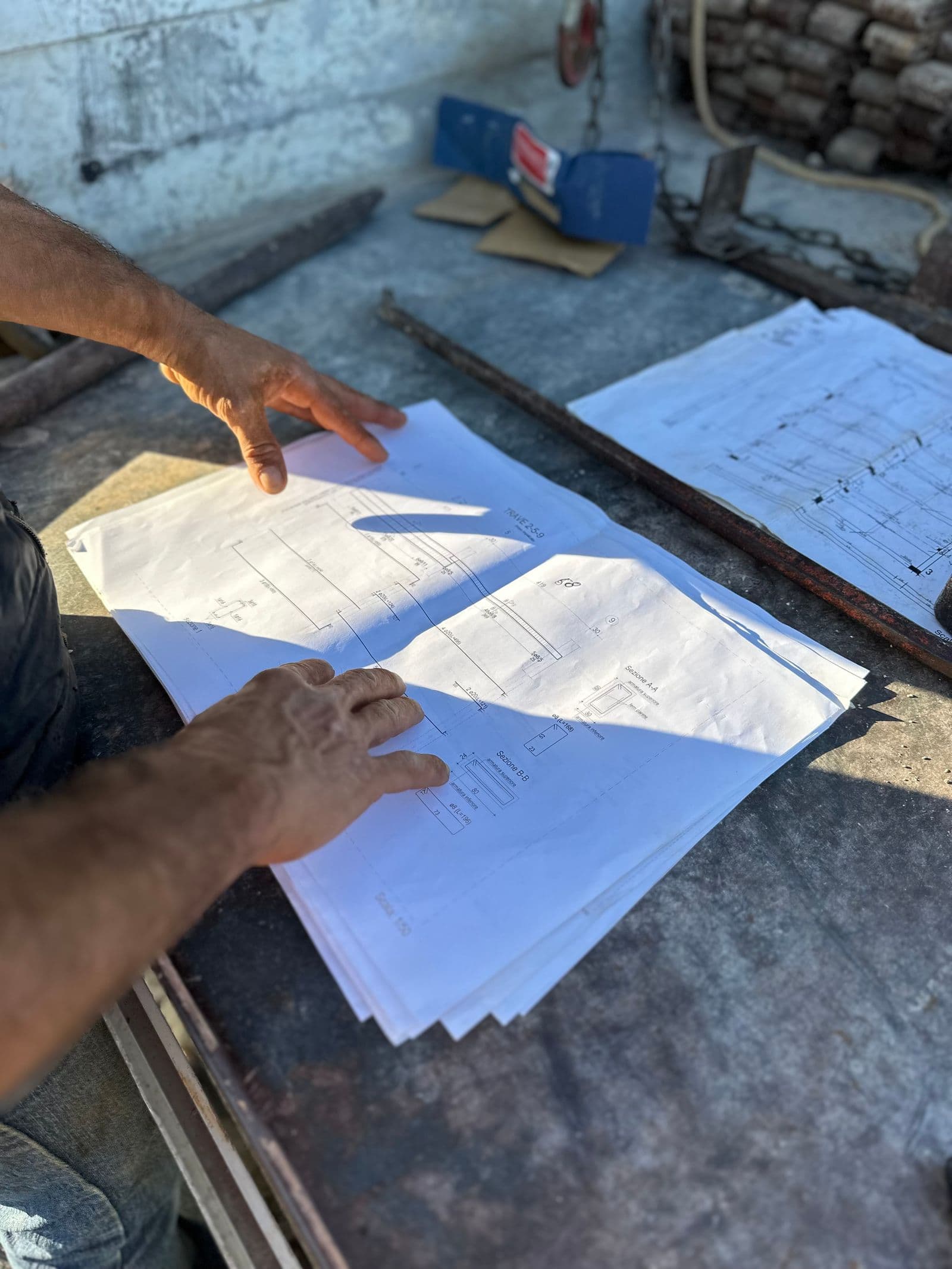
The takeoff is the quantity survey: counting and measuring everything the drawings show so you can price it. Linear feet of wall, square feet of slab, cubic yards of concrete, counts of doors and fixtures, tons of steel. The estimate is the takeoff multiplied by your unit costs for labor, material, equipment, and sub pricing, organized so nothing is double counted and nothing falls through.
This is where time and risk concentrate hardest. On a mid-size commercial job, a manual takeoff can run 30 to 50 hours, and it is the step most exposed to human error under deadline. A missed quantity, a wall counted once that should have been counted on both faces, a fixture schedule misread, any of these flows straight into the bid number. The deeper method for pricing the quantities lives in how to estimate construction costs; the point here is that the takeoff feeds everything downstream, so an error here is an error you submit.
Worked example, illustrative: take an interior partition scope. The drawings show 2,400 linear feet of metal stud partition at a furnished and installed cost of 38 dollars per linear foot. Correct takeoff: 2,400 LF times 38 dollars equals 91,200 dollars. Now suppose the estimator misses one wing of the floor plan and carries only 2,050 LF. That bid carries 2,050 LF times 38 dollars equals 77,900 dollars, a shortfall of 91,200 dollars minus 77,900 dollars equals 13,300 dollars on a single trade. If your net margin on the job was 5 percent of a 1.5 million dollar contract, that is 75,000 dollars of planned profit, and this one miss quietly eats 13,300 dollars of it before you have turned a shovel.
Leveling subs, then general conditions and markup
Once quotes are in, you cannot just take the low number. Bid leveling is the side-by-side comparison that normalizes every sub quote to the same scope so you are comparing apples to apples. Sub A may look 12,000 dollars cheaper than Sub B until you notice Sub A excluded fireproofing, excluded the temporary heat, and assumed a different finish. Leveling exposes those gaps and tells you the true low bidder. This is the second place risk concentrates, right behind takeoff, because an unleveled quote carried into the bid is a hole you discover during buyout.
With trades leveled and the self-perform work estimated, you build the indirect costs. General conditions are the project-level costs of running the job that do not belong to any single trade: project management and supervision, the field office and trailer, temporary utilities, dumpsters, safety, surveying, cleanup, and small tools. On commercial work these commonly land somewhere around 6 to 12 percent of the cost of the work, driven mostly by job duration.
Then markup. Overhead covers your home office. Fee is your profit. On hard-bid commercial work, combined overhead and profit often sits in the high single digits to low teens as a percentage, and bonds and insurance get added on top because they scale with contract value.
Worked example, illustrative: direct cost of work comes to 2,000,000 dollars. Add general conditions at 8 percent: 2,000,000 dollars times 0.08 equals 160,000 dollars, bringing subtotal to 2,160,000 dollars. Add overhead and profit at 10 percent: 2,160,000 dollars times 0.10 equals 216,000 dollars, subtotal 2,376,000 dollars. Add payment and performance bond at 1.2 percent: 2,376,000 dollars times 0.012 equals 28,512 dollars. Total bid: 2,404,512 dollars. Notice the order matters. Markup compounds on the costs below it, so an error in the direct cost does not stay small, it gets multiplied by every layer above it.
Assembling and submitting the bid
The final assembly is a stress test under a hard clock. Late sub numbers come in during the last two hours and have to be plugged, leveled, and re-totaled without breaking the spreadsheet. You confirm you have acknowledged every addendum, that allowances and alternates are priced, that the bid form is filled exactly as the instructions require, and that the bid bond is attached. On public work, a missing initial or an unacknowledged addendum can get your bid thrown out no matter how sharp the number is.
Here is one realistic timeline for a four-week bid window on a mid-size commercial job:
- Week 1: triage, document and site review, bid/no-bid decision, invitations to bid sent.
- Week 2: takeoff and self-perform estimate underway, sub coverage tracked.
- Week 3: takeoff finished, sub quotes arriving, leveling begins, general conditions built.
- Week 4: final leveling, late quotes plugged, markup applied, bid form assembled, submitted on bid day.
The compression is brutal and predictable: the takeoff has to be done early so the rest of the chain has room, but the takeoff is the slowest step. That is the bottleneck the whole industry feels.
This is where AI changes the shape of the week, not the responsibility. Ruh reads the drawing set, performs the takeoff quantities, and prices them against the contractor's own price book rather than a generic database, so the numbers speak your shop's cost structure. The estimator reviews the quantities, adjusts assumptions, and signs off. The work that ate 30 to 50 hours and crowded out leveling now starts earlier and leaves the human time for the judgment calls that actually win or lose money.
What happens after you win? Buyout.
Winning is not the finish line, it is the handoff. Buyout is converting the bid into contracts: awarding each trade to the leveled sub, locking scope and price in writing, issuing purchase orders for major materials, and reconciling the as-bought cost against what you carried in the estimate. This is where leveling pays off or punishes you. If you leveled scope properly during the bid, buyout is clean and the awarded numbers track the estimate. If you carried a low quote that quietly excluded a chunk of work, you find out now, when the sub will not sign for the price you bid, and the gap comes out of your fee.
The whole process is a chain, and buyout is where every earlier shortcut shows up. A disciplined bid/no-bid call keeps you off bad jobs. A clean takeoff keeps the foundation number honest. Real leveling keeps the sub numbers comparable. Correct markup keeps the math from compounding errors. Do those four well and the bid you submit is the bid you can build. Let AI take the slow, mechanical takeoff off the critical path so your people spend their hours on the decisions a spreadsheet cannot make, and keep the sign-off where it belongs, with the estimator who has to stand behind the number.
Try Ruh on a real bid. 100% money-back guarantee if you are not satisfied.*
*Scoped delivery, terms apply. Read the guarantee terms
Frequently asked questions
What are the main steps of the construction bid process?+
Find the opportunity, review the documents and visit the site, make a bid/no-bid decision, send invitations to bid and gather subcontractor quotes, perform the takeoff and estimate, level the sub quotes, add general conditions and markup, assemble and submit the bid, then buy out the awarded trades into contracts.
What is the difference between takeoff and estimate?+
The takeoff is the quantity survey: counting and measuring everything the drawings show, like linear feet of wall or cubic yards of concrete. The estimate is those quantities multiplied by your unit costs for labor, material, equipment, and sub pricing. The takeoff feeds the estimate, so a quantity error flows straight into your bid number.
Why is bid leveling so important?+
Bid leveling normalizes every subcontractor quote to the same scope so you compare apples to apples. The apparent low bidder often excluded items others included. Without leveling, you can carry a quote that quietly drops a chunk of work, then discover the gap during buyout when the sub will not sign for your bid price, with the difference coming out of your fee.
How much should general conditions and markup add to a bid?+
On commercial work, general conditions commonly run around 6 to 12 percent of the cost of the work, driven mostly by job duration. Combined overhead and profit often sits in the high single digits to low teens as a percentage, with bonds and insurance added on top because they scale with contract value. Apply markup in order, since each layer compounds on the costs beneath it.
How does AI fit into the bidding process?+
AI compresses the slowest step, the takeoff. A tool like Ruh reads the drawing set, performs the takeoff quantities, and prices them against the contractor's own price book rather than a generic database. The estimator then reviews the quantities, adjusts assumptions, and signs off. It moves the bottleneck off the critical path while keeping the human accountable for the final number.
Still pricing in a spreadsheet? Your price book, automated end to end. Your estimator signs off.
See it runTerms used in this guide
Figures on this page are illustrative. Construction estimates depend on project-specific conditions, source documents, market pricing, and professional judgment. Ruh's AI assists the estimator and does not replace professional review: your team reviews, validates, and approves every estimate, bid, and pricing decision.