

Quick Answer
Takeoff accuracy is how closely the quantities measured from a drawing set match the work actually in the bid scope, and on a lump-sum bid it decides the price, because every unit you miss or overcount goes straight into the number you live with. This guide shows how far two measuring methods drifted on the same building in a recent study, works through what one quantity miss costs on a lump-sum package, compares manual, digital and model-based takeoff, and gives an accuracy check to run before quantities go to pricing.
What you'll find below:
- A table of how far two takeoff methods differed on concrete, formwork and rebar for the same building
- A worked example of one formwork miss on a lump-sum concrete package, with the arithmetic in the open
- A comparison of manual, digital on-screen and model-based takeoff, and where each one drifts
- A seven-point takeoff accuracy check to run before quantities go to pricing
- What to look for in an AI takeoff tool when you bid lump sum
Why Does Lump-Sum Work Need Exact Quantities?
On lump-sum work the quantity is the price, so every unit you miss is paid for out of your margin, not the owner's budget. A unit-price contract pays for what you install. A lump-sum contract pays the number you bid, whatever the job turns out to need.
That makes the takeoff the riskiest document in the bid. A wrong unit price can be argued about. A wrong quantity on a lump-sum job becomes a wrong material order, extra crew hours and a smaller profit, and nobody pays you back for it.
The errors start early and they start in quantities. Shrestha and Lee of the University of Nevada analysed around 200 pre-bid RFIs from US state departments of transportation in a 2022 study, and errors in the bill of quantities were the most frequent type, ahead of errors in the drawings.
Why Do Two Estimators Get Different Takeoffs From the Same Drawings?
Two estimators get different totals from the same set because they measure with different conventions, not because one of them cannot read drawings. One deducts every opening, the other only the large ones. One measures rebar laps at the spec length, the other at a rule of thumb. Both totals look reasonable, and they do not match.
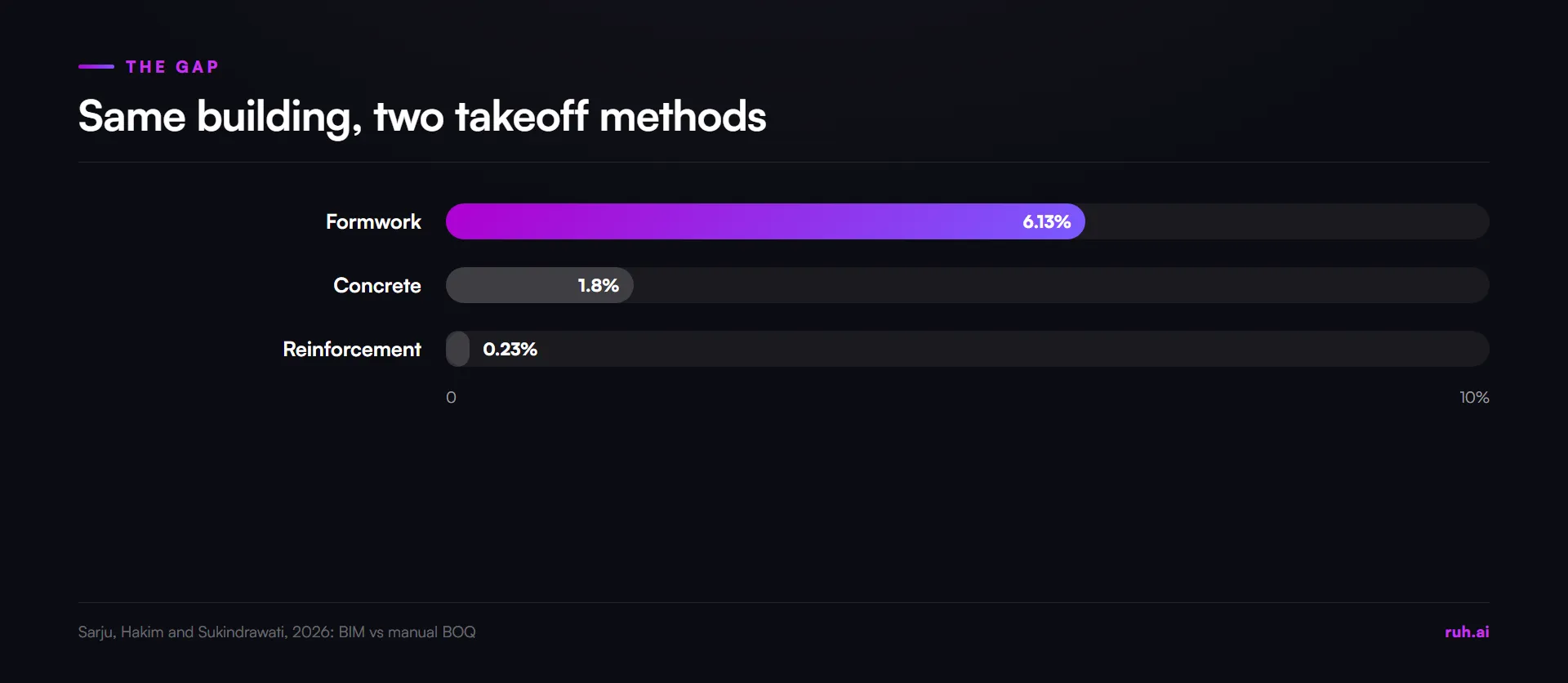
A 2026 study measured the size of that gap on a real building. In that study, Sarju, Hakim and Sukindrawati of Universitas Janabadra measured the same structural work two ways, from a BIM model and from a manual bill of quantities, and found the formwork quantities differed by 6.13%, concrete by about 1.8% and reinforcement by 0.23%. They traced the gaps to geometry the model cut short, elements such as pit-lift walls handled separately, and inconsistent reinforcement rules for clear span, overlap and development length in the manual calculation.
Same building, two takeoff methods, BIM model against the manual bill of quantities:
| Item | BIM model | Manual bill of quantities | Difference (2026 study) |
|---|---|---|---|
| Concrete | 1,989.49 m³ | 2,025.37 m³ | 1.8% |
| Formwork | 6,857.70 m² | 7,305.17 m² | 6.13% |
| Reinforcement | 302,817.10 kg | 303,502.10 kg | 0.23% |
The lesson is in the pattern, not the averages. The items with simple geometry agreed closely. Formwork, where the measurement depends on how every edge, opening and junction is treated, moved the most. On your own jobs, the items that depend on conventions are the ones to check twice.
How Does a Takeoff Count Work That Is Not in Scope?
A takeoff counts out-of-scope work when it measures what is drawn rather than what is bid. Drawing sets show the whole building. Your scope is one trade, often one phase, and sometimes one area, and the boundary lives in the bid documents, not on every sheet.
The common versions:
- Alternates and future phases drawn in full. The area is on the plan, and nobody marked it out before measuring.
- Work by others. Owner-furnished items, or another trade's portion of a shared assembly, measured as yours.
- Revised sheets alongside the originals. An addendum replaces a sheet, and both get measured.
- Areas outside the limit of work. Sitework and paving runs that continue past the boundary line.
Any method can make this mistake, manual or automated. A scale ruler, an on-screen tool and an AI model all measure what you point them at. Marking the scope boundary on every sheet before anyone measures is the only reliable fix.
Which Measurements Are Easiest to Get Wrong From Floor Plans?
Linear runs, openings and anything read from a sheet at the wrong scale are the measurements most often wrong from floor plans. They look simple, which is why they get the least checking.
- Linear footage. Storefront and glazing runs, base, trim, curbs and edge forms. A run that turns a corner or steps at a column is easy to cut short, and short runs add up across a floor.
- Openings. Whether a wall area deducts doors and windows, and above what size, changes drywall, paint and masonry quantities.
- Scale. A half-size print measured with a full-size scale halves every length. A sheet marked "not to scale", or a detail at a different scale from the plan, gives a number that looks right and is not.
- Heights. Plans show length, not height. Wall area needs the height from a section or schedule, and a missed soffit or bulkhead changes it.
To measure linear footage from a floor plan reliably, confirm the sheet scale against a known dimension first, trace each run end to end including corners and returns, and log the sheet number with the total. The guide to doing a construction takeoff covers the full measuring sequence.
What Does a Quantity Miss Cost on a Lump-Sum Bid?
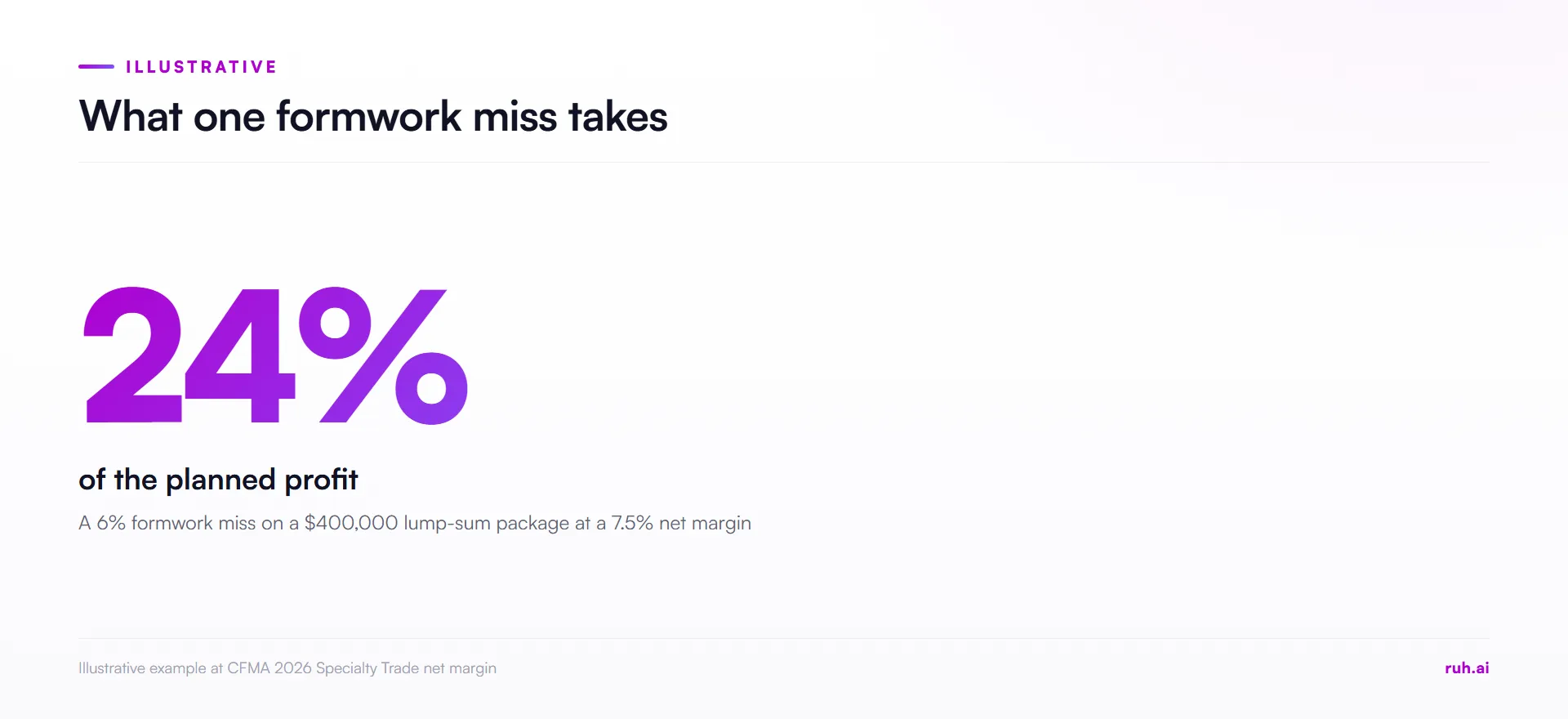
A quantity miss on a lump-sum bid costs its full value out of profit, which is a far larger share of the profit than of the contract. The worked example below shows the size of it. The package, the formwork share and the miss are illustrative, and the margin is CFMA's published figure.
- The package. A $400,000 lump-sum concrete package, priced at the 7.5% net margin CFMA's 2026 Financial Benchmarker reported for Specialty Trade contractors in fiscal 2025.
- The planned profit. $400,000 × 7.5% = $30,000.
- The miss. Formwork is carried at $120,000 of cost, on a quantity that turns out 6% low, close to the formwork gap in the 2026 study above.
- The extra cost. $120,000 × 6% = $7,200.
- The result. Profit falls from $30,000 to $22,800, a 5.7% margin.
- The share. $7,200 ÷ $30,000 = 0.24, so one item takes 24% of the planned profit.
Run it with your own package. Use the item you trust least, its cost, and how far off it could be. Waste belongs on its own line, as the waste factors guide explains, so a quantity error is not hidden inside a waste allowance.
The same arithmetic applies to scope you miss altogether, which the guide on why winning bids still lose margin works through at the 6.8% all-company margin in CFMA's 2026 report.
Manual, Digital or Model-Based Takeoff: What Does Each Do Well?
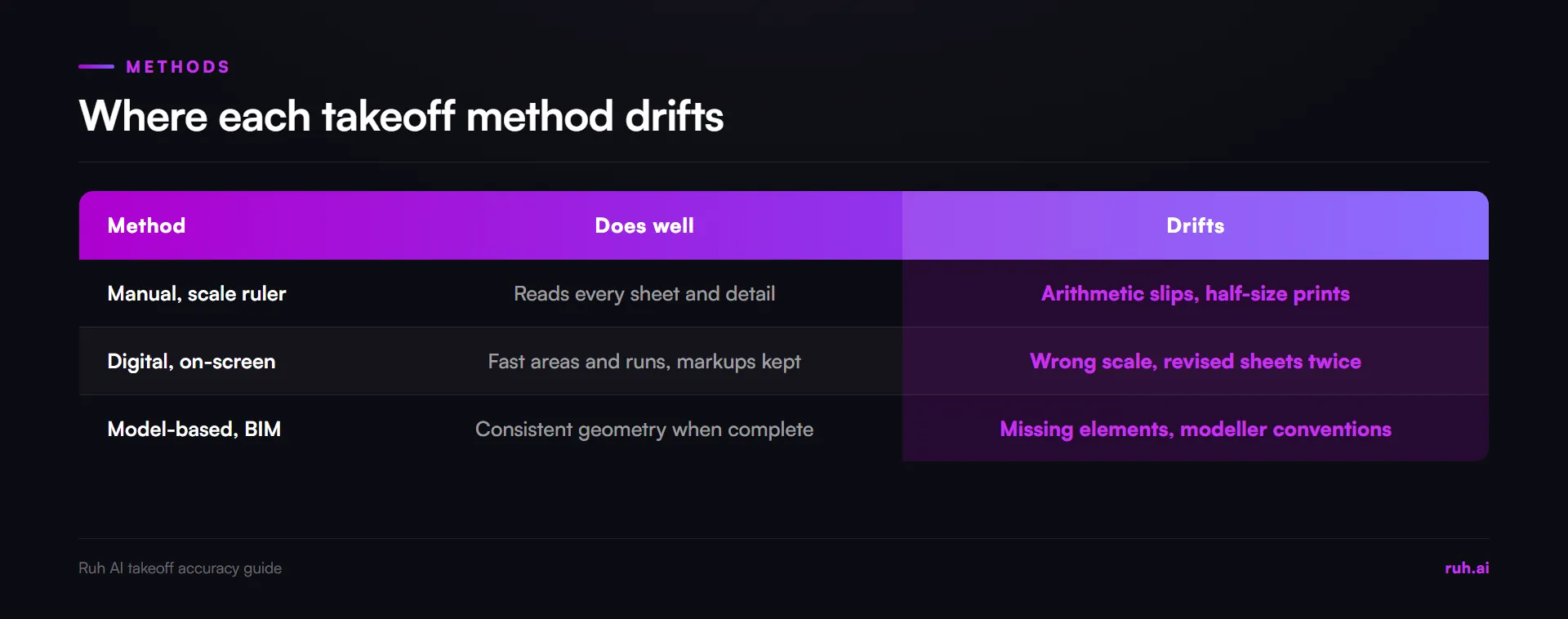
Each takeoff method is accurate at something and drifts somewhere else, and knowing where is more useful than picking a winner.
| Method | What it does well | Where it drifts | The check that catches it |
|---|---|---|---|
| Manual, paper and scale ruler | Forces the estimator to read every sheet and detail | Arithmetic slips, half-size prints, runs measured once and never re-traced | Re-add totals, confirm print size, second count on large items |
| Digital, on-screen measuring | Fast area and linear measurement, with markups kept on the sheet | Wrong or uncalibrated scale, revised sheets measured twice, layers left on | Calibrate scale on every sheet, supersede old sheets, review markups |
| Model-based, from a BIM model | Consistent geometry and quick quantities when the model is complete | Missing or simplified elements, geometry cut short, conventions set by the modeller | Compare against the drawings for the items that carry the money |
Whatever the method, accuracy comes from the conventions you set. A team that writes down how it treats openings, laps, waste and boundaries gets closer totals from any tool than a team that leaves it to each estimator. For a broader look at choosing a tool, see the 2026 guide to takeoff tools.
How Do You Check Takeoff Accuracy Before Pricing?
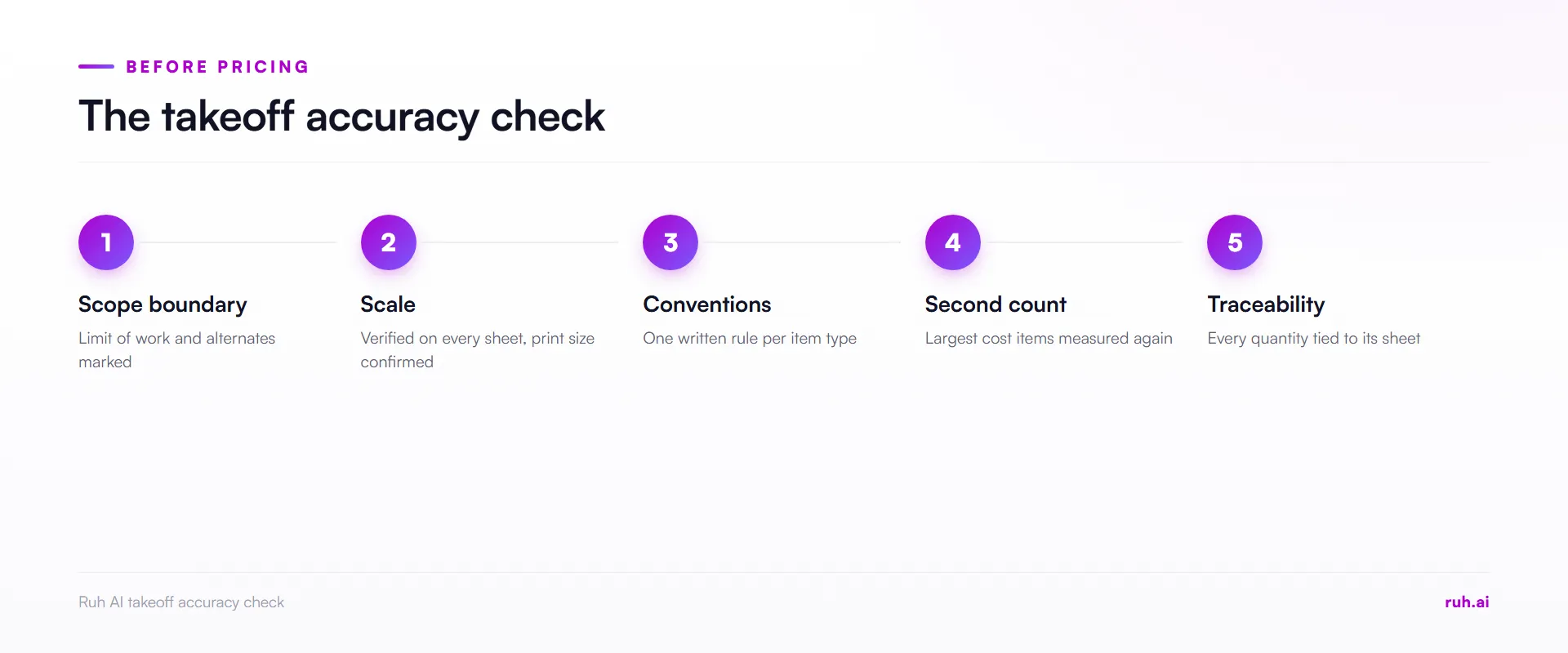
Check takeoff accuracy with the same seven-point review before every set of quantities goes to pricing, whoever measured it. Copy it into your bid checklist.
| # | Check | Done when |
|---|---|---|
| 1 | Scope boundary | The limit of work, alternates and work by others are marked on every sheet |
| 2 | Scale | The scale is verified against a known dimension on every sheet, and print size confirmed |
| 3 | Conventions | One written rule per item type for openings, laps and junctions |
| 4 | Revisions | Every addendum is logged and every superseded sheet removed |
| 5 | Second count | The largest cost items are measured again, by a second person or method |
| 6 | Traceability | Every quantity is tied to its sheet and detail |
| 7 | Waste | Waste is added as a separate line, not inside the quantity |
The material takeoff guide shows how to turn checked quantities into an order list.
What Should You Look For in an AI Takeoff Tool for Lump-Sum Bids?
For lump-sum work, look for an AI takeoff tool that handles scale safely, respects your scope boundary and shows where every quantity came from. Speed matters less than whether you can check the result before you price it.
- Scale handling. What does it do on a sheet with no scale, or a detail at a different scale? A tool that guesses gives you a confident wrong number.
- Scope control. Can you mark the limit of work and exclude alternates and work by others before it measures?
- Traceability. Can you click a quantity and see the sheet and the area it came from?
- Conventions. Can you set how openings, laps and waste are handled, so every job uses the same rules?
- Review. Can an estimator change any quantity and see what changed before it goes to pricing?
Ask for a takeoff on one of your own past bids, where you already know the true quantities. That test tells you more about AI takeoff accuracy than any demo set.
What Estimators Get Wrong About Takeoff Accuracy
In Ruh's opinion, estimators get four things wrong about takeoff accuracy, and the tool they use is not one of them. These are our positions, argued from the study and the arithmetic above, not survey findings.
Accuracy is set by conventions, not tools. The 2026 study's formwork gap came from how edges, elements and laps were treated. Change the tool without changing the rules and the gap moves with you.
Waste does not belong inside the quantity. A quantity padded for waste hides the measuring error you most need to see.
The total is the wrong thing to check. Errors in opposite directions cancel out in the total. Check the items that carry the money, one by one.
A second count is only a check if it uses the same rules. Two estimators with different conventions will disagree for reasons that have nothing to do with mistakes.
The Honest Assessment: What an Accuracy Check Cannot Catch
An accuracy check makes your quantities match the drawings, and it cannot make the drawings match the building. Four limits are worth stating.
- It cannot fix incomplete documents. If a detail is missing, the quantity is a guess, and the check only flags it.
- It cannot settle scope the documents leave open. That takes an RFI, an exclusion or an assumption written into the bid.
- It takes time. A second count on the largest items costs hours on a tight bid day. Decide in advance which items always get one.
- It does not control the field. Installation waste, rework and site conditions still move the real quantity.
How Ruh AI Fits Into This
Ruh AI's Takeoff Agent withholds a figure when a sheet has no scale instead of guessing, so a missing quantity shows up as a gap your estimator can see rather than a number nobody checked.
When the quantities move to pricing, the Estimating Agent prices from your company's own rate book and history. Your estimator can change any price or add their own costs, and a person approves the budget before the next stage.
Frequently Asked Questions
Q: What is takeoff accuracy? A: Takeoff accuracy is how closely the measured quantities match the work actually in the bid scope. On a lump-sum bid it decides the price, because any miss is paid out of margin.
Q: How accurate should a construction takeoff be? A: Accurate enough that the items carrying the most cost can be traced to a sheet and survive a second count. No single published tolerance fits every trade, so track how far your own quantities move between bid and actual, item by item.
Q: Why do estimators get different quantities from the same plans? A: They use different measuring conventions, such as how openings are deducted or how laps are measured. Writing those conventions down closes most of the gap.
Q: How do you measure linear footage from a floor plan? A: Confirm the sheet scale against a known dimension, trace each run end to end including corners and returns, and record the sheet number with the total.
Q: Is AI takeoff accurate? A: AI takeoff is as accurate as its handling of scale, scope and review. Test it on a past bid where you know the true quantities, and keep an estimator checking the items that carry the money.
Q: What is lump sum bid estimating? A: Lump sum bid estimating is pricing a fixed total for a defined scope. Because the contractor keeps any overrun, quantity accuracy matters more than on unit-price work.
The Bottom Line
On a lump-sum bid you live with the quantities you measured. Mark the scope boundary, verify scale on every sheet, write down your conventions and count the expensive items twice. The method matters less than the rules, and the rules are what make two estimators agree.
See how Ruh AI supports the estimating team. Explore Ruh AI for estimators and precon.
Sources
- Sarju, Hakim and Sukindrawati, "Comparative Analysis of BIM-Based Quantity Take Off and Manual BOQ in Building Structural Work", Jurnal Konstruksi dan Infrastruktur 14(1), 2026: jurnal.ugj.ac.id
- Shrestha and Lee, "Investigation on Uncertainty in Construction Bid Documents", International Conference on Construction Engineering and Project Management, 2022: koreascience.kr
- Construction Financial Management Association, CFMA's 2026 Financial Benchmarker, Executive Summary, fiscal year 2025 results: cfma.org