EstimatingExplore estimating
Construction glossary · Estimating Concepts

What is self-perform work in construction?

Self-perform work is the part of a job a general contractor builds with its own employees and equipment instead of subcontracting it. Read on for common reasons GCs do it, one scope priced both ways, our view, and a link to a calculator that finds the break-even.

Free 30-minute walkthrough on your own drawings. No card.

Updated November 2026 · Reviewed by the Ruh construction team

The definition

Self-Perform Work, Explained.

Concrete, rough carpentry, general labor and cleanup are common self-performed scopes. The general contractor takes on the production risk and keeps the margin a subcontractor would have earned.

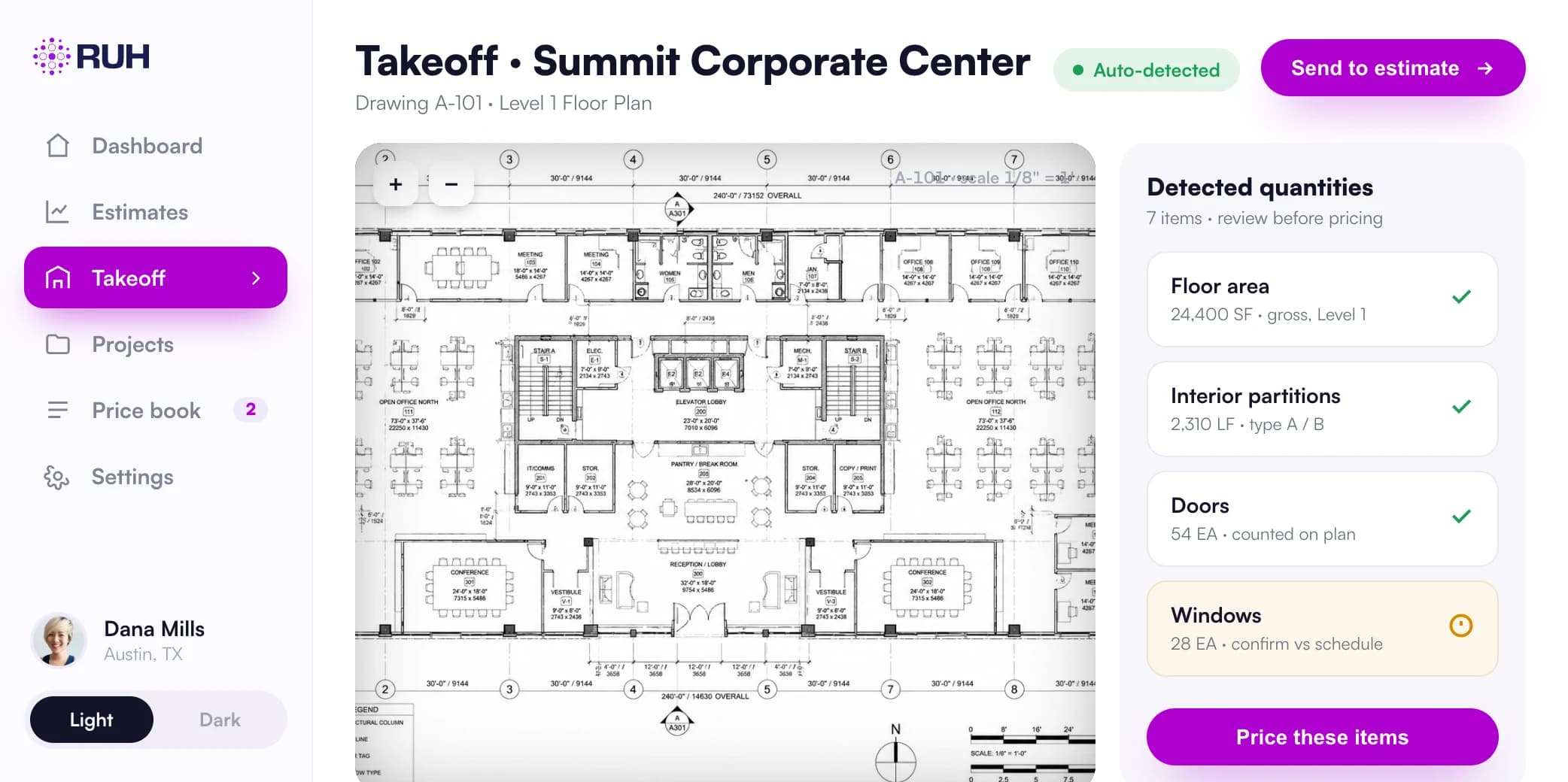
To price it, the GC needs what a subcontractor has: quantities from the drawings, its own production rates and a burdened labor rate. Without those, the GC carries the production risk on a guessed price, with no fixed price behind it.

To compare self-performing a scope with buying it, use the free self-perform vs subcontract calculator.

How it is measured

Self-perform work is measured by the full cost of the scope done in house, labor at a burdened rate plus material, equipment, supervision and a contingency, against the leveled subcontract price.

Why General Contractors Self-Perform

Common reasons include control of the schedule on scopes that drive it, such as concrete, margin on work the company already does well, and coverage when too few subcontractors bid a trade.

Crew labor in the comparison below is priced at the labor burden rate per hour worked.

Our View

In our view, self-perform the scopes your own cost reports can price with confidence. For the rest, a subcontractor's fixed price is worth paying for.

Worked example

A Worked Self-Perform Comparison

Illustrative example from the free calculator: a 12,000 unit scope.

Self-perform $71,056.65 against a $82,836.00 subcontract: self-performing is $11,779.35 lower, breaking even at $72.36 an hour.

Amount
Self-perform: 420 hours at $45.65, plus $48,500 material, equipment and supervision, plus 5%$71,056.65
Subcontract: $78,000 quote plus 1.2% bond, 3% coordination and 2% scope gaps$82,836.00
Self-performing is lower by$82,836.00 - $71,056.65 = $11,779.35

Break-even sits at a $72.36 labor rate, or 0.0555 hours a unit where 0.035 was planned.

Illustrative figures, not a customer job.

How Ruh handles it

How Ruh Handles Self-Perform Work.

Try Ruh on a real bid.

Start with a walkthrough

Self-Perform Work: Frequently Asked Questions

What does self-perform mean in construction?+

The GC's own crews and equipment build that scope, rather than a subcontractor.

Which scopes do general contractors self-perform?+

Commonly concrete, rough carpentry, general labor and cleanup, and any trade the company has its own crews for.

Is self-performing cheaper?+

Only if your crew's output and labor cost beat the sub's number once bonding, your own coordination time and any missing scope are counted.

What do you need to price self-perform work?+

Quantities from the drawings, your own production rates and a burdened labor rate, plus material, equipment and supervision.

Still measuring by hand? Your next takeoff can run while you review this one.

See it on your plans

Related Terms

Keep going: A Worked Self-Perform Comparison, the free self-perform vs subcontract calculator or explore General Contractor Software.

The Construction Estimating Cheat Sheet
Every unit, waste factor, and conversion on one page. Free PDF.

Figures on this page are illustrative. Construction estimates depend on project-specific conditions, source documents, market pricing, and professional judgment. Ruh's AI assists the estimator and does not replace professional review: your team reviews, validates, and approves every estimate, bid, and pricing decision.
Try Ruh on a Bid You Are Pricing Now.

Put Your Next Takeoff on Ruh.