Construction glossary · Estimating concepts
What is ROM estimate in construction?
A ROM estimate (rough order of magnitude estimate) is an early conceptual cost estimate prepared before design exists, used to test whether a project is financially feasible. It is built from historical unit rates such as dollars per square foot rather than a quantity takeoff. Commonly cited accuracy ranges run from about minus 25 percent to plus 75 percent, and AACE International class 5 guidance allows even wider spreads.
Updated June 2026 · Reviewed by the Ruh construction team
ROM estimate accuracy band
Estimating estimating concepts scope this week? Watch Ruh take off a real plan in 30 minutes.
Book a walkthroughA ROM estimate is the first cost number a project team sees, usually prepared when the owner has little more than a site, a building size, and a use type. You will produce them during feasibility studies, developer pro formas, capital planning, and early design-build pursuits, often from a one-page program rather than drawings. Precon managers and chief estimators typically own them, because judgment matters more than math at this stage. The term shows up in budget letters and conceptual estimate deliverables; it does not belong on bid forms or pay applications. The most common mistake new estimators make is presenting a ROM as a single hard number. Always attach the accuracy range, the pricing date, escalation assumptions, and a written list of inclusions and exclusions, because the owner will remember the number long after they forget the caveats. The second mistake is anchoring low to please the room; a ROM that has to grow 40 percent at schematic design damages your credibility more than an honest wide range ever will.
ROM estimates are built from broad unit rates, most often dollars per square foot of gross floor area, sometimes dollars per unit (per bed, per hotel key, per parking stall) or per linear foot for utilities and roadway. The source is historical cost data: the contractor's own completed projects, adjusted for location, building size, scope differences, and escalation to the expected midpoint of construction, supplemented by published cost data where history is thin. There is no quantity takeoff at this stage beyond gross areas pulled from a program or massing sketch. The deliverable is usually a one-page or two-page budget letter labeled conceptual or AACE class 5, stating the basis of estimate, the accuracy range, and exclusions such as land, soft costs, and FF&E.
Worked example
An owner asks for a ROM on a 40,000 sf tilt-up warehouse shell. Your last three comparable tilt-up jobs averaged $105 per sf for the building shell, illustrative 2025 pricing. Building: 40,000 sf x $105/sf = $4,200,000. Site work on similar flat suburban sites has run about 15 percent of building cost: $4,200,000 x 0.15 = $630,000. Subtotal: $4,830,000. Add a 10 percent design contingency for the scope you cannot see yet: $4,830,000 x 0.10 = $483,000, bringing the ROM to $5,313,000, which you round and present as $5.3 million. Stated with a minus 25 percent to plus 75 percent range, that is roughly $4.0 million to $9.3 million ($5,313,000 x 0.75 = $3,984,750 and $5,313,000 x 1.75 = $9,297,750). The range looks wide because it is supposed to be; the single number is for planning, the range is the honest answer.
Try Ruh on a real bid. 100% money-back guarantee if you are not satisfied.*
*Scoped delivery, terms apply. Read the guarantee terms
How Ruh handles ROM estimate
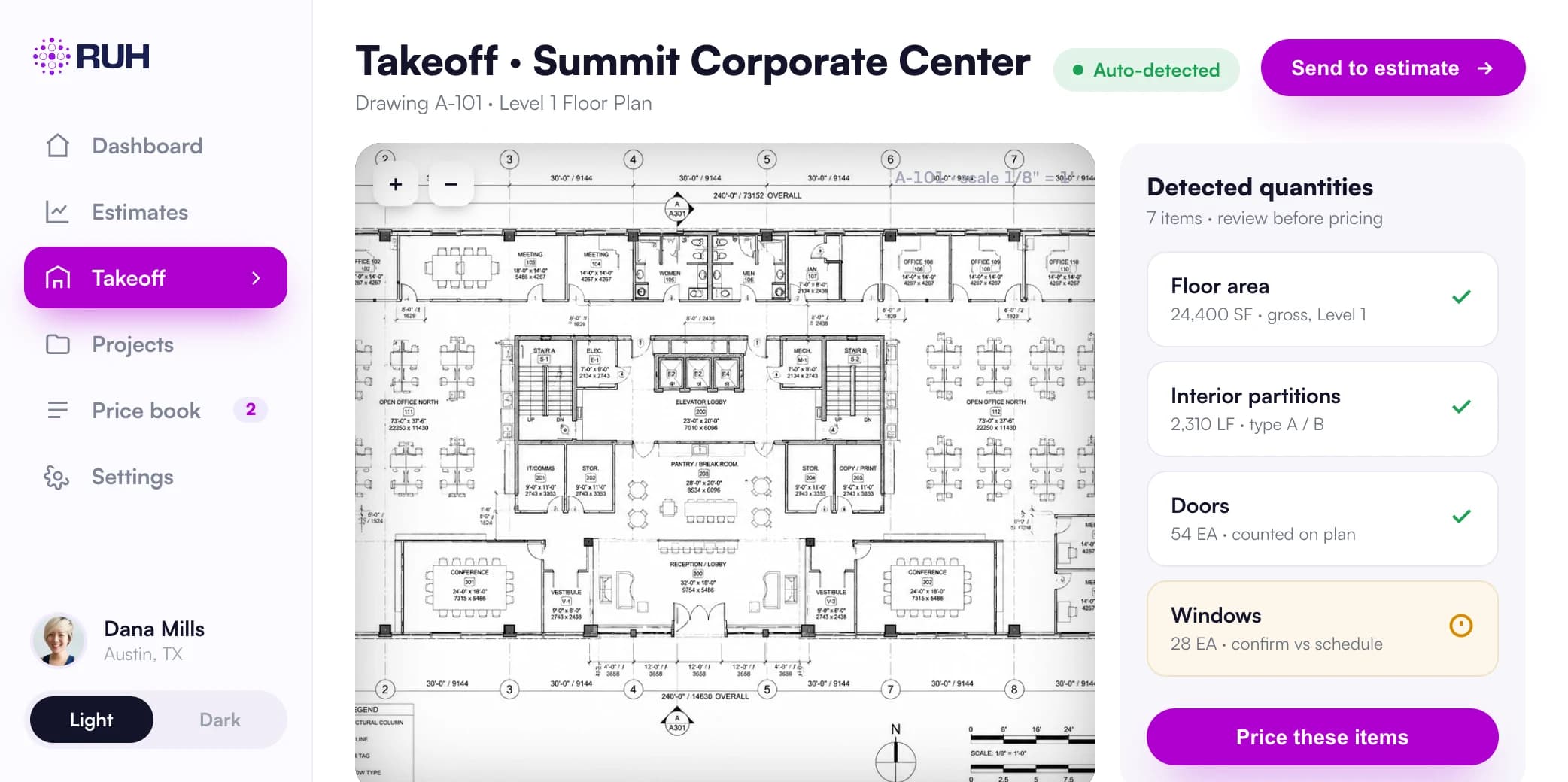
Ruh comes in when the project moves past the ROM stage and drawings exist: it reads the contractor's drawing set, performs the takeoff, and prices quantities against the contractor's own price book, handing the estimator a line-item draft to review, adjust, and sign off. That makes it faster to replace a ROM with a real quantity-based estimate, and the priced history accumulating in the price book gives the estimator better dollars-per-square-foot benchmarks for the next ROM. The estimator's judgment still sets the contingencies and the range; Ruh just gets the detail on the table sooner.
See construction estimating softwareROM estimate: frequently asked questions
How is a ROM estimate different from a detailed estimate?+
A ROM is priced from gross unit rates like dollars per square foot with no quantity takeoff, while a detailed estimate is built from measured quantities priced line by line against unit costs, sub quotes, and vendor pricing. A detailed estimate requires substantially complete drawings; a ROM needs only a program and a building type. Accuracy tightens accordingly, from a spread that can approach half the project value down to ranges commonly cited near plus or minus 5 to 10 percent for a definitive estimate.
Why is the ROM accuracy range wider on the high side than the low side?+
Because early unknowns mostly add cost rather than remove it. Scope tends to grow as design develops, site conditions and code requirements surface new work, and owners rarely shrink a program. Ranges like minus 25 percent to plus 75 percent reflect that asymmetry: a project is far more likely to land well above an early conceptual number than well below it.
Can a contractor commit to a price based on a ROM estimate?+
No. A ROM is a planning tool, not a bid, and committing to one as a fixed price is how contractors buy projects they regret. If an owner pushes for a commitment at the ROM stage, protect yourself with a written basis of estimate, a validity date, clearly stated exclusions, and contract language that converts the number to a GMP or lump sum only after a detailed, takeoff-based estimate on developed drawings.
Still measuring by hand? Your next takeoff can run while you review this one.
See it on your plansRelated terms
Keep going: read the full guide or explore construction estimating software.
See Ruh price a bid from your own drawings.
AI takeoff and estimating on your price book, your estimator signs off.
Figures on this page are illustrative. Construction estimates depend on project-specific conditions, source documents, market pricing, and professional judgment. Ruh's AI assists the estimator and does not replace professional review: your team reviews, validates, and approves every estimate, bid, and pricing decision.