

100% money-backBook a walkthrough

Construction glossary · Estimating concepts

What is markup in construction?

Markup in construction is the percentage a contractor adds to direct job costs to cover overhead and profit when setting the bid price. It is calculated on cost rather than on the final price, which is what separates it from margin. A 15% markup on $850,000 of direct cost produces a $977,500 bid but only about a 13% margin.

Updated June 2026 · Reviewed by the Ruh construction team

Markup on cost25% markup = 20% marginFormula price = cost x (1+markup)

Markup vs margin on the same job

Cost 80%Markup (25%) 20% of price25% markup on cost = 20% margin on price

Estimating estimating concepts scope this week? Watch Ruh take off a real plan in 30 minutes.

Book a walkthrough
Definition

Markup is the amount an estimator adds to the direct cost of the work (labor, material, equipment, and subcontractor quotes) to arrive at the bid price. It has to carry two loads: company overhead (the office, estimating staff, insurance, software, trucks) and the profit the company actually keeps. New estimators see it on the bid recap sheet as a percentage line below the direct cost subtotal, and again in the contract itself, where many commercial contracts cap the markup a contractor may add to change order work, with typical caps somewhere in the 5% to 15% range depending on whether the work is self-performed or subcontracted. Two mistakes bite new estimators. First, treating markup and margin as interchangeable, then wondering why a 15% markup never shows up as a 15% margin on the income statement. Second, setting markup by habit instead of math: if company overhead runs around 8% of revenue (illustrative), a 10% markup leaves far less profit than it appears to once the markup-to-margin conversion is done.

How it is measured

Markup is expressed as a percentage of direct cost, applied either as one blended rate on the whole estimate or as tiered rates by cost type (a common practice is one rate on self-performed labor and material and a lower rate on subcontractor quotes). On the estimate it lives on the bid summary or recap sheet: direct cost subtotal, then markup as a percentage line, then bid price. Some estimators carry it as a multiplier instead, cost times 1.15 for a 15% markup. To back-calculate markup from a finished bid, divide gross profit dollars by direct cost: a $977,500 bid on $850,000 of cost is ($977,500 - $850,000) / $850,000 = 15%. In contracts it appears in the change order article as the allowable percentage for overhead and profit.

Worked example · live calculator

Markup to margin on your job

Live calculator
Cost$100,000
20% markupprice $120,000
Actual margin16.67%
100%

Try Ruh on a real bid. 100% money-back guarantee if you are not satisfied.*

*Scoped delivery, terms apply. Read the guarantee terms

Start with a walkthrough
How Ruh handles it

How Ruh handles markup

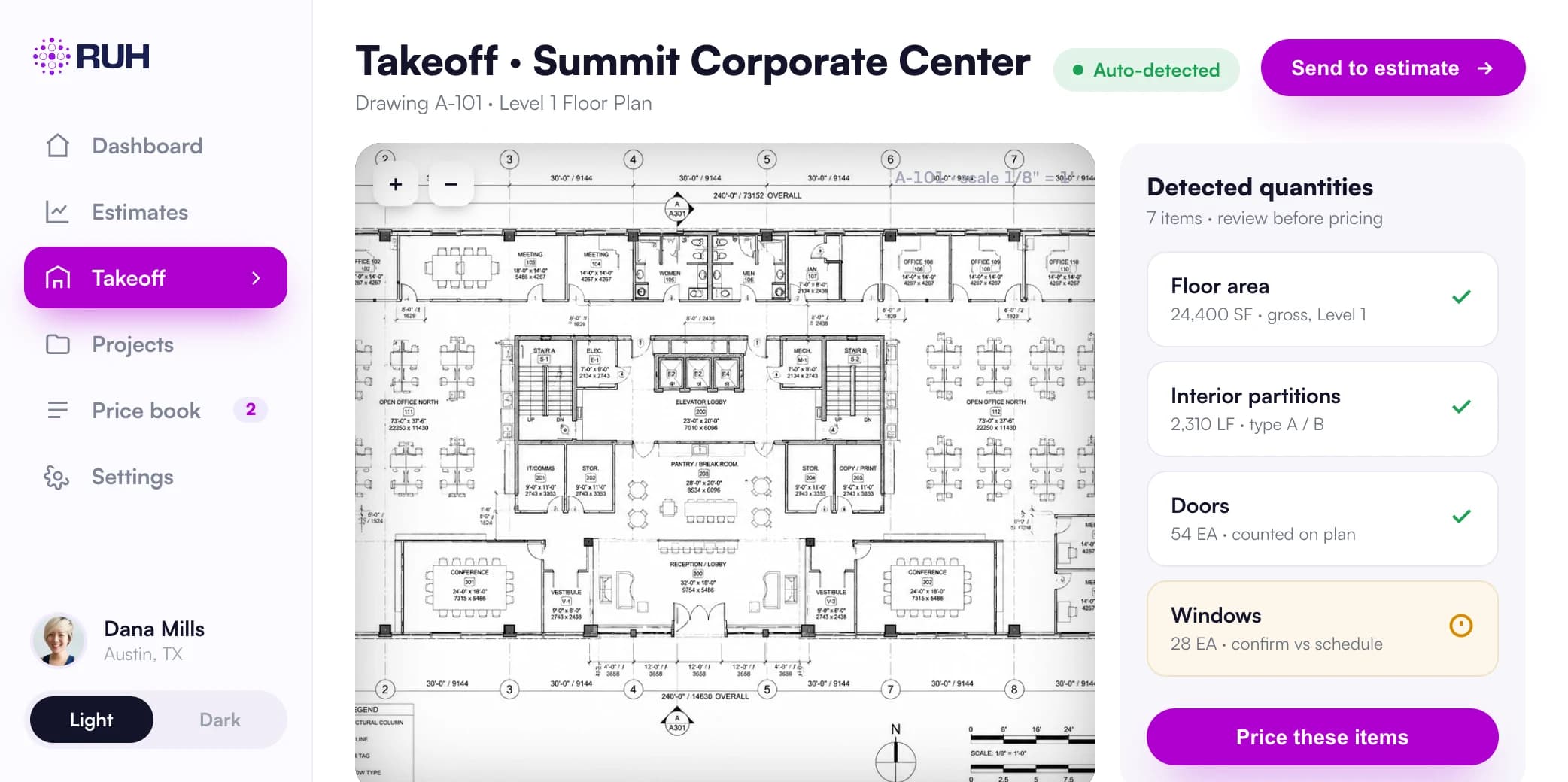
Ruh reads the drawings, runs the takeoff, and prices the quantities against the contractor's own price book, so the draft estimate the estimator receives is a clean direct cost number with no markup baked in. That separation matters for markup specifically: the estimator reviews the line items, adjusts anything that needs adjusting, and then applies the company's markup on top with full visibility into what is cost and what is pricing decision. Markup stays a human judgment call; Ruh just makes sure the cost base underneath it is accurate.

See construction estimating software

Markup: frequently asked questions

How do you convert markup to margin?+

Divide the markup rate by 1 plus the markup rate: margin = markup / (1 + markup). A 20% markup is 0.20 / 1.20 = 16.7% margin, and a 10% markup is 0.10 / 1.10 = 9.1% margin. Going the other way, markup = margin / (1 - margin), so a target of 20% margin requires a 25% markup.

Does markup include overhead or just profit?+

Both. Markup is the only place in the bid where overhead and profit can come from, and overhead gets paid first. As an illustration, if a company's overhead runs 7% of revenue and its 15% markup converts to about a 13% margin, roughly 6% of revenue is left as actual profit. An estimator who sets markup below the company's overhead rate is bidding to lose money before the job even starts.

Can a contractor mark up subcontractor quotes?+

Yes. On bid work, a general contractor marking up sub quotes is normal practice, since the GC carries coordination, schedule, and payment risk on that scope. On change orders the contract usually controls: many commercial contracts cap markup on subcontracted change order work at a lower percentage than on self-performed work, so read the change order article before pricing extra work.

Still measuring by hand? Your next takeoff can run while you review this one.

See it on your plans

Related terms

Keep going: read the full guide or explore construction estimating software.

The Estimating concepts estimating cheat sheet
Every unit, waste factor, and conversion on one page. Free PDF.

See Ruh price a bid from your own drawings.

AI takeoff and estimating on your price book, your estimator signs off.

Figures on this page are illustrative. Construction estimates depend on project-specific conditions, source documents, market pricing, and professional judgment. Ruh's AI assists the estimator and does not replace professional review: your team reviews, validates, and approves every estimate, bid, and pricing decision.
What is markup in construction? Markup vs margin | Ruh AI