Construction glossary · Estimating concepts
What is bid leveling in construction?
Bid leveling is the process of adjusting subcontractor bids to a common scope so they can be compared accurately. Because subs rarely bid identical inclusions and exclusions, the estimator adds or deducts dollar values for missing or extra scope items, producing a leveled total for each bidder. The leveled totals, not the raw numbers, tell you who is actually low.
Updated June 2026 · Reviewed by the Ruh construction team
How bids are leveled
Estimating estimating concepts scope this week? Watch Ruh take off a real plan in 30 minutes.
Book a walkthroughBid leveling is the comparison step in subcontractor buyout. The GC's estimator lines up every sub bid for a trade, normalizes them to the same scope, and adjusts each total so the numbers can be compared apples to apples. It shows up on bid day and during buyout, usually in a spreadsheet called a leveling sheet or bid tab, with one column per bidder and one row per scope item pulled from the spec section and the instructions to bidders. Estimators, precon managers, and project managers all use it; on hard bid work it happens in the final hours before the bid goes in, and on negotiated work it happens during buyout. The classic rookie mistake is taking the low number at face value. A bid that excludes scaffolding, taxes, or a spec section is not the low bid, it is an incomplete bid. The second mistake is plugging missing scope with a guess instead of a real number from another bidder, your own takeoff, or historical cost.
Bid leveling is measured in dollars on a leveling sheet, also called a bid tabulation or bid tab. The sheet is usually a spreadsheet with one column per bidder and one row per scope item taken from the spec section, the bid instructions, and each sub's inclusions and exclusions list. Where a bidder excludes an item, the estimator enters a plug value, ideally drawn from another bidder's breakout, the GC's own takeoff, or historical unit costs. Adds, deducts, alternates, allowances, and unit prices each get their own line. The output is a leveled total in dollars per bidder, and a wide spread between leveled totals is usually a sign that someone misread the scope or that the bid documents were unclear.
Worked example
Say you are leveling three drywall subs on a mid-rise office fit-out. Sub A bids $487,000 with full scope: metal framing, gypsum board, insulation, and lifts. Sub B bids $462,000 but excludes batt insulation and lifts. Sub C bids $475,000 but excludes the Level 5 finish at the lobby. Using Sub A's breakout and your own takeoff, you plug $21,000 for insulation, $9,500 for lifts, and $6,800 for the Level 5 finish (illustrative numbers for a US commercial job). Leveled totals: Sub A stays at $487,000. Sub B becomes $462,000 + $21,000 + $9,500 = $492,500. Sub C becomes $475,000 + $6,800 = $481,800. The raw low bidder, Sub B, ends up highest once scope is normalized, and Sub C is your true low at $481,800. Reading the raw numbers alone would have cost you $10,700 on the buy.
Try Ruh on a real bid. 100% money-back guarantee if you are not satisfied.*
*Scoped delivery, terms apply. Read the guarantee terms
How Ruh handles bid leveling
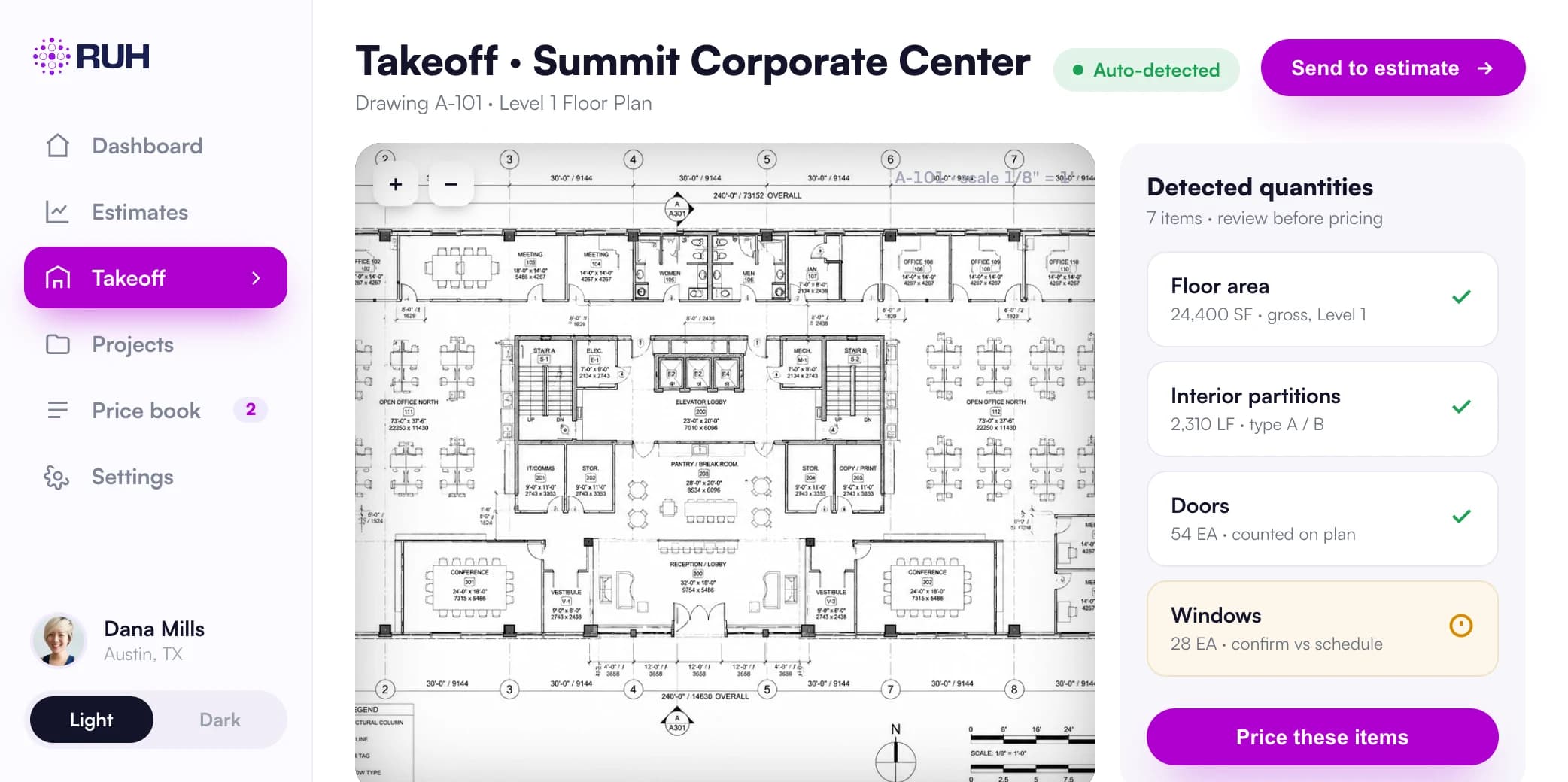
Ruh gives the estimator an independent baseline to level against. Because it reads the drawings, runs the takeoff, and prices quantities from the contractor's own price book, you have a line-item drywall estimate to set each sub bid beside, which makes scope gaps obvious and gives you real numbers for plug values instead of guesses. The estimator still reviews, adjusts, and signs off; Ruh supplies the quantities and pricing, not the judgment call on which sub to buy.
See construction estimating softwareBid leveling: frequently asked questions
What is the difference between bid leveling and bid tabulation?+
In practice the terms overlap and many estimators use them interchangeably. Strictly speaking, a bid tabulation is the raw side-by-side listing of bids as received, while bid leveling is the adjustment work that normalizes those bids to a common scope. The tab is the document; leveling is the analysis you do on it.
Who does bid leveling, the general contractor or the owner?+
Both, at different tiers. The GC's estimating or precon team levels subcontractor bids on bid day and during buyout, while owners and their construction managers level GC proposals on negotiated or CM at risk work. Architects sometimes assist owners with leveling on design-bid-build projects, especially public work where the award has to be defensible.
How do you handle a sub bid with a long exclusions list?+
Price every exclusion and add it back. Pull plug values from other bidders' breakouts, your own takeoff, or historical costs, and call the sub to confirm anything ambiguous before the leveled number drives a buy decision. If the leveled total still looks good, get the cleaned-up scope in writing in the subcontract; an exclusion you ignored at leveling becomes a change order later.
Still measuring by hand? Your next takeoff can run while you review this one.
See it on your plansRelated terms
Keep going: read the full guide or explore construction estimating software.
See Ruh price a bid from your own drawings.
AI takeoff and estimating on your price book, your estimator signs off.
Figures on this page are illustrative. Construction estimates depend on project-specific conditions, source documents, market pricing, and professional judgment. Ruh's AI assists the estimator and does not replace professional review: your team reviews, validates, and approves every estimate, bid, and pricing decision.