100% money-backBook a walkthrough

Construction glossary · Estimating concepts

What is general conditions in construction?

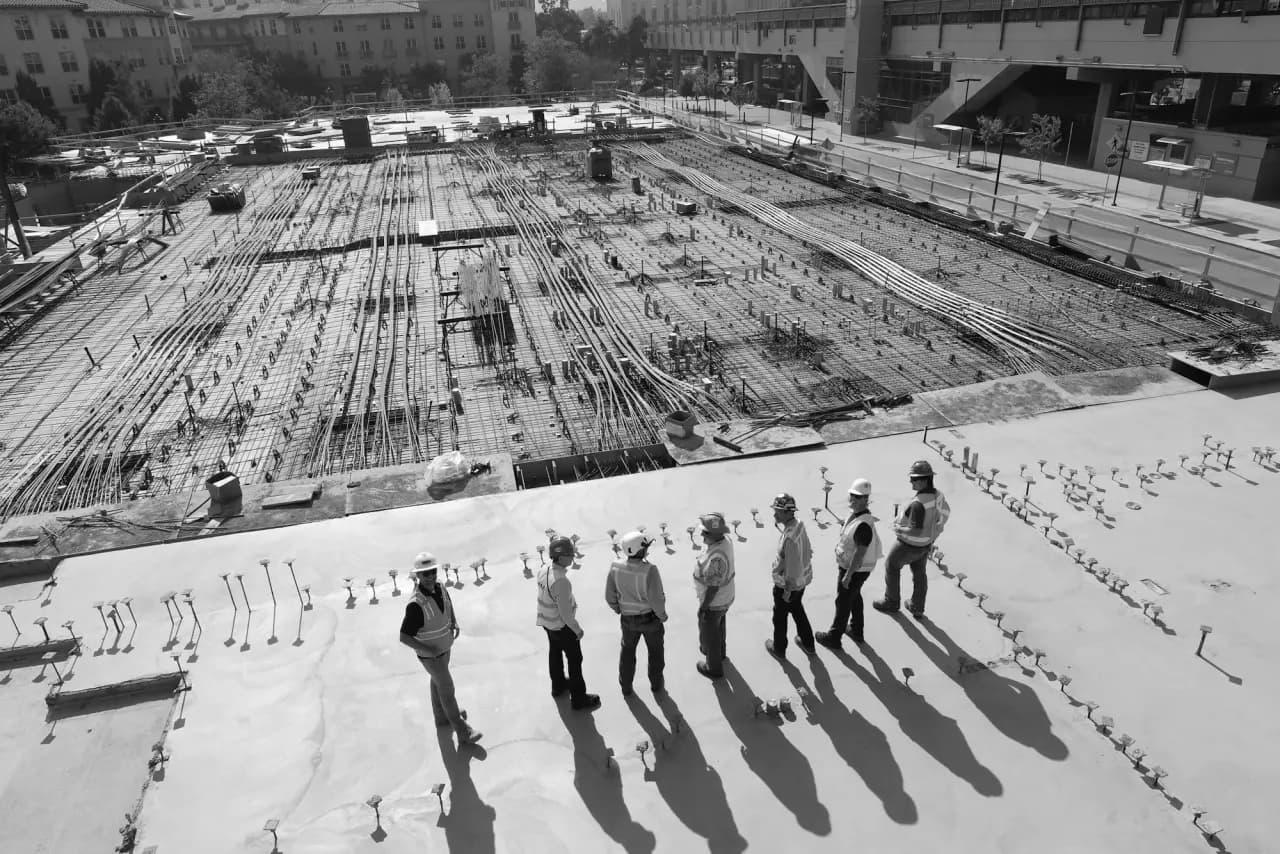
General conditions are the project-specific costs a contractor incurs to run a job, such as the superintendent, jobsite trailer, temporary utilities, safety, and cleanup, that support the work but never become part of the finished building. They are priced as their own section of the estimate, mostly as time-based costs tied to the project schedule, and billed as line items on the schedule of values.

Updated June 2026 · Reviewed by the Ruh construction team

GCs = project run costTypical ~5-10% of costIncludes super, trailer, temp utilities

General conditions as a cost share

General conditions ~8%Direct work ~92%Cost of running the project, not the work itself

Estimating estimating concepts scope this week? Watch Ruh take off a real plan in 30 minutes.

Book a walkthrough
Definition

General conditions are the costs a general contractor incurs to staff, manage, and physically support a specific project: the superintendent and project manager, the jobsite trailer, temporary power and water, dumpsters, fencing, safety supplies, and final cleanup. In the estimate they live in their own section, usually organized under Division 1 (General requirements) of the CSI MasterFormat, and on the pay application they show up as line items in the schedule of values. Owners and lenders scrutinize them because they are pure cost with no installed work behind them. Two mistakes show up constantly with new estimators. First, confusing general conditions costs with the AIA A201 "General conditions of the contract," which is a legal document, not a cost category. Second, pricing general conditions as a flat percentage of the bid instead of building them bottom-up from the schedule. Most of these costs are time-driven, so a job that runs 14 months instead of 10 months burns roughly 40 percent more general conditions money, and a percentage-based number will not catch that.

How it is measured

General conditions are quantified on a dedicated worksheet keyed to the project schedule, not taken off from the drawings. Most line items are time-based: a loaded monthly rate for each staff position multiplied by months on site, monthly rentals for the trailer, toilets, and dumpsters, and monthly bills for temporary power, water, and internet. A smaller group is one-time: mobilization, trailer setup and removal, project signage. A few items scale with the work itself, such as final cleaning priced per square foot. The output lands in the estimate as Division 1 line items and later in the schedule of values on the pay app. The single most important input is duration in months, which is why the general conditions sheet should be rebuilt whenever the schedule changes.

Worked example

Worked example

Illustrative numbers for a 10-month commercial job. Superintendent at a loaded cost of $12,000 per month: $12,000 x 10 months = $120,000. Jobsite trailer at $900 per month: $900 x 10 months = $9,000, plus a one-time $3,000 for delivery, setup, and removal, for $12,000 total. Temporary utilities (power, water, internet) at $1,500 per month: $1,500 x 10 months = $15,000. Total for these three items: $120,000 + $12,000 + $15,000 = $147,000, which is a run rate of $14,400 per month plus the one-time $3,000. On an illustrative $4.9 million contract, that is about 3 percent of contract value before adding dumpsters, toilets, fencing, or cleanup. The schedule sensitivity is the real lesson: if the job slips 2 months, the time-based items alone add $14,400 x 2 = $28,800 in cost with no added revenue behind it.

100%

Try Ruh on a real bid. 100% money-back guarantee if you are not satisfied.*

*Scoped delivery, terms apply. Read the guarantee terms

Start with a walkthrough
How Ruh handles it

How Ruh handles general conditions

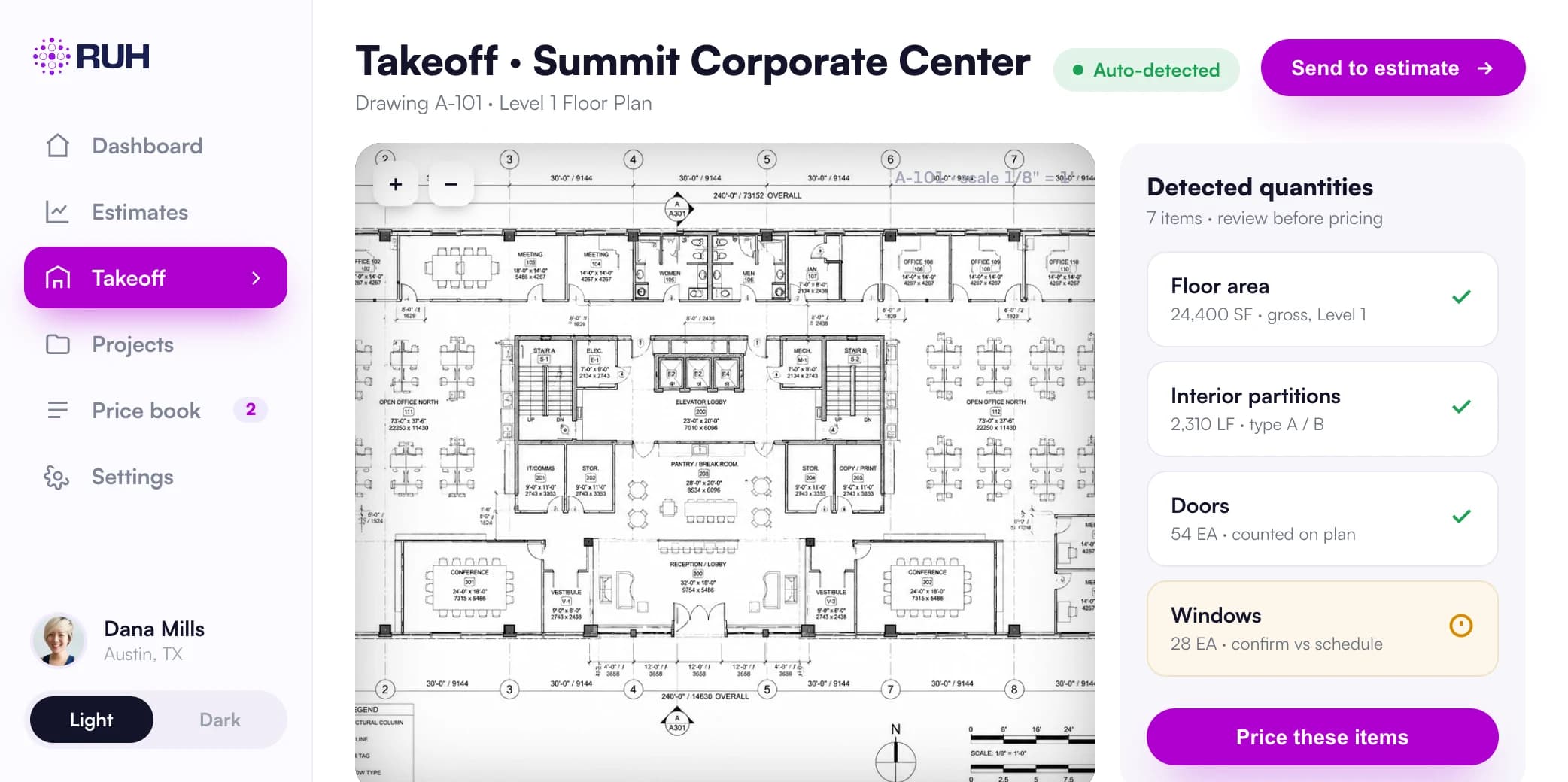
Ruh reads the contractor's drawings, performs the takeoff, and prices the quantities against the contractor's own price book, so the direct costs that drive job duration are drafted as line items first. Because general conditions are schedule-driven rather than drawing-driven, the estimator supplies the duration and staffing plan, applies their own monthly rates from the price book, and reviews and signs off on the full draft. The AI handles the quantity grind; the judgment call on how long and how heavily to staff the job stays with the estimator.

See construction estimating software

General conditions: frequently asked questions

What is the difference between general conditions and general requirements?+

General requirements is Division 1 of the CSI MasterFormat specifications, the written rules covering submittals, temporary facilities, and project management. General conditions costs are what the contractor spends to satisfy those requirements and run the job. Many estimators use the terms interchangeably for the cost section, but on the contract side, general conditions usually refers to the AIA A201 legal document, so confirm which meaning is in play.

What percentage of project cost should general conditions be?+

There is no single correct percentage because general conditions are driven by duration and staffing, not contract value. A short, high-dollar job carries a smaller share than a long, low-dollar one. Build the number bottom-up from the schedule, then use a percentage of contract value only as a sanity check against your own historical jobs.

Are general conditions the same as overhead and profit?+

No. General conditions are project-specific costs billed through the schedule of values on that job. Home-office overhead (rent, accounting, business development) and profit are recovered through the markup or fee applied on top of general conditions and direct costs. Lumping them together usually means one of them is underpriced.

Still measuring by hand? Your next takeoff can run while you review this one.

See it on your plans

Related terms

Keep going: read the full guide or explore construction estimating software.

The Estimating concepts estimating cheat sheet
Every unit, waste factor, and conversion on one page. Free PDF.

See Ruh price a bid from your own drawings.

AI takeoff and estimating on your price book, your estimator signs off.

Figures on this page are illustrative. Construction estimates depend on project-specific conditions, source documents, market pricing, and professional judgment. Ruh's AI assists the estimator and does not replace professional review: your team reviews, validates, and approves every estimate, bid, and pricing decision.
General conditions costs in construction | Ruh AI