100% money-backBook a walkthrough

Construction glossary · Process and contract terms

What is buyout in construction?

Buyout is the post-award phase of a construction project where the general contractor converts the line items in its winning estimate into committed subcontracts and purchase orders. The team levels subcontractor bids, verifies scope coverage, negotiates final pricing, and awards each work package against the budget set on bid day. The gap between each budgeted amount and the committed amount is tracked as buyout savings or buyout loss.

Updated June 2026 · Reviewed by the Ruh construction team

Goal award below estimateDifference = buyout savingsDone after award, before mobilize

How buyout locks in subcontracts

Compare bids (level)Negotiate scope & priceAward subcontractsCompare to estimateConverting the estimate into signed subcontracts

Estimating process and contract terms scope this week? Watch Ruh take off a real plan in 30 minutes.

Book a walkthrough
Definition

Buyout is where estimating hands off to operations. After the owner signs, the project team works through the estimate package by package (concrete, steel, drywall, and so on) and commits real dollars through subcontracts and purchase orders. The bid-day numbers become the buyout budget, usually organized by cost code in a buyout log that tracks budget, committed value, and variance for every package. Estimators stay involved because they know what carried each number: which sub quotes were used, where plugs or allowances sit, and how scope was split between trades. The classic new-estimator mistake is calling a package bought the moment a sub signs, without confirming the subcontract scope matches the estimate scope. A drywall sub who excluded ceilings looks like found money until the gap comes back as an unbudgeted cost. Clean handoff notes from the estimate make buyout faster and protect the margin the bid was built on.

How it is measured

Buyout is measured in dollars and tracked in a buyout log, one row per work package or cost code. Each row carries the estimate budget, the committed subcontract or purchase order value, and the variance: savings when the commitment lands under budget, loss when it lands over. Two summary figures matter most: percent bought out (committed dollars divided by total direct cost budget) and net buyout variance to date. Teams also track buyout against time on a procurement schedule, since a package bought late can cost more through escalation than a package bought slightly over budget. On GMP work, the contract typically defines how buyout savings are shared or returned, so the log doubles as a contractual record.

Worked example

Worked example

Take three packages with illustrative numbers. At bid, the general contractor carries concrete at $1,200,000, structural steel at $850,000, and drywall at $600,000, a combined budget of $2,650,000. In buyout, concrete signs at $1,150,000, a savings of $50,000. Steel pricing moved between bid day and award and signs at $890,000, a $40,000 loss. Drywall bids come in at $570,000, which looks like $30,000 of savings, but scope review shows the low sub excluded the level 5 finish the estimate carried. Pricing that gap at $25,000 puts the true commitment at $595,000, so real savings are $5,000. Net buyout variance: $50,000 minus $40,000 plus $5,000 equals $15,000 of savings, about 0.6 percent of budget ($15,000 divided by $2,650,000). That is why buyout gets tracked line by line instead of assumed.

100%

Try Ruh on a real bid. 100% money-back guarantee if you are not satisfied.*

*Scoped delivery, terms apply. Read the guarantee terms

Start with a walkthrough
How Ruh handles it

How Ruh handles buyout

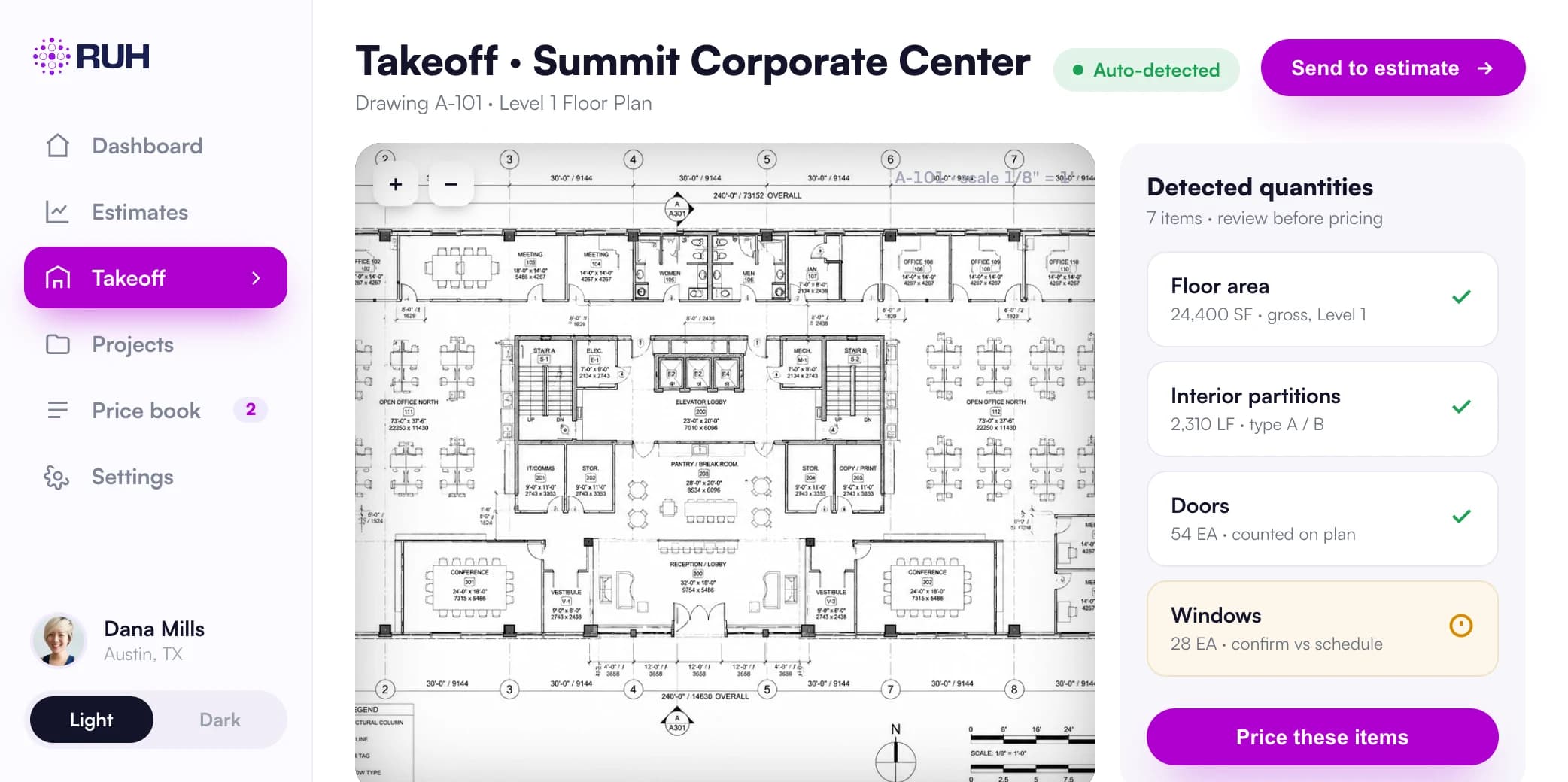
Ruh reads the contractor's drawings, performs the takeoff, and prices the quantities against the contractor's own price book, then hands the estimator a line-item draft to review, adjust, and sign off. Because each package is built from measured quantities and the contractor's real unit costs, the approved estimate doubles as a clean buyout budget, with quantity backup the team can use to level sub bids and price scope gaps. The estimator remains the decision maker; Ruh just makes the number behind every package easier to defend when commitments get signed.

See construction invoice and pay app software

Buyout: frequently asked questions

Is buyout the same as procurement?+

They overlap but are not identical. Procurement is the broader purchasing function that runs for the life of the job, while buyout specifically means committing the awarded project's direct cost budget through subcontracts and purchase orders, measured package by package against the estimate. Buyout is effectively complete when every major cost code has a signed commitment; procurement continues through closeout for change work and miscellaneous purchases.

What happens to buyout savings?+

It depends on the contract. On lump sum work, savings typically stay with the general contractor and improve margin, or offset losses on other packages. On GMP contracts, the savings clause usually dictates a split with the owner or a return at the end, so many teams park buyout savings in contingency until project risks retire. Either way, savings claimed before scope is fully verified have a habit of evaporating.

How long does buyout take after award?+

There is no fixed rule; lead times and the construction schedule drive it. Typical practice on US commercial work is to buy long-lead packages first (structural steel, switchgear, elevators), often within the first 30 to 60 days after award, while later finish trades may not be bought until months into construction. Waiting too long exposes the budget to price escalation and can turn a bid-day savings position into a loss.

Still measuring by hand? Your next takeoff can run while you review this one.

See it on your plans
The Process and contract terms estimating cheat sheet
Every unit, waste factor, and conversion on one page. Free PDF.

See Ruh price a bid from your own drawings.

AI takeoff and estimating on your price book, your estimator signs off.

Figures on this page are illustrative. Construction estimates depend on project-specific conditions, source documents, market pricing, and professional judgment. Ruh's AI assists the estimator and does not replace professional review: your team reviews, validates, and approves every estimate, bid, and pricing decision.
What is buyout in construction? | Ruh AI