100% money-backBook a walkthrough

Construction glossary · Estimating concepts

What is soft costs in construction?

Soft costs in construction are the expenses required to deliver a project that do not pay for the physical building itself, such as design fees, permits, insurance, legal fees, financing costs, and testing. They sit apart from hard costs (labor, materials, equipment, and subcontracts) and on typical US commercial projects are often budgeted in the range of 15 to 30 percent of hard costs. Owners and developers carry most soft costs, but estimators need to know which ones land in the contractor's bid.

Updated June 2026 · Reviewed by the Ruh construction team

Soft = non-construction costIncludes design, permits, financingShare ~20-30% of budget

Soft costs share of the budget

Soft costs ~25%Hard costs ~75%Design, fees, financing, permits

Estimating estimating concepts scope this week? Watch Ruh take off a real plan in 30 minutes.

Book a walkthrough
Definition

Soft costs are the project expenses that do not buy physical construction: architecture and engineering fees, permits and plan review, builder's risk and liability insurance, legal fees, financing and loan interest during construction, testing and inspections, commissioning, and owner-side project management. They live mostly in the owner's or developer's budget rather than the general contractor's bid, which is why a GC estimator usually meets them in conceptual budgets, development pro formas, and feasibility studies rather than on the drawings. Lenders watch them closely because soft costs draw down the construction loan just like hard costs do. The classic new-estimator mistake is mixing up soft costs with general conditions: supervision, temporary power, and the jobsite trailer are part of the construction contract and count as hard costs even though you cannot point at them in the finished building. The second mistake is forgetting that some items move between buckets by contract; permits and builder's risk can be carried by the owner or pushed onto the GC, so always read the instructions to bidders before deciding where they live in your estimate.

How it is measured

Soft costs are measured in dollars, but they are usually derived rather than taken off. Design fees are typically quoted as a percentage of construction cost or as a lump sum per the owner-architect agreement. Permit fees come from the municipal fee schedule, often expressed per $1,000 of construction valuation. Builder's risk insurance is commonly quoted as a rate per $100 of completed value, and general liability as a rate per $1,000 of contract value. Financing costs are calculated from the loan amount, interest rate, and draw schedule. You will see soft costs itemized in the owner's development budget and loan draw schedule, and occasionally as allowances in Division 01 of the specifications. The estimator's job is to apply the right rate to the right base, and to state which basis was used.

Worked example

Worked example

Take an illustrative $10,000,000 commercial project, where $10,000,000 is the hard cost of construction. Design fees: the owner hires the architect and engineers at 6 percent of hard costs, so 0.06 x $10,000,000 = $600,000. Permits: the city charges an illustrative $15 per $1,000 of construction valuation, so $10,000,000 / $1,000 = 10,000, and 10,000 x $15 = $150,000. Builder's risk insurance: at an illustrative $0.35 per $100 of completed value, ($10,000,000 / $100) x $0.35 = $35,000. Those three lines alone total $600,000 + $150,000 + $35,000 = $785,000 in soft costs, about 7.9 percent of hard costs, bringing the budget to $10,785,000 before financing, legal, testing, or contingency. This is why a $10 million building never costs $10 million to deliver, and why lenders ask for the soft cost schedule on day one.

100%

Try Ruh on a real bid. 100% money-back guarantee if you are not satisfied.*

*Scoped delivery, terms apply. Read the guarantee terms

Start with a walkthrough
How Ruh handles it

How Ruh handles soft costs

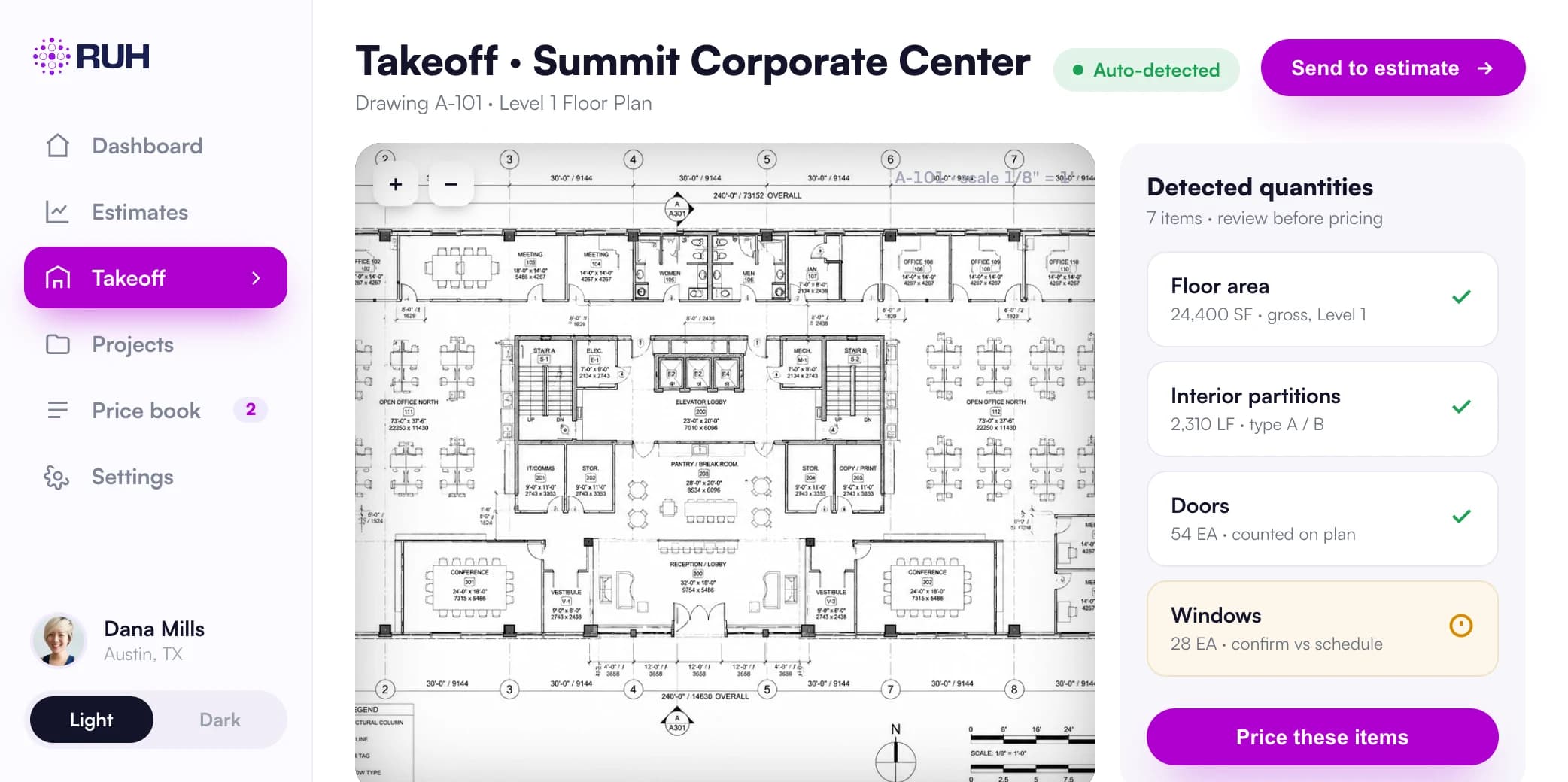
Ruh works the hard cost side of the equation: it reads your drawings, performs the takeoff, and prices the quantities against your own price book, so the hard cost base is built from your real unit costs. Since most soft cost allowances are applied as a percentage of hard costs, a cleaner hard cost number gives you a more defensible base for design fee, permit, and insurance lines. The estimator still decides which soft costs belong in the estimate, adds or adjusts those lines in the draft, and signs off on the final number.

See construction estimating software

Soft costs: frequently asked questions

What is the difference between hard costs and soft costs in construction?+

Hard costs pay for the physical work: labor, materials, equipment, and the subcontracts that put the building in the ground. Soft costs pay for everything else the project needs to exist, including design, approvals, insurance, financing, and legal work. A useful field test: if you can hit it with a hammer when the job is done, it is a hard cost. The gray zone is items like permits and builder's risk, which can sit on either side depending on who the contract makes responsible.

What percentage of a construction budget is soft costs?+

There is no single number; it depends on project type, location, and how the owner categorizes items. As a rough planning figure, ground-up US commercial work often budgets soft costs somewhere between 15 and 30 percent of hard costs, with design-heavy buildings like hospitals and labs trending toward the high end. Treat any percentage as a starting allowance and replace it with real quotes (the actual A/E fee proposal, the actual permit schedule) as soon as you have them.

Are general conditions a soft cost?+

In the general contractor's world, no. Supervision, the jobsite trailer, temporary utilities, and cleanup are general conditions, and they sit inside the construction contract as hard costs even though they never become part of the finished building. Some owner-side pro formas group them differently, which is why budgets get garbled when the two sides compare numbers. Pick one convention for your estimate, label it, and stay consistent.

Still measuring by hand? Your next takeoff can run while you review this one.

See it on your plans

Related terms

Keep going: read the full guide or explore construction estimating software.

The Estimating concepts estimating cheat sheet
Every unit, waste factor, and conversion on one page. Free PDF.

See Ruh price a bid from your own drawings.

AI takeoff and estimating on your price book, your estimator signs off.

Figures on this page are illustrative. Construction estimates depend on project-specific conditions, source documents, market pricing, and professional judgment. Ruh's AI assists the estimator and does not replace professional review: your team reviews, validates, and approves every estimate, bid, and pricing decision.
Soft costs in construction: definition and example | Ruh AI