
100% money-backBook a walkthrough

Construction glossary · Process and contract terms

What is RFQ (request for quotation) in construction?

In construction, an RFQ (request for quotation) is a procurement document a contractor sends to suppliers or subcontractors asking for firm pricing on a clearly defined scope or a quantified list of materials. Because quantities and specs are already set, price, lead time, and terms are the main points of comparison. It differs from an RFP, which invites proposals weighing approach and qualifications, and an ITB, which invites lump-sum bids on complete contract documents.

Updated June 2026 · Reviewed by the Ruh construction team

RFQ = request for quotationFocus price for set scopeFeeds the buyout

How an RFQ gathers prices

Define quantities & specsSend RFQ to vendorsVendors return quotesCompare & selectAsks vendors to price a defined scope

Estimating process and contract terms scope this week? Watch Ruh take off a real plan in 30 minutes.

Book a walkthrough
Definition

An RFQ is the document you send when you already know exactly what you need and only need a firm price on it. In commercial work, estimators issue RFQs during bidding and buyout for material packages (rebar, structural steel, lumber, pipe, doors and hardware) and for tightly defined subcontract scopes. A good RFQ lists quantities pulled from the takeoff, the governing spec sections, delivery requirements, and a quote due date, and suppliers respond with unit prices and terms. That is what separates it from an RFP, where the issuer wants a proposed approach and qualifications alongside price, and from an ITB, where an owner invites lump-sum bids on a complete set of contract documents. New estimators make two common mistakes. First, sending an RFQ with vague or missing quantities, which forces every supplier to do its own takeoff and makes the quotes impossible to compare. Second, confusing it with a request for qualifications, a different document used in public procurement to shortlist firms. Keep the quantity list precise and the comparison stays clean.

How it is measured

An RFQ is only as good as the takeoff behind it. Each line carries a quantity in the unit the supplier actually sells: tons or hundredweight (cwt) for rebar, MBF for lumber, LF for pipe, EA for doors and fixtures. The estimator converts takeoff units to purchase units (LF of bar to lb to tons, for example) and adds lap, waste, or overage allowances before the RFQ goes out. Quotes come back as unit prices (dollars per ton, dollars per LF) or lump sums, each with a validity period (commonly 30 to 90 days) and a lead time in weeks. The estimator logs them on a bid tab and levels them, same quantities and same tax, freight, and escalation terms, so the comparison is unit price against unit price.

Worked example

Worked example

Say the takeoff for a small commercial foundation shows 9,000 LF of #4 bar and 11,500 LF of #5 bar. Convert to weight: 9,000 LF x 0.668 lb per LF = 6,012 lb, and 11,500 LF x 1.043 lb per LF = 11,995 lb. That totals 18,007 lb, or about 9.0 tons. Add a 5 percent allowance for laps and waste: 9.0 tons x 1.05 = 9.45 tons, so the RFQ asks for roughly 9.5 tons of fabricated, tagged, and delivered rebar. Supplier A quotes an illustrative $1,450 per ton: 9.5 tons x $1,450 = $13,775. Supplier B quotes $1,395 per ton but excludes freight, which adds $600: 9.5 tons x $1,395 = $13,252.50, plus $600 = $13,852.50. Supplier A is actually $77.50 cheaper. Because the RFQ defined identical quantities and terms, that comparison takes minutes instead of a phone call per supplier.

100%

Try Ruh on a real bid. 100% money-back guarantee if you are not satisfied.*

*Scoped delivery, terms apply. Read the guarantee terms

Start with a walkthrough
How Ruh handles it

How Ruh handles RFQ (request for quotation)

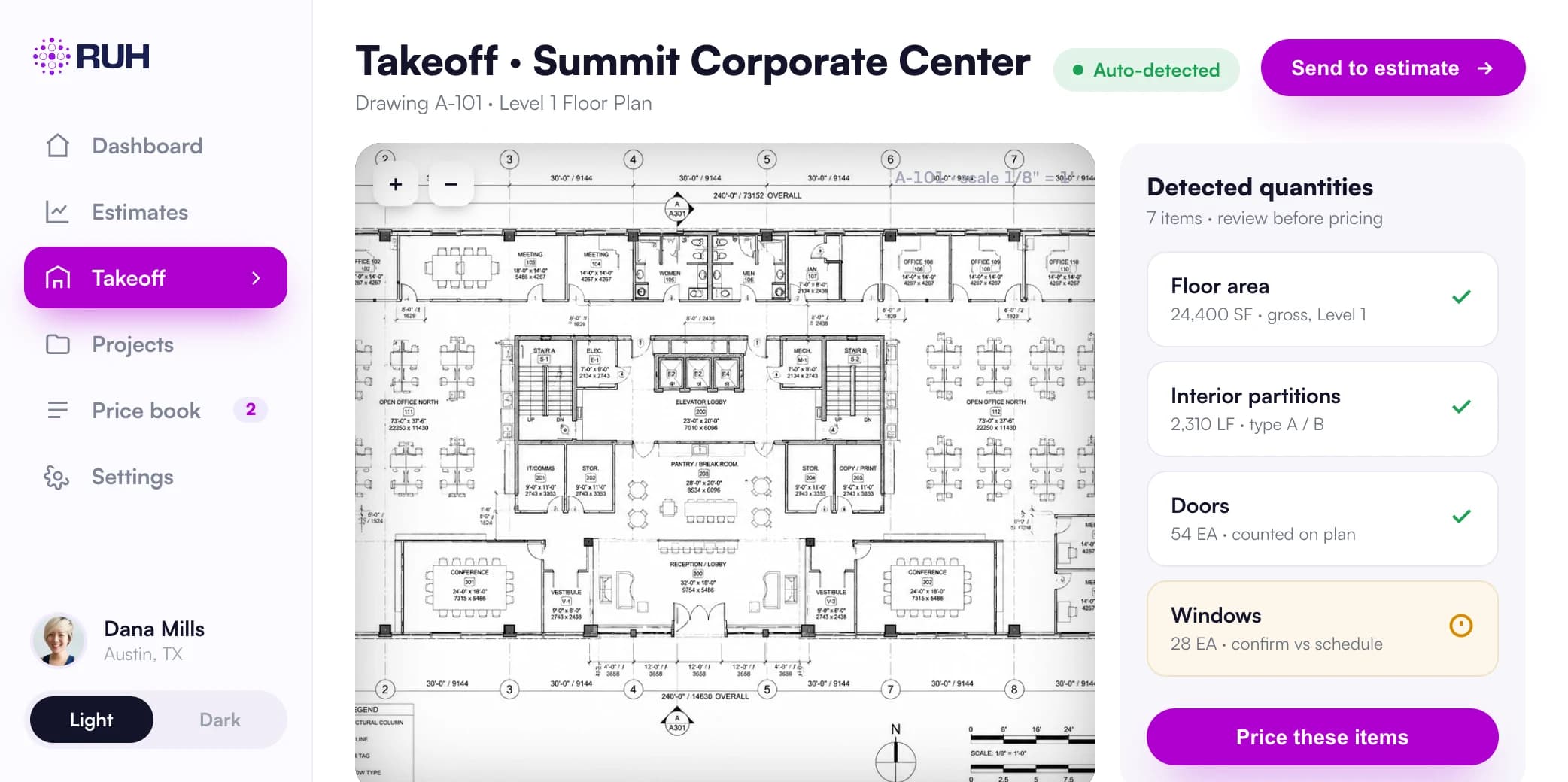
Ruh reads the contractor's drawings, runs the takeoff, and prices every quantity against the contractor's own price book, so the quantities feeding an RFQ come from a reviewed line-item estimate instead of a rushed manual count. When the estimator sends a rebar or lumber RFQ, the line items, units, and spec references are already structured, and returned quotes can be checked against the price book's unit costs to spot outliers. The estimator still reviews, adjusts, and signs off before anything is bought; Ruh drafts the numbers, it does not replace that judgment.

See construction invoice and pay app software

RFQ (request for quotation): frequently asked questions

When should I use an RFQ instead of an RFP?+

Use an RFQ when the scope is fully defined and you can hand the bidder exact quantities or complete specs, leaving price, lead time, and terms as the only open questions. Use an RFP when you want the respondent to propose means, schedule, or design input, such as design-build packages or preconstruction services, and you will weigh qualifications alongside cost. An ITB sits at the owner level: complete contract documents, sealed lump-sum bids, and an award driven mostly by price among responsive bidders.

Does RFQ mean request for quotation or request for qualifications?+

Both expansions exist, and context tells you which one you are holding. In supplier and subcontractor procurement, RFQ almost always means request for quotation, a pricing request. In public work, agencies often issue a request for qualifications to shortlist firms before an RFP, so read the document body before responding: a qualifications request wants resumes and project history, not unit prices.

Is an RFQ legally binding?+

The RFQ itself is an invitation to quote, not a commitment to buy. The supplier's quotation is an offer that typically holds for its stated validity period, often 30 to 90 days, and a contract forms when you accept it with a purchase order. Watch quote expiration on long bid cycles: if material prices move and the validity lapses, you may need to re-solicit before buyout.

Still measuring by hand? Your next takeoff can run while you review this one.

See it on your plans

Related terms

Keep going: read the full guide or explore construction invoice and pay app software.

The Process and contract terms estimating cheat sheet
Every unit, waste factor, and conversion on one page. Free PDF.

See Ruh price a bid from your own drawings.

AI takeoff and estimating on your price book, your estimator signs off.

Figures on this page are illustrative. Construction estimates depend on project-specific conditions, source documents, market pricing, and professional judgment. Ruh's AI assists the estimator and does not replace professional review: your team reviews, validates, and approves every estimate, bid, and pricing decision.