100% money-backBook a walkthrough

Construction glossary · Process and contract terms

What is General contractor (GC) in construction?

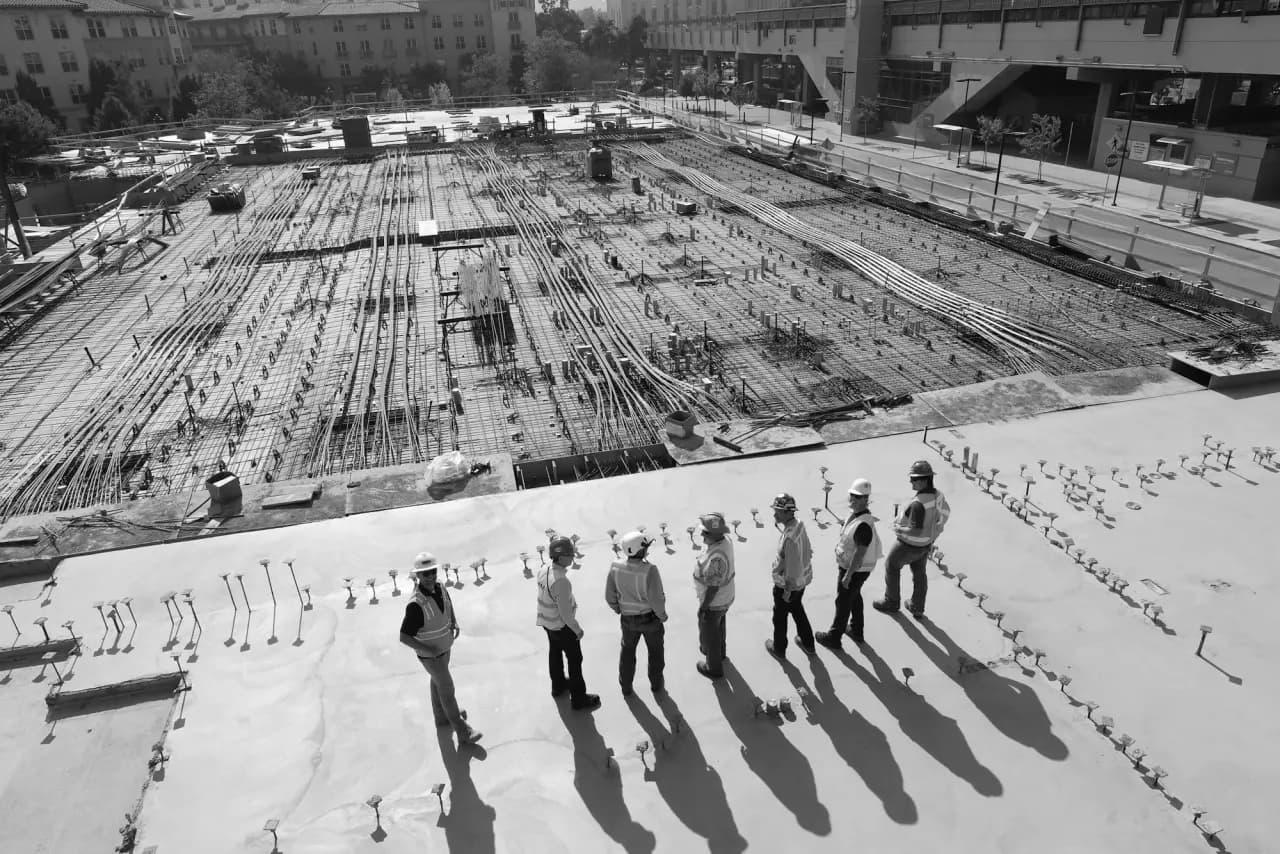
A general contractor (GC) is the company that holds the prime contract with the project owner and takes single-point responsibility for delivering the building: hiring and coordinating subcontractors, managing schedule, site logistics, and safety, and finishing the work for the contract price. Most commercial GCs subcontract the majority of the trades and earn their money through general conditions, overhead, and fee. A construction manager (CM) differs mainly in how and when it is hired; an agency CM advises the owner for a fee and never holds the trade contracts, while a GC always does.

Updated June 2026 · Reviewed by the Ruh construction team

GC = general contractorHires the subcontractorsCarries general conditions cost

What a GC coordinates

Win contract with ownerBuy out subcontractorsSchedule & supervise fieldBill via pay appsHolds the prime contract and runs the build

Estimating process and contract terms scope this week? Watch Ruh take off a real plan in 30 minutes.

Book a walkthrough
Definition

The general contractor is the prime contractor on a commercial project. It signs directly with the owner (commonly an AIA A101 or A102 contract with A201 general conditions), then buys out the work through subcontracts for each trade. You see the term all over the documents: drawing notes like "coordinate with GC" or "furnished by owner, installed by GC", and Division 01 of the specs, which defines the general requirements the GC must price (supervision, temporary facilities, cleanup, closeout). A GC estimate is mostly an assembly job: collect and level sub bids, price any self-perform work from your own production rates, then add general conditions, overhead, and fee. New estimators trip on three things. They read "by GC" notes as self-perform work, when the note usually just means the GC must deliver it through someone. They confuse general conditions (time-based site costs) with general requirements (the Division 01 spec sections). And they leave scope gaps between subs, which the GC owns by default because it carries single-point responsibility.

How it is measured

You do not measure a GC, you measure its cost structure, and it shows up in three buckets. General conditions are time-based: superintendent, project staff, trailer, temporary utilities, and cleanup, priced per month against schedule duration (an illustrative superintendent might run $15,000 per month with burden, so 14 months costs $210,000). Fee and home-office overhead are percentage-based on the cost of the work, typically low single digits on competitively bid commercial jobs. Insurance and bond are percentages of contract value. These numbers live on the bid form, in the schedule of values, and in the general conditions estimate that backs them up. During buyout, the GC measures itself line by line: buyout savings or busts against what the estimate carried for each trade.

Worked example

Worked example

Foundation package, 500 CY of structural concrete, illustrative numbers. A solid sub bids $325,000 turnkey, which is $650 per CY. Your self-perform estimate: ready-mix at 500 CY x $190 per CY = $95,000, formwork materials $38,000, labor at 2,400 crew hours x $62 per hour burdened = $148,800, pump and equipment $21,000. Direct cost = $302,800, about $22,200 under the sub. Now the markup math. Subcontract it and carry 5 percent fee: $325,000 x 1.05 = $341,250, with $16,250 of low-risk margin. Self-perform and mark up 10 percent: $302,800 x 1.10 = $333,080, so you bid $8,170 lower and keep $30,280 of margin. Self-perform wins on paper, but only if the crew hits 2,400 hours. A 15 percent labor overrun is 360 hours x $62 = $22,320, which wipes out the advantage. That is the GC decision in a nutshell: trading margin for risk.

100%

Try Ruh on a real bid. 100% money-back guarantee if you are not satisfied.*

*Scoped delivery, terms apply. Read the guarantee terms

Start with a walkthrough
How Ruh handles it

How Ruh handles General contractor (GC)

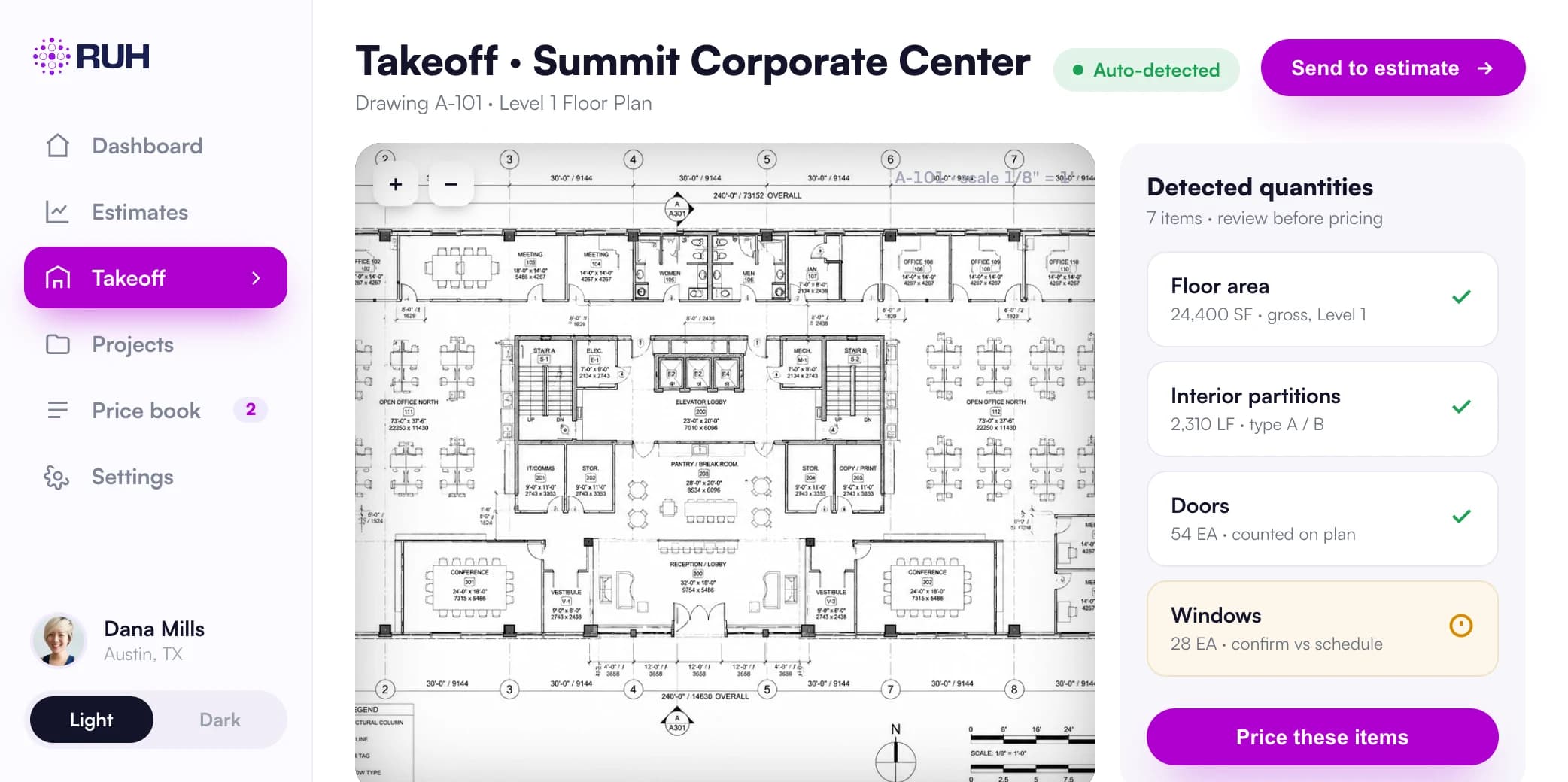
A GC estimate lives or dies on independent quantities, both to price self-perform work and to check whether sub bids are complete. Ruh reads the drawings, performs the takeoff, and prices the quantities against the GC's own price book (its real crew and unit costs), handing the estimator a line-item draft to level subs against or to test a self-perform versus subcontract decision. The estimator reviews, adjusts, and signs off; Ruh handles the counting while the judgment stays with the estimator.

See construction invoice and pay app software

General contractor (GC): frequently asked questions

What is the difference between a GC and a construction manager at risk (CMAR)?+

A CMAR is hired during design, gives preconstruction pricing input, and then converts to a guaranteed maximum price (GMP) and holds the trade contracts, so during construction it looks and acts much like a GC. The practical differences are procurement and openness: a GC is usually selected on a lump sum bid against finished drawings, while a CMAR is selected on qualifications and fee, with open-book costs and savings typically returned to the owner. From an estimator's seat, GC bid work rewards aggressive buyout, while CMAR work rewards accurate early budgets.

Do general contractors do any of the construction work themselves?+

Many commercial GCs self-perform a few trades where they own crews and equipment, most commonly concrete, demolition, rough carpentry, and general labor, and subcontract everything else. Others are pure brokers and subcontract 100 percent of the field work. On bid day the estimator makes that call trade by trade, comparing a self-perform estimate built from production rates against incoming sub quotes.

How does a general contractor make money?+

On a lump sum job the GC earns its fee plus whatever it saves in buyout, when subcontracts are bought below the numbers carried in the estimate, minus anything it loses to scope gaps or general conditions overruns. Fees on competitively bid commercial work are typically thin, often low single digits as a percentage of cost, so a few months of schedule slip on the superintendent and trailer line can erase the planned profit. That is why GC estimators obsess over schedule duration as much as quantities.

Still measuring by hand? Your next takeoff can run while you review this one.

See it on your plans

Related terms

Keep going: read the full guide or explore construction invoice and pay app software.

The Process and contract terms estimating cheat sheet
Every unit, waste factor, and conversion on one page. Free PDF.

See Ruh price a bid from your own drawings.

AI takeoff and estimating on your price book, your estimator signs off.

Figures on this page are illustrative. Construction estimates depend on project-specific conditions, source documents, market pricing, and professional judgment. Ruh's AI assists the estimator and does not replace professional review: your team reviews, validates, and approves every estimate, bid, and pricing decision.