Construction glossary · Process and contract terms
What is Purchase order (PO) in construction?
A purchase order (PO) in construction is a written agreement a contractor issues to a supplier to buy specific materials or equipment at stated quantities, unit prices, and delivery terms. Once the supplier accepts it, the PO becomes a binding commitment that locks the quoted price. During buyout, the project team converts winning supplier quotes from the estimate into POs coded to the job's cost codes.
Updated June 2026 · Reviewed by the Ruh construction team
How a purchase order commits a buy
Estimating process and contract terms scope this week? Watch Ruh take off a real plan in 30 minutes.
Book a walkthroughA purchase order is the standard instrument for buying goods on a commercial job: structural steel, rebar, lumber, pipe, switchgear, doors and hardware, rooftop units. It lives in the buyout phase. The estimator builds the budget from takeoff quantities and quoted unit prices, then after award the project manager or purchasing agent converts the winning quotes into POs, line by line, against the same cost codes. Each PO carries quantities, unit prices, extended amounts, delivery dates, freight terms, tax treatment, and the buyer's terms and conditions, and it shows up afterward in the buyout log and the committed cost report. The dividing line new estimators blur first: subcontracts buy labor and scope, POs buy material and equipment only. Other common mistakes are carrying a quote past its expiration date without reconfirming the price, leaving freight and sales tax out of quote comparisons so the cheap vendor is not actually cheap, and letting PO quantities drift from the takeoff so the job either runs short or pays restocking fees on returns.
A PO is quantified in line items. Each line carries a quantity, a unit of measure, a unit price, and an extended amount, and the units should mirror the takeoff: tons of rebar, linear feet of pipe, each for doors and frames, squares or square feet for roofing. Order quantity is normally the takeoff quantity plus a stated waste or lap allowance. The PO total is the sum of the line extensions plus freight and applicable sales tax. On the job, POs appear in the buyout log, the procurement schedule, and the job cost report as committed cost against a budget line. The estimator measures buyout performance as the budget line minus the PO value, and the field tracks deliveries against released quantities so the commitment matches what actually arrives.
Worked example
Take a foundation rebar package with illustrative US pricing. The takeoff shows 38 tons of #5 bar. Add a 5 percent allowance for laps and waste: 38 tons x 1.05 = 39.9 tons, so order 40 tons. The low quote is $1,450 per ton of fabricated rebar, freight at $1,200 per truckload with 2 loads required, plus 7 percent sales tax on material. Build the PO from the quote: material is 40 tons x $1,450 per ton = $58,000. Freight is 2 loads x $1,200 per load = $2,400. Sales tax is $58,000 x 0.07 = $4,060. PO total = $58,000 + $2,400 + $4,060 = $64,460. The estimate carried $66,000 for this line, so buyout savings are $66,000 minus $64,460 = $1,540. Write the delivery terms into the PO: two releases of 20 tons each tied to the pour schedule, price held firm for 90 days.
Try Ruh on a real bid. 100% money-back guarantee if you are not satisfied.*
*Scoped delivery, terms apply. Read the guarantee terms
How Ruh handles Purchase order (PO)
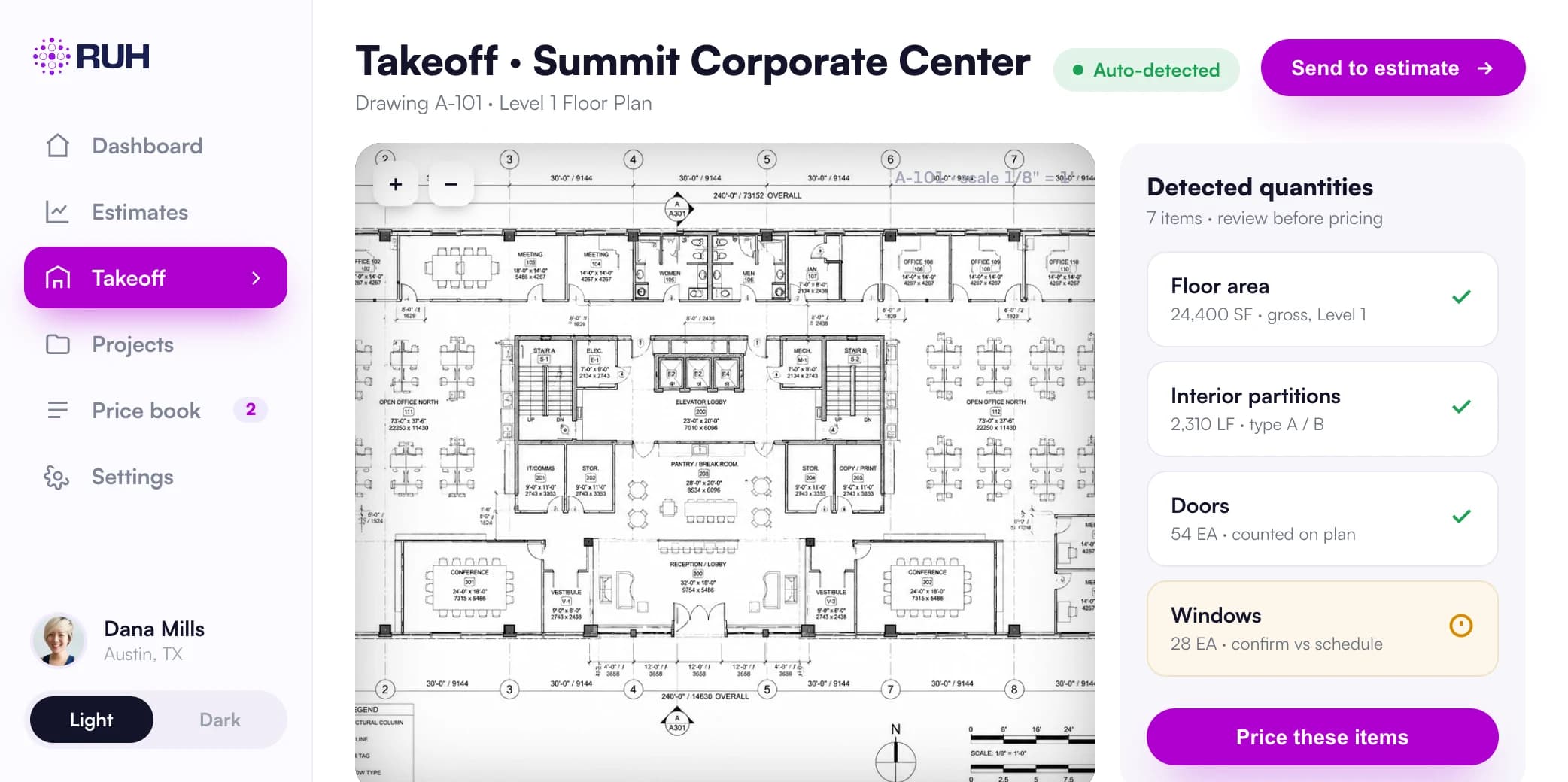
Ruh reads the contractor's drawings, performs the takeoff, and prices the quantities against the contractor's own price book, so every line in the draft estimate already carries the quantity, unit, and unit cost a PO line needs at buyout. That gives the estimator a baseline to check vendor quotes against before a quote gets converted into a PO commitment. The estimator still reviews, adjusts, and signs off; Ruh drafts the numbers, it does not commit the dollars.
See construction invoice and pay app softwarePurchase order (PO): frequently asked questions
What is the difference between a purchase order and a subcontract in construction?+
A PO buys goods: material or equipment the vendor furnishes but does not install. A subcontract buys a scope of work that includes labor on site, so it carries insurance requirements, lien waivers, retainage, and safety obligations a PO does not. Furnish-and-install scopes, such as a supplier who also erects the joists, are normally written as subcontracts even when material dominates the price.
Is a purchase order legally binding?+
Yes. Once the supplier accepts the PO, whether by signing it, confirming it in writing, or shipping against it, it is an enforceable contract for the goods at the stated price and terms. That is why the terms and conditions printed on the PO matter: they govern price escalation, restocking charges, delivery delays, and whose paperwork controls if the quote and the PO conflict.
When should purchase orders be issued during buyout?+
As early as the schedule and quote validity allow, starting with long-lead items such as switchgear, elevators, steel joists, and rooftop units. Most supplier quotes are only firm for 30 to 90 days, so waiting can expose the job to price escalation the estimate never carried. Commodities with volatile pricing, lumber and copper for example, are often bought out first to lock in the numbers the estimate was built on.
Still measuring by hand? Your next takeoff can run while you review this one.
See it on your plansRelated terms
Keep going: read the full guide or explore construction invoice and pay app software.
See Ruh price a bid from your own drawings.
AI takeoff and estimating on your price book, your estimator signs off.
Figures on this page are illustrative. Construction estimates depend on project-specific conditions, source documents, market pricing, and professional judgment. Ruh's AI assists the estimator and does not replace professional review: your team reviews, validates, and approves every estimate, bid, and pricing decision.