Construction glossary · Process and contract terms
What is Schedule of values (SOV) in construction?
A schedule of values (SOV) is a line-item breakdown of the total contract sum that assigns a dollar value to each portion of the work, and it becomes the basis for monthly progress payments. On most US commercial projects the SOV is submitted on the AIA G703 continuation sheet, which backs up the G702 application for payment. Each billing cycle the contractor reports percent complete against every line, and those amounts determine what gets paid.
Updated June 2026 · Reviewed by the Ruh construction team
How a Schedule of Values is built and billed
Estimating process and contract terms scope this week? Watch Ruh take off a real plan in 30 minutes.
Book a walkthroughThe schedule of values is the billing backbone of a commercial project. The contractor breaks the contract sum into line items, usually following CSI divisions or the estimate's cost codes, and submits it to the architect for approval before the first payment application. From then on, every monthly pay app on AIA G702 is backed by a G703 continuation sheet that lists each SOV line, its scheduled value, work completed to date, stored materials, and balance to finish. Estimators feed the SOV even when the project manager owns it. The approved estimate becomes the source for line values, so how you structure the estimate determines how cleanly the project bills. New estimators make two common mistakes: lumping too much scope into one line, which forces an argument with the architect over percent complete every month, and letting the SOV drift away from the cost codes, which makes job cost reports useless for tracking margin. A good SOV has enough lines that progress is observable in the field, and every line maps back to the estimate.
An SOV is measured in dollars per line item, and billing against it is measured in percent complete per line. The standard format is the AIA G703 continuation sheet, with columns for item number, description of work, scheduled value, work completed in previous applications, work completed this period, materials presently stored, total completed and stored to date, percent complete, balance to finish, and retainage. All line values must sum exactly to the current contract sum, and approved change orders are added as new lines so the total stays reconciled. Estimators typically build the SOV by rolling estimate cost codes up into billable lines, with mobilization and general conditions carried as their own lines so early costs are recoverable.
Worked example
Take an illustrative $1,200,000 contract for a small commercial building, broken into six SOV lines: mobilization $36,000, sitework $180,000, concrete foundations $240,000, structural steel $204,000, building envelope $300,000, and interior finishes $240,000. The lines sum to $1,200,000, matching the contract. At the end of month 2, progress stands at mobilization 100 percent complete ($36,000), sitework 100 percent ($180,000), and concrete 50 percent ($240,000 x 0.50 = $120,000). Total completed to date is $36,000 + $180,000 + $120,000 = $336,000. With 10 percent retainage, the holdback is $336,000 x 0.10 = $33,600. If the first application covered $150,000 of work, the prior payment was $150,000 less 10 percent retainage, or $135,000. This period's payment is $336,000 minus $33,600 retainage minus $135,000 already paid, which equals $167,400. Every number traces to a specific SOV line, which is exactly what the architect checks before certifying payment.
Try Ruh on a real bid. 100% money-back guarantee if you are not satisfied.*
*Scoped delivery, terms apply. Read the guarantee terms
How Ruh handles Schedule of values (SOV)
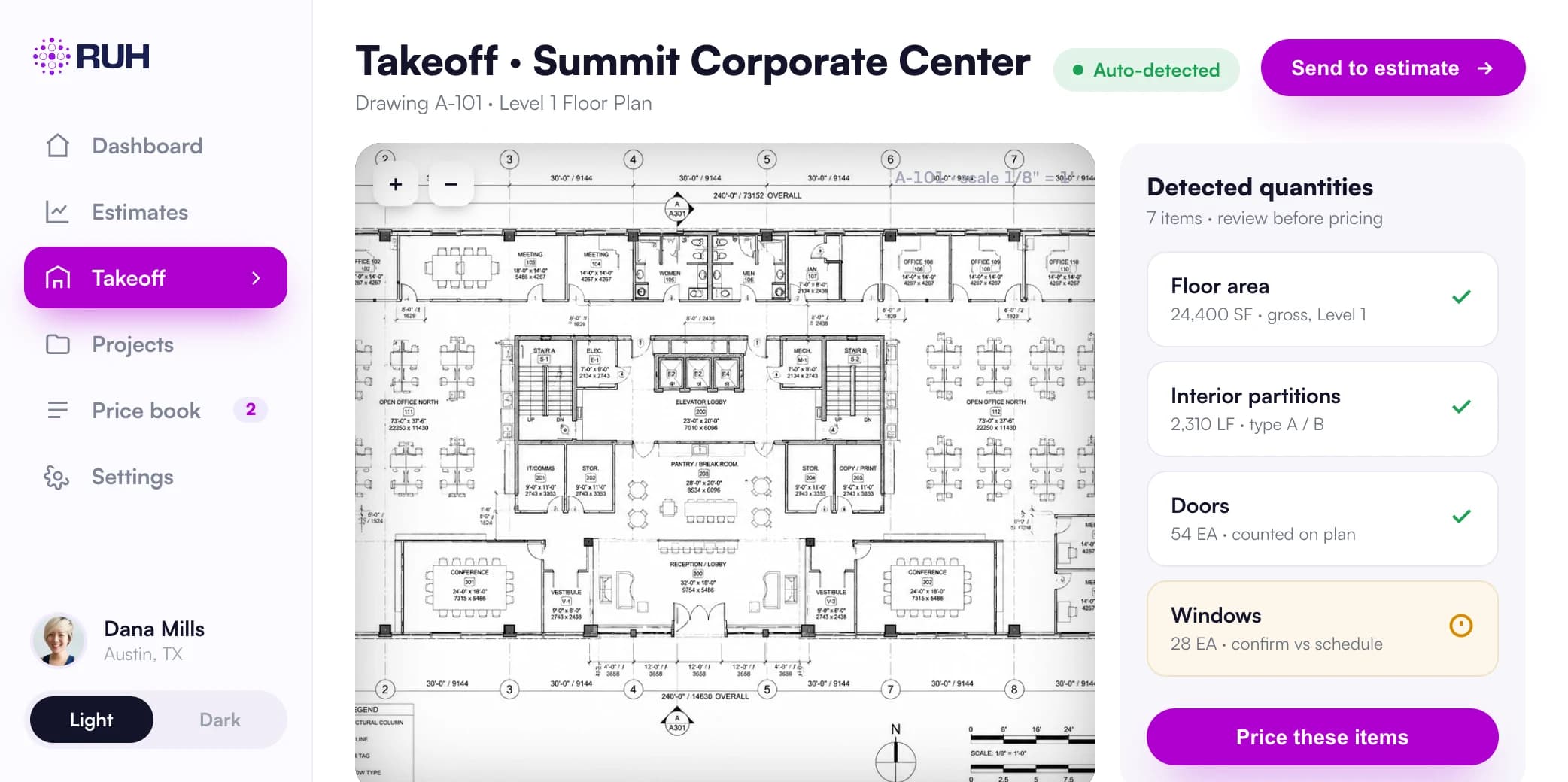
Ruh reads the contractor's drawings, performs the takeoff, and prices quantities against the contractor's own price book, so the draft estimate arrives already organized into the cost-coded line items an SOV is built from. When the project moves to billing, those same lines roll up cleanly into a G703-ready schedule of values instead of being reverse-engineered from a lump sum. The estimator reviews, adjusts, and signs off on every line; Ruh drafts the structure, it does not replace professional judgment.
See construction invoice and pay app softwareSchedule of values (SOV): frequently asked questions
What is the difference between AIA G702 and G703?+
G702 is the application and certificate for payment, the one-page summary the contractor signs and the architect certifies. G703 is the continuation sheet behind it, where every SOV line item is listed with its scheduled value, work completed, stored materials, and balance to finish. The G703 line totals feed the G702 summary, so the two documents always travel together.
Can a contractor front-load a schedule of values?+
Mild front-loading, such as carrying mobilization and general conditions as early line items, is normal and helps cover startup costs. Aggressive front-loading, where early lines carry inflated values to pull cash forward, is a different matter: architects review SOVs for unbalanced values and can reject them, and overbilling early creates an underbilled hole at the end of the job. Lenders and sureties also flag unbalanced SOVs during their reviews.
How detailed should SOV line items be?+
Enough lines that the architect can verify percent complete by walking the site, but not so many that monthly updates become a burden. On a typical mid-size commercial job that often means one line per major trade or CSI division, with separate lines for mobilization, general conditions, and any large equipment purchases. Match the lines to your cost codes so job cost tracking and billing stay in sync.
Still measuring by hand? Your next takeoff can run while you review this one.
See it on your plansSee Ruh price a bid from your own drawings.
AI takeoff and estimating on your price book, your estimator signs off.
Figures on this page are illustrative. Construction estimates depend on project-specific conditions, source documents, market pricing, and professional judgment. Ruh's AI assists the estimator and does not replace professional review: your team reviews, validates, and approves every estimate, bid, and pricing decision.