100% money-backBook a walkthrough

Construction glossary · Process and contract terms

What is RFP (request for proposal) in construction?

An RFP (request for proposal) in construction is a solicitation document the owner issues asking contractors to submit both a price and a proposed approach (team, schedule, methodology), with award based on weighted evaluation criteria rather than price alone. It differs from an ITB (invitation to bid), which uses complete drawings and awards to the lowest responsive bidder, and from an RFQ, which requests either qualifications or a simple price quote. RFPs are standard on design-build, CM at risk, and negotiated commercial work in the US.

Updated June 2026 · Reviewed by the Ruh construction team

RFP = request for proposalScores price + qualificationsMore than low-bid

How an RFP solicits proposals

Owner issues RFPFirms ask questionsProposals submittedScored on price + approachAward & contractSolicits a full proposal, not just a price

Estimating process and contract terms scope this week? Watch Ruh take off a real plan in 30 minutes.

Book a walkthrough
Definition

An RFP is the owner's solicitation package for procuring a contractor when factors beyond price matter: approach, schedule, team, and qualifications. You will see RFPs on design-build, CM at risk, and negotiated work, usually in the Division 00 procurement documents along with instructions to proposers, evaluation criteria, and the proposal forms. The owner (or their procurement agent) issues it; the GC's preconstruction team, estimators, and proposal writers respond. Unlike an ITB (invitation to bid), where complete drawings exist and the low responsive bid wins, an RFP often arrives with partial design (bridging documents or basis-of-design narratives), and the award is scored on weighted criteria. New estimators make two common mistakes. First, they price an RFP like a hard bid, doing a full takeoff on 30 percent drawings instead of building a conceptual estimate with design contingency. Second, they ignore the evaluation matrix; if price is only 40 points out of 100, shaving the fee matters less than nailing the technical approach. Read the instructions to proposers before you open the drawings.

How it is measured

An RFP is not measured in field units, but estimators quantify against it in three places. The evaluation matrix assigns points (for example, 40 points price, 35 points technical, 25 points qualifications), which tells you where estimating precision pays off. Pricing forms dictate the breakdown: lump sum, GMP with an itemized fee percentage, or cost of work plus fee. And because design is incomplete, conceptual estimates run in dollars per square foot or per unit (an illustrative $280 to $350 per square foot for mid-rise office shell and core, US market, 2024 to 2026), carried with a stated design contingency of 5 to 10 percent. Always log the addenda and the proposal due date; a missed addendum acknowledgment can make a proposal non-responsive.

Worked example

Worked example

Same project, two delivery methods, illustrative numbers. Design-build RFP: the owner issues bridging documents for a 40,000 square foot office building at roughly 30 percent design. You build a conceptual estimate: 40,000 SF x $310 per SF = $12,400,000 construction cost. Add design contingency at 7 percent: $12,400,000 x 0.07 = $868,000. Add design fees at 6 percent: $12,400,000 x 0.06 = $744,000. Proposed GMP: $12,400,000 + $868,000 + $744,000 = $14,012,000, submitted with a technical narrative, schedule, and team resumes scored against the owner's matrix. Hard-bid ITB: 100 percent drawings, full quantity takeoff. Direct costs total $11,500,000. Add general conditions and overhead at 8 percent ($920,000) and profit at 5 percent of the $12,420,000 subtotal ($621,000). Lump sum bid: $13,041,000, where the lowest responsive bid wins. The RFP number carries more contingency because the design risk sits with you.

100%

Try Ruh on a real bid. 100% money-back guarantee if you are not satisfied.*

*Scoped delivery, terms apply. Read the guarantee terms

Start with a walkthrough
How Ruh handles it

How Ruh handles RFP (request for proposal)

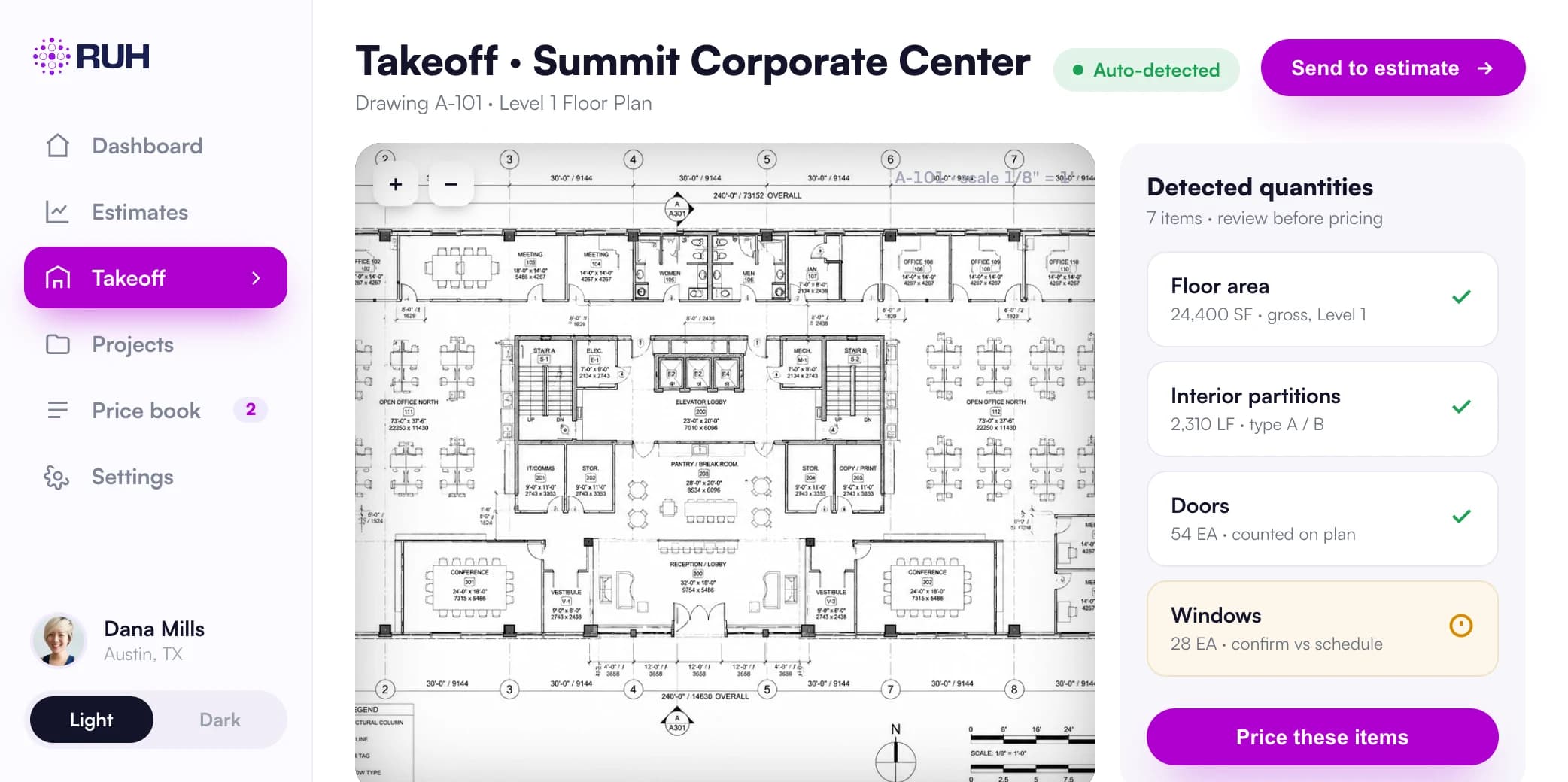
RFP responses squeeze takeoff into a fixed proposal window while the drawing set keeps changing through addenda. Ruh reads whatever drawings the RFP includes, performs the takeoff, and prices the quantities against the contractor's own price book, handing the estimator a line-item draft to review, adjust, and sign off. That frees more of the window for the work AI should not own: contingency judgment, the technical narrative, and the fee strategy the evaluation matrix actually rewards.

See construction invoice and pay app software

RFP (request for proposal): frequently asked questions

What is the difference between an RFP, an RFQ, and an ITB?+

An ITB (invitation to bid) goes out with complete drawings, and award goes to the lowest responsive, responsible bidder. An RFQ can mean request for qualifications (a shortlisting step with no pricing, common before a two-step RFP) or request for quotation (a price-only ask for a defined scope, common for materials and subcontract buyouts). An RFP asks for price plus approach, and the owner scores proposals on weighted criteria instead of price alone.

Is a construction RFP response legally binding?+

The proposal itself is generally an offer, not a contract; neither side is bound until an agreement is executed. Owners do hold proposers to their numbers during negotiation, though, and public agencies may require proposal security or bid bonds that put real money behind the offer. Check the instructions to proposers for the price validity period, commonly 60 to 90 days.

How should an estimator price an RFP when the design is only 30 percent complete?+

Use conceptual methods: dollars per square foot from your own historical cost data, assemblies pricing for the major systems, and an explicit design contingency (an illustrative 5 to 10 percent) carried as its own line. Document every assumption in your clarifications and exclusions so scope growth during design development becomes a negotiation, not an absorbed loss.

Still measuring by hand? Your next takeoff can run while you review this one.

See it on your plans

Related terms

Keep going: read the full guide or explore construction invoice and pay app software.

The Process and contract terms estimating cheat sheet
Every unit, waste factor, and conversion on one page. Free PDF.

See Ruh price a bid from your own drawings.

AI takeoff and estimating on your price book, your estimator signs off.

Figures on this page are illustrative. Construction estimates depend on project-specific conditions, source documents, market pricing, and professional judgment. Ruh's AI assists the estimator and does not replace professional review: your team reviews, validates, and approves every estimate, bid, and pricing decision.