100% money-backBook a walkthrough

Construction glossary · MEP

What is RTU (rooftop unit) in construction?

An RTU (rooftop unit) in construction is a packaged HVAC unit installed on the roof that contains its own compressors, condenser, fans, and heating section in one factory-built cabinet, supplying conditioned air directly into the building's ductwork. Estimators count RTUs each (ea) from the mechanical equipment schedule, with cooling capacity in tons driving the equipment price. Unlike an indoor air handling unit, an RTU is self-contained: it needs only a roof curb, power, gas (if gas heat), and duct connections.

Updated June 2026 · Reviewed by the Ruh construction team

RTU = rooftop unitPackaged heat + cool in oneSits on a roof curb

How rooftop units are counted

5 EARooftop unitmechanical schedule

Estimating mep scope this week? Watch Ruh take off a real plan in 30 minutes.

Book a walkthrough
Definition

Rooftop units dominate low-rise US commercial work, retail, light industrial, and office, because they put the entire HVAC plant outside the leasable space. On the documents an RTU appears as a tagged unit on the mechanical roof plan, with tonnage, cfm, electrical data, and heating input in the equipment schedule, and its structural support (curbs, sleepers, added framing) on the structural drawings. The mechanical contractor furnishes and sets the unit, but the scope crosses trades: the roofing contractor flashes the curb into the roof system, the electrician runs the feed and disconnect, and gas heat pulls in gas piping. The classic new estimator mistake is pricing the unit and stopping. Every RTU needs a factory roof curb, crane or helicopter time to set it, condensate routing, and duct connections through the roof deck, and on replacement work the existing curb rarely matches, which adds a curb adapter. Crane day economics matter too: setting six units in one mobilization is a different number than six separate picks, so the estimator should always read the roof plan with the rigging plan in mind.

How it is measured

RTUs are counted each (ea) from the mechanical equipment schedule, with cooling capacity in tons as the primary cost driver (one ton equals 12,000 Btuh of cooling). Airflow in cfm tracks tonnage, with roughly 400 cfm per ton as a common design rule of thumb, so either column signals the unit's size class. The takeoff carries one line per tag, plus separate lines for the roof curb, crane and rigging time, electrical connection, gas piping for gas heat units, condensate drain, and duct transitions at the roof deck. Keep curbs and crane time out of the equipment unit cost: they vary with roof height, site access, and how many units one mobilization can set, so burying them in the per-unit price hides exactly the costs that move from job to job.

Worked example

Worked example

A single-story retail shell's roof plan shows six gas heat RTUs: four at 10 tons and two at 25 tons, a total of (4 x 10) + (2 x 25) = 90 tons of cooling. At an illustrative installed equipment cost of $2,200 per ton, the units price out at 90 x $2,200 = $198,000. Factory roof curbs at an illustrative $1,400 each add 6 x $1,400 = $8,400. All six units can be set in one crane mobilization: an illustrative $3,500 for the crane day plus $2,400 for the rigging crew adds $5,900. The RTU scope totals $198,000 + $8,400 + $5,900 = $212,300, with curbs and crane carried as their own lines. Spread per unit, the rigging works out to about $983 each ($5,900 / 6); if deliveries slip and the units arrive in two shipments, that line roughly doubles while the equipment line never moves.

100%

Try Ruh on a real bid. 100% money-back guarantee if you are not satisfied.*

*Scoped delivery, terms apply. Read the guarantee terms

Start with a walkthrough
How Ruh handles it

How Ruh handles RTU (rooftop unit)

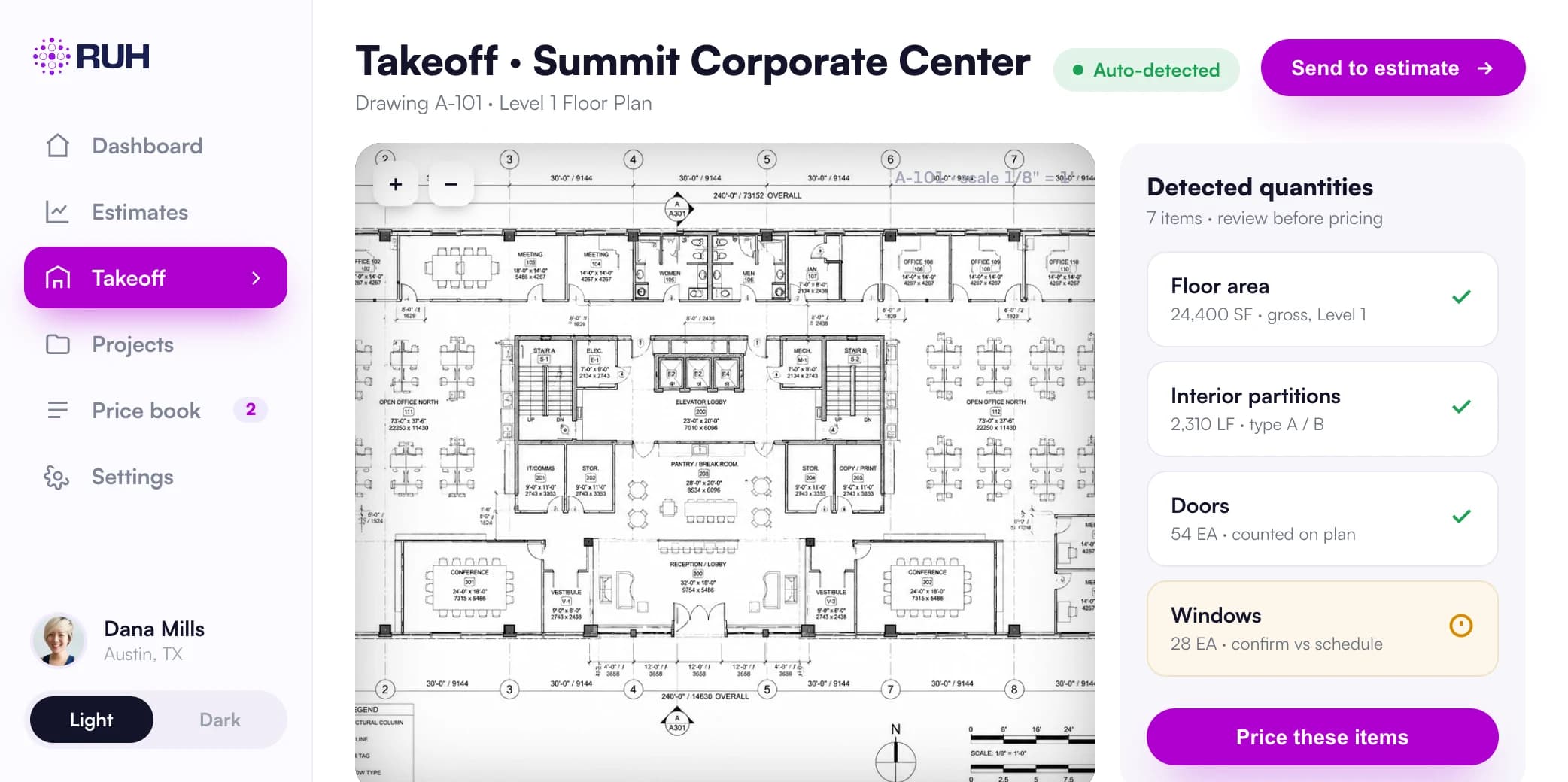
Ruh takes the unit count and tonnage straight from the contractor's drawings and schedules, breaks out curbs and rigging as separate takeoff lines, and prices everything on the contractor's own price book. The estimator reviews the draft, checks the crane plan against site access, and signs off on the final number.

See AI construction takeoff and estimating software

RTU (rooftop unit): frequently asked questions

Why are the curb and crane priced separately from the RTU?+

Because they move independently of the equipment price. The curb depends on the roof system, unit footprint, and whether an adapter is needed on replacement work, while crane cost depends on roof height, site access, pick radius, and how many units one mobilization can set. Burying those in a per-ton unit cost hides the variables that actually change from job to job, so experienced estimators carry rigging and curbs as separate lines.

How many cfm per ton does an RTU deliver?+

A common design rule of thumb in US commercial work is roughly 400 cfm of supply air per ton of cooling, so a 10 ton unit moves around 4,000 cfm. Actual selections vary with climate, humidity control, and the engineer's design, so always price from the scheduled values rather than the rule of thumb. The ratio is still useful for sanity-checking a schedule or sizing duct mains early in design.

What is the difference between an RTU and a split system?+

An RTU packages the compressor, condenser, evaporator coil, and fans in one rooftop cabinet connected directly to the ductwork. A split system separates them: an outdoor condensing unit piped with refrigerant lines to an indoor furnace or air handler. Splits suit buildings without practical roof mounting or with small loads; packaged RTUs win on low-rise commercial roofs because installation is one curb, one crane pick, and one set of connections.

Still measuring by hand? Your next takeoff can run while you review this one.

See it on your plans

Related terms

Keep going: read the full guide or explore AI construction takeoff and estimating software.

The MEP estimating cheat sheet
Every unit, waste factor, and conversion on one page. Free PDF.

See Ruh price a bid from your own drawings.

AI takeoff and estimating on your price book, your estimator signs off.

Figures on this page are illustrative. Construction estimates depend on project-specific conditions, source documents, market pricing, and professional judgment. Ruh's AI assists the estimator and does not replace professional review: your team reviews, validates, and approves every estimate, bid, and pricing decision.