100% money-backBook a walkthrough

Construction glossary · Process and contract terms

What is pay application in construction?

A pay application (pay app) is the formal billing package a contractor submits, usually monthly, to request payment for work completed and materials stored during a billing period. On most US commercial projects it uses AIA forms G702, the application and certificate for payment, and G703, the continuation sheet that breaks the contract sum into a schedule of values. Each application shows percent complete by line item, deducts retainage and previous payments, and arrives at the net amount currently due.

Updated June 2026 · Reviewed by the Ruh construction team

Filed monthlyForm AIA G702/G703Pays work in place to date

The monthly pay application cycle

Update % complete on SOVSubmit G702/G703Architect certifiesOwner pays less retainageProgress billing against the schedule of values

Estimating process and contract terms scope this week? Watch Ruh take off a real plan in 30 minutes.

Book a walkthrough
Definition

A pay application is the contractor's formal monthly request for payment under a commercial construction contract. On most US projects it rides on AIA form G702, the application and certificate for payment, backed by G703, the continuation sheet that lists every line of the schedule of values. The project manager or project accountant usually assembles it, but the estimator sets it up for success or failure: the schedule of values comes straight from the estimate, and if the estimate's line items are too coarse or do not match how the work will actually be billed, every pay app for the life of the job becomes a fight. New estimators commonly make two mistakes here. They lump scope into a few giant line items the architect cannot verify in the field, and they ignore retainage when running cash flow, which understates how much working capital the job ties up month over month.

How it is measured

Pay applications are measured in dollars and percent complete, line by line against the schedule of values. Each G703 row carries a scheduled value, work completed in previous applications, work completed this period, materials presently stored, total completed and stored to date, percent complete, balance to finish, and retainage. Percent complete is the contractor's assessment of progress on that line, which the architect or owner's representative verifies on site before certifying. Stored materials need backup, typically supplier invoices and proof of insurance for anything stored off site. Retainage is applied as a contract percentage, commonly 5 percent to 10 percent in the US, and everything nets out on the G702 summary to produce the current payment due.

Worked example

Worked example

Take an illustrative $2,000,000 contract with 10 percent retainage, billing in month 4. The G703 shows total work completed to date of $800,000 plus $50,000 in materials stored on site, so total completed and stored to date is $800,000 + $50,000 = $850,000. Retainage is 10 percent of $850,000, which is $85,000. Total earned less retainage is $850,000 - $85,000 = $765,000. Previous certificates for payment totaled $540,000, so the current payment due is $765,000 - $540,000 = $225,000. The balance to finish, including retainage, is $2,000,000 - $765,000 = $1,235,000. That $225,000 is what the contractor actually collects this month, which is why estimators who skip retainage in cash flow projections overstate early job income.

100%

Try Ruh on a real bid. 100% money-back guarantee if you are not satisfied.*

*Scoped delivery, terms apply. Read the guarantee terms

Start with a walkthrough
How Ruh handles it

How Ruh handles pay application

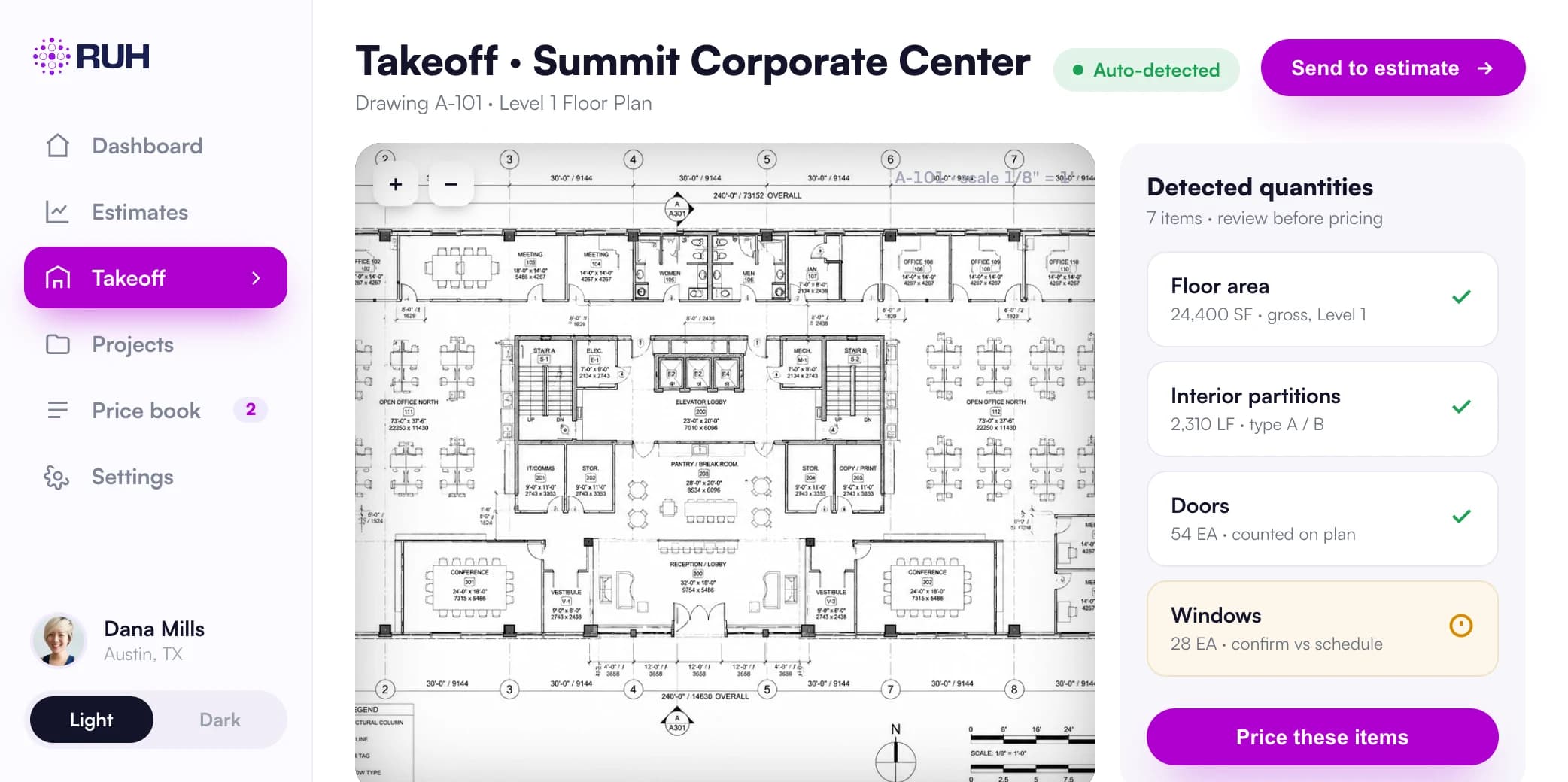
Ruh reads the contractor's drawings, performs the takeoff, and prices quantities against the contractor's own price book, then hands a line-item draft to the estimator to review, adjust, and sign off. Because that estimate arrives already broken into clean line items with real quantities and unit costs, it converts naturally into a schedule of values that holds up on G703, so monthly pay apps bill against numbers the team can defend. The estimator still owns the final schedule of values and every billing judgment; Ruh just makes the starting point accurate.

See construction invoice and pay app software

Pay application: frequently asked questions

What is the difference between AIA G702 and G703?+

G702 is the one-page summary, the application and certificate for payment. It carries the original contract sum, approved change orders, total completed and stored to date, retainage, previous payments, and the current payment due, plus the contractor's notarized signature and the architect's certification. G703 is the continuation sheet behind it, listing every schedule of values line with its scheduled value, progress this period, stored materials, percent complete, and balance to finish.

How does retainage work on a pay application?+

The owner withholds a contract percentage, commonly 5 percent to 10 percent in the US, from each payment as security for completion. Many contracts reduce or stop retainage once the job reaches 50 percent complete, and several states cap retainage by statute. The withheld money is released through the final pay application after substantial completion, punch list closeout, and delivery of lien waivers and closeout documents.

How often are pay applications submitted and when does the contractor get paid?+

Monthly is standard on US commercial work, with a billing cutoff date set in the contract, often the 20th or 25th of the month. Many teams submit a pencil draft for the architect and owner to review before the formal notarized submission, which cuts down on rejections. Once certified, payment timing follows the contract terms, commonly within 30 days, and prompt payment statutes in many states set outer limits.

Still measuring by hand? Your next takeoff can run while you review this one.

See it on your plans
The Process and contract terms estimating cheat sheet
Every unit, waste factor, and conversion on one page. Free PDF.

See Ruh price a bid from your own drawings.

AI takeoff and estimating on your price book, your estimator signs off.

Figures on this page are illustrative. Construction estimates depend on project-specific conditions, source documents, market pricing, and professional judgment. Ruh's AI assists the estimator and does not replace professional review: your team reviews, validates, and approves every estimate, bid, and pricing decision.
Pay application in construction (G702/G703) | Ruh AI