100% money-backBook a walkthrough

Construction glossary · Envelope and finishes

What is LVT (luxury vinyl tile) in construction?

LVT (luxury vinyl tile) is a multilayer resilient flooring with a printed design film and a clear wear layer, supplied as planks or tiles that are glued down, loose-laid, or rigid-core click-installed. The estimator takes it off by the square foot of floor area, then converts to boxes after adding cut waste for the plank layout. LVT is specified across offices, healthcare, hospitality, and retail because it mimics wood or stone, resists water, and needs no wax.

Updated June 2026 · Reviewed by the Ruh construction team

Wear layer 12 to 20 milPlank size 6 x 48 inInstall glue or clickWaste add 8 to 10%

LVT plank layer build-up

Wear layer (mil)Clear filmPrinted decor filmRigid/vinyl coreAttached underlayment

Estimating envelope and finishes scope this week? Watch Ruh take off a real plan in 30 minutes.

Book a walkthrough
Definition

LVT, luxury vinyl tile, is a layered resilient product: a backing, a vinyl core (flexible glue-down, loose-lay, or rigid SPC or WPC click), a high-resolution printed film that imitates wood or stone, and a clear wear layer measured in mils that governs durability. It comes as planks (commonly 6 to 9 inches wide by 36 to 48 inches long) or as tiles, and the install method (full-spread adhesive, loose-lay, or floating click) changes both labor and substrate requirements. The wear-layer thickness and the commercial warranty class drive the spec, since a thin residential wear layer will not hold up in a corridor. The estimator reads the floor finish plan and schedule to assign LVT by room and pattern, and notes plank direction, herringbone, and feature areas because diagonal and herringbone layouts raise cut waste materially. Like VCT, LVT depends on slab prep and moisture conditions, so floor prep and moisture mitigation are separate lines. Transitions, reducers, and the base or shoe at the wall are also taken off apart from the field area.

How it is measured

Quantify LVT by the square foot of net floor area from the finish plan, room by room and split by product or pattern. Add a cut-waste factor based on layout: roughly 5 percent for straight plank, 8 to 10 percent for offset or random layouts, and more for diagonal or herringbone. Convert the waste-adjusted area to boxes using the coverage printed on the carton (commonly about 30 to 40 sf per box for plank), rounding up to whole boxes. Take off adhesive for glue-down by the spread rate, and underlayment for floating installs by area. Measure transitions and reducers by the linear foot at doorways and material changes, and confirm wear-layer mils and install method against the spec.

Worked example

Worked example

Illustrative, US market. A 3,200 sf open office gets glue-down LVT plank in a random offset layout. Apply an 8 percent cut-waste factor: 3,200 x 1.08 = 3,456 sf to purchase. At a carton coverage of 36 sf per box, boxes needed are 3,456 / 36 = 96 boxes, rounded up to whole cartons. As a sanity check on plank count, a 7.25 by 48 inch plank covers (7.25 x 48) / 144 = 2.42 sf, so a 36 sf box holds about 15 planks. For material budgeting at an illustrative 3.25 per sf, the field material is 3,200 x 3.25 = 10,400 dollars, before adhesive, slab prep, transitions, and labor. A herringbone layout in the same room would push the waste factor higher and add boxes.

100%

Try Ruh on a real bid. 100% money-back guarantee if you are not satisfied.*

*Scoped delivery, terms apply. Read the guarantee terms

Start with a walkthrough
How Ruh handles it

How Ruh handles LVT (luxury vinyl tile)

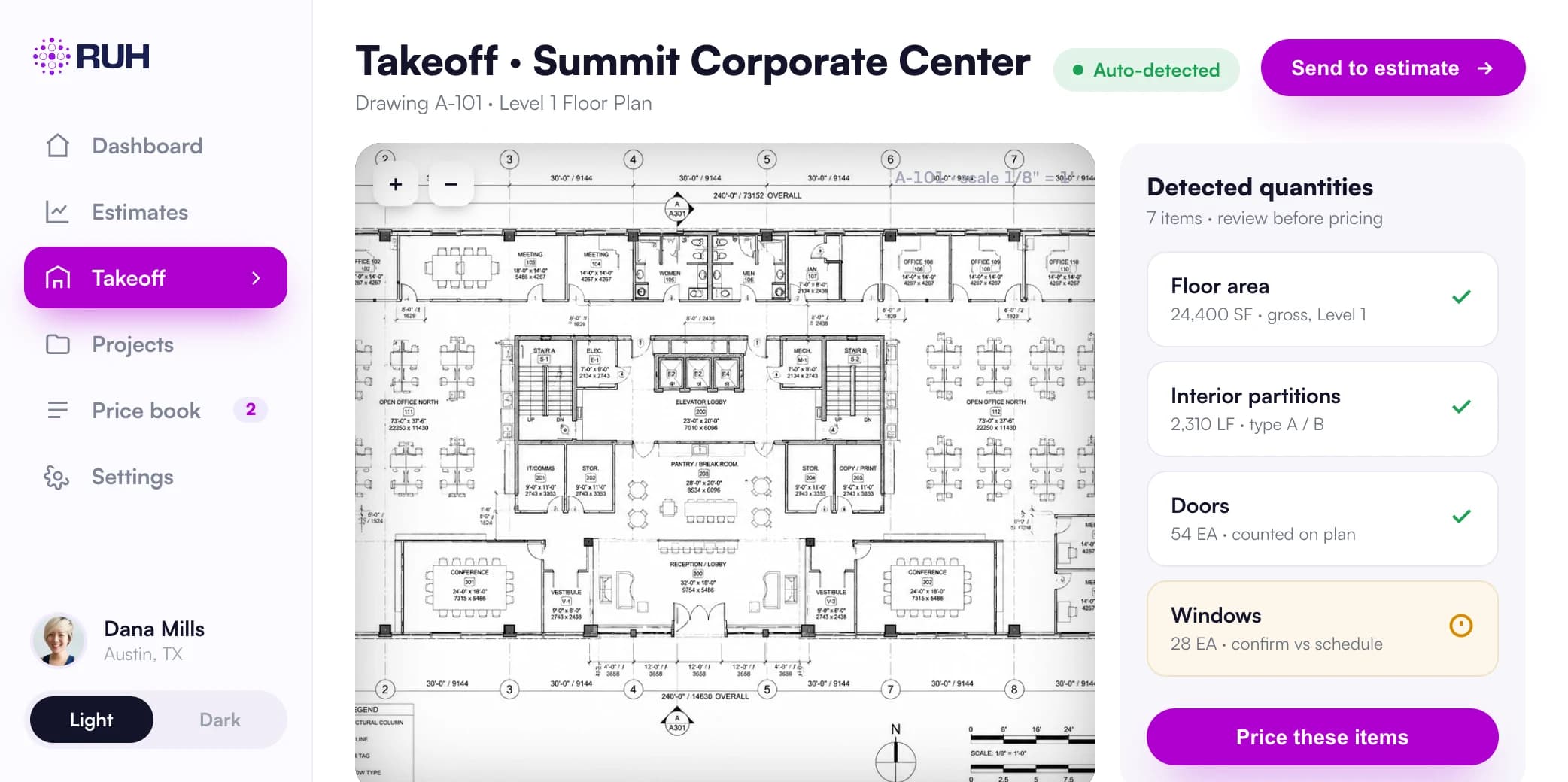
Ruh reads the floor finish plan and schedule, takes off LVT by the square foot of net area per room, and splits it by product, pattern, and plank direction so straight and herringbone areas carry their own waste factors. It converts the waste-adjusted area into full boxes using the carton coverage and carries adhesive or underlayment, transitions, and floor prep as separate lines. It prices everything on the contractor's own price book, and the estimator reviews the layout and waste assumptions and signs off.

See construction estimating software

LVT (luxury vinyl tile): frequently asked questions

How do I convert LVT square footage into boxes?+

Multiply net area by the waste factor for the layout (about 5 percent straight, 8 to 10 percent offset, more for diagonal or herringbone), then divide by the carton coverage printed on the box (often 30 to 40 sf per box) and round up to whole cartons. You order full boxes, so always round up.

What is the difference between glue-down, loose-lay, and click LVT?+

Glue-down uses full-spread adhesive and needs a smooth, dry slab; loose-lay relies on friction backing for fast install and easy replacement; rigid-core click (SPC or WPC) floats over an underlayment and tolerates minor slab irregularity. Each method changes labor, substrate prep, and accessories, so price by the specified method.

Why does the wear layer thickness matter to the estimate?+

The clear wear layer, measured in mils, sets the durability and warranty class. A corridor or retail floor needs a thicker commercial wear layer than a private office. Matching the specified mils is a cost driver, so confirm it in the schedule before pricing rather than quoting a generic LVT.

Still measuring by hand? Your next takeoff can run while you review this one.

See it on your plans

Related terms

Keep going: read the full guide or explore construction estimating software.

The Envelope and finishes estimating cheat sheet
Every unit, waste factor, and conversion on one page. Free PDF.

See Ruh price a bid from your own drawings.

AI takeoff and estimating on your price book, your estimator signs off.

Figures on this page are illustrative. Construction estimates depend on project-specific conditions, source documents, market pricing, and professional judgment. Ruh's AI assists the estimator and does not replace professional review: your team reviews, validates, and approves every estimate, bid, and pricing decision.