Construction glossary · Envelope and finishes
What is millwork in construction?
Millwork in construction is custom architectural woodwork: reception desks, wall paneling, ornamental trim, stair rails, and one-off built-ins fabricated to the project's specific drawings rather than from standard catalog sizes. It is shop-built, made to order, and usually specified to an AWI grade for material and joinery quality. The estimator takes it off the millwork drawings and details, measuring custom runs in linear feet and counting discrete fabricated assemblies as units.
Updated June 2026 · Reviewed by the Ruh construction team
AWI millwork quality grades
Estimating envelope and finishes scope this week? Watch Ruh take off a real plan in 30 minutes.
Book a walkthroughMillwork, also called architectural millwork or architectural woodwork, is the custom, made-to-order woodwork scope on a project. It covers reception and transaction desks, decorative wall and ceiling paneling, custom trim and moldings, wood door and window casing beyond the standard, handrails and guardrails, and unique built-ins. Unlike casework, which is modular cabinetry built to standard box sizes, millwork is engineered and fabricated to the specific shop drawings, so it prices as labor-heavy, made-to-order work, not per standard unit. The estimator reads the millwork drawings, the interior elevations, and the details to understand each piece, then reads the spec, commonly an AWI section, for wood species, veneer matching, finish, and grade (economy, custom, or premium), all of which move the price hard. Because millwork is shop fabricated and then field installed, the estimate carries both a shop cost and a field installation cost, often as separate lines. Common misses: pricing custom paneling or a curved desk at standard trim rates, missing the finish and the field installation labor, and overlooking blocking and backing in the walls that other trades must provide for heavy millwork to anchor to.
Millwork is measured by the nature of each piece. Linear runs (custom trim, crown, chair rail, wall paneling bands, handrail) are measured in linear feet (lf) off the elevations and details. Discrete fabricated assemblies (reception desk, transaction counter, custom built-in) are counted in each (ea) and often estimated as individual engineered items rather than by length. Paneling fields are measured in square feet (sf). The estimator reads the millwork drawings and interior elevations for configuration, and the architectural woodwork spec for species, veneer, finish, and AWI grade, which drive the unit cost. Shop fabrication and field installation are tracked, and required wall blocking or backing is noted for the rough carpentry scope. Quantities come from the millwork drawings and details, with the schedule confirming finish and grade.
Worked example
Take a lobby off the millwork drawings. The drawings show a custom reception desk, counted as 1 ea engineered assembly; 38 lf of custom wood wall paneling band at 4 ft tall, measured as 38 lf x 4 ft = 152 sf of paneling; and 60 lf of custom wood handrail with returns. Quantities: 1 ea desk, 152 sf paneling, 60 lf handrail. Price illustratively, premium AWI grade. Reception desk, shop plus install, $14,000 ea. Paneling at $42/sf x 152 = $6,384. Handrail at $95/lf x 60 = $5,700. Subtotal $14,000 + $6,384 + $5,700 = $26,084. Then note, not price here, that the desk and paneling need blocking in the framing, which belongs to rough carpentry. Each quantity traces to a specific sheet in the millwork drawings.
Try Ruh on a real bid. 100% money-back guarantee if you are not satisfied.*
*Scoped delivery, terms apply. Read the guarantee terms
How Ruh handles millwork
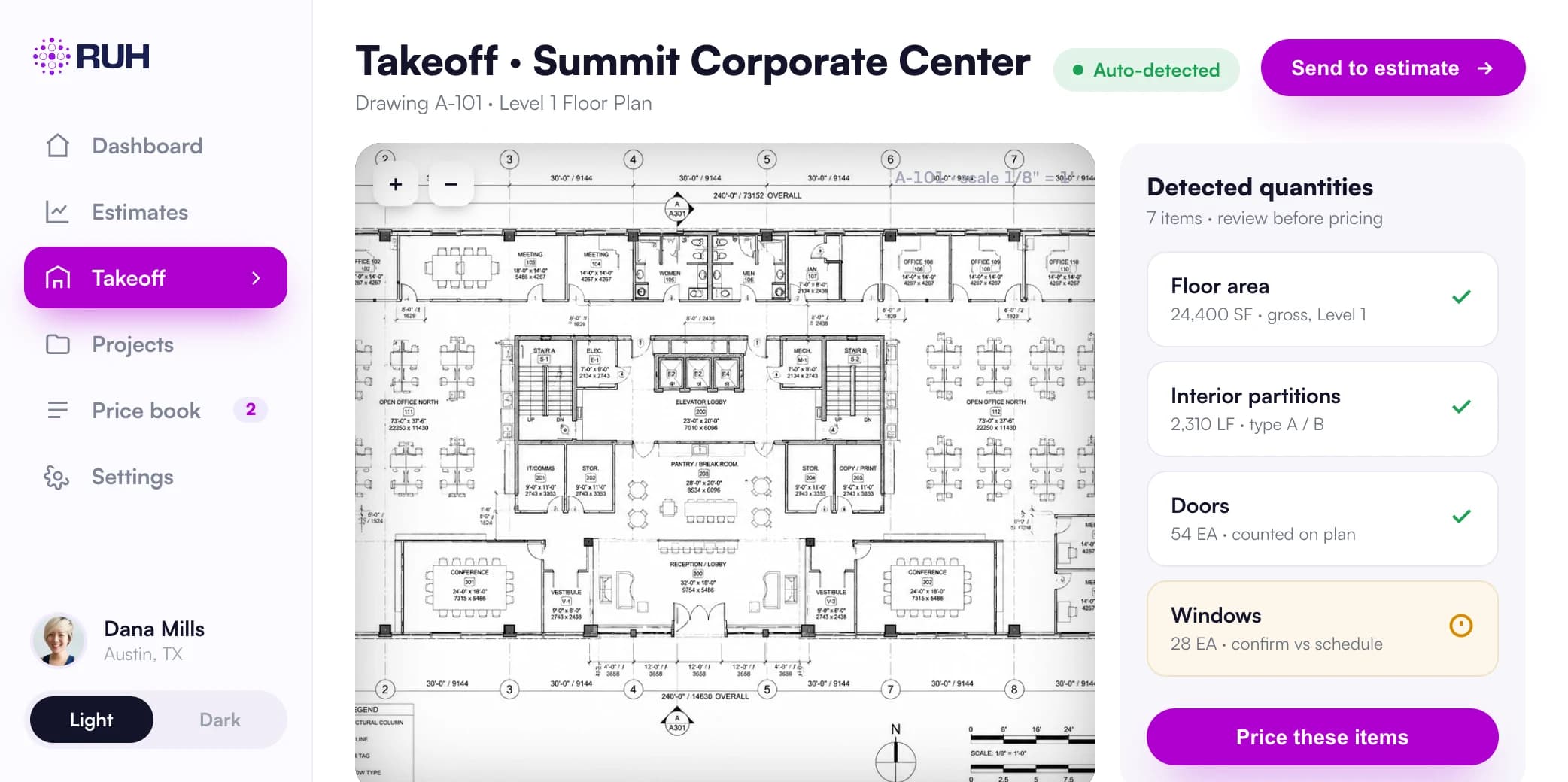
Ruh reads the millwork drawings, interior elevations, and details, then does the takeoff: lf of custom trim and handrail, sf of paneling, and counts of engineered assemblies like reception desks and built-ins, with species and AWI grade pulled from the spec. It prices shop fabrication and field installation against the contractor's own price book and returns a line-item draft. The estimator reviews the grade, finish, and installation assumptions, flags required blocking, and signs off.
See construction estimating softwareMillwork: frequently asked questions
What is the difference between millwork and casework?+
Millwork is custom architectural woodwork fabricated to the specific drawings, reception desks, paneling, ornamental trim, and one-off built-ins. Casework is modular cabinetry built to standard box sizes, base and upper cabinets, and tall units. Millwork prices as engineered, made-to-order work with separate shop and install costs, while casework prices closer to per linear foot of standard cabinet.
What does AWI grade mean for a millwork estimate?+
AWI grade (economy, custom, or premium) sets the standard for materials, veneer matching, joinery, and finish quality. The grade can swing the unit cost substantially because premium work demands tighter tolerances, better veneers, and more finishing labor. Read the architectural woodwork spec for the grade and species before pricing, since the same piece costs very differently across grades.
Should I include installation in the millwork price?+
Yes, and usually as its own visible line. Millwork is shop fabricated and then field installed, so the estimate should carry both a shop cost and a field installation cost. Also note any blocking or backing the framing must provide for heavy items to anchor to, since that scope belongs to rough carpentry and is a common coordination miss.
Still measuring by hand? Your next takeoff can run while you review this one.
See it on your plansRelated terms
Keep going: read the full guide or explore construction estimating software.
See Ruh price a bid from your own drawings.
AI takeoff and estimating on your price book, your estimator signs off.
Figures on this page are illustrative. Construction estimates depend on project-specific conditions, source documents, market pricing, and professional judgment. Ruh's AI assists the estimator and does not replace professional review: your team reviews, validates, and approves every estimate, bid, and pricing decision.