100% money-backBook a walkthrough

Construction glossary · MEP

What is AHU (air handling unit) in construction?

An AHU (air handling unit) in construction is the central piece of HVAC equipment that conditions and moves air through a building, packaging fans, heating and cooling coils, filters, and dampers in one casing, usually installed in a mechanical room. Estimators count AHUs each (ea) from the mechanical equipment schedule, with the unit's airflow in cfm driving the price. Unlike a packaged rooftop unit, an AHU does not generate its own cooling; it relies on chilled water or refrigerant from separate equipment.

Updated June 2026 · Reviewed by the Ruh construction team

AHU = air handling unitMoves conditioned airCounted from the mech schedule

How AHUs are counted

6 EAAir handling unitmechanical schedule

Estimating mep scope this week? Watch Ruh take off a real plan in 30 minutes.

Book a walkthrough
Definition

An air handling unit is the indoor air-side hub of a commercial HVAC system: supply and return fans, chilled water and hot water coils (or DX coils), filter banks, and mixing dampers assembled in one casing. On the documents it lives as a tagged unit (AHU-1) on the mechanical plans with its capacity data, cfm, coil rows, static pressure, and motor sizes, in the equipment schedule. Most commercial AHUs are factory-packaged modular units; true built-up units, field-assembled inside a mechanical room, show up on large hospital and lab projects. The mechanical contractor owns furnishing and setting the unit, but the scope touches everyone: concrete housekeeping pads, electrical feeds, hydronic piping connections, condensate drains, and BAS controls. New estimators price the box and miss the path. An 18,000 cfm unit may not fit in the freight elevator or through the corridor, which means knockdown shipment and field reassembly, rigging through a wall opening, or a roof hatch pick, all real money that never appears on the schedule. Verify the rigging route before the bid goes out, not after.

How it is measured

AHUs are counted each (ea) from the equipment schedule, and the schedule's airflow column, in cubic feet per minute (cfm), is the main cost driver: more cfm means a bigger casing, larger fans and motors, and deeper coils. Estimators carry one line per unit tag rather than lumping units together, because a 5,000 cfm unit and an 18,000 cfm unit are entirely different prices. Beyond the equipment line, the takeoff should capture rigging and setting, the housekeeping pad, vibration isolation, coil piping connections (chilled water, hot water, condensate), the electrical connection, and controls. The mechanical room plan and sections show clearances and the rigging path; the schedule shows static pressure and motor horsepower, both of which push the price within a given cfm size.

Worked example

Worked example

A four-story office building's schedule lists two indoor chilled water units: AHU-1 at 18,000 cfm and AHU-2 at 12,000 cfm. At an illustrative equipment cost of $4.50 per cfm, AHU-1 runs 18,000 x $4.50 = $81,000 and AHU-2 runs 12,000 x $4.50 = $54,000, an equipment subtotal of $135,000. Rigging and setting at an illustrative $6,500 per unit adds 2 x $6,500 = $13,000. The housekeeping pads are 4 in thick: an 8 ft x 24 ft pad (192 sf) for AHU-1 and an 8 ft x 18 ft pad (144 sf) for AHU-2, totaling 336 sf x 4/12 ft = 112 cf, and 112 / 27 = about 4.15 cy, carried as 5 cy at an illustrative $600 per cy for a small interior pour, or $3,000. Those three lines total $135,000 + $13,000 + $3,000 = $151,000 before piping, electrical, or controls connections.

100%

Try Ruh on a real bid. 100% money-back guarantee if you are not satisfied.*

*Scoped delivery, terms apply. Read the guarantee terms

Start with a walkthrough
How Ruh handles it

How Ruh handles AHU (air handling unit)

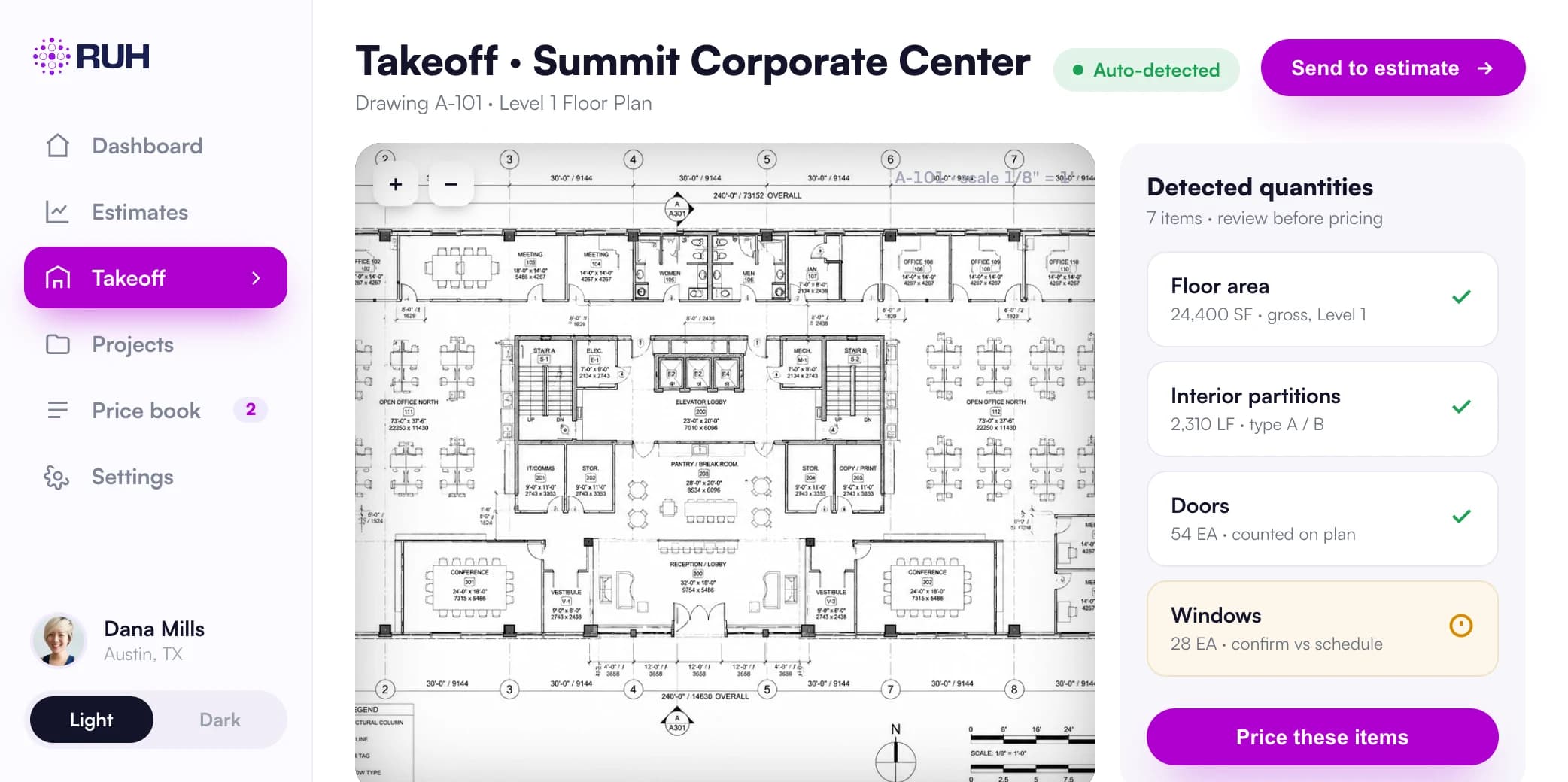
Ruh pulls the unit tags and cfm data from the equipment schedule, performs the takeoff with each AHU as its own line, and prices it against the contractor's own price book rather than generic cost data. The estimator then reviews the draft, adds job-specific items like rigging routes and pad sizes, and signs off before the number goes in the bid.

See AI construction takeoff and estimating software

AHU (air handling unit): frequently asked questions

What is the difference between an AHU and an RTU?+

An AHU is an indoor air-side unit, usually in a mechanical room, that moves and conditions air but relies on remote equipment (a chiller, boiler, or condensing unit) for its cooling and heating source, and it is sized in cfm. An RTU is a packaged rooftop unit with its own compressors and heat source built in, sized in tons. RTUs suit low-rise buildings with available roof area; AHUs serve larger or taller buildings with central plants.

What does cfm mean on an air handler schedule?+

Cfm is cubic feet per minute, the volume of air the unit moves. It is the single best proxy for an AHU's physical size and cost: higher cfm means larger fans and motors, a bigger casing, deeper coils, and heavier rigging. The schedule also lists external static pressure and motor horsepower, which push price within a cfm class, so two units with the same airflow are not automatically the same money.

What is a built-up air handler?+

A built-up AHU is assembled in the field inside a mechanical room from individual components (fans, coil sections, filter racks, casing panels) rather than arriving as a factory package. They appear on large hospital, laboratory, and industrial projects where airflow or space constraints exceed packaged offerings. For estimating, a built-up unit shifts cost from equipment to field labor and stretches the schedule, so it cannot be priced from a packaged unit's cost per cfm.

Still measuring by hand? Your next takeoff can run while you review this one.

See it on your plans

Related terms

Keep going: read the full guide or explore AI construction takeoff and estimating software.

The MEP estimating cheat sheet
Every unit, waste factor, and conversion on one page. Free PDF.

See Ruh price a bid from your own drawings.

AI takeoff and estimating on your price book, your estimator signs off.

Figures on this page are illustrative. Construction estimates depend on project-specific conditions, source documents, market pricing, and professional judgment. Ruh's AI assists the estimator and does not replace professional review: your team reviews, validates, and approves every estimate, bid, and pricing decision.