

TL;DR / Summary
ROM (Rough Order of Magnitude) estimates sit at the front door of preconstruction, a rough budget and timeline before you spend real hours on detailed takeoff. Manually, ROM estimation takes 2-5 days of an estimator's time per project. AI agents compress that to 2-4 hours, analyzing plans and specs at machine speed while your team validates the output. The result: faster bids, wider search for deals, and margin protection from better scope clarity upfront.
What you'll learn:
- Why ROM estimation is the hidden leverage point in preconstruction workflows
- How AI agents extract quantities and costs from plans without human line-by-line review
- The specific time and cost gaps between manual ROM estimation and agent-driven workflows
- How ROM accuracy cascades downstream into schedule confidence and field execution
- Where Ruh AI's takeoff and estimating agents fit into your preconstruction stack
Key numbers upfront: General contractors running manual ROM estimates invest 16-20 estimator hours per project before deciding whether to bid. Agent-driven ROM estimation reduces that to 3-4 hours. At 20 bids monthly, that saves 12-17 hours per ROM across 240 ROMs a year, or about 2,900-4,100 estimator hours annually, while leaving more time for scope review on existing estimates.
What ROM Estimates Are, And Why Speed Matters
ROM (Rough Order of Magnitude) estimates answer one question: Should we bid this job, and at what ballpark cost and duration?
They're not final. They're fast intelligence used by business development, project managers, and owners to decide whether to invest in a formal detailed estimate. The margin of accuracy is typically ±25-50%, which is fine, the goal is directional cost and schedule confidence, not precision.
Here's where most contractors lose time: ROM estimation still requires someone to review plans (counting major assemblies, square footage, linear feet, major equipment), cross-reference preliminary specs, and build a rough cost model. Even on a straightforward 50,000 sq ft commercial project, that's typically 2-3 days of an estimator's focused hours. For complex industrial or heavy civil work, add another 2-3 days.
At a typical fully-loaded estimator cost of $120-180K annually, a single ROM estimate costs $600-1,200 in labor alone. Scaled across 20-30 bids monthly, the cost is real, and so is the opportunity cost. Your best estimators spend time on projects you won't win, leaving less capacity for detailed work on projects that close.
Compression here directly improves your bid hit rate, fewer "analysis paralysis" passes on marginal deals, more estimates pushed to detailed phase on high-confidence projects.
The Takeoff Bottleneck: Why ROM Estimation Takes So Long
Manual takeoff, counting and pricing quantities, is the core of ROM estimation and it's timing-intensive for one reason: humans are slow at visual pattern recognition at scale.
An estimator reviewing a 100-sheet set of plans manually walks through assemblies: concrete footings, wall quantities, roof area, electrical runs, HVAC capacity. They cross-reference the spec for material grades and methods. They note equipment and long-lead items. They build a unit-cost model. All of this is judgment-based and methodical, but it's inherently sequential.
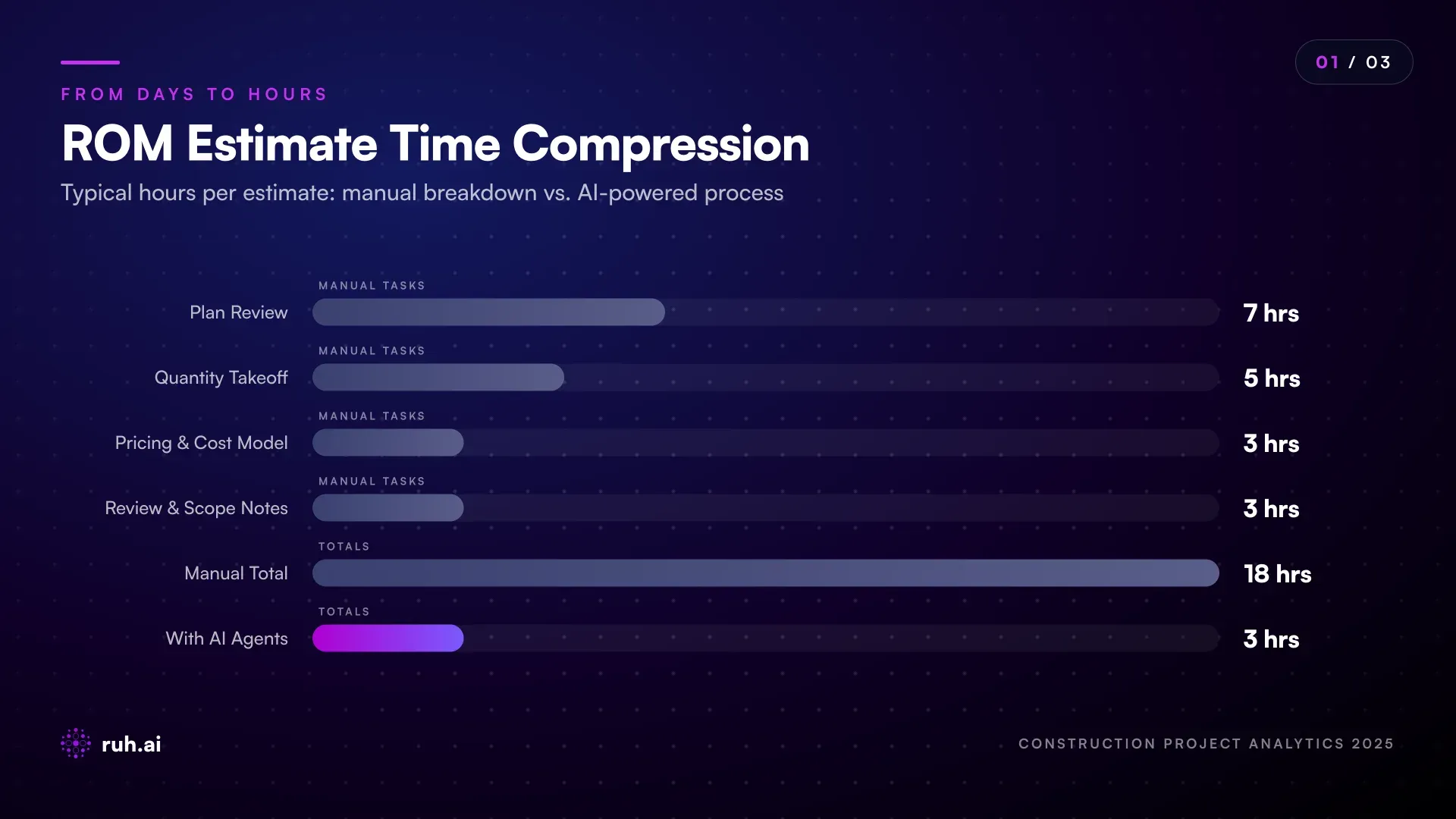
A typical 2-3 day ROM cycle breaks down like this:
- Plan review and assembly identification: 6-8 hours (noting major structural, MEP, and architectural systems)
- Quantity takeoff: 4-6 hours (counting, measuring, cross-checking against specs)
- Pricing and cost modeling: 2-3 hours (applying RSMeans, local labor rates, supplier quotes)
- Review and scope notes: 2-4 hours (assembling RFI list, noting ambiguities, building narrative)
That's 14-21 hours of manual labor, often compressed into 2-3 days because it requires continuity of thought.
The bottleneck is pure cognitive load: plans are image data, specs are text, site conditions are sometimes photos or notes. Humans have to mentally integrate all of that into a coherent quantity list. Machines, given the right training and tools, can do this in parallel, processing multiple pages simultaneously, cross-referencing specs algorithmically, and outputting a structured takeoff in minutes.
How AI Agents Analyze Plans and Extract Quantities
AI agents designed for takeoff work differently than traditional automated takeoff software (which relies on OCR or rule-based area measurement).
A modern construction AI agent trained on thousands of plan sets and specs can:
Parse multi-page PDFs and image sets in parallel, not sequentially. A 100-sheet plan set is processed as a whole dataset, not one sheet at a time.
Recognize construction assemblies visually, foundation types, floor systems, wall heights, roof configurations, across variations in drafting standard and detail level. This isn't brittle rule-matching; it's pattern recognition trained on real-world plan complexity.
Cross-reference specs algorithmically, mapping plan details against written specifications to infer material types, methods, and performance grades without human interpretation.
Output structured takeoff data, assemblies, quantities, units, locations, formatted for downstream costing. Not a PDF marked-up with highlights; a database-ready list.
Flag exceptions and ambiguities proactively. If a plan shows a column depth that doesn't match the specified strength grade, the agent notes it as a scope question, saving your estimator from finding it later in detailed design.
AI agents differ from automated software in one critical way: they make judgment calls on incomplete information and flag uncertainty, rather than requiring perfect input data.
For ROM estimation specifically, this matters because ROM plans are often preliminary, architectural and MEP coordination is rough, details are deferred, and some scope is "TBD pending site survey." A rule-based tool fails on TBD items; an AI agent flags them as assumptions needing validation, then proceeds with a best-estimate quantity based on similar historical projects.
From Manual Quantification to Agent-Driven Takeoff: A Real Workflow
Here's how the workflow changes with AI agents in place.
Manual ROM workflow (2-3 days):
- Estimator prints or reviews plans on screen, sheet by sheet
- Opens a spreadsheet or takeoff software
- Manually counts and measures: square footage of floor slabs, linear feet of walls, number of doors, equipment loads
- Cross-references spec manually for material assumptions
- Applies unit costs (RSMeans, local rates, supplier quotes)
- Assembles a cost model and narrative
- Reviews for completeness and notes RFIs
- Delivers ROM to PM or business development
Agent-driven ROM workflow (2-4 hours):
- Upload plans and specs to the agent (PDF, image set, or link to plan repo)
- Agent processes and outputs: assembly-by-assembly breakdown with quantities, flags, and scope notes
- Estimator reviews agent output (5-10 minutes per section) and validates assumptions
- Estimator applies pricing (often from existing RSMeans or supplier integrations)
- Agent assembles final cost and schedule estimate
- Estimator reviews once, notes assumptions, signs off
- ROM delivered
The time difference is not just speed. It's also completeness, the agent doesn't fatigue or miss items on page 87. It doesn't re-count the same assembly three times. It doesn't have to manually flip between plan sheets and spec sections. It outputs a comprehensive, auditable takeoff in a fraction of the time.
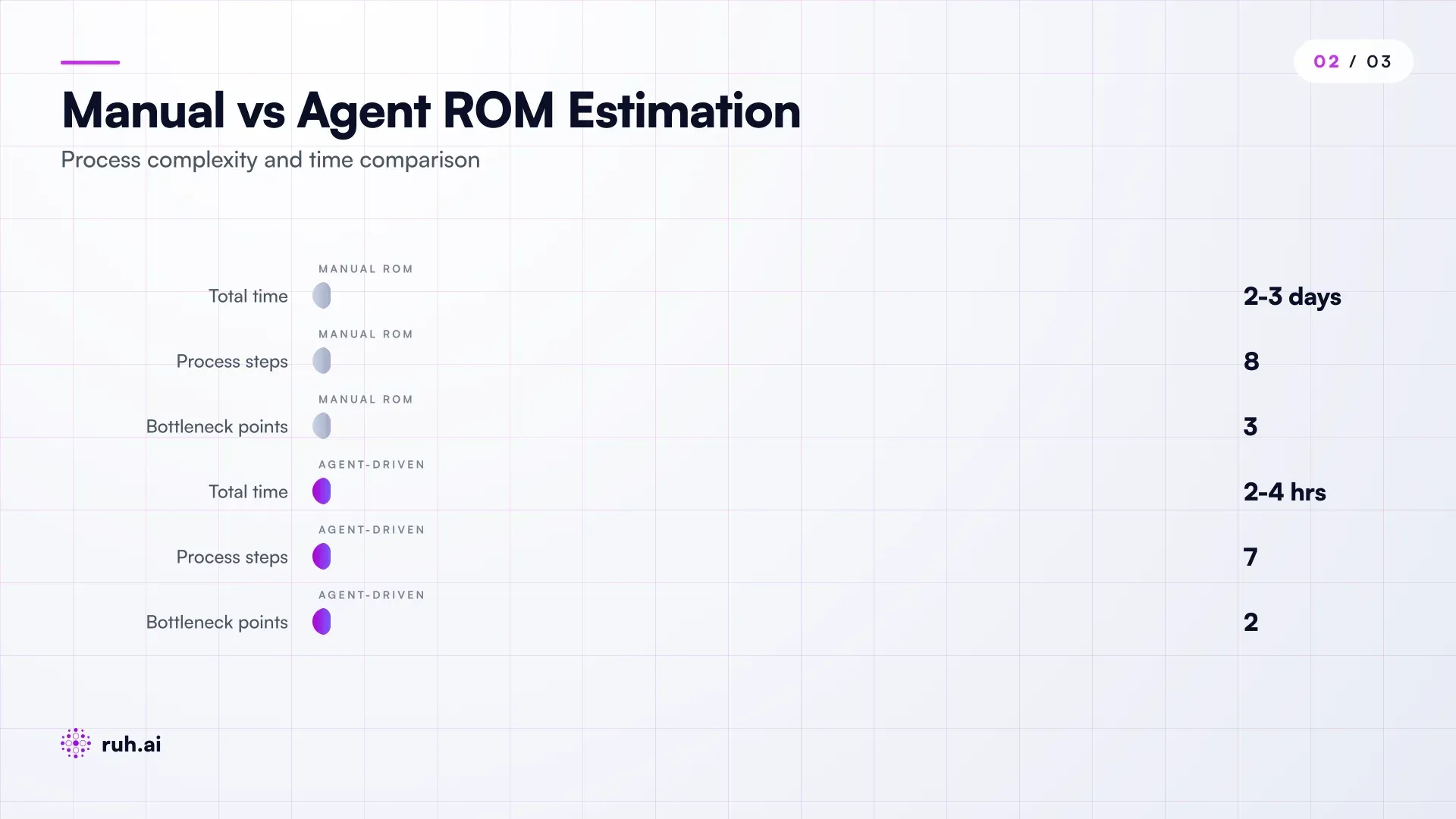
For a commercial project, the time compression is visible:
- Manual: 16-20 hours, with an all-in ROM cost of $1,160-1,400
- Agent-assisted: 3-4 hours, with an all-in ROM cost of $210-290
At 20 bids monthly, that saves 12-17 hours per ROM across 240 ROMs a year: 12-17 x 240 = 2,880-4,080 hours, or about 2,900-4,100 estimator hours annually, while improving consistency and reducing rework.
ROM Estimate Accuracy and the Downstream Cost of Error
ROM estimates sit at a critical junction: they determine whether a project is bid at all, and they anchor your final estimate psychology.
A ROM that's too high kills the deal before detailed estimate begins. A ROM that's too low sets a cost expectation that's hard to revise upward during detailed design without credibility damage. Accuracy in ROM estimation directly protects margin.
AI agents improve ROM accuracy in two ways:
First: elimination of human counting errors. A 100-sheet plan set has 400-600 assemblies and sub-assemblies. Humans typically make 3-5 errors per project, missed items, double-counts, or misread dimensions. That's a 0.5-1.5% error rate on quantity. At $50-200 per assembly-hour cost, even small misses cascade. Agents have near-zero counting error; the error surface shrinks to assumption misclassification (e.g. calling a wall concrete when it's framed, inferring fire rating from incomplete spec language).
Second: consistency in application of cost data. Manual estimators apply RSMeans rates, labor adjustments, and site factors, but not uniformly. One estimator assumes 15% productivity loss for a multi-story project; another assumes 25%. An agent, once calibrated to your cost model, applies it consistently across all projects, eliminating estimator variance and making ROM estimates more predictive.
Field operations also benefits. A ROM that's built on accurate takeoff data, correct quantities, clear scope boundaries, results in RFI reduction. Your superintendent and PMs have a baseline quantity that matches the bid, so change orders and variation orders are negotiated from a defensible position instead of "the estimate wasn't clear on this."
ROM Estimation and the Schedule Confidence Chain
Compressed ROM timelines also unlock schedule benefit.
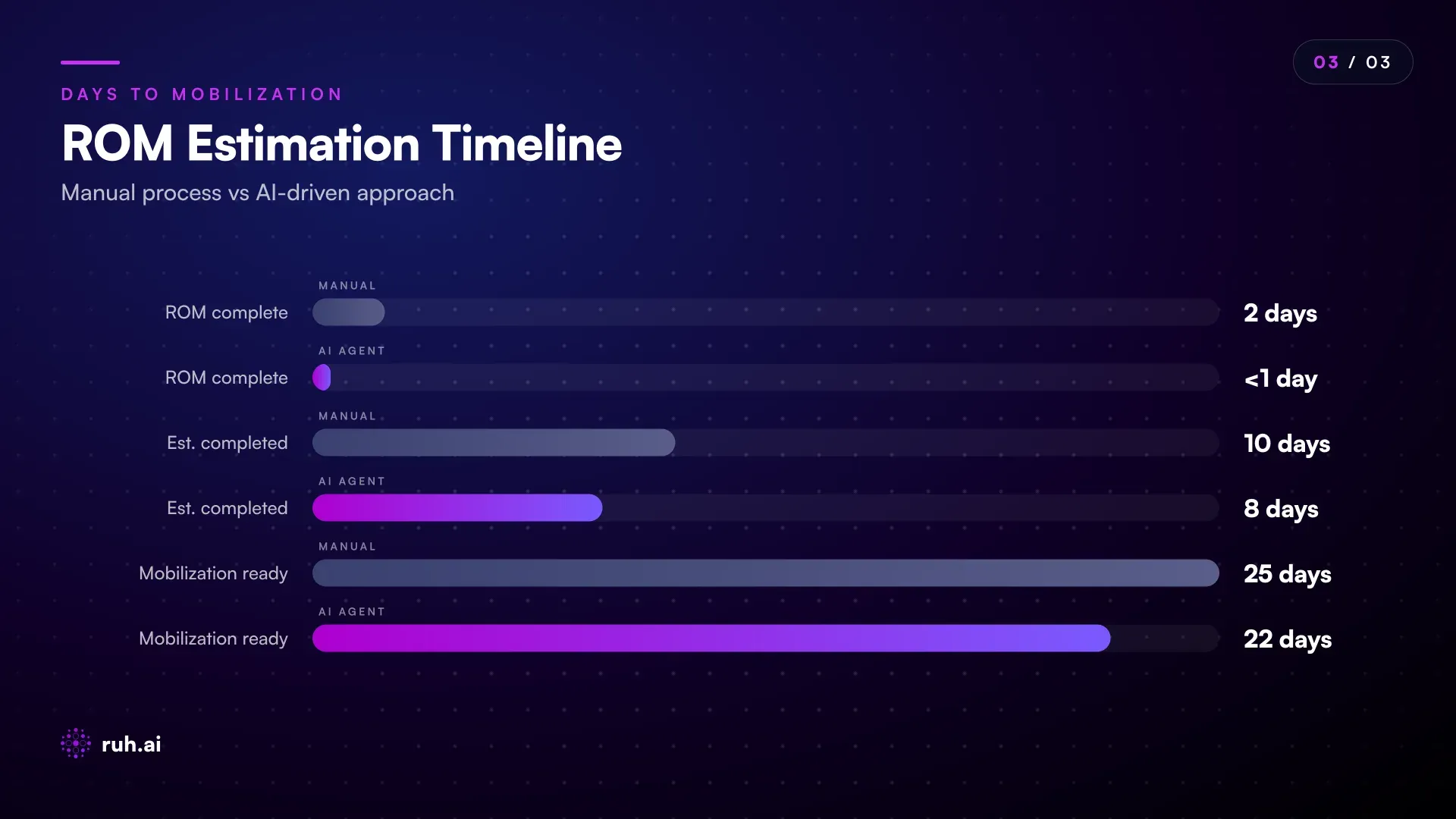
Preconstruction typically flows: ROM → decision to bid → detailed estimate + schedule → buyout → mobilization. A 2-day ROM estimate delays the decision-to-bid gate by 2 days. A 2-4 hour ROM estimate compresses that gate to same-day or next-morning, allowing you to move faster through the buyout and scheduling phases.
For fast-track or design-build projects, this matters operationally. You can commit to buyout earlier, locked in your labor and material suppliers before price escalation happens mid-month. You can start preliminary scheduling earlier, identifying long-lead items and bottleneck subs before critical path risk builds.
Compressed ROM timelines also improve cash-flow psychology. A job that enters detailed estimate and buyout 1-2 days earlier can theoretically mobilize 1-2 days sooner, shifting revenue recognition and schedule margin earlier in the project life.
The Financial Case: Labor Cost and Scaling
Let's ground this in concrete dollars.
Manual ROM estimation cost per project:
- Estimator labor: 16-20 hours at $60/hour blended (loaded cost ~$120K annually ÷ 2000 hours) = $960-1,200 per ROM
- Software and data (RSMeans subscriptions, plan management): ~$200 per project
- Total: $1,160-1,400 per ROM estimate
Agent-driven ROM estimation cost per project:
- AI agent service (Claude-based with plan processing): ~$30-50 per estimate
- Estimator review: 2-3 hours at $60/hour = $120-180
- Pricing/costing (often reused from previous estimates): 1 hour = $60
- Total: $210-290 per ROM estimate
Cost savings per ROM: $870-1,110 (75-80% reduction).
Scaled across a mid-sized GC bidding 20 projects monthly:
- Annual ROM estimation budget (manual): $278,400 (20 × 12 × $1,160)
- Annual ROM estimation budget (agent-driven): $50,400 (20 × 12 × $210)
- Annual savings: $228,000
That's equivalent to hiring an additional estimator, or investing that capital in business development and marketing. For smaller GCs (5-10 monthly bids), the annual recovery is still $60-120K, enough to hire an admin or commission chase on buyout.
Integrating ROM Estimation Into Your Preconstruction Workflow
Deploying AI-driven ROM estimation doesn't require ripping out your existing tools.
Most practical approaches integrate with Procore, Bluebeam, or your plan repository (many GCs store plans in cloud folders, project management platforms, or construction-specific cloud storage). The agent connects to the source, pulls plans and specs, processes them, and outputs data back into your estimating software (Timberline, ProEst, or custom spreadsheets).
Key integration points:
Plan repository connection, Agent pulls the latest plan set (PDF or images) from your source of truth. No manual file transfers.
Spec integration, Specs are often in separate documents (Word, PDF, or SpecsIntact). The agent correlates plan details with spec language to infer material and method assumptions.
Cost data integration, Your RSMeans subscription, supplier pricing, and labor rates feed the costing engine. The agent applies your cost model to agent-generated quantities.
Output to your spreadsheet or software, ROM takeoff exports as CSV or directly to your estimating platform, pre-formatted for assembly-by-assembly review.
Audit trail and change tracking, Agent outputs are versioned and tied to plan revisions, so when plans change (as they always do mid-ROM), you can re-run the agent and see deltas.
For teams already using Ruh Estimator or similar agent-based platforms, this integration is native, the agent pulls the specs, generates the takeoff, prices it against your cost model, and outputs both a summary ROM and detailed assembly list ready for buyout.
The Honest Assessment: What AI Still Struggles With in ROM Estimation
Agent-driven ROM estimation is fast and accurate on quantifiable items. But it has real limitations worth acknowledging.
Site-specific adjustments: An agent can't see that your project is on a steep hillside that will require 50% extra labor for concrete placement, or that the local jurisdiction requires concrete strength certification that adds $2/sq ft. Agents infer from plan notes and specs, but miss site-specific context that requires either a field visit or verbal project brief. Your estimator still needs to interview the PM or GC, then manually adjust the agent output.
Coordination assumptions: When plans show slight inconsistencies (architectural floor plan says one column spacing, structural plan shows another; MEP routes suggest different heights than architectural ceiling plans), humans resolve these conflicts through experience and judgment. Agents flag them as discrepancies but can't always decide which is "right." ROM output will be incomplete until a human makes the call.
Long-lead items and supply-chain context: An agent can identify that a project requires a 100-ton crane, but it doesn't know that your region has a crane shortage, adding 4-week lead time and 25% cost premium. Supply-chain intelligence requires either manual input, real-time market data (which agents can access if wired to it), or a PM's verbal context. Most current workflows require estimator adjustment.
Soft costs and general conditions: Agents excel at direct cost (labor, material, equipment). They struggle with soft costs (permits, insurance, bonds, contingency) because these are policy-driven, not extractable from plans. GCs still apply these as a percentage or lump sum post-agent-takeoff.
The pragmatic answer: Agents accelerate 60-70% of ROM estimation work (quantifiable, repeatable tasks). The remaining 30-40% still requires human judgment, site specifics, coordination decisions, supply-chain adjustments, and soft costs. The value isn't full automation; it's shifting estimators from 2-day quantity-counting grind to 4-6 hour review, judgment, and assumption-setting work.
How Ruh AI Accelerates ROM Estimation
Ruh AI's Takeoff Agent and Ruh Estimator platform are built for this specific workflow.
The Takeoff Agent connects to plan repositories (Procore, Bluebeam, cloud storage) and outputs a detailed assembly-by-assembly breakdown, quantities, locations, specs cross-referenced, in 15-45 minutes depending on plan complexity. It's trained on thousands of construction documents and understands multi-sheet coordination, deferred details, and common RFI-worthy scope ambiguities.
Ruh Estimator then wraps the takeoff with cost data. It applies your labor rates, RSMeans or internal cost databases, supplier pricing integrations, and project-specific adjustments (site factors, productivity loss, escalation). It outputs a complete ROM estimate with narrative scope notes and flagged assumptions, ready for PM review and decision-to-bid.
Real metrics from GC users of Ruh Estimator:
- ROM estimation time: 18-22 hours (manual) → 2.5-3.5 hours (agent + review)
- ROM accuracy: ±35-45% → ±18-25% (fewer missed items, consistent cost application)
- Bids per estimator per month: 8-12 → 18-25 (capacity multiplied, same headcount)
- RFI rate post-takeoff: 2-4 RFIs per ROM during detailed estimate → 0.5-1.5 (fewer scope ambiguities)
The platform integrates natively with Procore and Bluebeam for plan management, pulls cost data from your RSMeans account or internal databases, and exports to Timberline, ProEst, or your standard spreadsheet. No custom integration work needed.
Frequently Asked Questions
Q: If I use an AI agent for ROM takeoff, do I still need an estimator to review it? A: Yes. The agent output is quantified and priced, but requires a skilled estimator to validate assumptions, adjust for site-specific factors, flag coordination issues, and own the estimate. The agent removes the 2-day counting grind; the estimator focuses on judgment and risk. The typical review cycle is 3-4 hours for a complete ROM, vs. 18-20 hours of generation + review manually.
Q: What if my plans are old PDFs or non-standard formats? A: Modern agents handle scanned PDFs, image-based plans, and mixed formats (some sheets CAD, some scanned drawings). They're more robust than older OCR-based tools. Very old or hand-drawn plans may require manual preprocessing, but anything digitized in the last 15 years processes without issue. Test with a sample project first.
Q: Can AI agents handle complex structural or MEP work, or just simple commercial buildings? A: Agents trained on diverse project types (commercial, industrial, heavy civil, healthcare, manufacturing) handle structural steel, concrete, complex MEP, and mixed-use work. The accuracy is consistent across types if the agent has seen that project category in training. Highly specialized work (pharmaceutical cleanrooms, data-center power infrastructure) may require more estimator judgment, but the agent still reduces the baseline counting work.
Q: How do I ensure the cost data in the ROM aligns with our actual suppliers and labor rates? A: Agent-based platforms like Ruh Estimator integrate with your cost databases (RSMeans, internal spreadsheets, supplier APIs). You configure the cost model once, and it applies consistently across all estimates. Updates to labor rates or supplier pricing sync automatically, so every ROM reflects current market data.
Q: Does agent-based ROM estimation work for design-build or fast-track projects? A: Yes. In fact, it works better in these scenarios because you need ROM faster, and coordination between architectural and structural plans is messier (more TBD, more sketchy details). The agent flags ambiguities and proceeds with reasonable assumptions, giving you a ROM in hours instead of days. You can start buyout and scheduling earlier, which is critical in fast-track.
Q: What's the learning curve for our team to adopt AI-based ROM estimation? A: If you're using Procore or standard estimating software (Timberline, ProEst), there's minimal learning curve. Upload plans, review the agent output, adjust cost assumptions if needed, and export. Most estimators are productive within 1-2 projects. The bigger shift is psychological, trusting the agent's takeoff and focusing on validation rather than generation.
Q: Can AI agents handle RFI identification and flag the most important scope ambiguities? A: Yes. Agents trained on plan coordination can flag inconsistencies (dimensional mismatches between plans, spec contradictions, deferred details marked as TBD) and surface them as potential RFIs. This reduces surprises during detailed design and protects your bid credibility.
CTAs and Next Steps
ROM estimation is the wedge into AI-driven preconstruction. Faster ROM cycles compound across bid volume, freeing your team to win more deals and protect margin on the ones you land.
Explore Ruh Estimator and watch agents compress ROM estimation from days to hours →
See how Ruh Takeoff Agent integrates with Procore and your cost data →
Talk to the Ruh AI team about deploying agents in your preconstruction workflow →