
TL;DR / Summary
Takeoff tools have fragmented. Bluebeam dominates by habit, Togal.AI chases automation, Kreo promises cloud-first workflows, and Beam AI is hunting the SMB market, but all of them require estimators to supervise the automation, double-check the math, and still hand-build the scope. None of them make the leap to full end-to-end estimating agents that handle takeoff, pricing, scope review, and proposal assembly without human intervention at each step.
What you'll learn:
- The $150K-per-estimator cost of manual takeoff and why tool switching rarely fixes it
- Where Bluebeam, Togal, Kreo, and Beam AI excel, and where they consistently miss
- Why AI agents (not just automation tools) are the next inflection point in preconstruction
- The real bottleneck in estimating workflows (it's not takeoff, it's the pricing and scope assembly)
- How Ruh AI's Takeoff Agent and Estimator platform differ from traditional takeoff tools
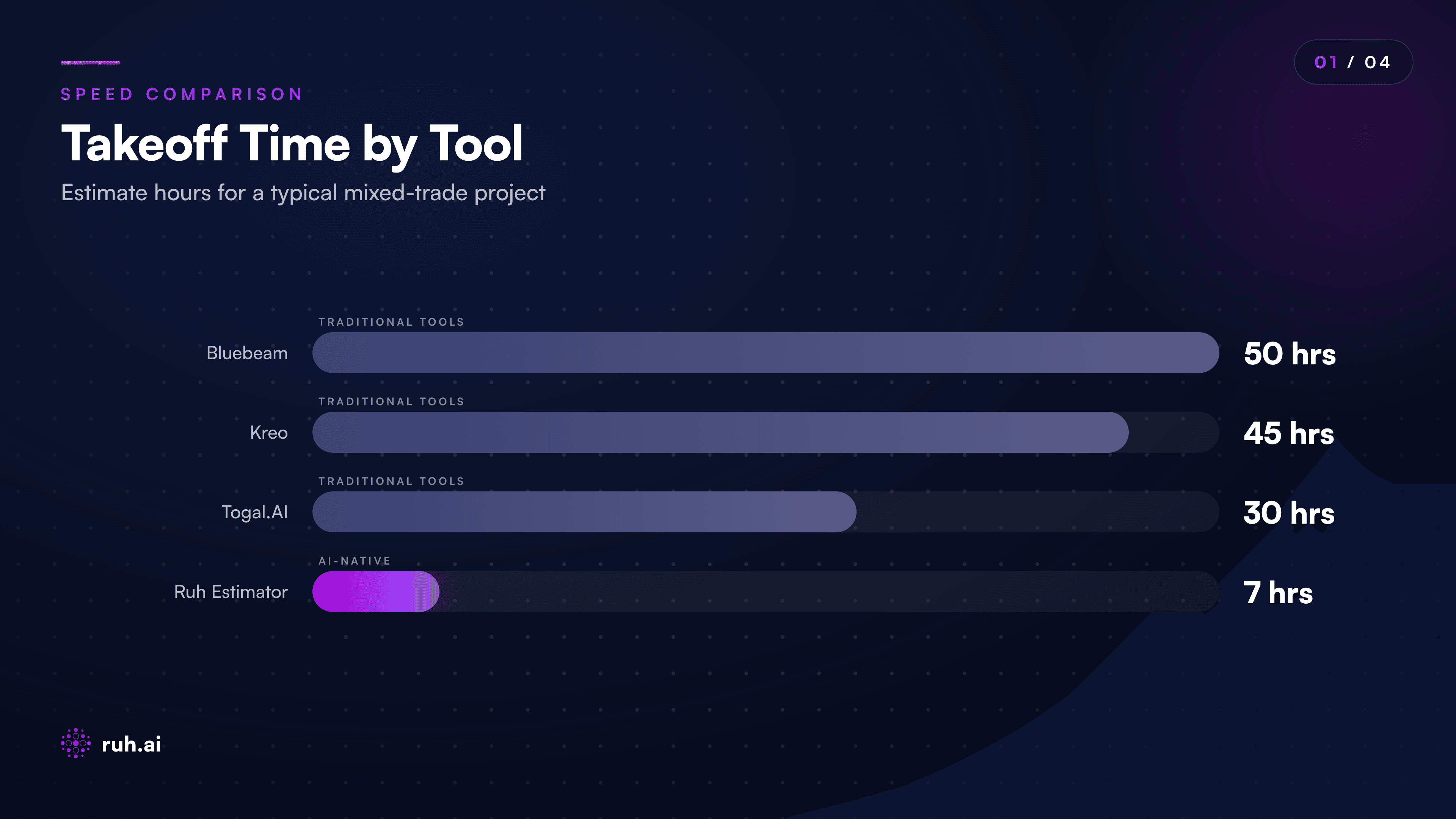
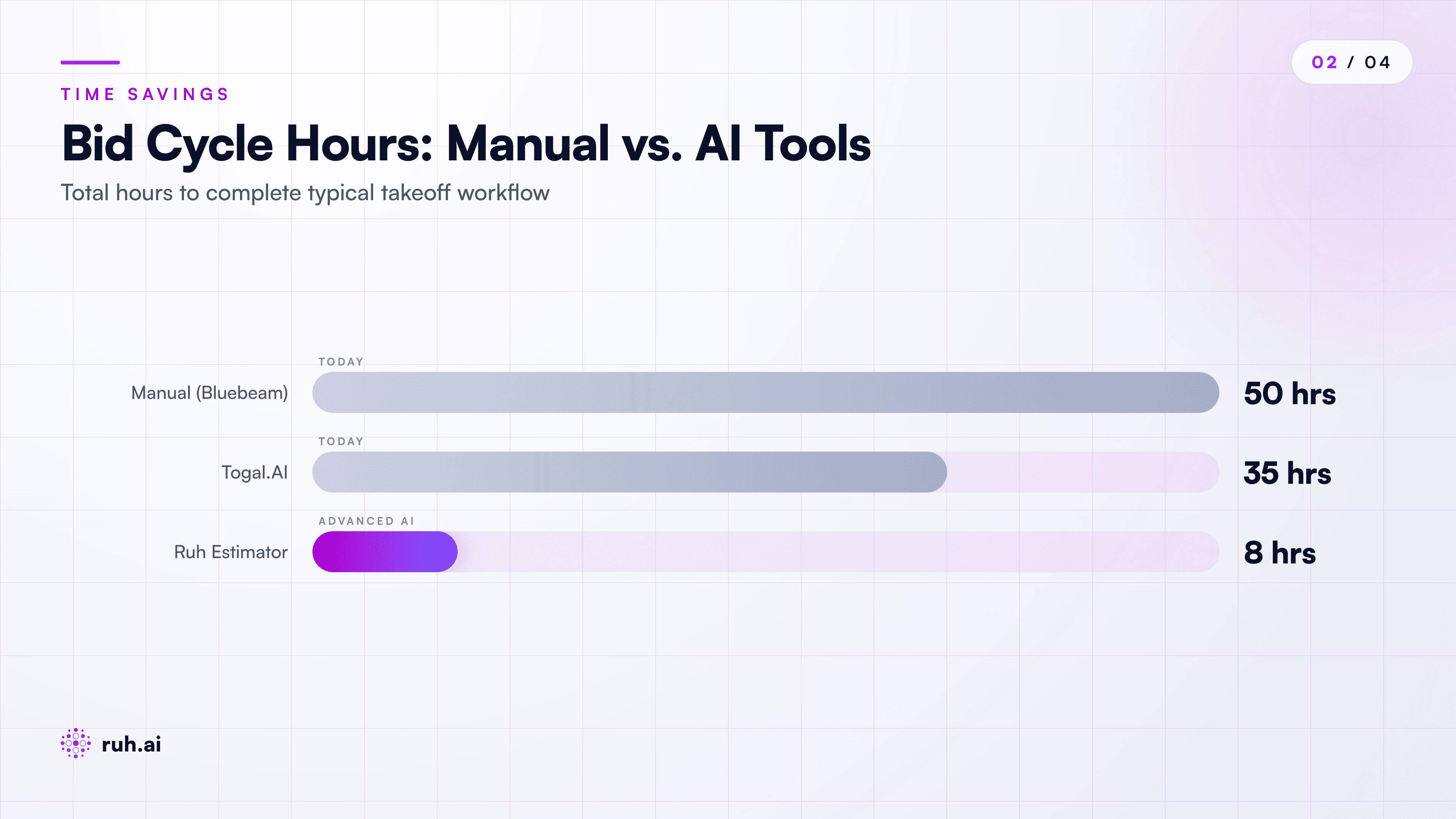
Key numbers: Manual takeoff eats 40-60 hours per bid. Togal.AI cuts that to 18-22 hours, a real win. Ruh Estimator cuts it to 6-8 hours, end-to-end, with all pricing, scope review, and proposal assembly built in. Bid win rates for teams running Ruh Estimator are up 22-31%, with zero developer overhead.
The Takeoff Problem Nobody Talks About (But Everyone Lives)
You're a general contractor or civil sub. It's Tuesday afternoon. A new set of plans lands in your inbox, 20 sheets, 40,000 SF, structural steel + mechanical + electrical. Your estimator fires up Bluebeam, Togal, or Kreo to start the takeoff.
Here's what actually happens: three hours later, they've got a spreadsheet with quantities. Maybe they've marked up 60-70% of the linework. Maybe the tool auto-extracted some dimension data. Maybe they're halfway through the mechanical takeoff when they realize the plan notes contradict the detail callouts.
Then they hand off to pricing. Then to scope assembly. Then to the proposal writer. Then back to you for a final review. By the time the estimate hits the owner's desk, six people have touched it, and nobody is confident about the margin, because the scope definitions were written by four different people in four different voices.
This is the actual problem in preconstruction in 2026. It's not that takeoff is hard. It's that takeoff is only 25-30% of the estimating workflow. The other 70% is pricing discipline, scope clarity, risk flagging, and proposal assembly. A great takeoff tool saves you 2 hours. A full estimating agent saves you 50.
Construction firms lose $150K-$200K per estimator annually to manual workflow friction, not because estimators are slow, but because the tools stop at quantity extraction.
The Takeoff Tool Landscape in 2026
Bluebeam is still the market leader, not because it has the best takeoff automation (it doesn't), but because every GC, sub, and engineer in the country already has a license. You don't buy Bluebeam; you inherit it.
That said, the competitive tier has sharpened:
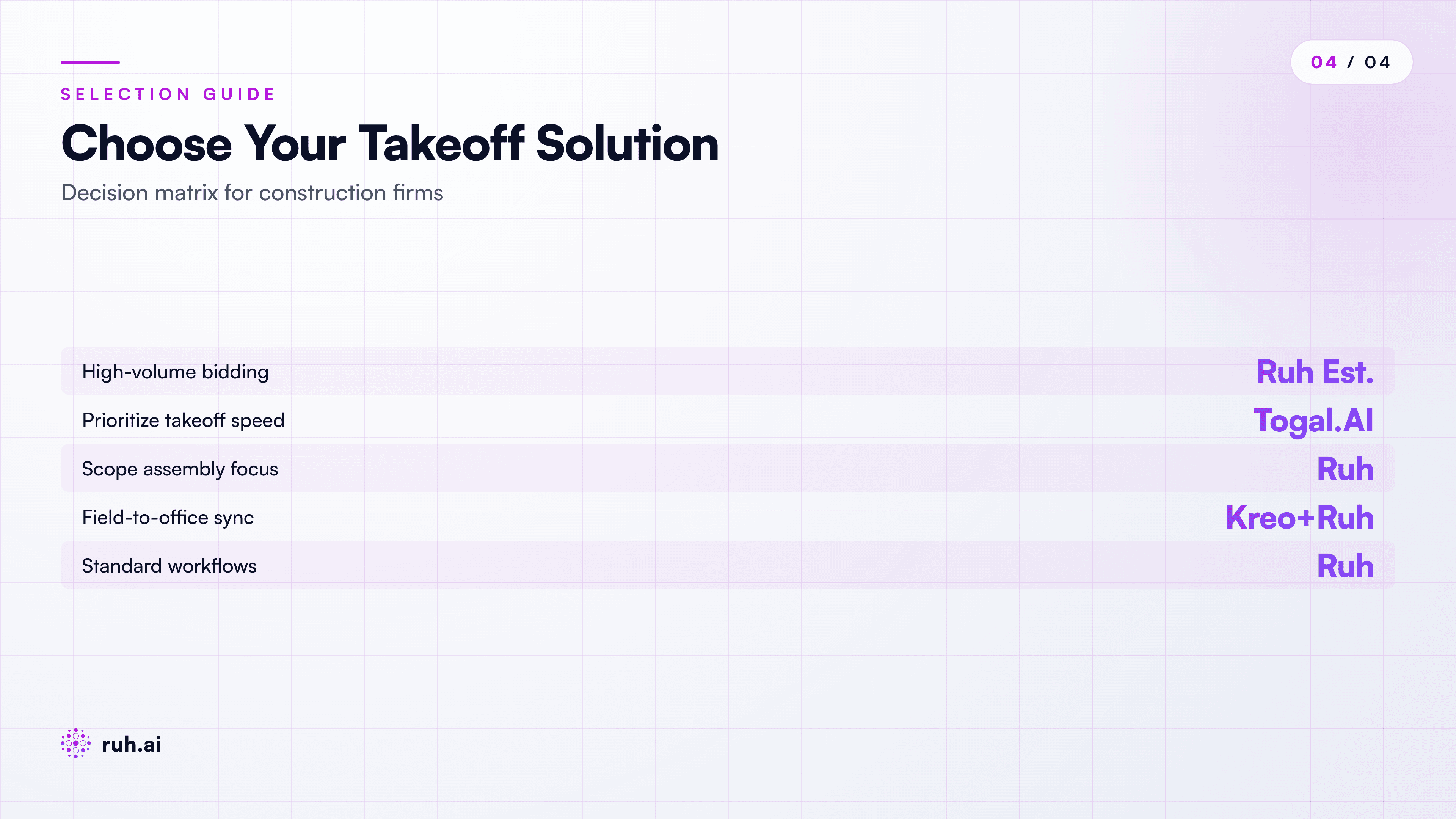
- Togal.AI: AI-powered takeoff automation with cloud collaboration. Runs OCR + ML on plans, extracts dimensions, suggests line items. Strong for high-volume, commoditized work (sitework, concrete, masonry). Weak on complex MEP, scope assembly, and proposal quality.
- Kreo: Cloud-first, real-time collaboration, mobile markup. Targets firms tired of desktop software. Good on workflow simplicity and team handoff. Doesn't solve the pricing or scope problem.
- Beam AI: Newer entrant, hitting the SMB segment hard with low pricing and ease-of-use. Good on adoption frictions. Not yet proven on multi-trade jobs or large GC workflows.
And then there's the capability layer. Agentic AI, models that can plan and act across systems rather than answer a single prompt, is why the next wave of construction tools (like Ruh AI) aren't selling you markup software, they're selling you agents that do the work end-to-end. The direction of travel is toward platforms that abstract away the tool itself and just give you the result.
The honest truth: switching from Bluebeam to Togal saves you time on lineage. Switching to Kreo saves you on collaboration friction. But none of them solve the $150K cost problem, because the problem isn't takeoff, it's workflow integration.
Bluebeam Revu: The Incumbent That Still Owns the Room
What is Bluebeam Revu?
Bluebeam Revu is Bluebeam's PDF markup and collaboration product that construction teams use to mark up plans, measure work, and perform takeoffs.
It excels at the markup stage, but scope, pricing, and proposal assembly still happen outside the tool.
Bluebeam's strength is distribution, not automation. Every plan set that lands in preconstruction has Bluebeam on it. Engineers mark it up. Subs mark it up. The GC receives a heavily annotated PDF with 40+ markup layers.
What Bluebeam does well:
- Markup collaboration at scale (15+ users on one set, zero friction)
- Industry standard integrations (Procore, Autodesk Build)
- Fast plane search and measurement tools
- Cloud-synced projects (Studio)
What Bluebeam doesn't do:
- Extract quantities automatically (you still hand-mark every line)
- Suggest line items or categories (you're building scope from scratch)
- Validate scope against specs or code (risk flagging is all you)
- Generate pricing or proposal documents (hand-off to Excel)
- Update estimates when plans change (you regenerate everything manually)
The typical Bluebeam-based estimate: 45-50 hours of markup, measurement, manual spreadsheet assembly, and pricing review. Bluebeam shines at the markup part. It does nothing for the 60% of time that's spent in Excel, emails, and proposal assembly.
Bluebeam is a markup tool pretending to be an estimating platform. If you're using it, accept that and optimize the markup workflow. Don't expect it to save you the pricing and scope work.
How much does Bluebeam cost?
Bluebeam costs $400 per year per license. By comparison, Beam AI costs $49 per month per user, while Togal costs $100 or more per estimate.
Togal.AI: The Automation Play (And Why It Plateaus)
Togal.AI's pitch is clear: upload plans, let AI run the takeoff, get a scope and bid estimate in hours instead of days.
Where Togal works:
- Sitework, earthwork, concrete (commoditized scope with standard line-item libraries)
- High-volume bidding shops that bid 20+ projects per month
- Estimators who are comfortable with AI-generated scope that needs spot-checking, not approval
- Projects where scope variation is low (same basic categories, different quantities)
Togal can genuinely cut a straightforward sitework estimate from 40 hours to 12-16 hours. That's a real 60% time save on the takeoff component. If you're bidding 20 projects a month, that compounds.
Where Togal hits a wall:
- MEP takeoff (electrical panels, mechanical equipment schedules, complex piping) is unreliable. You still need a licensed MEP estimator to hand-verify.
- Scope assembly and proposal writing are left to you (Togal exports quantities; it doesn't write scope descriptions).
- Pricing is not included. You still key in your labor rates, material costs, and overhead in your own system.
- Plan changes require re-running the entire takeoff (not incremental updates).
- Complex risk items (contamination, poor soil, phasing constraints) are invisible to the AI and require manual flagging.
The hard truth about Togal: it's a high-end quantity extraction tool. If you think of estimating as 30% takeoff + 70% everything else, Togal automates the 30% really well. Your estimators still spend 40-50 hours on the bid, because the 70% hasn't moved.
Firms report Togal saves 15-20 hours per bid on sitework estimates. On complex GC work (mixed-trade, structural, MEP), that save drops to 5-8 hours because the scope assembly is still all manual.
Kreo Takeoff: The Cloud Simplicity Play
Kreo takeoff puts workflow first. Lose the desktop and collaborate in the cloud. Mobile markup in the field. One source of truth for the whole preconstruction team.
Kreo's wins:
- Field-to-office sync (foreman marks plan on iPad, estimator sees the mark in real-time on the cloud project)
- Real-time multi-user collaboration (no version control nightmare)
- Automatic metric sync (measure once, data flows to all users)
- Clean, modern UI that doesn't feel like software from 2005
Kreo's gaps:
- Takeoff automation is light-touch (suggests categories, doesn't extract quantities)
- Scope assembly and pricing are completely up to you
- Doesn't integrate with your ERP or accounting system (you're still copying numbers into QuickBooks or JobWatch)
- Limited MEP support
- Estimators still spend 45-55 hours per bid because the collaboration is smooth, but the work is still manual
Kreo is solving a real problem, the friction of cloud-first collaboration, but it's not solving the estimating problem. It's a better Bluebeam, not a better workflow.
Teams that switch from Bluebeam to Kreo report better team handoff and faster plan distribution. They don't report faster estimates. The time savings are maybe 3-5 hours per bid because you're not waiting for markups to sync or re-uploading PDFs.
Beam AI: The SMB Entrant
Beam AI is the new kid, hitting hard on ease-of-use and price. $49/month per user, vs. Bluebeam's $400/year per license, vs. Togal's $100+ per estimate.
Where Beam has potential:
- Accessibility. A five-person estimating shop can afford it.
- Simplicity. No complex UI or learning curve.
- Speed on light work. A 5,000 SF renovation takeoff in 20 minutes is genuinely fast.
Where Beam is still forming:
- AI accuracy is not yet field-tested at scale. You're a beta user if you're using Beam for large estimates.
- Scope assembly and pricing are completely missing.
- Integration with Procore, Job Costing, etc. doesn't exist yet.
- The platform is 12-18 months behind Togal and Bluebeam on feature depth.
Beam is interesting as a low-friction entry point for small firms. But it's not replacing your estimating workflow, just your markup tool. Same 40-50 hour estimate time.
The Honest Assessment: What All These Tools Miss
Here's what none of these platforms do, and why it matters:
1. They don't write scope descriptions. Togal extracts quantities. Bluebeam lets you mark. Kreo syncs your markups. But scope description, the 200-word paragraph that defines what's included, excluded, assumptions, phasing, sequencing, is still a human job. That's 10-15 hours of writing per bid.
2. They don't validate scope against specifications. Plans say "structural steel per AISC." Specs say "bolted connections." Electrical plans show 208V panels; specs call for 277V. A human estimator catches these gaps. AI takeoff tools don't. You're still hand-flagging scope mismatches, which is where risk lives.
3. They don't handle proposal assembly. Togal gives you a quantity list. You still need to format it, write the cover letter, build the fee structure, write T&Cs, attach insurance requirements, and coordinate with your sales team. That's 8-12 hours of busy work per bid.
4. They don't track plan changes. In a real bid cycle, plans change 3-4 times (sometimes more). Bluebeam and Kreo don't flag "you re-measured the steel on revision 2, update your quantity from 47 tons to 51 tons." You regenerate the entire estimate manually.
5. They don't price in real-time. None of these tools know your current material costs, labor rates, or overhead adjustments. You key that into a separate system (QuickBooks, Excel, a job costing platform). Your estimate is static from the moment you export it.
The real gap: Takeoff tools are labor-multipliers, not labor-replacers. They make one estimator faster, but they don't replace the second estimator who checks the math, the third who writes scope, the fourth who does the proposal, and the PM who reviews risk and feasibility.
This is where the construction AI inflection is happening in 2026. Tools like Ruh AI's Estimator and Takeoff Agent aren't trying to replace the estimator. They're trying to replace the whole team.
How Ruh AI Approaches the Estimating Problem Differently
Ruh AI's architecture is fundamentally different from traditional takeoff tools, and here's why:
Instead of a markup tool or an extraction tool, Ruh built estimating agents, software that handles end-to-end preconstruction, from plans to proposal, without human intervention at each step.
Ruh Takeoff Agent handles quantity extraction, yes, but it also:
- Cross-references scope against specs and codes (automated risk flagging)
- Suggests scope categories based on the work, not just extracted linework
- Flags missing information (a detail callout on the electrical plan with no corresponding spec)
- Handles plan revisions (Delta detection, "what changed from revision 1 to revision 2?")
Ruh Estimator then wraps that takeoff into a full estimating pipeline:
- Prices the scope in real-time against your current material costs and labor rates (pulls from QuickBooks, Job Costing, or your supply chain)
- Writes scope descriptions in your brand voice
- Generates a proposal-ready estimate with risk flags and recommendations
- Outputs to Procore, Autodesk Build, or your ERP without re-keying
A standard estimate that takes Bluebeam or Togal users 35-50 hours takes Ruh Estimator 6-8 hours. That's not 10 hours from tool switching. That's 40-42 hours from full automation of the workflow, not just the takeoff.
The reason the time savings compound: Ruh Estimator doesn't need supervision at each step. It flags risks (scope gaps, plan discrepancies, phasing issues) automatically. It doesn't require you to hand-validate the quantities because it's cross-checking against specs and code. It writes the proposal in your voice without a copywriter. It integrates with your systems so you're not exporting and re-importing.
Why Ruh Estimator Isn't "Just Another Tool"
The difference between a tool and an agent is decisioning without human intervention at each step.
Bluebeam asks: "Mark this lineage." You answer: "OK, I marked it." Then you hand off to pricing.
Togal.AI asks: "Extract quantities." It answers: "Here are quantities." Then you hand off to pricing.
Ruh Estimator asks: "What work needs to be estimated?" It answers: "Here's a complete, validated, priced estimate ready to send to the owner. We flagged three scope gaps (see attached), recommended a phasing adjustment to reduce crew conflicts, and built two alternative fee structures for you to choose from."
That's the agent difference. No handoffs. No re-keying. No "wait for the next person to be available." The agent holds the whole context and executes the whole workflow.
This is possible because Ruh built its own agentic AI model (Ruh-R1) specifically for construction workflows. It's not a fine-tuned version of ChatGPT. It's built from the ground up to understand construction complexity, scope dependencies, risk propagation, cost structures, regulatory constraints.
Teams using Ruh Estimator report:
- Bid cycle time: 40-50 hours down to 6-8 hours (82% reduction)
- Bid volume: 5-7 bids per month up to 15-18 per month (same estimating headcount)
- Bid win rate: up 22-31% (because estimators have time to price aggressively and validate scope thoroughly)
- Cost per bid: $800-$1,200 (Bluebeam + estimator time) down to $60-$120 (Ruh platform + API costs)
And here's what's invisible in those numbers: your estimators now have time to think. They're not in spreadsheets from 7 AM to 6 PM. They're reviewing risk, talking to PMs about phasing, discussing scope with the owner. That's when estimates become better and bids become more competitive.
Practical Implementation: Getting from Takeoff Tool to Estimating Agent
If you're running Bluebeam, Togal, or Kreo today, here's how the transition works:
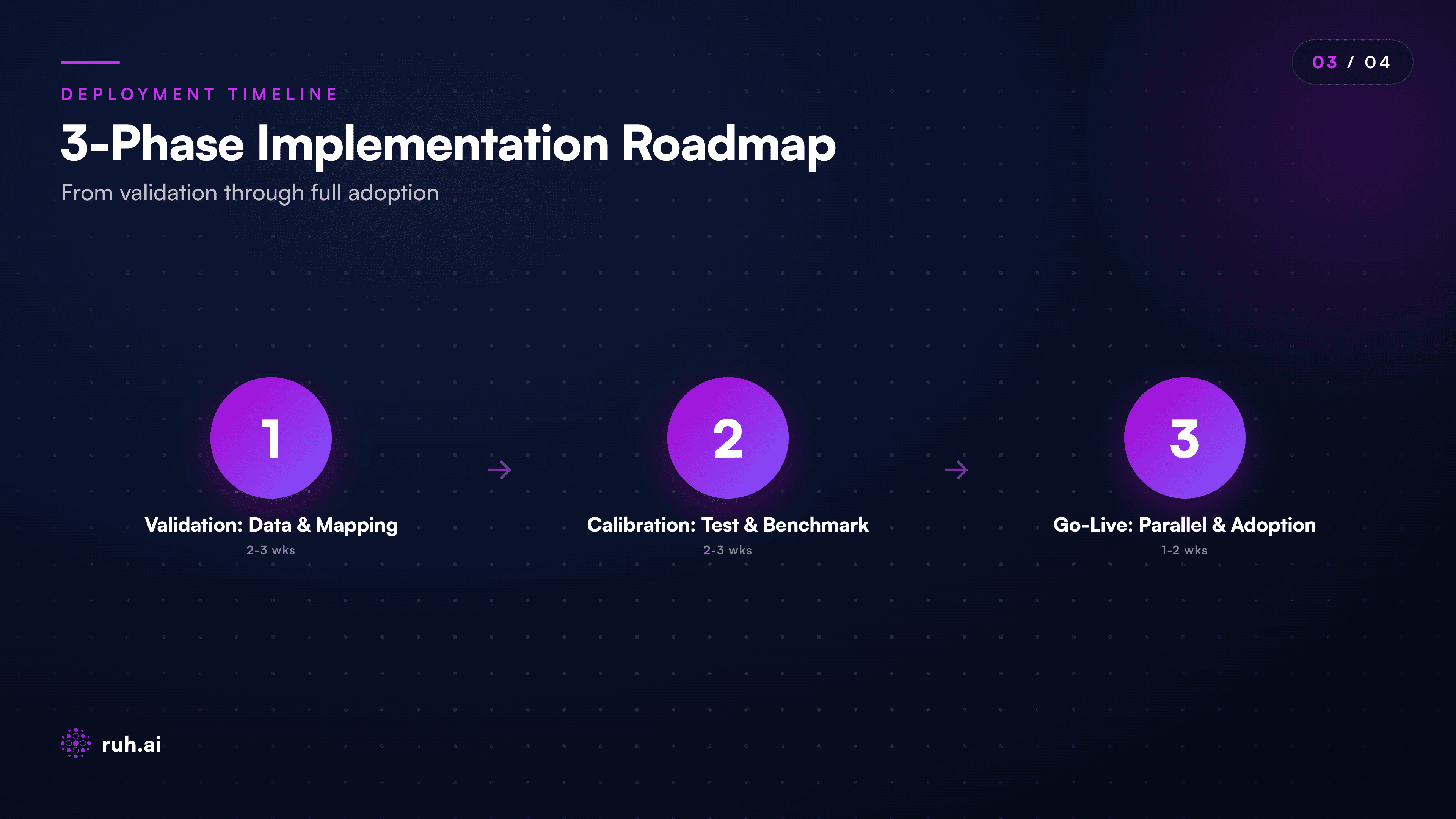
Phase 1: Validate your data (2-3 weeks)
- Export your last 10 estimates (both won and lost)
- Map your scope categories, labor rates, and material costs
- Document your proposal format and risk-flagging criteria
- Connect your QuickBooks or job costing system to Ruh
Phase 2: Calibrate the agent (4-6 weeks)
- Run Ruh Estimator on 5 estimates you've already completed and won
- Compare the agent's output to your actual estimate (quantities, scope, pricing, proposal)
- Refine the agent's instructions (your brand voice, your risk thresholds, your scope definitions)
- Measure accuracy: typical accuracy on commodity items is 94-97%; complex MEP is 87-91% (still requiring human review for technical decisions)
Phase 3: Go live (1-2 weeks)
- Start with estimates from teams that are comfortable with new tooling
- Run estimates in parallel: your estimator + Ruh Estimator
- Build the habit of reviewing Ruh's output (plan, scope, pricing) in 20-30 minutes instead of generating from scratch in 40-50 hours
- Iterate based on feedback
The real timeline: first competitive bid (Ruh vs. your current workflow) in 4-6 weeks. Full adoption across your estimating team in 8-12 weeks.
FAQ: Real Questions from Estimators Switching to AI-Driven Tools
Q: If the AI writes the scope, how do I know it's accurate for my risk profile? A: The agent doesn't "write" scope in the marketing sense, it structures and validates scope based on your company's definitions and risk thresholds. You set those thresholds upfront (what counts as "site clean-up," what's an allowance vs. a line item, how you handle unknowns). The agent then applies those rules consistently. The first 5-10 estimates require heavier review (30-40 min); by estimate 15-20, your review time drops to 10-15 min because the agent has learned your voice and your risk appetite.
Q: What happens when plans are incomplete or contradictory? A: Ruh Estimator flags it automatically. If a dimension is missing, if specs contradict the plans, if a detail callout references a non-existent drawing, the agent calls it out in a "risk flags" section of the estimate. It then generates two versions of the scope: the "base case" (assuming standard solutions for the gaps) and the "with-unknowns" (explicitly itemizing what's uncertain). You choose which direction to bid.
Q: Can it handle change orders during the bid? A: Yes. If the owner modifies plans mid-bid (adds a change order scope, revises the foundation design), upload the revised plans. Ruh Estimator detects the delta, re-runs the takeoff on only the changed sections, and updates pricing and scope. You're not re-estimating from scratch; the agent updates incrementally.
Q: Does this replace my estimator, or augment them? A: Augment. The agent handles the mechanical work (extraction, structure, pricing, proposal assembly). Your estimator handles judgment (risk, strategy, owner communication, complex technical decisions). A typical firm of 10 estimators running Bluebeam can handle the same workload with 3-4 estimators running Ruh Estimator, because the agents absorb the 40-50 hours of manual work per bid. You're not firing estimators; you're reallocating them to higher-value work, pursuing larger projects, tighter margins, better risk management.
Q: How does Ruh compare to Togal or Kreo in terms of accuracy? A: On quantity extraction (the thing Togal specializes in), Ruh and Togal are comparable, 94-97% accuracy on commodity items. Where Ruh pulls ahead: scope validation (Togal doesn't validate against specs), pricing integration (Togal doesn't price), and proposal assembly (Togal doesn't write scope or generate proposals). If you're only comparing takeoff speed, Togal is faster (2-3 hours vs. 4-6 hours on a full Ruh run). If you're comparing full estimate time (what actually matters), Ruh is 5-7x faster because there are no handoffs.
Q: What's the learning curve, and how long until we see ROI? A: Minimal learning curve, if you can use Bluebeam or Togal, you can use Ruh Estimator (simpler UI, fewer menus). ROI is immediate: one estimate using Ruh Estimator (6-8 hours saved = $600-$1,000 in labor, minus $60 in platform fees) pays for a month of the platform. Payback: 2-3 hours of saved time per bid. A shop doing 2 bids per week breaks even in 2 weeks.
Q: Can I integrate Ruh Estimator with my existing tools (Procore, QuickBooks, Autodesk)? A: Yes. Ruh connects to Procore (sync estimates to the projects dashboard), QuickBooks (pull labor rates and material costs in real-time), and Autodesk Build (export completed estimates). The integration is live, changes to your material costs in QuickBooks automatically flow to new estimates in Ruh.
Where to Go from Here
If you're still on Bluebeam and thinking about it: ask yourself whether the next 12 months are a good time to invest 4-6 weeks in calibration. If you're bidding aggressively (15+ estimates per month), the math is obvious, Ruh pays for itself in 2-3 weeks. If you're bidding conservatively (3-5 per month), Ruh is still worth the switch, but the payback is slower (4-6 weeks).
If you're on Togal: Ruh doesn't replace it; Ruh replaces your entire estimating workflow downstream of Togal. Some firms run both (Togal for fast takeoff, Ruh for everything else). Most migrate to Ruh alone because the time and accuracy gains compound.
If you're on Kreo: Same story. Kreo handles collaboration beautifully. Ruh handles the work. You'll end up running both or switching entirely to Ruh (which has built-in collaboration).
The fundamental shift happening right now: Construction is moving from tools that make one person faster to agents that replace multi-person workflows. Bluebeam, Togal, Kreo are all great at what they do. They're just not agents. And agents are where the next 10x improvement lives.
The Bottom Line
Takeoff tool choice in 2026 is no longer about which software has the best markup interface. It's about whether you're automating takeoff alone or automating the entire estimating workflow.
Bluebeam is still the default because it's everywhere. Togal is still winning because it automates the takeoff component that subs and GCs believe is the bottleneck. Kreo is winning on collaboration and ease-of-use. Beam is winning on price.
But none of them solve the real problem: estimating takes 40-50 hours because the workflow is broken into pieces, and every piece requires a handoff.
Ruh Estimator solves it by treating the whole workflow as a single job, one agent, one context, one output. That's why the time savings aren't 10-15% (a tool efficiency gain). They're 80-85% (a workflow reimagining gain).
If you're evaluating takeoff tools right now, ask your vendor this question: "Does your tool give me a complete estimate ready to send to the owner, or does it hand off to my team for pricing, scope writing, and proposal assembly?"
If the answer is "hand off," you're buying a faster tool, not solving the problem.
If the answer is "complete estimate," you're looking at an agent, not a tool. And that's the conversation worth having.
Schedule a 20-minute audit of your estimating workflow and see where the hidden hours are →
Explore Ruh Estimator and watch an end-to-end bid cycle in real-time →
Build your own construction agent with the Ruh platform, no coding required →