
TL;DR / Summary
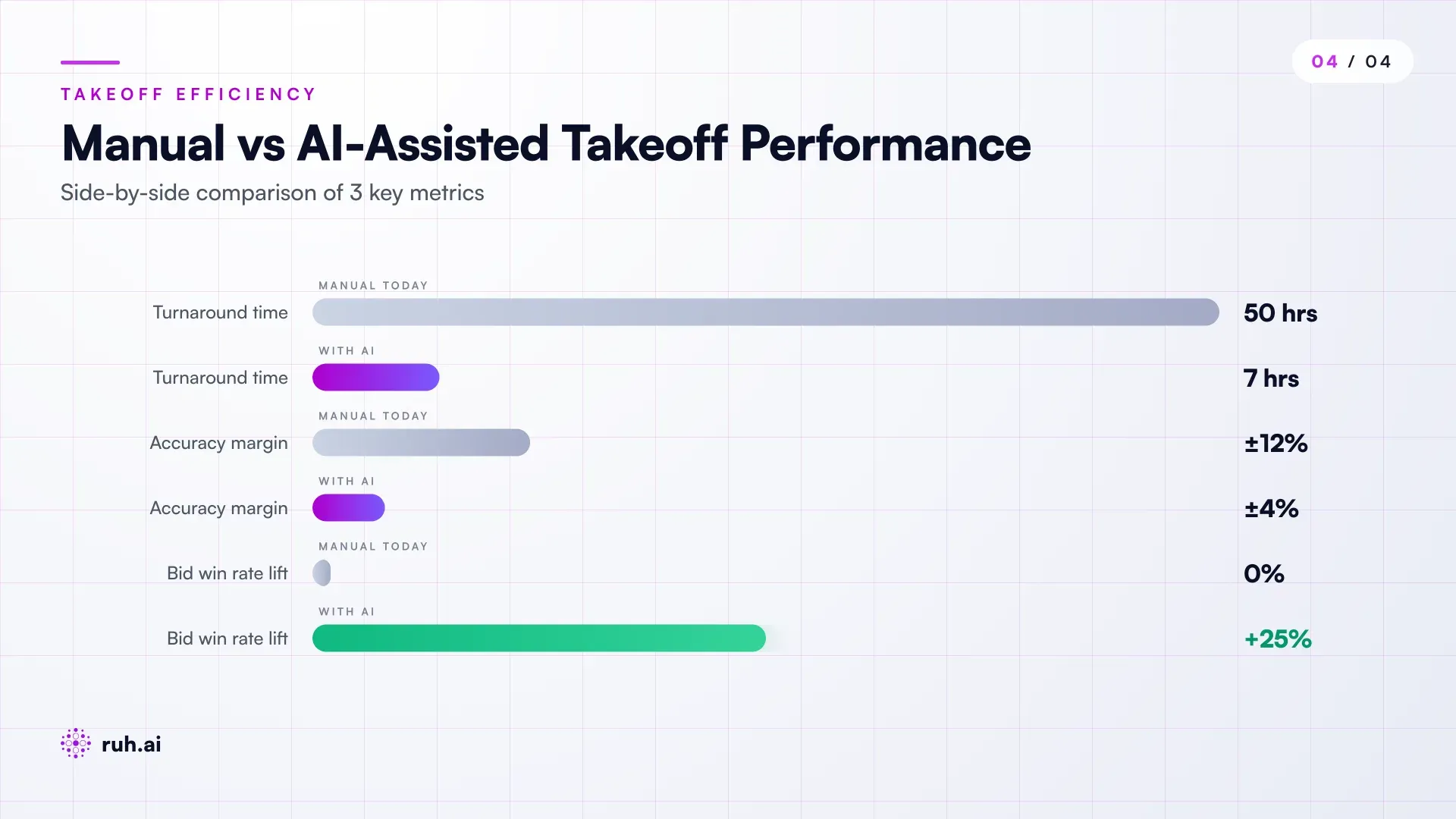
Construction takeoff is the foundation of accurate estimating. It's the process of extracting quantities from plans, linear feet of framing, square feet of concrete, count of fixtures, and feeding them into pricing to create a bid. Done manually, it consumes 40-60 hours per project. Done with AI, that drops to 6-8 hours, and your quantities are traceable back to the source drawings.
What you'll learn:
- Why takeoff accuracy drives field execution and margin protection
- The five core takeoff workflows and which one costs estimators the most time
- How manual takeoff creates downstream RFI spiral and scope creep
- The toolset construction teams are actually using in 2026
- How AI agents invert the takeoff bottleneck and make bid-win rate improvements a side effect, not a target
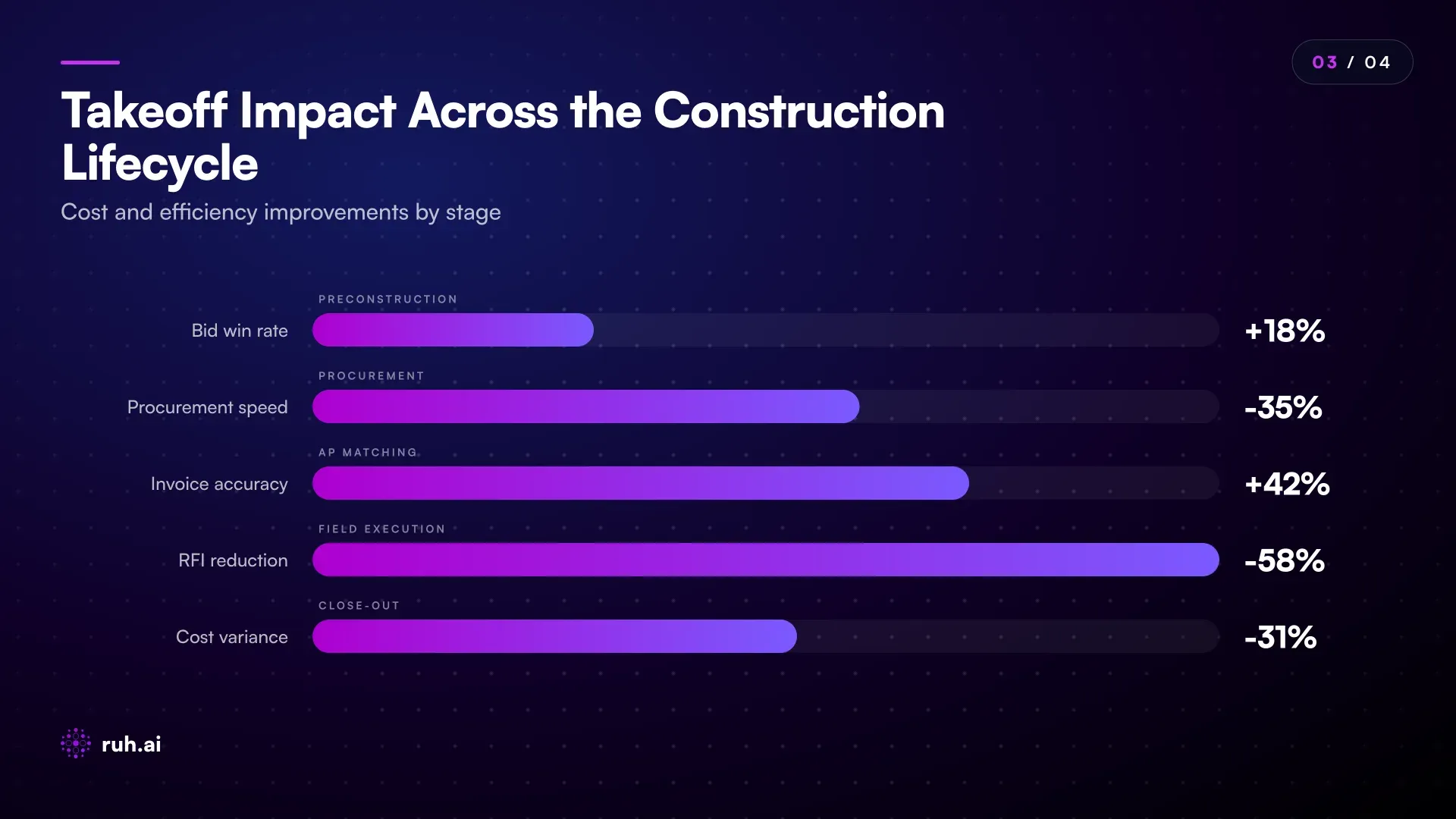
The numbers upfront: Takeoff accuracy directly predicts cost variance at close-out. A 10% quantity error on structural steel doesn't just blow the bid, it cascades into purchase orders, change orders, RFIs to clarify scope, and field surprises. Teams cutting takeoff time from 40-60 hours to 6-8 hours report bid win rates up 22-31%.
What Happens When Takeoff Gets Wrong
Takeoff errors don't stay in preconstruction. They travel.
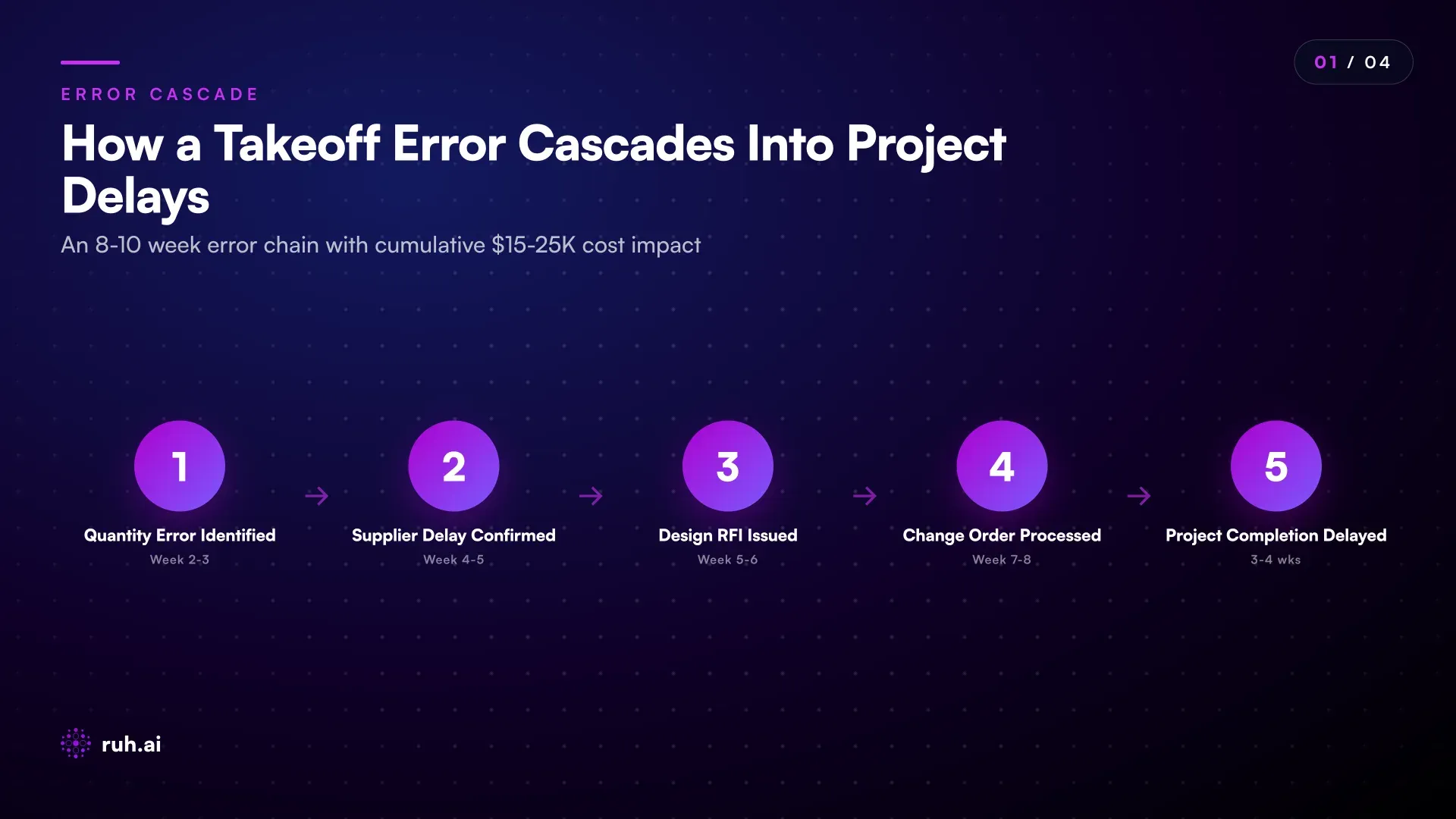
A single miscounted door frame creates a purchase order mismatch. The wrong qty reaches the supplier. Two weeks later, the frames arrive short. That's an RFI to the designer asking for clarification, a change order to cover the shortage, and now the framing crew is waiting. The schedule moves.
Accuracy matters more than speed because the penalty for bad quantity data compounds through field execution, AP reconciliation, and final cost reconciliation. An estimator might argue: "We bid conservatively. We build in contingency." That contingency dies fast. One major scope miscount eats it.
This is why field operations teams care more about right than fast. A PM reviewing bid estimates isn't optimizing for the fastest takeoff, they're optimizing for the one that prevents RFIs and holds budget at close-out.
The real cost of manual takeoff isn't the 40-60 hours sitting in estimating, it's the downstream work it triggers: clarifications from the GC, RFIs to designers, change orders when field reality meets inaccurate scope, and the margin compression that follows.
The Five Core Takeoff Workflows, And Which One Breaks Most Estimators
Takeoff splits into five core workflows. Not all are equal in difficulty or time impact.
1. Structural & MEP quantities (the heavy lift), Linear feet of structural steel, concrete volumes, duct runs, pipe lengths. These require interpretation of schedules, symbology reading, and 3D spatial reasoning from 2D orthogonal views. A 20-story mixed-use project's structural takeoff alone is 60+ hours of drafter time, and errors are expensive.
2. Finish schedules (the volume killer), Door count, finish specifications by room, window count, hardware sets. These are high-volume, low-complexity extractions from finish schedules, but the sheer count makes manual takeoff tedious and error-prone. One missed room in a 200-unit residential project adds 40 units of unpriced scope.
3. Temporary facilities & demolition (the forgotten line item), Shoring, hoarding, site access, demo sequence, selective demolition scope. These live in notes and general conditions but don't appear in primary schedules. Most teams underbid this section because information scatters across multiple plan sets.
4. Site infrastructure & utility coordination (the interpretation layer), Trenching depth, utility coordination, site grading volumes. These require reading utility plans, site plans, and geotechnical reports in parallel. Misreading soil conditions or utility conflict depth creates costly field surprises and RFI ping-pongs.
5. Allowances & pricing inputs (the calibration step), Market rate inputs for labor, material cost verification, regional adjustment factors. This is partly research, partly calculation. Outdated material costs propagate directly into bid pricing. An estimator using 2024 steel pricing in 2026 loses margin immediately.
The heaviest time sink is structural and MEP, but the highest-impact error source is finish schedules, one missed floor or zone creates unpriced scope that field discovers on day one.
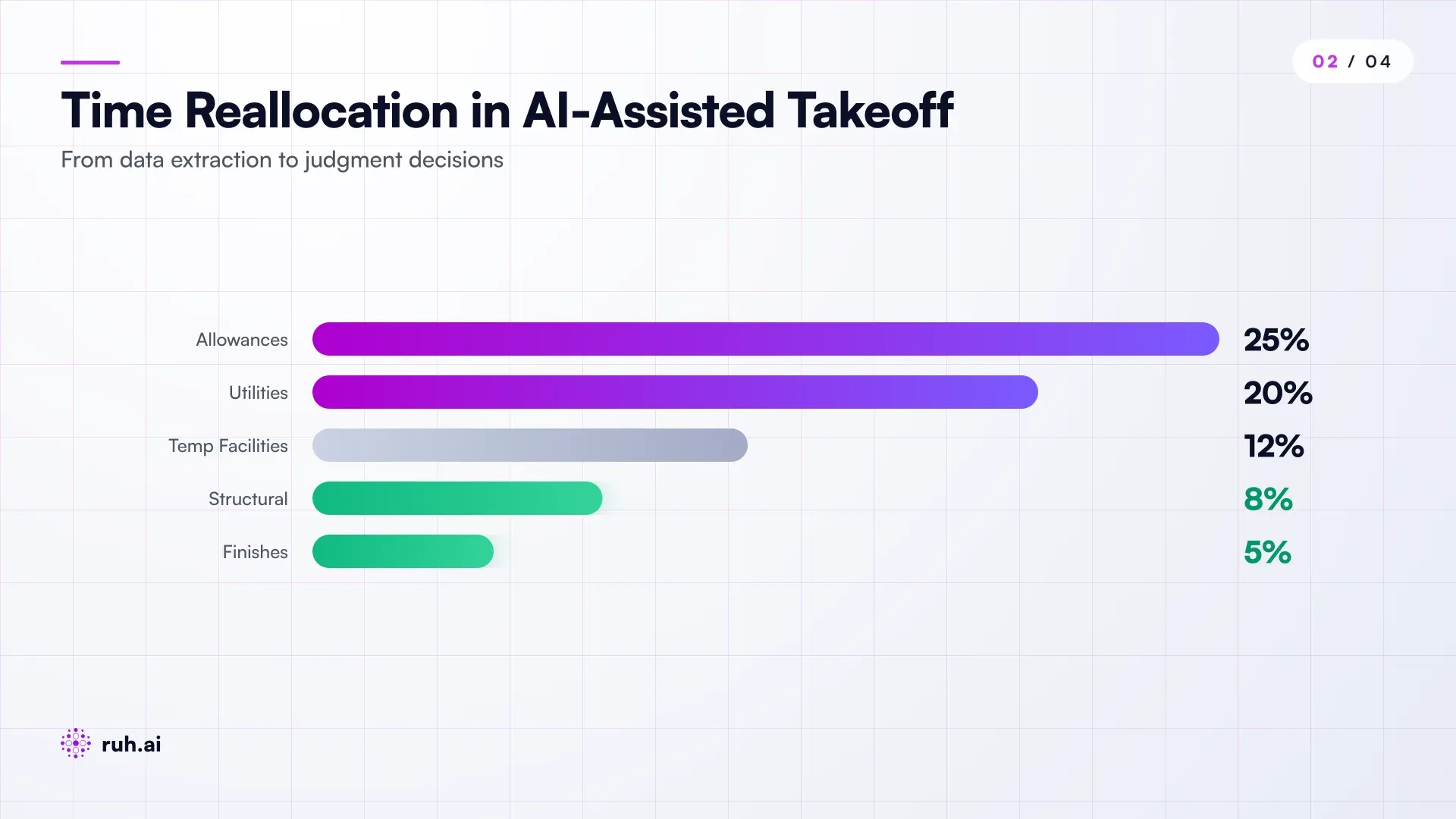
AI changes this calculus. It excels at (1) and (2), structural reading and high-volume schedule extraction, because both are pattern recognition at scale. It struggles with (4), utility coordination and site-specific interpretation, because that requires field knowledge and code reading. The net effect: AI agents handle 60% of takeoff volume, leaving estimators to focus on the 40% that needs human judgment.
Why Estimators Still Manually Digitize Plans
The honest question: if takeoff is so painful, why hasn't it been solved?
Two reasons. First, every project has a different plan format. Scanned PDFs, Revit, AutoCAD, CAD from the 1980s, hand-drawn changes, marked-up prints. A tool that works on standardized Revit models doesn't work on the PDFs that represent 60% of bids in construction.
Second, quantity extraction requires interpretation, not just extraction. The drawings say "1/2" studs," but do they mean studs at 16" or 24" o.c.? The schedule lists "oak doors" but doesn't specify size or fire rating. A takeoff tool that returns raw numbers without context is fast but wrong.
Most estimation teams have learned to live with this. They've built workflows around it: experienced estimators who know how to read plans faster, markup shortcuts, templates, and contingency buffers built into bids to absorb the errors they know will happen.
This approach works until it doesn't. A particularly complex job with tight margins, fast turnaround, or aggressive cost targets becomes a margin killer. Teams don't want faster takeoff, they want accurate takeoff that frees their best estimator to do more bids per month instead of perfecting one.
AI agents invert this trade-off. They handle volume extraction at speed; the estimator validates and interprets. That changes the dynamic entirely.
How Takeoff Feeds Every Phase of Construction
Takeoff isn't a one-time event in preconstruction. It propagates downstream.
In project controls, the takeoff feeds the schedule. Structural steel count determines fabrication lead time, delivery windows, and erection sequencing. Finish quantities feed phasing logic. A concrete volume determines crew size and pour planning.
In procurement, the takeoff creates the purchase order template. Wrong quantity on the PO reaches the supplier. Receiving counts against the PO. If PO qty is low, the receiving dept. flags a "shortage" that becomes a discrepancy, then an RFI, then a change order. Accurate takeoff makes procurement seamless; inaccurate takeoff creates friction.
In AP automation, the invoice reconciliation happens at takeoff level. If the PO says 500 units and the invoice says 450, AP holds the invoice pending a debit memo or RFI resolution. Clean takeoff means invoices flow through 3-way matching without holds.
In field execution, scope clarity prevents RFIs and change orders. A super with accurate scope documentation knows exactly what's being built, doesn't call asking "do we have the doors for the East wing," and doesn't discover during framing that door frames weren't ordered.
Takeoff accuracy is the foundation of cost and schedule control. It's not just an estimating problem; it's an operations problem.
The 2026 Takeoff Toolkit, What Actually Works
In 2026, construction teams use a mix of tools, and no single tool dominates.
Autodesk Takeoff (part of Autodesk Construction Cloud): Works well on native Revit models. Weak on PDFs and scanned drawings. Requires significant setup and interpretation.
Procore Estimating: Integrates with workflow, covers templates and collaboration, but doesn't materially automate quantity extraction, it organizes the manual work.
BlueBeam Studio Sessions: Powerful for markup and collaboration, not for extraction. Teams still manually count and calculate.
On-screen takeoff tools (various brands): Limited to simple drawing types, struggle with complex building systems, and don't scale to large plan sets.
Excel + expertise: Still the dominant approach. Experienced estimators pulling quantities manually, entering into spreadsheets, using formulas and templates. It's slow but it works.
What's missing from this lineup: a tool that accepts any drawing format, reads complex building systems accurately, and doesn't require plan-by-plan training.
That's what AI agents target in 2026. The goal isn't to replace the estimator; it's to eliminate the data-entry layer so the estimator focuses on interpretation, pricing, and bid strategy.
The Honest Assessment: Where AI Takeoff Still Falls Short
AI agents handle quantity extraction at speed. They stumble on interpretation.
What works:
- Extracting structural quantities from well-marked Revit models
- High-volume schedule reading (doors, windows, finishes)
- Linear takeoff from plan grids (duct runs, pipe lengths, electrical circuits)
- Recognizing standard symbology and notation
What requires human judgment:
- Site-specific conditions: "What does the grading plan say about existing conditions that might affect excavation cost?"
- Utility coordination: "Is the 2" sewer line deep enough given the frost line, or will relocating it trigger a change order?"
- Code interpretation: "The spec says 'seismic bracing per code.' What does that mean for this structure in this jurisdiction?"
- Value engineering: "We counted 500 linear feet of drywall. Can we bid it cheaper by changing the framing system?"
- Temporary facilities: "How do we protect existing infrastructure during demolition?"
AI agents are pattern matchers. They're excellent at "extract all instances of the word 'door' and its associated schedule row." They're not yet reliable at "read the geotechnical report, cross-reference the site plan grading, and estimate the foundation adjustment needed for worse-case subsurface conditions."
The result: In 2026, the best teams use AI agents to handle 60% of takeoff volume, structural, MEP, schedules, and reserve estimator time for the 40% that requires site knowledge, code reading, and judgment calls.
This is the right place to land. It's not "AI replaces estimators"; it's "AI handles the mechanical extraction, estimators handle the thinking."
How Ruh AI Fits Into This
Ruh's Takeoff Agent is built for this exact workflow split.
What it does: Upload a set of plans (PDF, Revit, DWG). The agent reads them, extracts structural quantities, MEP counts, and schedule-driven takeoff, and returns a structured takeoff report organized by building system and CSI division. It flags ambiguities and missing information, "Schedule doesn't specify door size for Unit 412", so the estimator knows where to focus interpretation effort.
What changes in your workflow:
| Before (Manual) | After (with Takeoff Agent) |
|---|---|
| Open PDF, open Excel, manually count doors by reading each floor | Upload plans, agent extracts 500+ door counts by room and floor, organized by finish type and fire rating |
| Estimate framing quantities by counting studs and calculating linear footage | Agent reads structural details, counts studs, calculates lengths, flags non-standard spacing |
| Copy MEP quantities from schedule (or call the mechanical engineer) | Agent pulls duct runs, pipe lengths, circuit counts from as-drawn models; flags conflicts |
| Estimate 40-60 hours per project | Estimate 6-8 hours per project (estimator reviews agent output + interpretation work) |
| Turnaround for bid: 5-10 days if expedited | Turnaround for bid: 2-3 days even on large projects |
Why this works in preconstruction: The Takeoff Agent handles the volume. Your estimators do the judgment, pricing, value engineering, schedule coordination. Bid turnaround drops. Accuracy improves because the extraction is systematic and repeatable. Bid win rates improve because you're closing more bids per estimator per month, and the ones you close are more accurate.
It integrates with Ruh Estimator, which feeds takeoff into labor pricing, material pricing, and overhead allocation, producing a complete estimate from agent-generated quantities. The loop is: upload plans → Takeoff Agent extracts → Estimator validates and prices → bid ready.
Ruh AI also offers RFI Responder Agent downstream, which handles design questions that arise during takeoff review (or later during procurement/construction). When an RFI hits about scope or code interpretation, the agent drafts a response and routes it through your QA process.
For teams running Ruh Estimator end-to-end, takeoff to close-out, the entire preconstruction cycle compresses: faster bids, cleaner scope, fewer RFIs.
Frequently Asked Questions
Q: Is takeoff the same as estimating? A: No. Takeoff is quantity extraction from plans. Estimating is quantity + pricing + overhead. Takeoff answers "how much of each material?" Estimating answers "how much does this project cost?" You need both, but they're distinct workflows.
Q: How accurate do takeoff quantities need to be? A: Structural and MEP quantities need ±5% accuracy to avoid field surprises and change orders. Finish schedules can tolerate ±10% because contingency usually covers minor shortages. Anything worse than ±15% starts creating RFIs and delivery delays.
Q: Can AI handle scanned PDF plans, or only Revit models? A: Ruh's Takeoff Agent works on PDFs, Revit, CAD, and scanned drawings. The accuracy is slightly higher on native digital formats (Revit, CAD) because line weights and text are machine-readable, but it handles scans where symbol recognition is stable.
Q: How long does it take to get results from an AI takeoff agent? A: Most projects return results in 15-45 minutes, depending on plan set size and complexity. A 50-sheet set might take 30 minutes. A 200+ sheet hospital might take 60-90 minutes because the agent is extracting more systems in parallel.
Q: What if the agent misses a room or counts something twice? A: That's exactly why the estimator reviews. The agent's output is a draft, not final. You compare it to the plans, mark corrections, and iterate. Most teams report catching ~5-10% of rooms on first review, correcting them, and signing off. The agent's still 6x faster than the manual baseline.
Q: Do I need to retrain the agent for different project types? A: No. The Takeoff Agent uses a universal model trained on thousands of construction documents across residential, commercial, industrial, and mixed-use. You upload, it extracts. No per-project training needed.
Q: What happens if the plans are incomplete or marked up with handwritten changes? A: The agent flags them. It'll say "Structural detail marked with handwritten changes on sheet A-3; recommend clarification on bolt pattern before ordering." This is a feature, it surfaces ambiguity so the estimator knows where to dig deeper, not a failure.
The Practical Implementation Checklist
If your team is ready to move takeoff from manual to agent-assisted, here's the sequence:
- Pick a test project. Choose a mid-size, non-critical bid, something that's not do-or-die but representative of your typical work. Run the Takeoff Agent on it.
- Set estimator review time. Don't assume zero effort. Budget 1-2 hours for the estimator to review, correct ambiguities, and sign off.
- Compare to your baseline. Measure: Did we beat our internal 40-60 hour estimate? Did accuracy improve? Did the estimator feel confident in the output?
- Iterate on 2-3 more projects. Each one gets faster as your team learns what to expect and where corrections usually land.
- Wire into your workflow. Once you're confident, plug takeoff output into your standard estimating process (templates, pricing databases, client deliverables).
- Measure the impact. Track bid turnaround, win rate, and cost variance at close-out. These are the metrics that matter.
The goal isn't to remove estimators from the process, it's to move them from data entry to decision-making.
Key Takeaway
Takeoff is the hidden leverage point in construction estimating. It's the first thing people think they can speed up, and the easiest thing to get wrong. In 2026, the construction teams winning more bids with lower cost variance aren't the ones with bigger estimating departments, they're the ones using AI to handle extraction, freeing their best people to focus on pricing, value engineering, and bid strategy.
If your team is still running manual takeoff at 40-60 hours per project, you're leaving wins on the table.
Explore Ruh Estimator and automate takeoff to bid in under 8 hours →
Build your first construction agent without code in Ruh Work-Lab →