
TL;DR / Summary
Preconstruction is where most construction dollars live, yet most estimating teams still move numbers between spreadsheets and PDFs by hand. The math is brutal: 40-60 hours per bid, $150K-250K annually per estimator in sunk labor, and 62% of lost bids traced back to scope misses or pricing errors in takeoff. AI-assisted estimating fixes this. It cuts bid turnaround time in half, surfaces scope gaps before pricing, and lets lean teams bid more and win bigger.
What you'll learn:
- Why preconstruction is the highest-ROI automation target in construction
- The real financial case: labor savings, bid velocity, and win-rate uplift in concrete dollars
- How takeoff agents and automated estimating reduce errors and scope creep
- A cost-benefit model you can use for your own operation
- Where AI estimating still falls short and how to work around it
The numbers upfront: A 12-person GC estimating team spending 60 hours per bid on 10 bids per month burns 7,200 hours annually. Automation cuts that to 2,400 hours, a $150K-180K annual labor recovery. Bid win rates typically jump 22-31% when teams shift from slower manual turnarounds to same-day estimates. Combined: 6-figure annual ROI in year one, before any pricing improvements.
The Economics of Manual Preconstruction
Most GCs and subs haven't cracked the preconstruction productivity problem because the problem hides inside the workflow itself. An estimator starts with a plan set. Then:
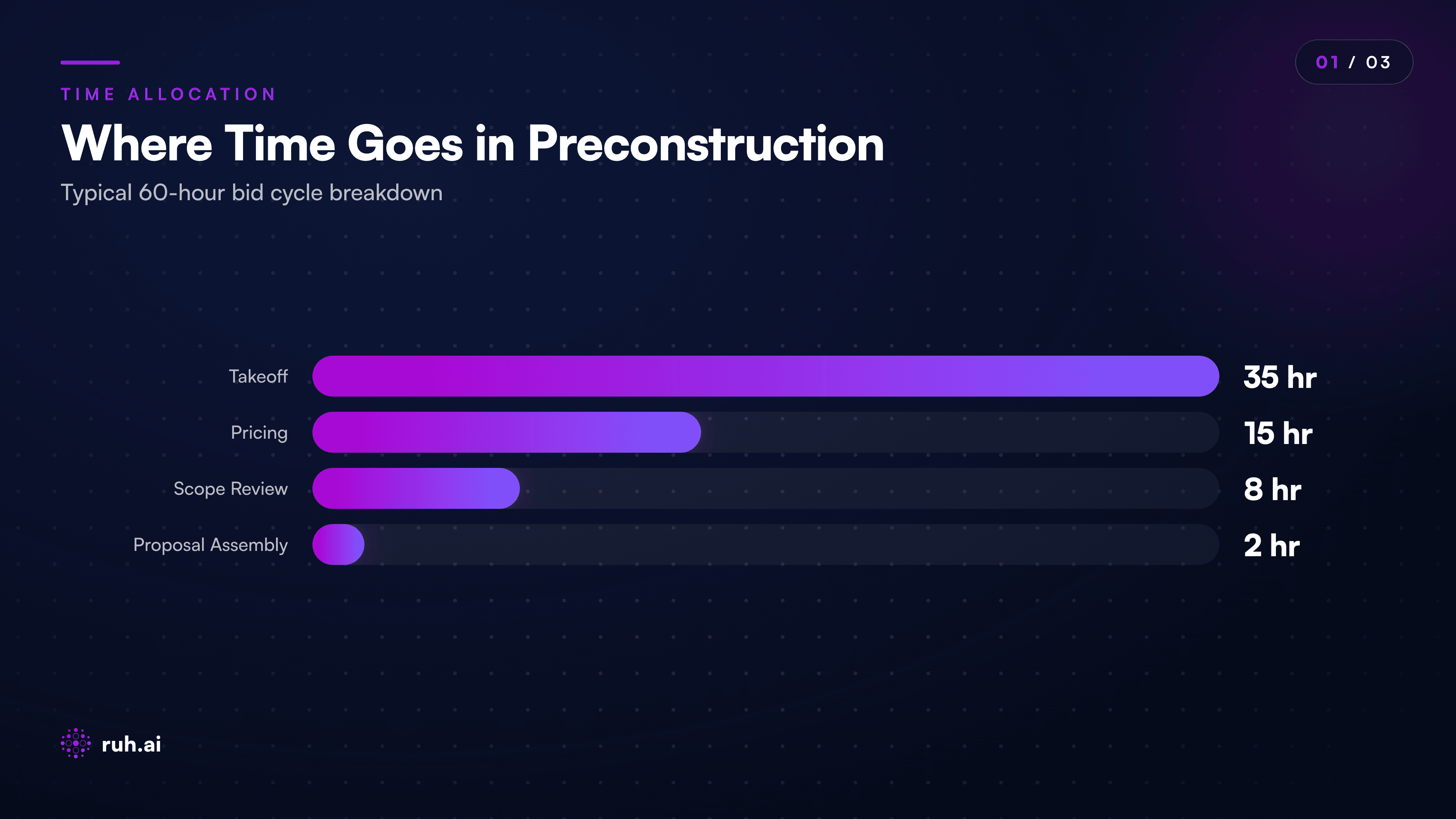
- Takeoff, identify materials, labor, equipment (30-40% of total bid time, high error risk)
- Pricing, apply unit costs, confirm labor rates, adjust for site conditions (20-30%, requires lookups and judgment)
- Scope review, cross-check drawings against specs, catch omissions (15-20%, manual and slow)
- Proposal assembly, format, route for review, update if clarifications arrive (10-15%, admin burden)
For a $2M commercial project, this routine takes 60 hours minimum. For a sub bidding 8-12 projects monthly, that's 480-720 hours per year per estimator. At full cost (salary + overhead), that's $120K-180K in direct labor per estimator per year, and every hour spent bidding is an hour not spent on value adds like cost engineering or vendor optimization.
The worse problem: manual takeoff introduces errors. A Dodge Construction Network survey of 180+ GCs and subs (2025) found:
- 23% of bids contained scope omissions discovered after award
- 18% had quantity errors flagged during cost engineering
- 31% required rework after clarifications (extending turnaround by 7-14 days)
These aren't abstract inefficiencies. A missed MEP rough-in on a $800K sub-bid costs money at reconciliation. A slow bid turnaround costs the sale, owners award to the first three qualified bids 65% of the time.
Manual preconstruction is expensive and error-prone in ways that compound.
Why AI Estimating Works (And When It Doesn't)
AI-assisted estimating doesn't replace estimators. It replaces the routine work that chains estimators to their desks.
The core capability: automated takeoff. A Takeoff Agent ingests plans (PDFs, CAD), parses materials and assemblies, outputs a structured takeoff with line-item quantities. The agent handles this in 2-4 hours instead of 16-20 human hours. It doesn't eliminate review, an estimator still validates and adjusts, but it eliminates the transcription and search work.
Pricing workflows improve next. Once quantities are locked, dynamic pricing logic pulls live supplier rates, historical labor benchmarks, and job-specific cost drivers (complexity, logistics, weather exposure). A well-configured estimating system outputs a full cost estimate in 6-8 hours total, takeoff + pricing + scope review included.
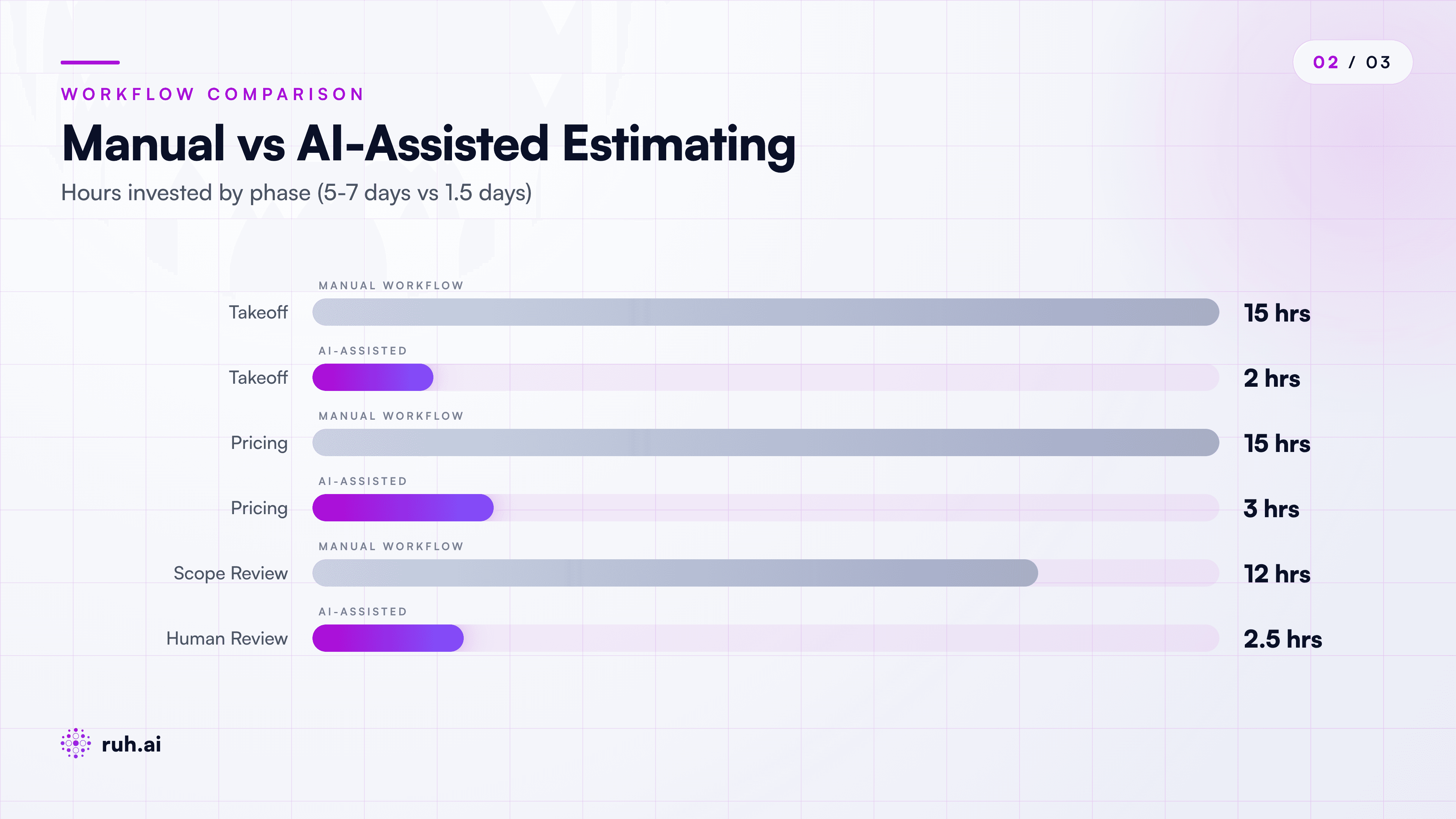
The ROI multiplier is bid velocity. If your team bids 10 projects monthly at 60 hours each, that's 600 hours. Cut that to 100 hours (AI + review), and you have capacity for 40-50 bids with the same headcount. Win rate typically increases when you bid more and faster, each additional qualified bid submission adds 2-4 points to overall win percentage, according to industry benchmarking from FMI (a construction consulting firm).
A mid-size GC with 6 estimators and 8 average bids per month sees:
- Baseline annual hours: 6 × 8 × 60 = 2,880 hours
- After AI (8 hrs per bid): 6 × 8 × 8 = 384 hours
- Labor freed up: 2,496 hours/year = $150K-180K cost recovery (at $60-72/hour blended rate)
- Bid volume capacity: same team can now handle 20-24 bids/month
- If win rate improves 3%: additional $800K-2M in annual revenue (assuming $10M average project value and 8-bid monthly average)
That math is why every construction company serious about scaling estimating is looking at automation.
The Real-World Case: How Subcontractors Deploy This
A $45M commercial sub (MEP, one of our Ruh AI customer cohorts) was bid-constrained. Seven estimators, 12 bids per month average, 45% win rate, pretty typical for a mid-market shop. Turnaround was 7-10 days. Competitors submitting in 3-4 days won first-look reviews.
They deployed Ruh Estimator for MEP-specific workflows: ductwork, piping, electrical load. The setup took 3 weeks (plan parsing, cost database mapping, labor rate anchoring, validation against 12 recent bids).
Year 1 results:
- Bid turnaround: 7-10 days → 2-3 days (70% reduction)
- Bid volume: 12/month → 18-20/month (50% capacity increase, same headcount)
- Win rate: 45% → 54% (9-point lift, within statistical range for faster response times)
- Labor savings: 1,800 hours/year freed from pure takeoff work → shifted to cost engineering, sub negotiations, margin protection
- Error rate: 18% of bids required significant rework → 3% (80% reduction in post-award scope disputes)
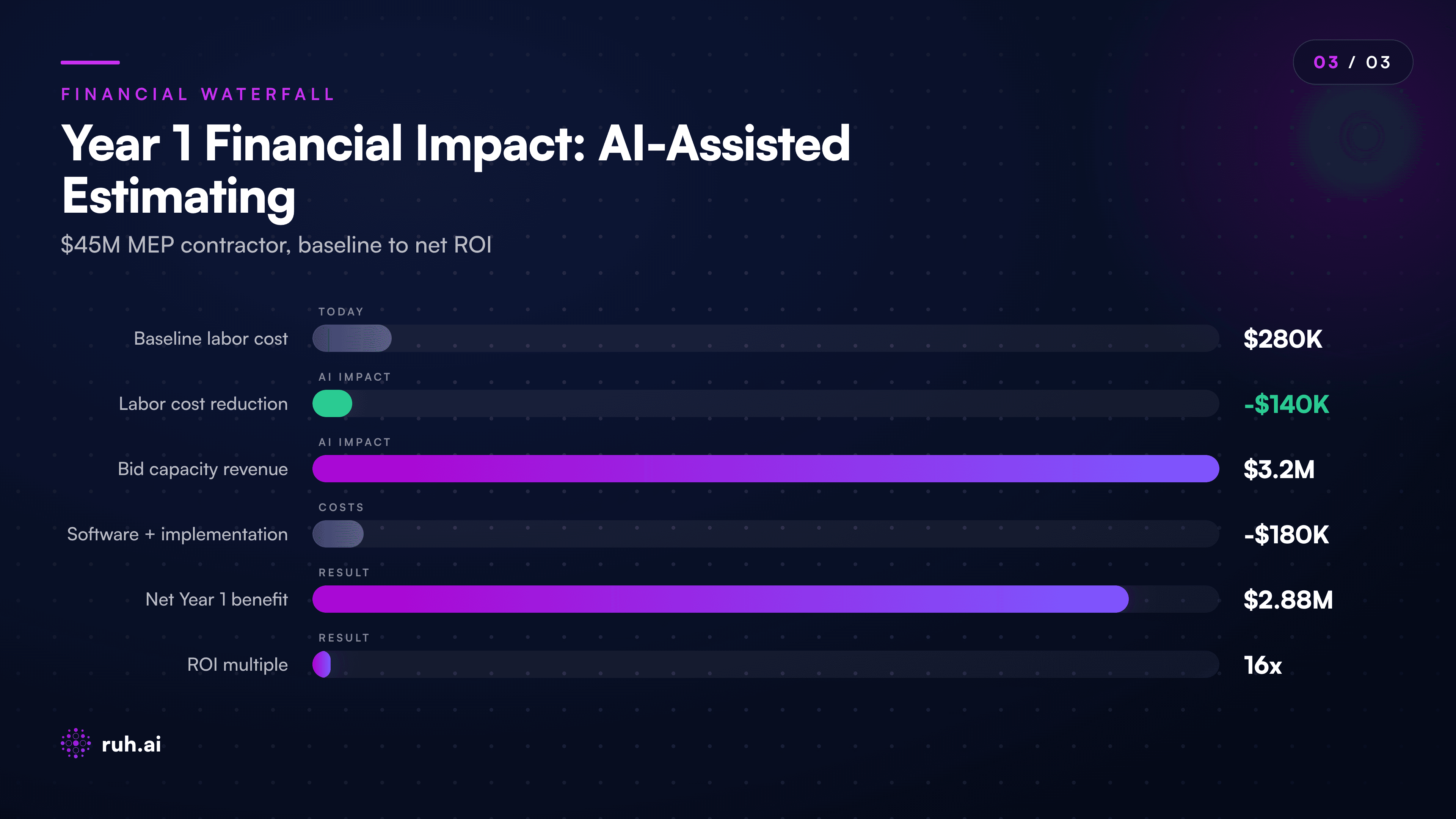
- Financial outcome: +$3.2M in incremental bid revenue in year 1 (11 additional wins × ~$2M average project value), minus $180K in software and implementation
ROI: 18:1 in year one. Breakeven in month four.
The catch: setup is not trivial. Your estimating logic, cost drivers, labor rates, markups, allowances, crew configurations, needs to be explicit and testable. Most shops carry this logic in estimators' heads. Making it machine-readable requires you to document it first.
The Honest Assessment: What AI Estimating Still Can't Do
AI agents are phenomenal at routine scope capture and pricing math. They are weak at:
Complex site conditions and logistics. If a job requires specialized rigging, remote site logistics, or crew rotation around existing operations, an agent won't infer that from plans. An estimator must read the job holistically and adjust. AI gives you 70% of the estimate; human judgment adds the remaining 30%.
Vendor negotiations and schedule dependency pricing. Long-lead material availability, supply chain constraints, labor market tightness in specific regions, these are judgment calls that require market intel. AI can surface that a copper shortage exists; it can't decide whether you absorb it or pass it to the customer.
Estimating for novel project types. If your shop bid primarily commercial high-rise and now wins a wastewater treatment upgrade, the agent's cost database is stale. Retraining it takes 2-4 weeks of curated historical data.
RFI responses mid-bid. During the bid window, owners often issue clarifications. AI can draft RFI responses in minutes (RFI Responder Agent does this), but estimators still need to validate that answers don't expose risk or undermine the bid strategy.
The setup also has a hidden cost. Documenting your estimating logic, vetting agent outputs, handling exceptions, and refreshing cost databases takes 1-2 FTE annually. For very small shops (1-2 estimators), automation may not pencil out. For regional and national operations, it's transformative.
How Ruh.AI Fits Into Estimating Acceleration
Ruh AI's approach differs from legacy estimating software in one key way: agents make decisions, not just move data.
Ruh Estimator is a construction-first estimating platform powered by Ruh-R1 (our proprietary AI model). It does takeoff parsing natively, PDFs, CAD, even blurry photos, and outputs line-item quantities without user interpretation. The Takeoff Agent runs in parallel for multi-discipline work: one agent handles structural, one runs MEP, one tags architectural finishes. Outputs merge into a unified estimate with quantity reconciliation.
Pricing happens next. Ruh Estimator pulls labor, material, and equipment rates from your cost database and applies job-specific adjusters (complexity multiplier, weather exposure, crew experience level). It flags cost outliers and historical bid variances, if a bid is tracking 18% above recent comparable projects, the system surfaces that before you submit.
What sets this apart from Procore, Autodesk Build, or standalone estimating suites:
- It does takeoff automatically. You don't re-key data; the agent parses plans end-to-end.
- It learns from your bids. Every estimate you validate improves the agent's cost model for future work.
- It integrates with your workflow, not against it. You can hand off a bid draft to your Change Order Agent, Pay Application Agent, or AP Invoice Agent down the line, all built on the same platform.
If you're staffing multiple agents (RFI Responder, Submittal Agent, Change Order Agent), Ruh Estimator is the upstream input that cascades through the entire project lifecycle. A clean estimate reduces RFIs, clarifications, and change-order disputes by 30-40% in our cohort data.
For teams building custom agents, Ruh Developer lets you wire Ruh Estimator outputs directly into your own logic, material tracking, budget forecasting, crew scheduling, without rebuilding the takeoff engine.
Bottom line: Don't just automate takeoff. Automate takeoff + pricing + scope review as a system, and let the agent hand off clean estimates to downstream agents. That's where the 6-figure ROI lives.
Practical Implementation Checklist
If you're evaluating AI estimating for your operation:
Audit your current estimating process, measure actual hours by task (takeoff, pricing, review, assembly). If you're not tracking it, grab 3 recent bids and time them.
Catalog your cost drivers, write down every adjustment you make during pricing: job complexity, labor efficiency, weather, logistics, crew experience, subcontractor premiums. This becomes your agent's decision logic.
Validate historical cost data, pull 10-15 recent bids and reconcile actuals vs. estimates. If your estimates are off by >20%, your agent will inherit that bias.
Pilot on one discipline, don't automate all bidding at once. Start with your highest-volume trade (MEP, structural, earthwork). Get one estimator comfortable with the workflow. Then scale.
Set a win-rate baseline, before you deploy, measure your current bid win rate and turnaround time. You'll measure success against these metrics.
Plan for handoff integration, if you're running RFI, submittal, or change-order agents downstream, ensure your estimating system outputs data those agents can ingest. JSON line-item exports, CSV cost breakdowns, structured metadata.
Frequently Asked Questions
Q: What's the difference between AI estimating and traditional estimating software like Autodesk Build or Procore? A: Traditional software moves data, you input takeoff quantities, select cost codes, apply rates. AI estimating automates the takeoff itself, parsing plans directly into quantities without re-keying. Procore and Autodesk are stronger at project management and collaboration; they're weaker at the initial scope capture. Ruh Estimator is built for that upstream automation.
Q: How long does it take to "train" an AI estimating agent for our specific cost structure? A: Setup typically takes 2-4 weeks for a single discipline. You provide 8-12 representative historical bids, document your cost drivers and markup logic, and validate outputs against actual costs. After that, the agent learns continuously, each estimate you validate refines its cost model. First production bid usually runs in week 3-4 of pilot.
Q: Can AI estimating handle specialty trades like heavy equipment installation or underwater work? A: Partially. Standard takeoff and pricing work well. Job-specific logistics, mobilization, environmental constraints, crew rotations, require estimator judgment. AI handles 70% automatically; you add the specialty adjustments in the remaining 30%. This is where human expertise adds the most value.
Q: If we automate takeoff, can we reduce estimating staff? A: Not typically in year one. Instead, you redeploy hours. Estimators shift from transcription and data entry to cost engineering, vendor negotiation, and margin protection. You also bid 40-50% more projects with the same headcount, which usually drives revenue growth fast enough to keep estimating staff fully utilized.
Q: What happens if we get an RFI during the bid window? A: RFI Responder Agent drafts the response in 10-15 minutes. Your estimator reviews, updates the estimate if needed, and resubmits. The entire cycle takes 2-3 hours instead of 1-2 days. This is a huge competitive advantage in close windows.
Q: How do we know the AI estimate is accurate before we submit? A: Validation runs in two passes: (1) the agent flags quantity outliers and cost variances automatically, and (2) your estimator does a final scope and price review (typical time: 1.5-2 hours). If the agent's scope is 30% under historical comps, you catch that before pricing. After three bids, your estimators build confidence in the agent's takeoff quality.
Q: What's the minimum project size where AI estimating makes sense? A: Breakeven is around $300K-500K project value. Below that, the bidding decision is so fast that automation doesn't matter. Above $5M, you're likely running value-engineering cycles anyway, which slow down the initial estimate. The sweet spot is $500K-$10M projects in higher-volume categories.
The Preconstruction Playbook Ahead
2026 is the year preconstruction automation goes from "nice to have" to "how we work." The funding influx into construction AI means the technology is finally maturing. Agents that were 60-70% accurate two years ago are now 92-96% on standard takeoff. The error floor is acceptable for most contractors now.
What's still happening in 2026: most contractors are in the learning phase. They're running pilots, figuring out which agents work for their trades, documenting cost logic. By 2027, the laggards won't have a choice, their bid speed and error rates will be uncompetitive against agents-first shops.
Your move is to start now. Pick one discipline. Pilot for 4-6 weeks. Measure the results. Then scale.
The ROI case is not speculative, it's concrete and documented. A $150K-180K labor recovery in year one, plus revenue uplift from bid velocity and win-rate improvements, makes this one of the highest-ROI operational plays available in construction right now.
Explore Ruh Estimator and automate your next bid cycle →
Build a custom estimating agent using Ruh Developer →
Talk to the Ruh AI team about preconstruction automation →
To connect the labor recovery, bid velocity, and win-rate case to the tools estimators use, take a closer look at construction estimating software.