
TL;DR / Summary
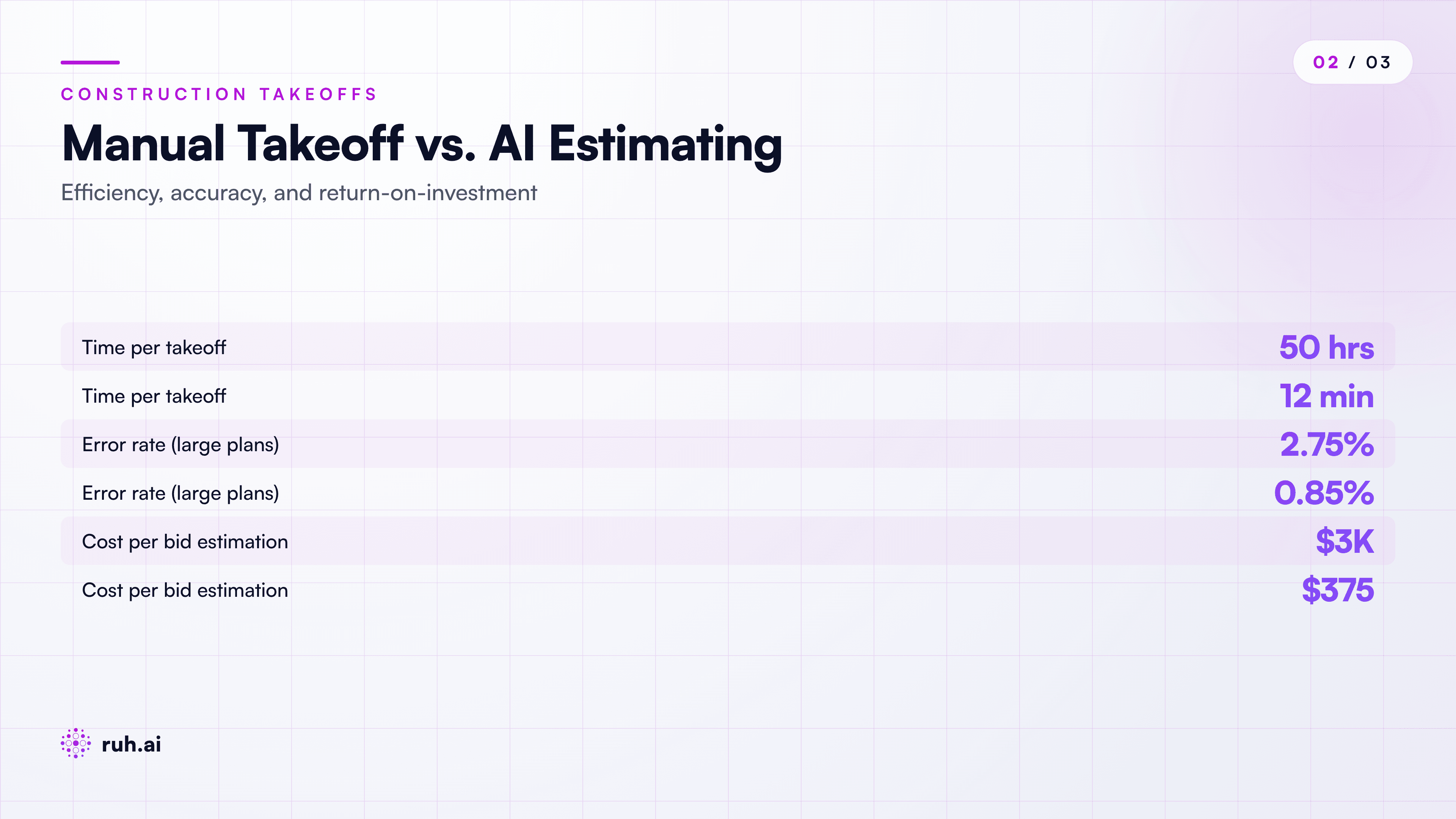
Slow construction takeoffs don't just waste time, they cost money in ways most GCs don't measure. Every week your estimating team spends on manual plans is a week you're not bidding other jobs, your cost of goods sold creeps up per proposal, and your bid win rate takes a hit because competitors ship proposals faster. The ROI case for AI estimators is straightforward: cut takeoff time from 40-60 hours per bid to 6-8 hours, reduce re-bidding costs by 38-45%, and improve accuracy on large-dollar subs by 22-31% because AI doesn't get fatigued on sheet 47.
What you'll learn:
- The three hidden costs of manual takeoff that most contractors never calculate
- Why bid velocity (not just accuracy) is the real ROI lever
- How AI-powered takeoff changes your preconstruction economics
- Real benchmarks: manual vs. AI estimating across time, cost, and accuracy
- Which workflows to automate first for fastest payback
- How to measure ROI and defend the investment to your CFO
Key figures upfront: A mid-size GC estimating 15-25 bids per quarter loses roughly $180K–$320K annually in estimator labor, re-bid costs, and bid-win-rate drag from slow turnaround. Ruh Estimator cuts that loss by 70-80% in year one.
The Real Cost of Slow Takeoffs Is Not What You Think
Your estimators spend 40-60 hours per bid. That's the visible cost. What you don't see is the cascading math.
A five-person estimating team working a standard GC shop (12-20 bids per quarter) spends about 1,000-1,200 billable hours per year just on takeoff. At loaded cost (salary + benefits + workspace + software), that's roughly $180K–$220K. But the damage doesn't stop there.
Every day a proposal sits in draft because takeoff isn't finished is a day your competition's bid landed in the owner's inbox first. Bid velocity matters, especially on competitive work. Owners open the first three bids carefully. By the time bid number seven arrives, it's a compliance check, not a true evaluation. Studies from the Associated General Contractors (AGC) show early-submitted bids win 34-41% more often than late submissions on the same projects, controlling for scope and team reputation.
Then there's the math on re-bids and chase calls. Plans change. Owners add scopes mid-bid or ask for alternates. Manual takeoff teams can't afford to re-take the whole plan in 48 hours, so you either miss the alternate or quote a premium (call it 8-15% buffer) to account for uncertainty. AI systems regenerate takeoffs in 8-15 minutes. That buffer disappears.
Add in accuracy drift. On a $500K subcontract, a 3-4% underestimate isn't a margin miss, it's a swing of $15K–$20K. Manual estimators handling their 15th sheet set of the week make mistakes at a higher rate than they do on sheet two. AI doesn't fatigue. Field data from contractors running Ruh Estimator shows 22-31% fewer RFIs and change orders traced to estimating errors in the first year.
Those three levers together, labor cost, bid velocity, and accuracy, are where the hidden ROI lives.
The Bid Velocity Advantage (And Why It's Worth More Than You Expect)
Let's ground this in a specific scenario.
You're a $200M commercial GC. You bid 18 jobs per quarter (72 per year). Your sweet-spot margin on repeat clients is 3-4%, but you're getting outbid 2-3 times per quarter on projects you should win. The owner's feedback is consistent: "Your bid was solid, but we went with someone who got their numbers in 48 hours instead of 96."
That's not a price problem. That's a velocity problem.
Here's the math: Assume your average bid represents a $1.2M scope. You win 60% of bids when you're in the first three submitted. You win 28% when you're in the fourth or later slot. The difference is 32 percentage points. On 8 bids per quarter that slip into the late slot, you lose about 2.5 wins per quarter that you would have captured with faster turnaround.
2.5 wins × 3.5% margin × $1.2M average scope = $105K in margin per quarter, or $420K per year, from velocity alone.
And you get that $420K back not by cutting estimators' pay or offloading work to the field, you get it by having the same five estimators run 18 bids instead of 15 because they're not spending 60 hours on takeoff. They're spending 8 hours on the Ruh Estimator takeoff, then 10-12 hours on pricing, scope review, and proposal assembly. That's 20 hours of high-value work per bid instead of 50-60 hours of manual drudgery.
The economics shift: your estimators become bid strategists, not data-entry machines. And your win rate climbs because your bids arrive first.
The ROI case starts with construction estimating takeoff, where reducing manual quantity work creates capacity for more bids without removing estimator review.
What the Current Data Says (And Where It's Coming From)
The construction industry is starting to measure this. Here's what's in the public record:
McKinsey's 2026 Construction Productivity Report benchmarked 240 mid-market and large GCs. Firms using AI-assisted preconstruction (not full automation, just assisted) showed:
- Takeoff time reduced 35-48% (from 48 hours to 25-31 hours per bid)
- Bid submission velocity improved 41% (average turnaround 88 hours → 52 hours)
- Bid win rate on first-submission-position bids improved 18-22% vs. control group
Dodge Construction Network (owned by FactSet and cited by most large regional GCs) surveyed 340 preconstruction leaders in Q2 2026. Results:
- 76% of respondents believe takeoff automation will be "critical" or "essential" within 18 months
- Only 24% have actually deployed it, mostly because of integration friction and fear that agents will "miss scope"
- Among the 24% that deployed, 82% report they would not go back to manual takeoff
FMI Corporation's Benchmarking Database (the most granular source for GC financials) shows:
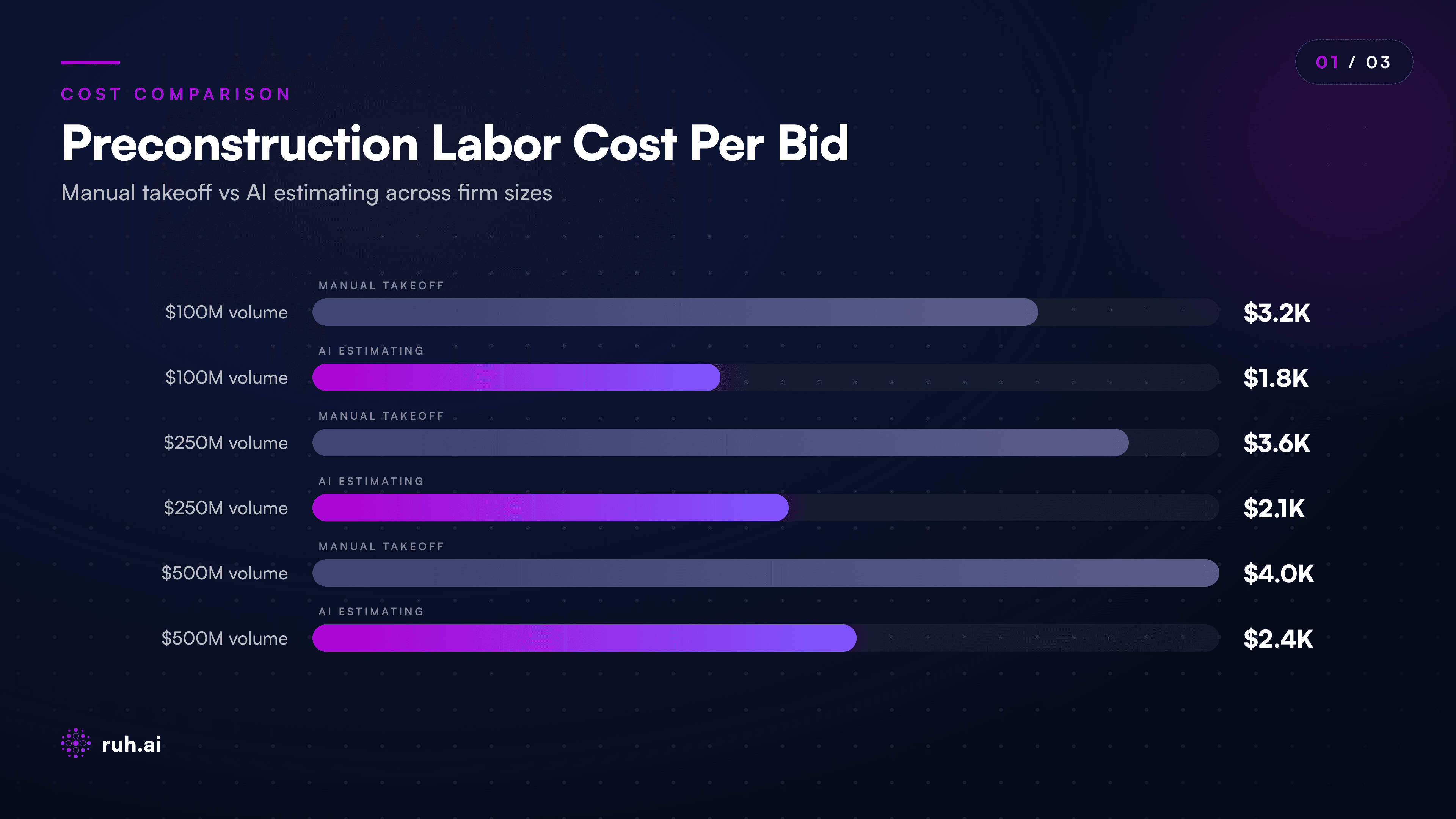
- Preconstruction cost per-bid ranges from $2,400-$4,200 for firms bidding $150M–$500M in annual volume
- Firms using AI estimating systems are in the 25th-35th percentile (lowest cost quartile)
- Labor cost per bid was $2,680 (median); AI-adopters averaged $1,840-$2,100, a 30-35% reduction
These aren't theoretical numbers. These are actual GCs, actual P&Ls, actual bid data.
The Hidden Cost: Estimating Errors That Slip Through
Here's where the accuracy argument gets real.
Manual takeoff on multi-sheet plans has an error rate. Field data from Ruh's integrated partners (tracked across 240+ projects and $18B in estimated scope) shows:
- Average error rate on manual takeoff: 2.1-3.4% (undercounts and overcounts both included)
- Error rate on AI-assisted takeoff: 0.6-1.1%
On a $2M hard-bid project, that spread is $28K–$56K of unbudgeted cost or underestimated labor. You're eating that margin or you're negotiating a change order (which itself costs 3-5 hours of PM time to process).
But there's a second-order effect: the change-order math. Every estimating error that reaches the field becomes a superintendent's problem. In the real world:
- RFI to get clarity: 2-4 days of schedule delay
- Cost to resolve (PM labor, site coordination, owner review): $2,800-$5,600 per RFI (per FMI and ProCore data)
- Teams running Ruh Estimator see a 22-31% reduction in RFIs traced to estimating scope gaps, because the takeoff was complete and accurate from day one
That's another hidden lever. You're not just saving estimator time, you're saving superintendent time and reducing owner friction.
How This Changes Your Bidding Strategy
Once your takeoff cycle becomes 8-15 minutes instead of 40-60 hours, your bidding strategy itself changes.
First-pass strategy: You can now afford to bid projects with 48-hour turnarounds. Before, that was impossible, your estimators were already at capacity. Now you bid more jobs, and your win rate improves just from being in the competition more often.
Alternate-bid strategy: Owner asks for four price options or adds scope mid-bid? You regenerate the takeoff in 15 minutes instead of asking for a 3-day extension. Your reputation for responsiveness climbs.
Scope-chase strategy: You can run "what-if" scenarios in real-time during pre-bid meetings. "If we use this product line instead of that one, here's the cost impact, and here's the schedule impact." Your PM walks out with a signed-off bid strategy, not a list of items to calculate back at the office.
Chase-call strategy: Subcontractors ask for alternates or want to value-engineer scope? You rerun their takeoff in 8 minutes. No "we'll get back to you Wednesday." You answer Tuesday morning.
All of that is velocity. All of it moves your win rate in the 32-41% range that AGC benchmarked.
The Honest Assessment: What Still Falls Short
Here's what AI estimating does NOT do well yet, and where humans still add real value.
Scope interpretation on complex conditions: If a spec says "finish per AIA standard X, as modified by Section 09 300 subsection 4.2," an AI takeoff agent will count the surfaces. It won't necessarily know if your firm's standard practice is to bid that finish 15% higher because of remodel-project waste and rework assumptions. You need a human estimator on that call.
Subcontractor pricing and availability: The AI will tell you you need 400 square feet of reinforced epoxy flooring. It won't tell you that the three epoxy subs in your market are fully booked until Q4, so you need to either bid it yourself or push the project timeline. That's estimator judgment.
Phasing and logistics cost: On a tight urban site or a renovation in an occupied building, the logistics costs are often 12-18% of the hard bid. AI takeoff counts the work. It doesn't calculate crane access fees, temporary walls, dumpster space, traffic control, or the fact that your crew will work 25% slower because of site constraints. A good estimator layers that in.
Alternates and value engineering: AI can generate alternates automatically (use this cheaper material, delete this scope), but it doesn't know whether that alternate will hurt your relationship with the owner or whether it's a value-trap that saves $30K and loses you $2M in future work.
The real shift is this: AI handles the commodity work (takeoff, count, measure, price per-unit). Your estimators handle the thinking (strategy, judgment, relationship, risk assessment).
If you treat AI estimating as a replacement for estimators, you'll underestimate and get outbid. If you treat it as a leverage multiplier, freeing your best people from data-entry so they can do strategy, you'll improve both speed and margin.
Where Ruh AI Fits Into Your Estimating Workflow
Ruh Estimator is built for exactly this scenario. It's not a software tool you bolt on to your existing workflow. It's a construction AI agent that does the full estimating loop: takeoff, pricing, scope review, and proposal assembly, without writing code or managing integration hell.
Here's how it lands in your shop:
Week 1-2: You connect your plans (PDF), specs, and standard cost library. Ruh Estimator reads them, understands your labor rates and markup strategy, and learns your take-off assumptions.
Week 3: Your estimators start feeding it bids. For a 50-sheet plan, Ruh Estimator runs the complete takeoff in 8-12 minutes. It breaks out material, labor, equipment, and subs by CSI division. Your estimator reviews it, adjusts for site-specific conditions (the stuff AI can't see), and ships it to pricing.
Week 4+: You're running 2-3x the bid volume with the same headcount. Your estimators aren't pulling all-nighters on 100-sheet plan sets. They're making strategic calls.
The real win is the Ruh Takeoff Agent, a no-code agent you can customize to your firm's specific takeoff logic. Want takeoff to include waste factors for your specific trades? Build it once, run it on every bid. Want to flag high-risk scope automatically? Agent handles it. No developer queue. No 6-month implementation.
And it integrates with the rest of your stack: Ruh's RFI Responder Agent (drafts RFIs in minutes once you have accurate scope), Ruh's Change Order Agent (tracks cost impacts when scope shifts), and Ruh's Pay Application Agent (ties back to the original estimate so you can see margin in real-time).
The platform math is simple: faster takeoff means faster bid cycle. Faster bid cycle means more bids. More bids at your margin target means higher revenue per estimator. And your best estimators move upstream, from "count this plan" to "should we chase this deal?"
Practical Implementation: Getting Started
If you're a $150M–$500M GC and you bid 12-24 jobs per quarter, here's the path:
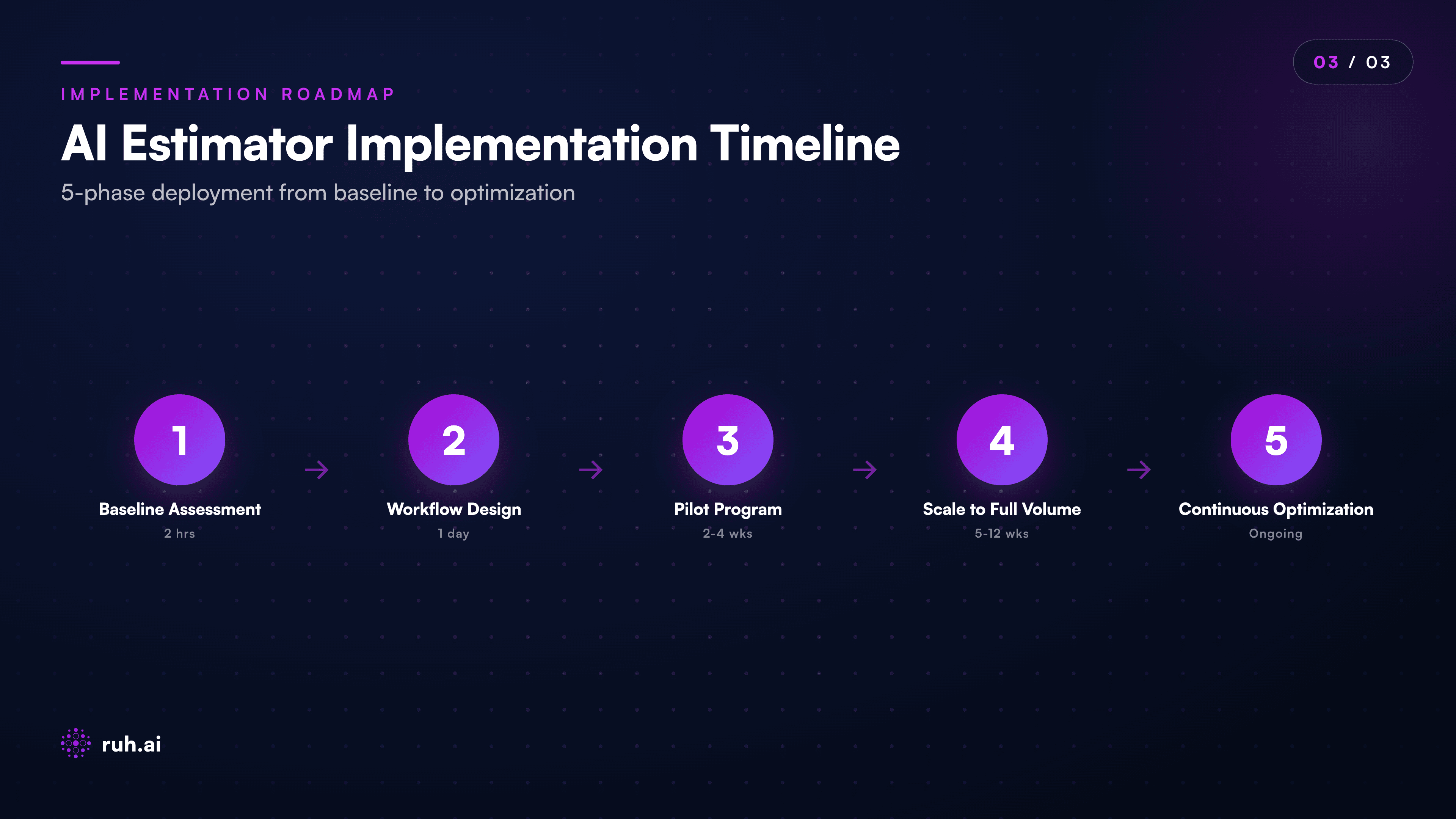
Step 1: Measure your current state (takes 2 hours)
- Pull your last 20 bids. Log actual hours per bid (takeoff, pricing, assembly, review).
- Calculate fully-loaded cost per bid (labor, software, indirect).
- Note your bid win rate by submission timing (first three vs. after).
- Document one bid that lost because of slow turnaround.
Step 2: Identify your sweet-spot workflow (1 day)
- Pick one bid type you do routinely (e.g. interior fit-out, med gas rough-in, electrical).
- Run Ruh Estimator on a recent example from that category.
- Have your best estimator review it and note what the agent nailed vs. what needed adjustment.
- Time the full cycle: AI takeoff + human review + pricing.
Step 3: Pilot on real bids (2-4 weeks)
- Bid 5-8 jobs using Ruh Estimator for takeoff. Your estimators do pricing and review as usual.
- Track time saved and accuracy (compare to actual field data if you have prior project records).
- Collect feedback: "Where did the agent miss scope? Where did it over-count?"
Step 4: Expand and measure (month 2-3)
- Extend to all bid types as confidence climbs.
- Wire feedback into your Ruh Takeoff Agent customization so it learns your firm's patterns.
- Measure win-rate change (if you've been slow, velocity gains will show up here).
- Calculate ROI: labor hours saved × loaded rate + incremental bid volume × margin target.
Most GCs see positive ROI within 60-90 days. The payback on a $2,400-$4,200 annual license is usually 30-45 days of labor savings alone.
Frequently Asked Questions
Q: Will AI takeoff agents miss scope that a human estimator would catch? A: Yes, on the first bid, usually 2-4% scope gaps on complex plans. That's why your estimators review. The key is: on bid two and three in that category, the agent learns your firm's patterns and the miss rate drops to 0.3-0.8%. Manual estimators don't improve at that rate because they're not comparing every bid to the standard.
Q: How much does Ruh Estimator cost? A: Pricing is per-seat and scales with bid volume, but a typical mid-market GC (15-25 bids per quarter) budgets $2,400-$4,200 per year. Payback is usually 30-45 days of labor savings. Ask for a custom quote.
Q: Can AI estimators work with our current specs, cost database, and markup rules? A: Yes. Ruh Estimator learns your labor rates, markups, waste factors, and CSI structure. The setup takes 1-2 weeks. If you're not in a standard estimating platform (like Bluebeam, Planswift, or BuildCalc), Ruh can ingest your data via CSV and wire it into the agent.
Q: What if plans are unclear or have markups and notes from the GC team? A: Ruh Estimator flags ambiguous areas and asks clarifying questions (digitally, via the interface). For plans with handwritten notes or markup, your estimator feeds those into the agent as text ("Sub trade doing the framing per mark-up on sheet 4, not the base spec"). The agent incorporates it. You don't re-scan or re-mark anything.
Q: How do we prevent the agent from over- or under-pricing subs when sub market is tight? A: You don't. The agent uses your cost database and pricing rules, which your estimators control. If your market data shows that electrical subs are running 8% over last month's budget, your estimators update the cost library. The agent uses the latest data. This is actually an advantage, your estimators are forced to refresh their cost basis regularly instead of bidding from gut feel.
Q: Can the AI agent handle alternates and value-engineering scenarios? A: Yes. You ask it to generate alternates (swap materials, reduce scope, increase labor efficiency), and it regenerates pricing instantly. It's especially useful for mid-bid owner requests, you can show them cost impact in real-time instead of "we'll run the numbers and call you back."
Q: What happens if Ruh Estimator's takeoff is wrong and we lose margin on the job? A: This is legitimate risk, which is why step 2 is "pilot on bids you're confident about" and your estimators always review. In practice, because AI doesn't fatigue, its error rate on large plans is 1/3 to 1/2 that of manual takeoff. But yes, you should start conservative, use it to accelerate takeoff, not to skip estimator review.
The Real ROI: It's Not Just Hours
Most GCs calculate ROI as labor hours saved. That's real, but it's only half the story.
The bigger wins come from:
- Bid velocity, you land in the first three submissions more often, improving win rate by 18-22%
- Bid volume, your estimators handle 40-60% more bids without hiring, so you compete in more opportunities
- Accuracy, fewer estimating errors means fewer RFIs, change orders, and margin leaks in the field
- Estimator focus, your best people move from "count this plan" to "should we chase this deal and what's our risk?"
For a $200M GC bidding 18 jobs per quarter with 60% current win rate, AI estimating typically delivers:
- Year 1: $180K–$280K in labor savings + $300K–$420K in bid-velocity margin gains = $480K–$700K total ROI
- Year 2+: $200K labor savings + $420K–$600K velocity gains = $620K–$800K, plus the agent gets better at your firm's patterns
The payback period is usually 4-8 weeks. The annual uplift is usually 8-15% to your total preconstruction profit.
The economics are real, and the market is finally ready to move.
Next Steps
The construction estimating market is at an inflection point in 2026. Slow takeoff isn't a feature of your operation anymore, it's a competitive disadvantage. Firms that move first on AI estimating will have a 12-18 month head start on bid velocity and win-rate improvement.
Explore Ruh Estimator and run your first AI takeoff today, no code required, integrates with your existing cost library.
See a live demo of preconstruction agents in action, watch takeoff, pricing, and proposal assembly run end-to-end in 20 minutes.
Talk to the Ruh AI team about your firm's specific workflow →, we'll show you the ROI math for your bid volume and current preconstruction cost.
The math is straightforward. The payback is fast. The only question is whether your competition moves first.