100% money-backBook a walkthrough

Construction glossary · Estimating concepts

What is contingency in construction?

Contingency is money added to a construction estimate or budget to cover costs that are likely to occur but cannot be specifically identified at the time of pricing. It is typically carried as a percentage of the cost of work, with design contingency covering scope the drawings do not show yet and construction contingency covering execution risk during the build. As the design matures and risk retires, the percentage carried goes down.

Updated June 2026 · Reviewed by the Ruh construction team

Design phase ~10%Construction ~3-5%Covers unforeseen, in-scope costs

Contingency on top of the estimate

Base estimate 90-95%Contingency 5-10%Buffer for the unknowns within scope

Estimating estimating concepts scope this week? Watch Ruh take off a real plan in 30 minutes.

Book a walkthrough
Definition

Contingency is a visible line item on the estimate summary, not padding hidden in unit prices. On US commercial work you will usually see two kinds. Design contingency covers scope the drawings do not show yet, and it shrinks as the documents mature. Construction contingency covers execution risk during the build, things like rework, minor scope gaps between trades, and field conditions. The term shows up on the estimate recap sheet, in GMP contract exhibits that define who controls the fund and how savings are split, and in the monthly contingency log the project team reviews with the owner. Estimators set it, project managers spend it, and owners audit it. New estimators make two common mistakes. The first is double-dipping: padding unit prices and then adding a contingency percentage on top, which makes the bid fat and uncompetitive. The second is using contingency as a catch-all for items that have their own line, like escalation, allowances, or known scope that simply was not taken off. Contingency is for the unknown, not for work you were too rushed to quantify.

How it is measured

Contingency is expressed as a percentage of the cost of work and carried in dollars as its own line on the estimate summary, below the trade subtotals and before fee. Common rules of thumb on US commercial work: 10% to 15% design contingency at concept or schematic, 5% to 10% at design development, 3% to 5% at construction documents, plus a separate construction contingency of roughly 2% to 5% held through the build. Treat those as starting points that flex with project risk, not fixed rules. In a GMP contract it appears as a distinct line in the contract exhibits and schedule of values, and during construction it is tracked in a contingency log that records each draw, the reason for it, and the remaining balance.

Worked example

Worked example

Say you are finalizing a $2,000,000 GMP at design development, with drawings roughly 75% complete. You estimate the cost of work at $1,750,000. The owner and your project executive agree to carry a 5% design contingency and a 3% construction contingency, both applied to cost of work. Design contingency: 0.05 x $1,750,000 = $87,500. Construction contingency: 0.03 x $1,750,000 = $52,500. Subtotal: $1,750,000 + $87,500 + $52,500 = $1,890,000. Add a 5% fee: 0.05 x $1,890,000 = $94,500, bringing the total to $1,984,500, just inside the $2,000,000 GMP. As the documents advance to 100% construction documents, the design contingency should burn down as real, quantified scope replaces it. Whatever construction contingency remains unspent at closeout is handled per the contract, often returned to the owner or split under a shared savings clause. All figures are illustrative.

100%

Try Ruh on a real bid. 100% money-back guarantee if you are not satisfied.*

*Scoped delivery, terms apply. Read the guarantee terms

Start with a walkthrough
How Ruh handles it

How Ruh handles contingency

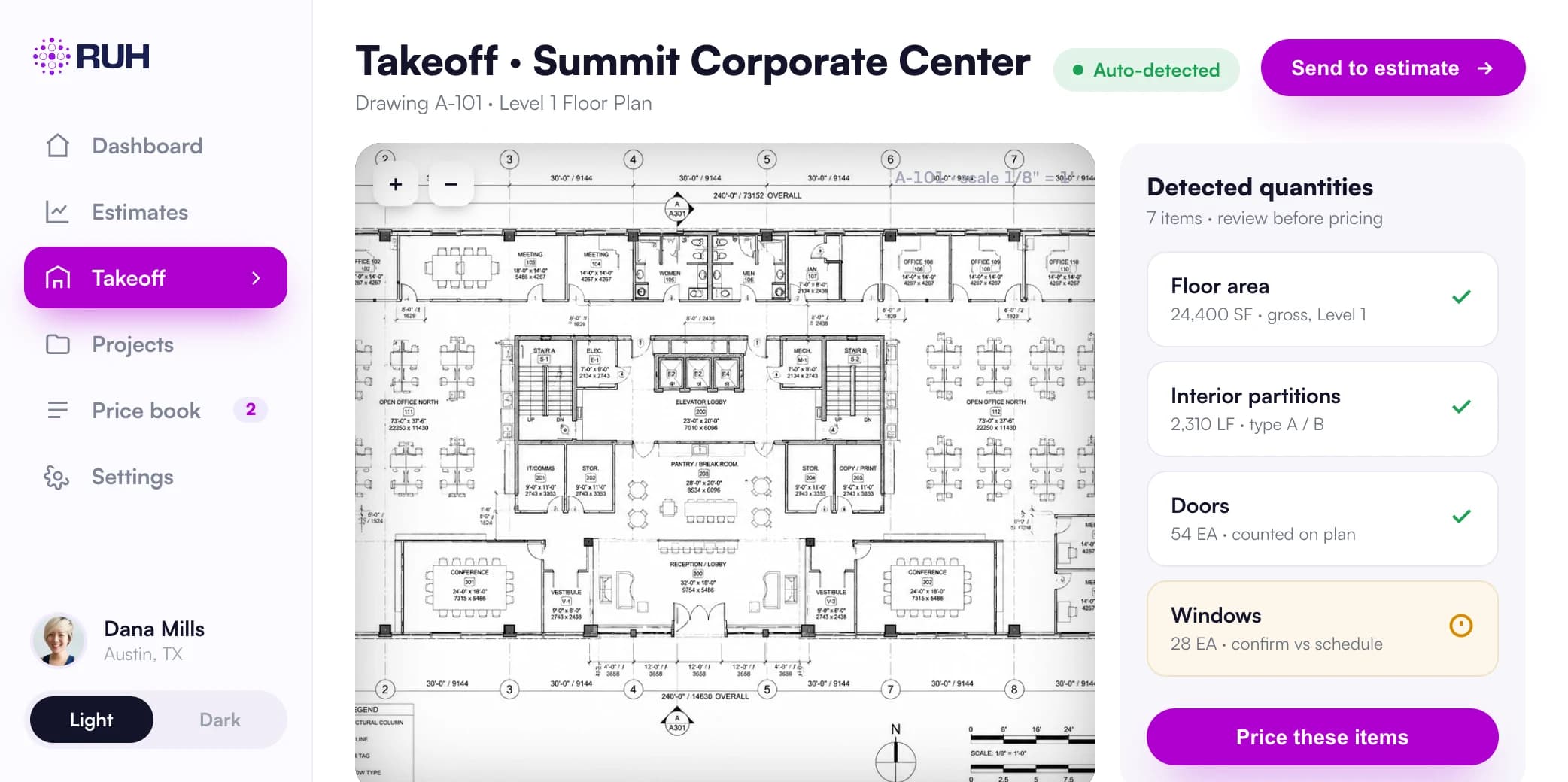
Ruh reads the contractor's drawings, performs the takeoff, and prices the quantities against the contractor's own price book, which gives the estimator a defensible base cost to apply contingency against. Because the draft is line by line, the estimator can see exactly what is quantified versus what the documents leave undefined, which is the judgment call that drives the design contingency percentage. The estimator reviews the draft, sets the contingency lines, and signs off; Ruh does not pick the percentage for you.

See construction estimating software

Contingency: frequently asked questions

What is the difference between contingency and an allowance?+

An allowance is a placeholder dollar amount for a known scope item that is not fully defined yet, for example an illustrative $40,000 for signage that has no design. Contingency covers unknowns across the whole job rather than one named item. When the signage gets priced, the allowance is reconciled against the real cost; contingency is only drawn down when an unplanned cost actually hits.

Who owns the contingency in a GMP contract?+

It depends entirely on how the contract is written, so read the GMP exhibit carefully. A contractor contingency inside the GMP is controlled by the GC, usually with a requirement to notify the owner or get approval for draws above a stated threshold. Owners often carry their own separate contingency outside the GMP for scope changes, and unspent contractor contingency at closeout is frequently returned or split under a shared savings clause.

What contingency percentage should I carry by phase?+

Common US commercial rules of thumb run 10% to 15% at concept or schematic design, 5% to 10% at design development, and 3% to 5% at construction documents, with a construction contingency of roughly 2% to 5% held through the build. Treat these as starting points, not rules. A repeat building type with a familiar subcontractor base justifies the low end; a renovation with unknown existing conditions justifies the high end or more.

Still measuring by hand? Your next takeoff can run while you review this one.

See it on your plans

Related terms

Keep going: read the full guide or explore construction estimating software.

The Estimating concepts estimating cheat sheet
Every unit, waste factor, and conversion on one page. Free PDF.

See Ruh price a bid from your own drawings.

AI takeoff and estimating on your price book, your estimator signs off.

Figures on this page are illustrative. Construction estimates depend on project-specific conditions, source documents, market pricing, and professional judgment. Ruh's AI assists the estimator and does not replace professional review: your team reviews, validates, and approves every estimate, bid, and pricing decision.
What is contingency in construction? | Ruh AI