
Construction glossary · Estimating concepts
What is quantity takeoff in construction?
A quantity takeoff is the process of measuring and counting every material and work item from a set of construction drawings, then listing the results in standard units such as cubic yards, square feet, linear feet, and each. It is the first step of every cost estimate, because each priced line item starts with a measured quantity. Estimators perform the takeoff from the plans and specifications before applying any unit prices.
Updated June 2026 · Reviewed by the Ruh construction team
How a quantity takeoff is built
Estimating estimating concepts scope this week? Watch Ruh take off a real plan in 30 minutes.
Book a walkthroughA quantity takeoff (often shortened to QTO, or just takeoff) is the systematic measurement of every work item shown on the drawings: concrete volumes, rebar tonnage, drywall square footage, door counts, linear feet of pipe. The takeoff feeds the estimate, so the quantities you pull set the ceiling on how accurate the bid can be. Estimators perform takeoffs during bidding, but the same quantities resurface later in purchase orders, subcontractor scope reviews, schedule of values line items, and pay application percent-complete checks. New estimators make three common mistakes: measuring at the wrong scale (always verify the printed scale against a dimensioned string before measuring anything), missing scope that lives in details, sections, and schedules rather than plan views, and forgetting to convert units before applying a unit price (square feet of slab is not cubic yards of concrete). A clean takeoff is organized by CSI division or by your own cost codes so the pricing step maps line for line.
Takeoff quantities carry the unit the work is bought and installed in: cubic yards (cy) for concrete, tons or pounds for rebar, square feet (sf) for slabs, drywall, and paint, linear feet (lf) for pipe, conduit, and footings, and each (ea) for doors, fixtures, and equipment. Quantities come off the architectural, structural, civil, and MEP sheets, with details and schedules filling in what the plan views do not show. Estimators measure digitally on a calibrated PDF or BIM model, or manually with a scale rule, then apply waste or lap factors before pricing. The finished quantities appear as the quantity column of the estimate, and later on the project as the basis for buyout and the schedule of values.
Worked example
Take a slab on grade that is 120 ft long, 80 ft wide, and 6 in thick. Step 1, area: 120 ft x 80 ft = 9,600 sf. Step 2, volume: 6 in is 0.5 ft, so 9,600 sf x 0.5 ft = 4,800 cubic feet. Step 3, convert to cubic yards: 4,800 cf divided by 27 cf per cy = 177.8 cy. Step 4, apply waste: subgrade variation and pump line loss typically justify a 5 percent waste factor, so 177.8 cy x 1.05 = 186.7 cy, ordered in whole yards as 187 cy. Step 5, price it: at an illustrative ready mix price of $185 per cy delivered, 187 cy x $185 = $34,595 for material alone, before placing, finishing, reinforcing, and vapor barrier. Notice that steps 1 through 3 are pure measurement, while the waste factor and the price are estimator judgment.
Try Ruh on a real bid. 100% money-back guarantee if you are not satisfied.*
*Scoped delivery, terms apply. Read the guarantee terms
How Ruh handles quantity takeoff
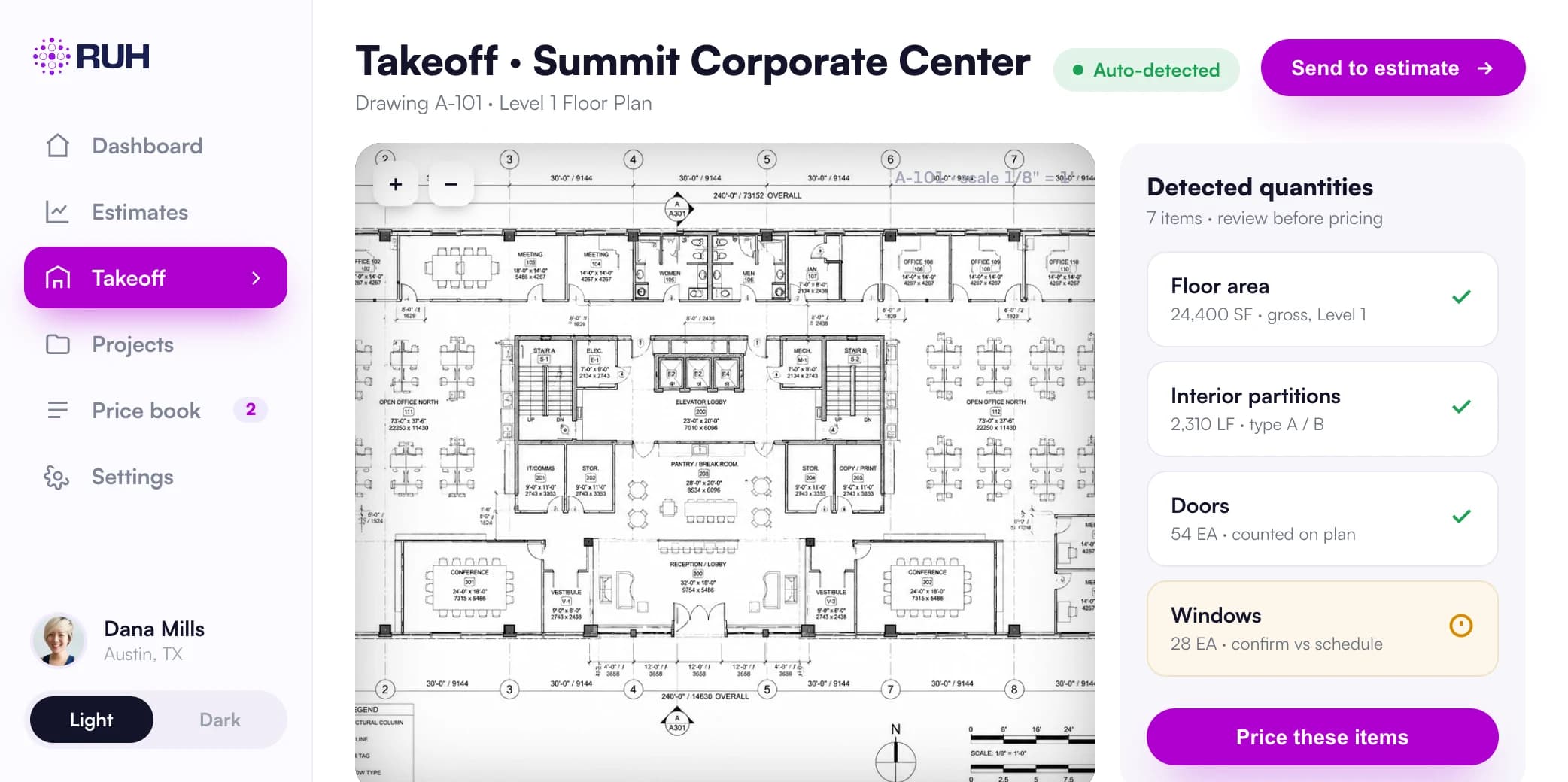
Ruh reads the contractor's drawings and performs the quantity takeoff directly, measuring the areas, volumes, lengths, and counts the same way an estimator would on screen. It then prices those quantities against the contractor's own price book, their real unit costs, and returns a line item draft of the estimate. The estimator stays in control: review the measured quantities, adjust waste factors and scope calls, and sign off before anything goes into the bid.
See construction estimating softwareQuantity takeoff: frequently asked questions
What is the difference between a quantity takeoff and a cost estimate?+
The takeoff is the measurement step: it produces quantities in units like cubic yards or square feet with no dollars attached. The estimate is what you get after applying unit prices, labor production rates, equipment, overhead, and markup to those quantities. A takeoff can be perfectly accurate while the estimate still misses, and vice versa, which is why good estimators check the two independently.
How long does a quantity takeoff take?+
It scales with the size of the drawing set, the number of trades covered, and the tool used. A single trade takeoff on a small commercial tenant improvement might take a few hours, while a full multi-trade takeoff on a ground-up commercial building can consume several days of estimator time inside a typical two to three week bid window. Digital and AI-assisted takeoff compresses the measuring, but scope review and judgment calls still need estimator hours.
Do I add waste to the takeoff quantity or to the unit price?+
Keep the measured (neat) quantity and the waste factor as separate, visible numbers rather than burying waste inside the unit price. That way you can defend the math at bid review, reuse the neat quantity for buyout, and tune waste per material. Concrete might carry 5 percent while drywall sheet goods often carry 10 percent or more depending on layout.
Still measuring by hand? Your next takeoff can run while you review this one.
See it on your plansRelated terms
Keep going: read the full guide or explore construction estimating software.
See Ruh price a bid from your own drawings.
AI takeoff and estimating on your price book, your estimator signs off.
Figures on this page are illustrative. Construction estimates depend on project-specific conditions, source documents, market pricing, and professional judgment. Ruh's AI assists the estimator and does not replace professional review: your team reviews, validates, and approves every estimate, bid, and pricing decision.