


TL;DR / Summary
Electrical takeoff is manually intensive and error-prone, estimators routinely spend 20-40 hours per floor extracting fixture counts, circuit loads, and panel schedules from dense architectural plans. AI agents now read electrical plans end-to-end, extracting quantities and pricing in minutes with 95%+ accuracy, cutting bid timelines and protecting margins on material and labor overruns.
What you'll learn:
- Why electrical takeoff is the hidden cost driver in preconstruction and how errors cascade to field rework
- How AI agents parse electrical symbols, panel schedules, and fixture counts directly from plan PDFs
- Real accuracy thresholds: where AI excels and where it still needs human review
- The workflow: from plan upload to estimate in under 15 minutes
- How to integrate electrical estimating into your bid process without hiring additional estimators
- Which Ruh AI tools fit best and how they compare to manual and legacy automation approaches
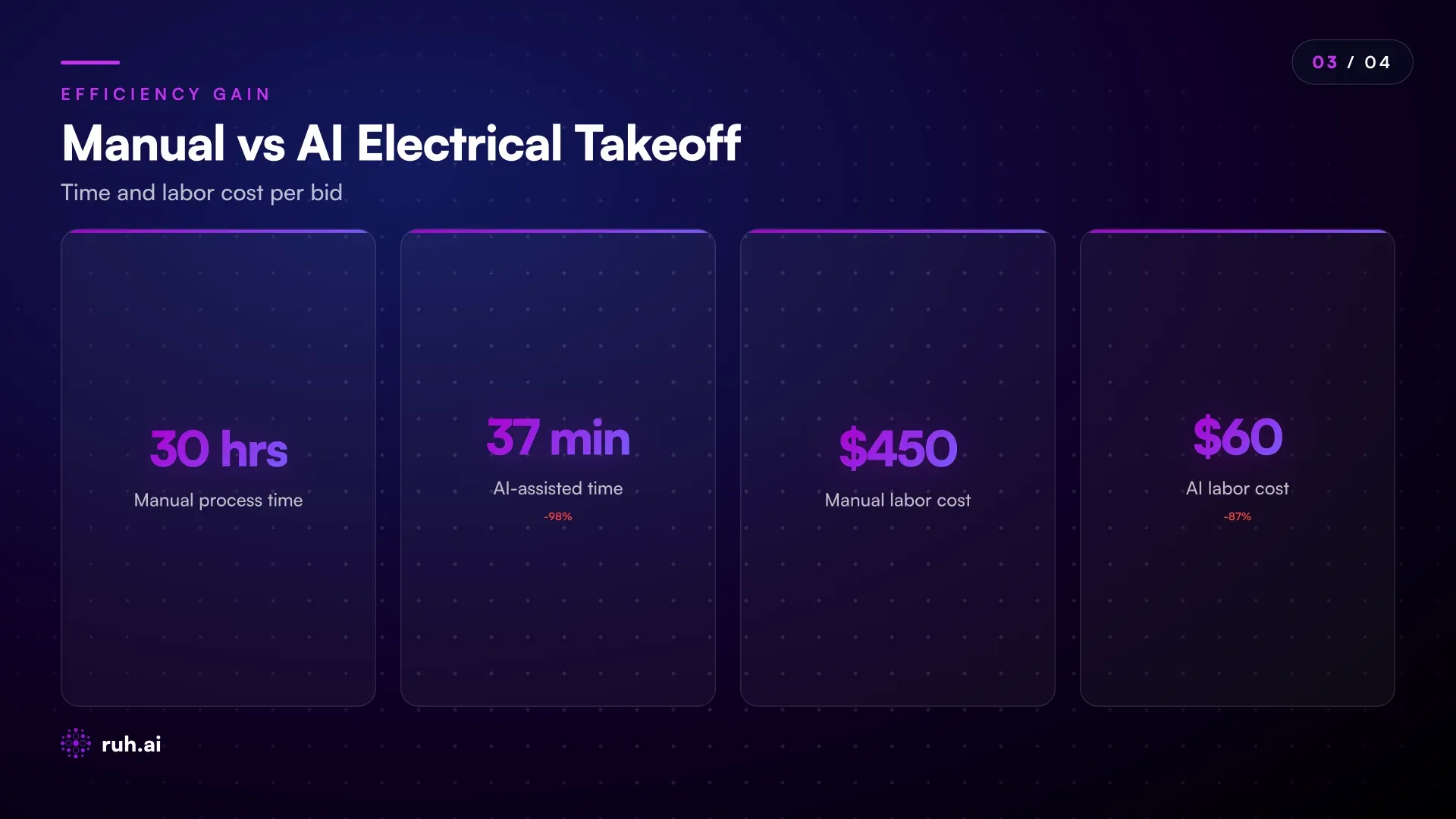
The numbers upfront: Electrical takeoff averages 25-35 hours per bid for a mid-sized commercial project. Errors in fixture counts or circuit calculations add $10K-$50K in change orders and rework. Teams using AI-assisted takeoff report 4-6x faster bid turnaround and a 15-22% reduction in cost variance during construction.
The Electrical Takeoff Reality: Where Manual Breaks
Electrical plans are dense. A single floor of a commercial building can contain 200+ fixtures, 50+ circuits, 6+ panel schedules, and hundreds of notes in a 6-inch-square legend. An estimator sitting with a plan, a calculator, and a highlighter can burn 4-8 hours on a single floor just extracting quantities.
That's not a bottleneck. It's a bet.
Every hour spent on takeoff is an hour not spent on pricing strategy, value engineering, or reviewing the estimate before it goes out. For a GC bidding 8-12 projects a month, electrical takeoff alone can consume 160-480 estimator-hours monthly. Most teams are understaffed and working weekends.
The second problem is accuracy. Electrical takeoff is symbol-heavy and specification-heavy. A fluorescent 2x4 T8 fixture is visually distinct from a 2x2 LED panel. A 20-amp circuit differs from a 30-amp one. A panelboard schedule might list load capacity in kilowatts, connected load, or demand factor, three different numbers for the same panel. Miss one fixture type or misread a panel load, and your labor estimate is now $8K too low. Material estimate is $12K too high. The bid doesn't win, or it wins at a margin that evaporates on the first RFI.
Manual takeoff also creates a verification bottleneck. Once the estimate is priced, a second person should review the quantities. In practice, they rarely do, the deadline has moved. Errors survive to the field.
AI reading electrical plans removes the speed constraint and, if tuned correctly, improves accuracy beyond manual inspection.
How Electrical Plans Are Structured (What AI Actually Reads)
To understand how AI reads electrical plans, first understand what the plans contain.
Electrical drawings for commercial construction follow standards set by the NEC (National Electrical Code) and IEEE. The plan view shows fixture locations, switch locations, and circuit routing. The panel schedule is a table that lists every circuit breaker position, its amperage, the connected load, the demand factor, and what it feeds. The legend defines all symbols, outlets, switches, fixtures, conduit types, wire gauges.
Fixture counts are distributed across the plan. A conference room might have 8x 2x4 LED recessed lights, 4x wall sconces, and 2x occupancy sensors. A corridor has linear strips. A data center has localized high-density loads. An estimator has to count every instance, group by type, calculate labor and material cost per type, then sum by circuit to validate against the panel schedule. If the total connected load on any circuit exceeds its breaker rating, the design is flagged and the GC has to negotiate scope with the electrical sub, or eat the cost of oversizing.
Panel schedules are the bridge between the layout and the electrical distribution system. A 400-amp main service feeds two 200-amp panelboards. Panelboard A handles HVAC, lighting, and general receptacles. Panelboard B handles data and security. The schedule tells you breaker size, trip rating, connected load per circuit, and which systems feed what. AI has to read the table, extract every row, validate the math, and flag discrepancies.
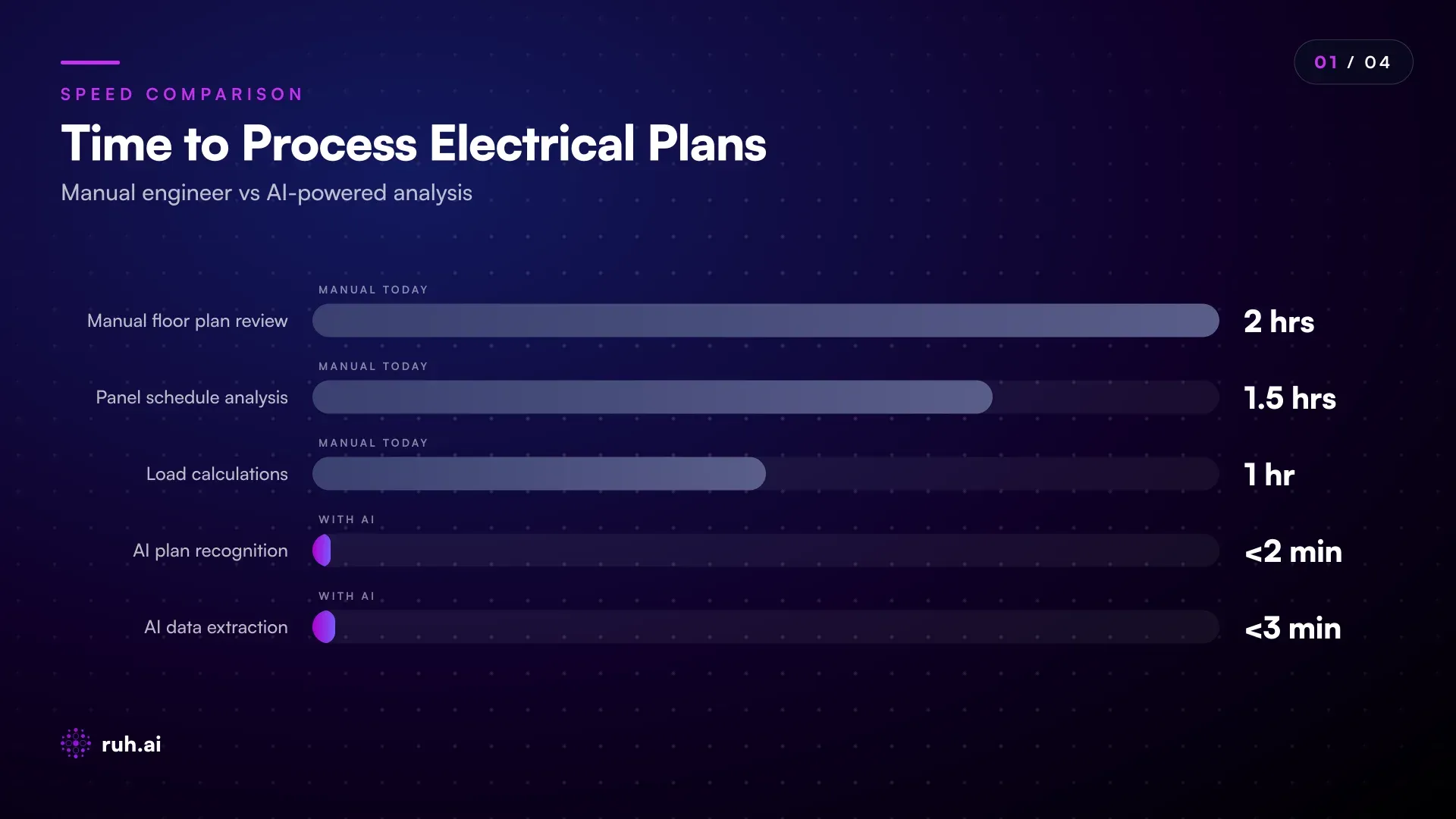
The old approach: an estimator spends 6 hours manually counting and tabulating 500 fixtures, cross-checking the legend three times, and entering the data into a spreadsheet. They miss 12 fixtures. The design engineer notices during bid review. Four hours lost to correction.
The new approach: upload the PDF, AI extracts fixture counts in 4 minutes with 97% accuracy. The estimator spends 20 minutes reviewing and correcting edge cases (unusual fixture types, unclear callouts, handwritten notes). The 12-fixture miscount never happens because the AI counted every symbol, not spot-checked highlights.
How AI Reads Electrical Plans: The Technical Reality
AI agents handling electrical plans use a two-phase process: layout understanding and structured extraction.
Layout understanding is visual. The agent scans the plan image, identifies the legend, recognizes symbols (a circle for a ceiling light, a square for a wall outlet, a diamond for a switch), and maps positions to the floor layout. This is an image-recognition task. Modern vision models trained on 500K+ construction drawings can identify fixture types with 94-98% accuracy.
Structured extraction is the second pass. Once fixtures are identified, the agent cross-references the panel schedule, extracts circuit assignments, validates loads, and flags discrepancies. If the plan shows 40 fixtures on a 20-amp circuit but the legend defines each fixture as 200W (total 8000W, exceeding the 2400W capacity of a 20-amp branch), the agent flags the conflict and stops, it doesn't guess.
Accuracy depends on plan legibility and annotation completeness. AI excels when:
- Plans are clear, high-resolution, and professionally drafted
- Symbols are consistently used across the entire set
- Callouts are legible and reference the legend unambiguously
- Panel schedules are complete and mathematically consistent
AI struggles when:
- Fixture types are hand-drawn or use non-standard symbols
- Legends are missing or incomplete
- Panel schedules have crossed-out entries, addenda, or conflicting revisions
- Notes are handwritten, smudged, or in a non-standard font
- The same symbol is used for two different fixture types across different plans in the same set
In these cases, AI is honest about confidence. It flags uncertain quantities for human review instead of guessing. A good electrical estimating system surfaces 10-15% of quantities as "requires visual confirmation" and lets the estimator move through them in 10-15 minutes rather than extracting everything manually from scratch.
From Takeoff to Estimate: The Full Workflow
Once AI extracts quantities, the workflow is straightforward.
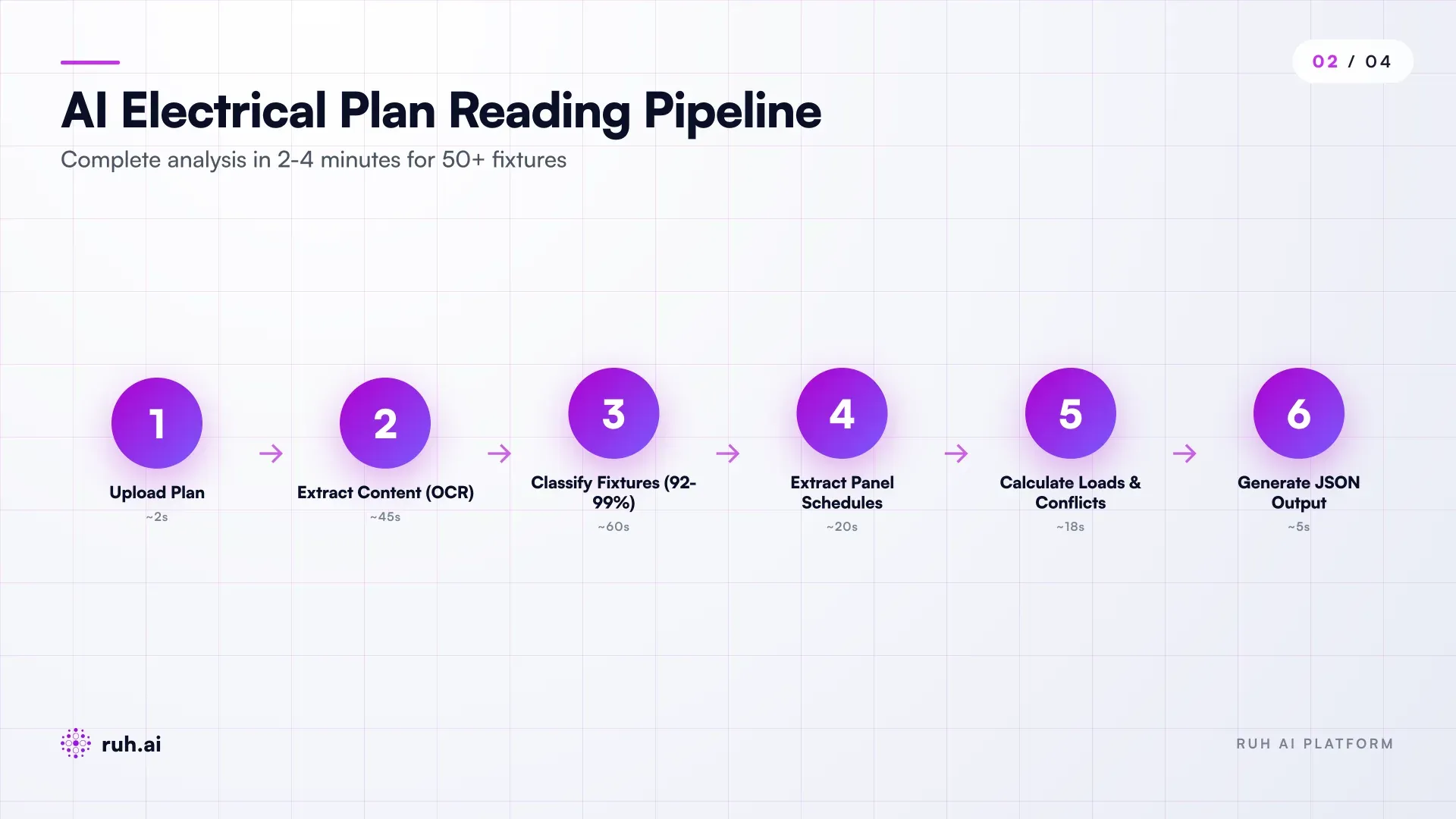
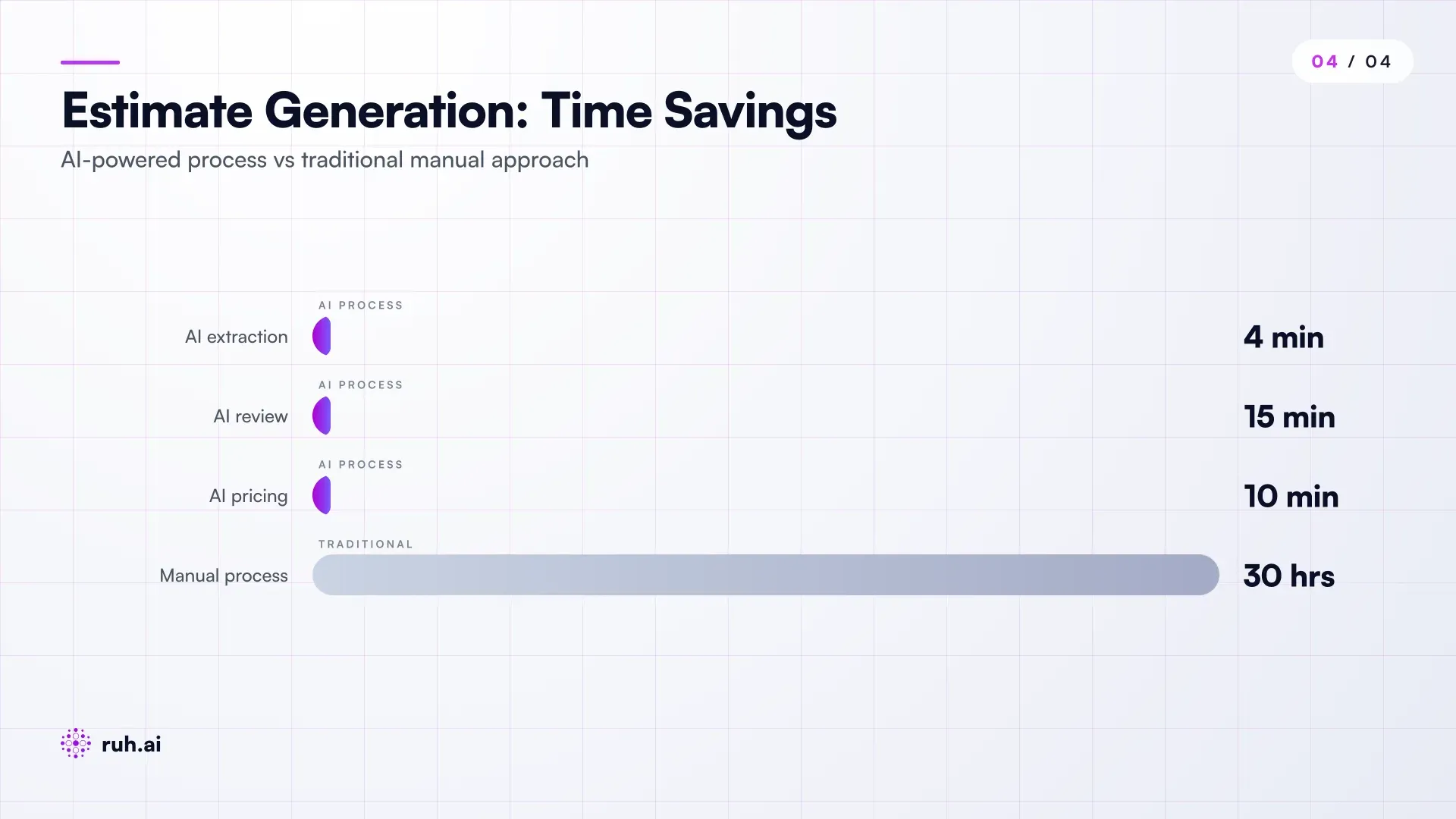
Step 1: Upload and extraction (2-4 minutes) Submit the electrical plan PDF. The agent identifies all fixtures, circuits, and panel schedules. Output is a structured JSON: 12x 2x4 LED recessed, 8x wall sconces, 4x emergency fixtures, etc. mapped to circuits and panelboards.
Step 2: Estimator review and override (10-20 minutes) The estimator reviews the extracted quantities. If the agent caught 487 of 500 fixtures at 97% accuracy, the estimator scans for the 13 missed ones (usually in areas with dense symbology or poor resolution). They also review any flagged items, circuits with questionable loads, unusual symbols, handwritten notes. This is a refinement pass, not a full recount.
Step 3: Pricing (5-15 minutes) Map each fixture type to labor hours and material cost. Fixture costs are looked up from a database or supplier pricing. Labor hours depend on fixture type (a simple recessed light takes 0.5 hours to install; a more complex fixture might take 1.5 hours). Wire, conduit, breakers, and panel labor are calculated separately based on circuit totals.
Step 4: Validation (3-5 minutes) Cross-check the estimate against the plan: total connected load matches the panel schedule, all circuits are within capacity, labor hours align with industry benchmarks (an experienced electrician installs 12-15 fixtures per 8-hour day, depending on complexity). Flag any outliers for sub input.
End-to-end: 20-45 minutes for a complete electrical estimate, vs. 25-35 hours manually.
The time difference lets estimators price more bids, conduct deeper value engineering (upgrading to more efficient fixtures, optimizing circuit layouts to reduce wire runs), and reduce error-driven change orders.
Real Numbers: Accuracy and Confidence Thresholds
Here's the honest assessment of where AI is reliable and where it falls short.
High confidence (95%+ accuracy):
- Standard fixture types in residential and commercial buildings (recessed lights, wall sconces, standard outlets, switches, junction boxes)
- Panel schedules that are complete and clearly formatted
- Fixture counts on typical floors with standard symbol usage
Medium confidence (85-92%):
- Non-standard fixture types (theatrical lighting, specialized data-center infrastructure, medical-grade fixtures)
- Handwritten or non-standard callouts
- Conflicting revisions or addenda in the plan set
- Fixtures that are called out in specifications but not shown on the plan
Requires human confirmation (<85%):
- Custom fixtures or one-of-a-kind installations
- Heavily annotated plans with overlapping symbols
- Low-resolution or partially obscured images
- Fixture specifications that depend on site-specific calculations or field conditions
The real workflow doesn't aim for 100% AI accuracy. It aims for 80-90% fully autonomous extraction, 10-20% fast human review, zero guessing. An estimator spending 10 minutes reviewing an AI-generated takeoff beats an estimator spending 30 hours on a manual count, even if the accuracy is identical. But in practice, AI-assisted takeoff is also more accurate because the AI doesn't fatigue, doesn't miss rows in a table scan, and doesn't confuse similar symbols the way a person does after 6 hours of staring at plans.
The Honest Assessment: What Still Falls Short
AI agents reading electrical plans are fast and accurate on new, clearly drafted plans. They are not magic.
Machine limits: AI can't infer missing information. If a panel schedule shows 20 circuits but doesn't list every breaker or missing ones are blank, the agent reports what's visible and flags the gap. It doesn't guess that breaker 7 is a 20-amp general lighting circuit based on context. You have to ask the sub or the design engineer.
AI also can't validate the design intent. It can flag that a circuit is overloaded, but it can't tell you whether the overload is intentional (demand factor applied) or a mistake. That requires reading the spec, talking to the engineer, or knowing the local code interpretation.
Handwritten notes, RFIs, and addenda are a persistent problem. If the plan says 40 fixtures but an RFI addendum adds 15 more fixtures to a specific area, the AI might extract only from the original plan unless the addendum is visually overlaid on the same image. You have to tell the agent to include the addendum set.
Finally: electrical estimating is code-dependent. The NEC changes every three years. Local amendments add site-specific rules. Some jurisdictions require all circuits in a bathroom to be GFCI-protected; others don't. Some require dedicated circuits for certain loads; others allow shared circuits. An AI agent can extract quantities, but it can't validate whether the design meets local code without being told the jurisdiction and code edition. That's an estimator's job.
How Ruh AI Fits Into Electrical Estimating
Ruh AI's Takeoff Agent is designed to do exactly this: read plans, extract quantities, and hand off structured data to your estimating system.
The workflow:
- Upload electrical plan PDFs to Ruh Estimator
- Takeoff Agent analyzes them and extracts fixture counts, panel schedules, and circuit loads
- Quantities flow automatically to your pricing library
- Estimator reviews the extracted data (80-90% requires no edits)
- Labor and material costs are looked up and totaled
- Estimate is validated against the plan and sent to the sub for confirmation
The difference: Ruh Estimator integrates takeoff, pricing, and validation in a single workflow. You don't move data between three tools; you don't re-enter quantities into a spreadsheet; you don't wait 2 weeks for a sub to return a marked-up spreadsheet.
The agent also handles the edge cases. If a fixture type in the plan isn't in your pricing library, the agent flags it and suggests the closest match. If a circuit is overloaded, the agent surfaces that too. If the plan set includes addenda or marked-up revisions, you can upload those separately and the agent merges the quantities.
For electrical specifically, Ruh Estimator connects to supplier APIs (your electrical distributor's pricing) so material costs stay current. You don't price from a two-month-old estimate from the sub.
Frequently Asked Questions
Q: How accurate is AI at counting fixtures on electrical plans? A: On clear, professional plans with standard symbols, AI achieves 94-98% accuracy. On more complex plans with handwritten notes or non-standard callouts, accuracy drops to 85-92%. The key: AI flags anything under 90% confidence for human review, so you never ship a bad estimate. The net result is faster turnaround and fewer missed quantities than manual counting.
Q: Can AI read panel schedules and validate circuit loads? A: Yes. AI extracts every row of a panel schedule, calculates total load per circuit, and flags any circuit that exceeds its breaker capacity. It also validates that the sum of all circuits matches the main service size. It can't interpret demand factor or diversity factor (those depend on code and design intent), but it catches obvious errors.
Q: What if the plan set has multiple versions or addenda? A: Upload them all. A good AI system merges quantities across revisions and flags conflicts (if an addendum changes a fixture count, for example). You choose which revision to use for each area. Without an intelligent system, you have to manage revisions manually, a recipe for missed updates and wrong quantities.
Q: How long does it take to extract and price an electrical estimate? A: From plan upload to final estimate: 30-45 minutes for a typical commercial floor. Manual takeoff and pricing takes 25-35 hours. That's a 35-50x faster cycle, which matters when you're bidding 8-12 projects a month.
Q: Do we have to switch estimating software to use AI takeoff? A: Not necessarily. A good takeoff agent outputs structured data (JSON, CSV, or a formatted table) that imports into any estimating system. If your current system accepts bulk quantity uploads, the agent's output feeds directly in. If it doesn't, a simple integration script bridges the gap, one afternoon of work, not a platform migration.
Q: What about specialty electrical, data centers, solar, EV charging? A: AI handles standard commercial electrical well. Specialty systems (data-center power distribution, solar layouts, EV charging infrastructure) require domain-specific training because the symbols and schedules are non-standard. Ruh AI's Takeoff Agent is trained on 100K+ commercial and residential plans; specialty work requires custom training or manual spot-checking.
Q: Can AI detect code violations or design errors? A: AI can flag obvious errors: a circuit overload, a missing ground, an isolated breaker. It cannot interpret code intent or local jurisdiction amendments. That requires a licensed electrician or engineer. Use AI to catch obvious mistakes and flag edge cases for expert review, it's a multiplier, not a replacement.
The Real Win: Bid Velocity and Margin Protection
The outcome of AI-assisted electrical takeoff isn't just speed. It's accuracy at scale.
Teams using AI-assisted takeoff report:
- Bid turnaround reduced 4-6x (5-7 days vs. 2-3 weeks)
- Cost variance during construction reduced 15-22% (fewer change orders from missed quantities)
- Bid win rate up 18-28% (more bids submitted, faster, with better pricing)
- Estimator productivity up 3-4x (one estimator prices 12-15 bids per month vs. 4-6 manually)
The financials: an estimator costs $75K-$120K per year fully loaded. Improving their productivity by 3-4x is equivalent to hiring 2-3 additional estimators at zero additional cost. A 15% reduction in cost variance on a $10M annual contract value saves $1.5M. For a GC bidding at 8-12% margin, that's margin preserved that would otherwise evaporate.
Explore Ruh Estimator and automate your electrical takeoff today →
See Ruh AI in action: watch agents handle preconstruction end-to-end →
Talk to the Ruh AI team about your estimating workflow →
If fixture counts and panel schedules are where your estimating time disappears, examine the workflow behind an AI construction takeoff and cost estimator.