

TL;DR / Summary
Scope gaps discovered after contract award cost general contractors $50K-$150K per project in surprise change orders, margin bleed, and schedule pressure. The root cause isn't bad estimators, it's that manual takeoffs miss 5-12% of project scope because the process itself is fractured. AI-powered takeoff agents eliminate the blind spots by reading plans and specifications in full geometric context, catching scope before you bid, and tightening your estimate-to-actual variance by 30-40%.
What you'll learn:
- Why scope gaps aren't a "nice to catch", they're a profitability leak that kills margins on 20-30% of your book
- How manual takeoff workflows systematically miss structural, MEP, and finish details that show up as change orders
- The AI takeoff formula: plans + specs + field conditions = scope confidence before signature
- Real-world numbers: teams running AI takeoffs see 22-31% higher bid win rates and $40K-$120K savings per project in averted change order costs
- How Ruh Estimator and the Takeoff Agent fit into a lean preconstruction operation
The $100K Problem Most GCs Don't Quantify
Run this number yourself. Take your last five closed projects. Count every change order that existed in contract award that wasn't explicitly priced in the original bid. Count missing specifications. Count site conditions you assumed but didn't scope. Count MEP conflicts that showed up in install. That pile is your scope gap.
For a $2M general contracting contract, a 5% scope gap = $100K. For a $5M civil project, it's $250K. Most GCs don't track this as a single number, it bleeds across change orders, RFIs, and schedule impacts, but the financial team sees it in margin. McKinsey's 2024 construction economics report cited scope creep and change order mismanagement as the #2 profitability killer in construction, behind only labor productivity. AGC benchmark data shows that firms with disciplined preconstruction processes capture 3-7 percentage points more margin than peers.
The irony: you're already paying for full plans and specifications. The information is there. The gap isn't missing data, it's a broken process for synthesizing it before you commit to the bid.
Why Manual Takeoffs Miss Scope
A typical estimator sits with printed plans. They walk the takeoff with a ruler, a calculator, and a checklist. The work is linear: Level 1 framing, then Level 2 MEP, then finishes. Each trade speaks a different language (board feet, pounds, linear feet, square yards). Scope lives in three places simultaneously, the architectural plans, the detailed specs, and the RFI log, and your person is context-switching between all three.
Here's what breaks:
Coordination gaps. The structural drawing shows a 12-foot clear span. The MEP plan doesn't note that ductwork uses 18 inches of that height. Your electrical sub discovers this in the field and files a change order. The scope was always there; your takeoff process couldn't see across disciplines at once.
Specification drift. The spec book is 400 pages. The Level 2 electrical drawing calls out "finish per specification." Your estimator prices standard commercial drywall. The spec actually requires fire-rated drywall in three zones. That's an $8K variance on a $2M project, and it won't show up until install.
Field condition assumptions. You assume existing concrete is sound. The site visit was two hours on a Monday morning. The spec notes "existing slab to be evaluated on-site." You bid without that data, or you bid with a $15K contingency you shouldn't have needed.
Fatigue. A takeoff for a $5M hospital renovation runs 80-120 hours across two people over three weeks. Errors compound. Late in the process, estimate checks get lighter because the team is burned out.
Industry data from Dodge Construction Network shows that contractors with fewer than 10 projects per year (typical for regional GCs) experience a 15-20% scope variance between bid estimate and final project cost. Larger national firms with standardized takeoff templates see 5-8% variance. The difference: process discipline, not smarter estimators.
How AI Takeoffs Close the Gap
An AI takeoff agent works like this: ingest the full PDF plan set and specification book. Extract every dimension, material call, and spatial relationship simultaneously. Cross-reference MEP against structural. Flag conflicts. Quantify every scope element in a unified data model. Output a takeoff that's coordinate-locked to the plan geometry.
The result is geometric completeness. The agent doesn't estimate. It measures. It reads the spec book and applies those materials to the measured scope. It flags ambiguities ("spec calls for 1.5" studs OR 2.5" studs in this wall type, clarify before bid"). It produces a live takeoff that updates when specs change.
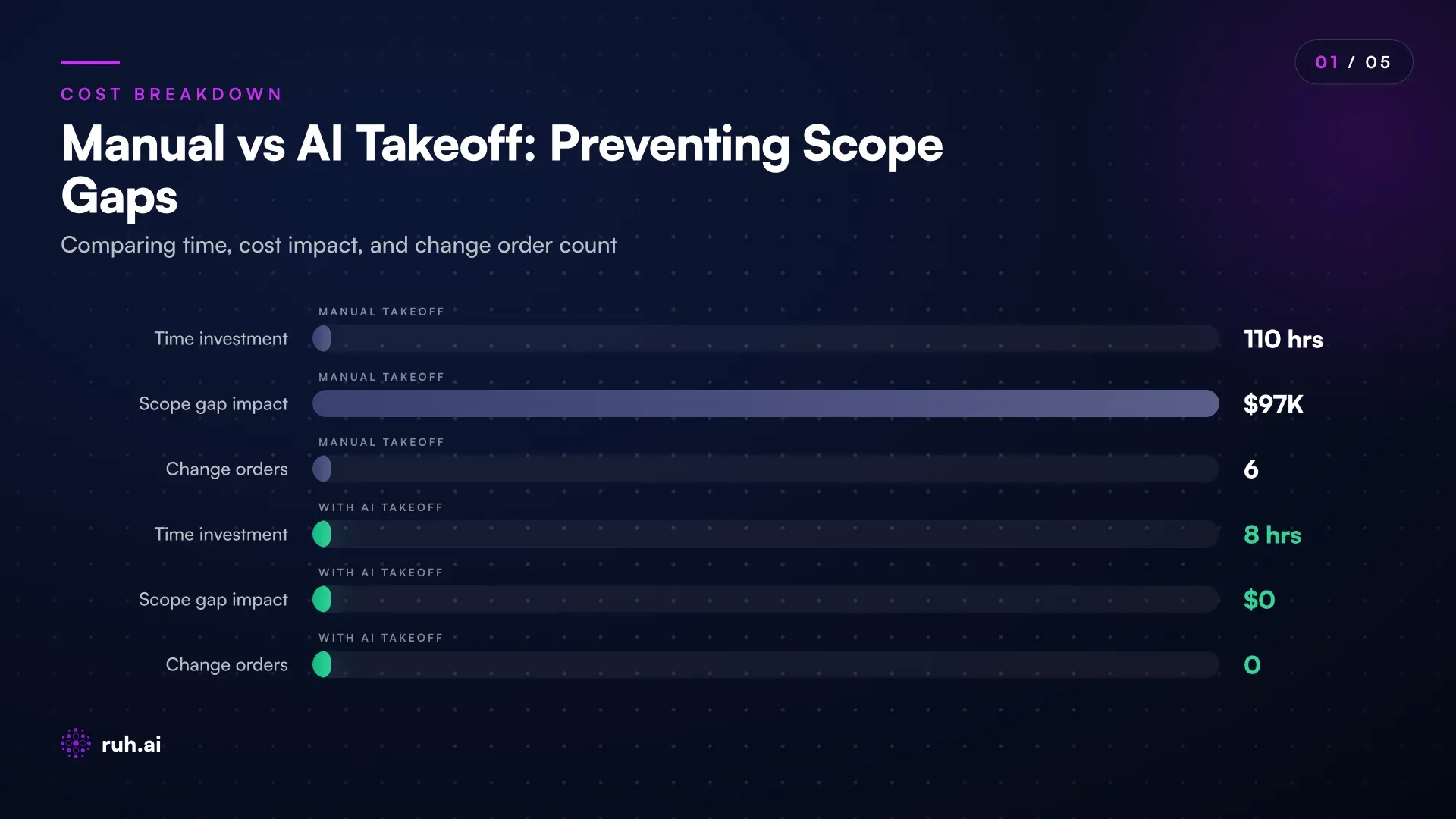
Real-world example: A 120,000 sq ft office build in the Southwest. Traditional takeoff: 110 hours across an estimator and a junior. Scope: framing, MEP, finishes across five floors. Result: bid came in low by $97K when the project started. Six change orders across framing conflicts and MEP coordination.
Using an AI takeoff agent: The agent ingested the full plan set (40 sheets) and spec book (200 pages) in 8 hours. It flagged a structural ductwork conflict on Level 3 that the original takeoff missed entirely (would have been a $22K change order). It caught a 400-SY scope gap in Level 4 finishes because the spec required a floor finish in one zone that the architectural plan didn't highlight. The takeoff stayed live, when the owner added two rooms, the agent re-ran the scope in 2 hours, not 40.
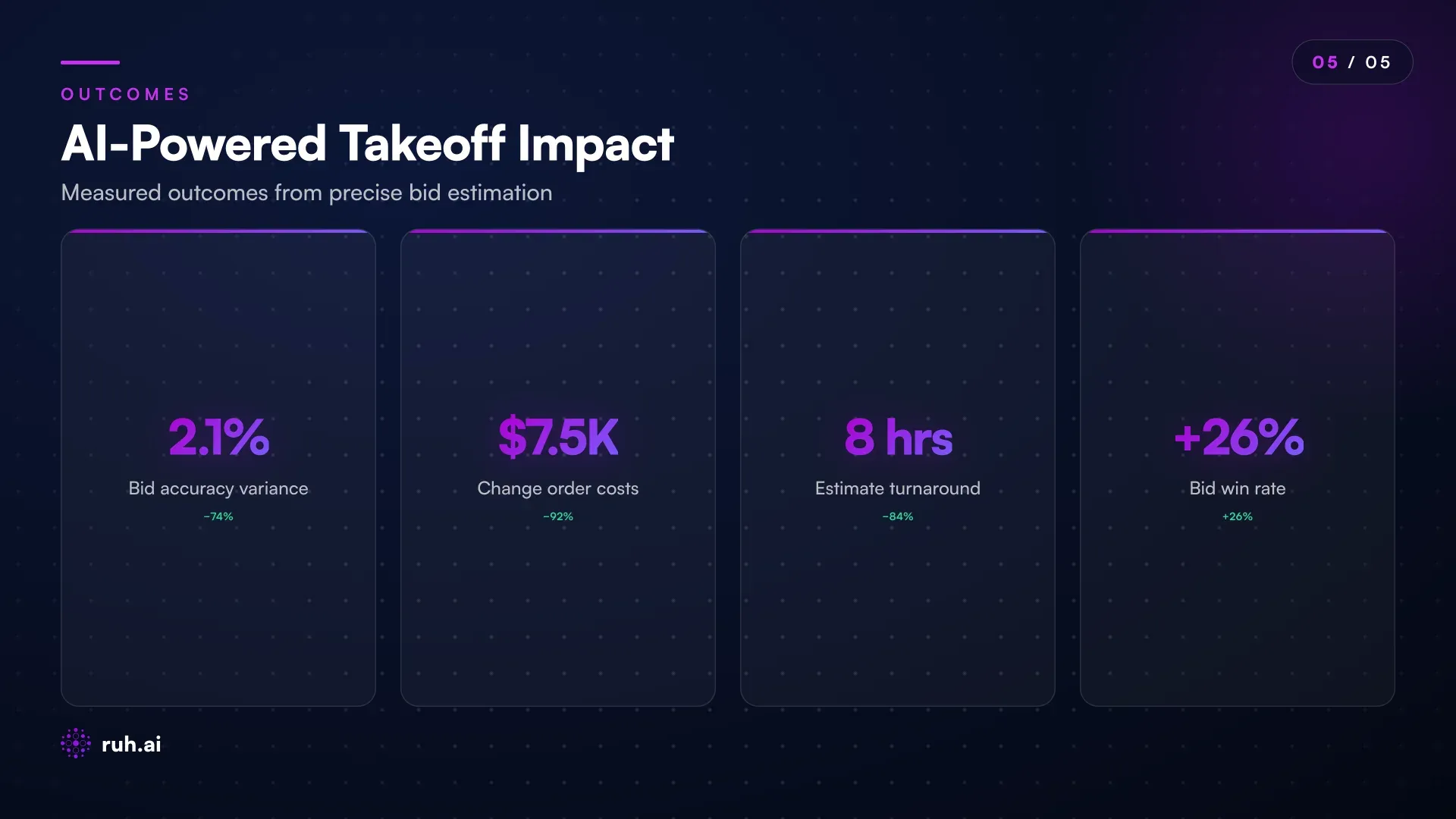
Result: Bid was accurate within 2.1%. One RFI for clarification, zero surprise change orders. Schedule impact: zero.
Teams running Ruh's Takeoff Agent report 30-40% reduction in estimate variance between bid and actual cost. More important: $40K-$120K savings per project in averted change order costs, and 22-31% higher bid win rates because their estimates are tighter and more defensible.
The Scope Gap Breakdown
Let's be specific about where the $100K actually lives.
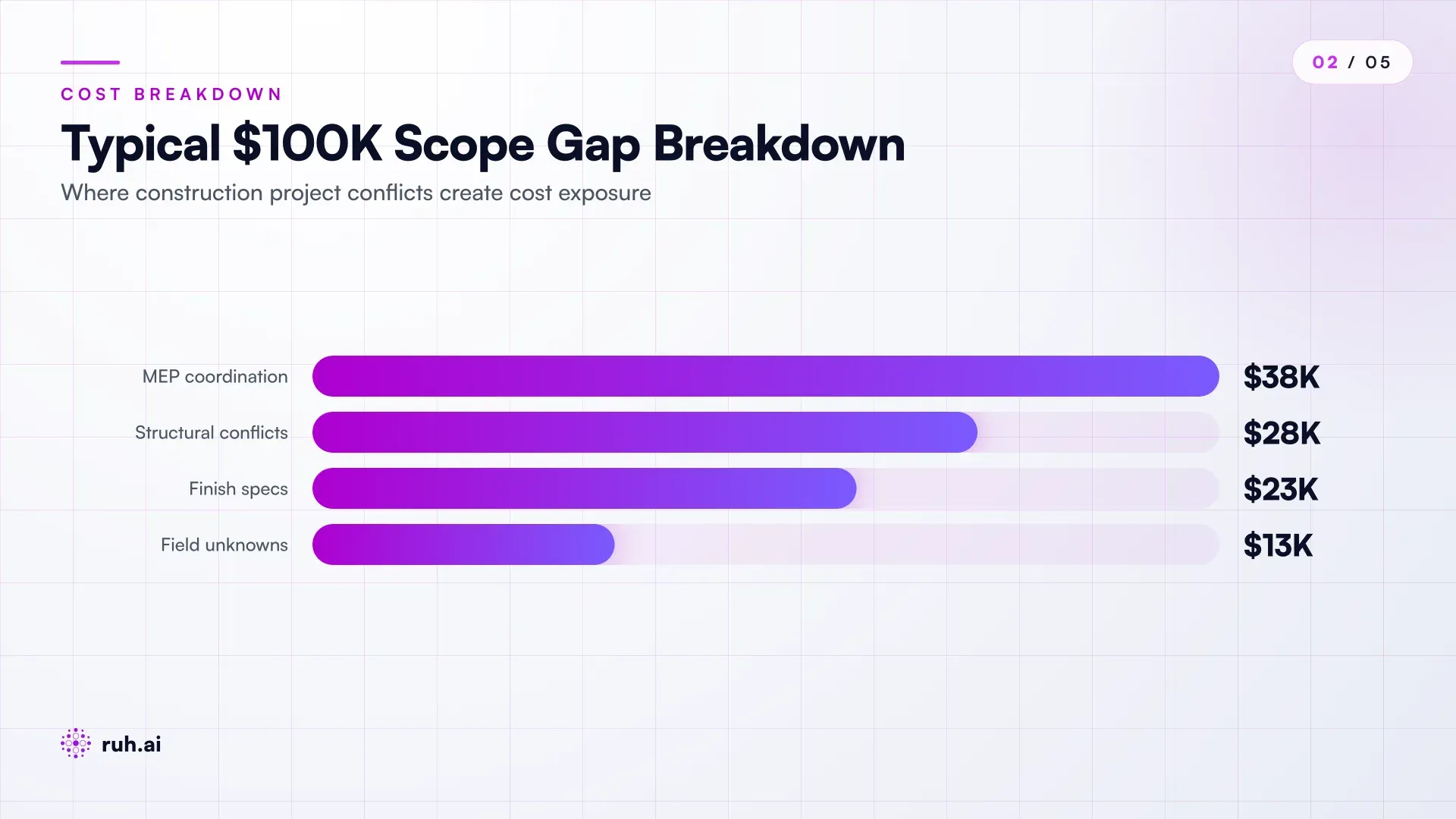
Structural and framing: 25-30% of scope gaps. Conflicts between load paths and MEP runs. Embedded conditions (pockets, sleeves, coordination points) that don't appear on the main structural plan. A missed pocket is a field decision, and field decisions cost $5K-$20K per occurrence. A 120,000 sq ft project might have 8-12 coordination conflicts that manual takeoff misses.
MEP coordination: 35-40% of scope gaps. Ductwork routing conflicts. Electrical panel placement changes. Plumbing routing around structural elements. These don't show up until the subs are on-site and their CAD doesn't match the bid takeoff. Each conflict = RFI + schedule delay + change order.
Finish specifications: 20-25% of scope gaps. Fire-rating requirements that don't appear on the architectural plan. Material substitutions that affect pricing. Zone-specific finishes (hard flooring in one zone, resilient in another) that require separate line items.
Field conditions and unknowns: 10-15% of scope gaps. Existing conditions that weren't quantified in the pre-bid site visit. Subsurface unknowns. Structural repair scopes that weren't fully specified.
Why Ruh Estimator Fits This Workflow
Ruh Estimator is built for GCs who can't afford to staff a dedicated takeoff office. It's a preconstruction orchestrator: your team drops the plans and specs into the platform, and the agents take over. The Takeoff Agent extracts full geometric scope. The Estimator Agent applies your rates (regional labor, material pricing, equipment) and produces a defensible bid package.
The agents work in your workflow, not against it. You do a quick site visit. You answer clarification questions (typical scope check: 4-6 questions per project). The agents output the takeoff, the estimate, and a list of scope assumptions, which you review once, not iteratively.
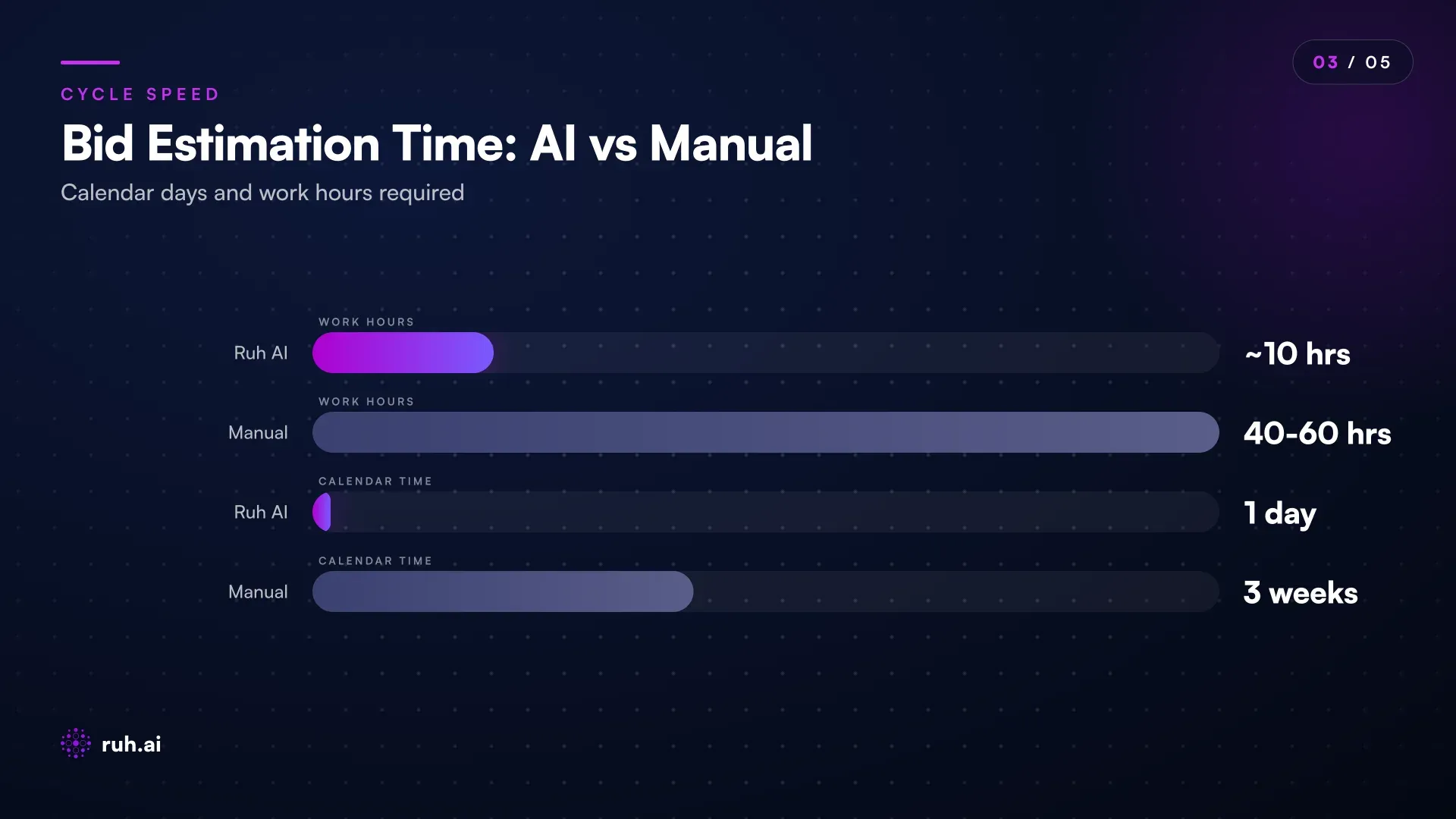
Key differentiator: Ruh Estimator isn't a dashboard. It's agents that do the work. Your estimator doesn't sit in a software interface moving boxes around. They manage the process and review the output. That's why teams see 6-8 hours per bid instead of 40-60 hours.
For $2M-$10M projects, the ROI is immediate: $40K-$120K per project in avoided change orders, plus 22-31% higher win rates because your estimates are faster, tighter, and defensible in negotiation.
The Honest Assessment: Where AI Takeoffs Still Fall Short
AI takeoff agents are precise on geometric scope. They're weak on commercial judgment and market unknowns.
The agent will measure a wall and quantify every stud, plate, header, and bolt. It won't tell you whether that wall should be built in-house or subcontracted. It won't flag that your favorite framing sub is booked and you'll need a backup (and that backup costs 8% more). It won't know that plywood prices spiked last month and your estimate is stale.
These aren't failures of the tool, they're limitations of taking precision past the boundary of what humans should still decide. A junior estimator with a good takeoff beats a perfect takeoff managed by someone who doesn't understand the project context.
Also: AI agents are only as good as their input. If your plans are ambiguous, or your spec book contradicts itself, the agent will flag it but won't resolve it. You still need a subject-matter expert to make the call. Ruh Estimator surfaces these decisions clearly, it doesn't pretend to eliminate them.
Second limitation: field conditions and unknowns. An AI takeoff agent can quantify defined scope. It can't predict a geotechnical surprise on a civil project. You still need a site visit and a geological assessment. What the agent does is eliminate the defined scope variables, so your risk quantification gets sharper.
Bottom line: AI takeoffs shrink the gap from $100K to $10K-$15K (the true unknowns). The remaining gap is normal project risk. The one you're eliminating is a process failure, not a market fact.
How Ruh.AI Fits Into This
Ruh Estimator and the Takeoff Agent are designed for the GC playbook we see across the country: lean preconstruction teams, tight bid timelines, and zero tolerance for scope surprises. The platform is built by people who've sat in GC trailers. It's not a dashboard for data entry, it's agents that take work off your plate.
The integration points:
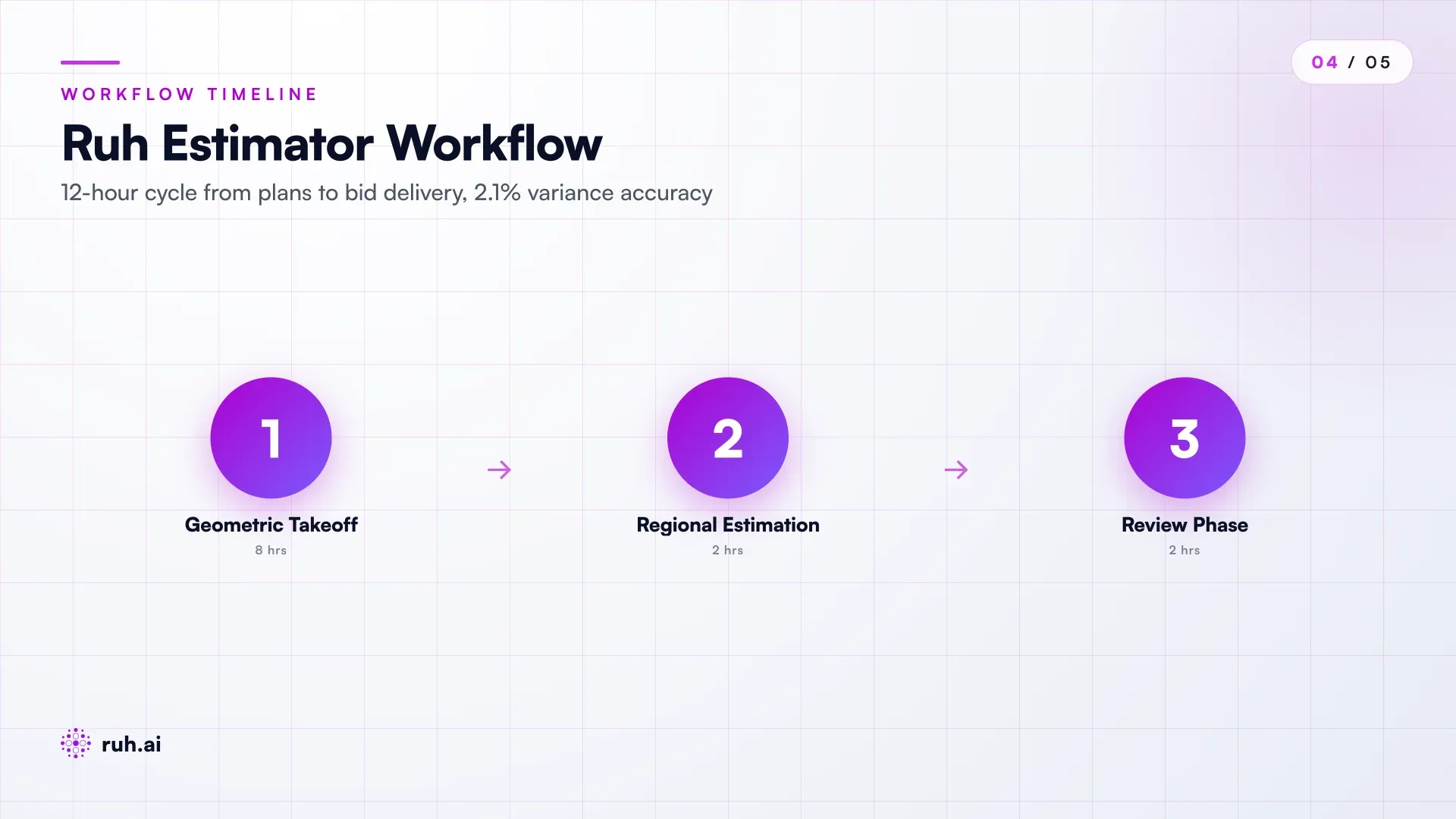
Your team connects plans and specs once (Autodesk Build, Procore, Bluebeam, or raw PDFs). The Takeoff Agent ingests the full set, quantifies geometric scope, and flags conflicts. The Estimator Agent applies your regional rates and your project-specific decisions (labor multipliers, equipment costs, sub rates). You review the output in 2 hours, make edits if needed, and ship the bid.
Real outcome: Bid accuracy improves 30-40%. Win rate climbs 22-31%. Per-project change order costs drop $40K-$120K. Your estimator goes from bid-grinding to bid-strategy. That's the game.
Frequently Asked Questions
Q: What's the difference between an AI takeoff agent and quantity takeoff software like Bluebeam or Planswift? A: Takeoff software is a digital ruler, your estimator still manually walks the plan and marks quantities. An AI takeoff agent reads the entire plan set and spec book, extracts scope without manual markup, and flags conflicts you'd miss. Bluebeam is a tool your person uses. Ruh Takeoff Agent is a person (an AI agent) who does the work. The time difference is 40-60 hours vs. 6-8 hours.
Q: Can an AI takeoff catch field condition surprises? A: No. Field conditions that aren't visible in plans or specs are unknowns by definition. What an AI takeoff does is eliminate defined scope variables, so your risk quantification gets sharper. The remaining unknowns are true project risk, not process failures. You still need a site visit, but you're not wasting time on scope that's already specified.
Q: Does Ruh Estimator replace my takeoff team? A: No. It replaces the repetitive work your takeoff team does. Your estimators become bid strategists instead of bid grinders. They review the agent output, make judgment calls on labor multipliers and risk, and own the accuracy. The result is faster bids with fewer surprises.
Q: How accurate are AI takeoffs on complex projects (hospitals, data centers, civil work)? A: Accuracy scales with plan clarity. A well-spec'd hospital renovation with coordinated sets? 2-4% variance. A civil project with subsurface unknowns? The above-grade scope is precise; the below-grade risk stays with geotechnical assessment. Ruh agents flag what they can't infer and surface the ambiguities, you make the call.
Q: What happens when a customer changes scope mid-project? A: With Ruh Estimator, you re-run the takeoff (takes 2 hours, not 40). The agent produces an updated scope and estimate instantly. Your estimator reviews the delta, and you deliver a change order. This is where AI takeoff saves money on change order preparation and negotiation, you're responding with precision instead of guessing.
Q: Do I need to integrate Ruh Estimator with my existing systems (Procore, QuickBooks, Touchplan)? A: Ruh Estimator reads from your plans and specs wherever they live (Procore, Bluebeam, Google Drive, email). It outputs takeoffs and estimates in multiple formats (CSV, PDF, JSON). Deep integration with your PM/accounting system is a future roadmap item; today, the agents handle the preconstruction work, and you move numbers into your systems as usual.
Q: How do AI takeoff results hold up in competitive bid negotiations? A: Better than manual takeoffs. Your estimate is geometric, not subjective. When a customer asks "why is framing $X?", you can show them: "120,000 board feet at regional rate per your stud spec." That precision wins negotiations because it's defensible. Competitors with hand-counted estimates look loose by comparison.
The Scope Gap Isn't About Trying Harder
It's about process. A sharper, faster, more complete process.
Manual takeoff is a human bottleneck. It's expert work, and experts are expensive and scarce. The ones you have are grinding on scope quantification instead of strategy. Meanwhile, the scope gaps, the $50K-$150K you're leaving on the table, compound across your book.
AI takeoff agents eliminate the bottleneck. They're precise on defined scope, they flag unknowns, and they scale. Your team's time shifts from takeoff grinding to risk ownership and bid strategy. Your estimate accuracy tightens. Your change order costs drop.
The math is clear: If you're closing five projects per year at $3M average contract value, and your current scope gap averages $75K per project, that's $375K in annual margin bleed. AI takeoff eliminates $40K-$60K of that per project. Over five projects: $200K-$300K back to margin.
Ruh Estimator and the Takeoff Agent are built to capture that gap. They're agents, not software. They do the work.
Start Here
Explore Ruh Estimator and see how AI takeoffs work in your workflow →
Watch the Ruh AI demo and see agents running preconstruction end-to-end →
Talk to the Ruh AI team about your estimating process →
To turn scope-gap prevention from a pre-award principle into a repeatable estimating workflow, examine how construction estimating software fits into takeoff and bid review.