


Quick Answer
Rebidding a construction estimate quickly means reusing the quantities, rates and assemblies your team already approved, and re-measuring and re-pricing only what changed in the revised scope or documents, so a re-bid round becomes a review of differences instead of a new estimate. Below are the reasons a job comes back for re-bid, a map of where re-bid time goes, how to handle subcontractor bid revisions, a worked re-bid where 9 of 120 lines change, a re-bid checklist and our view on what estimators get wrong.
What you'll find below:
- The reasons FAR 14.404-1 gives for cancelling and re-soliciting a federal bid
- Where re-bid hours go, task by task, and which ones can be reused
- How to update subcontractor bid revisions without a full re-quote
- A worked re-bid where 9 of 120 lines change and the number drops by $46,300
- A re-bid checklist for estimators and precon teams
Why Does the Same Job Keep Coming Back for Re-Bid?
Jobs come back for re-bid because the scope, the documents or the budget changed after the first round: the owner trimmed scope, an addendum moved walls, every bid came in high, or a GC sent the job out again. The work you priced last month returns with a new date and a shorter deadline.
Federal sealed bidding lists the reasons in writing. FAR 14.404-1, on Acquisition.gov in the 2026 edition, lets an agency cancel an invitation after opening and reject all bids when, among other reasons, the specifications were inadequate or ambiguous, the specifications have been revised, every acceptable bid came in at an unreasonable price, or no responsive bid arrived from a responsible bidder.
The same section tells agencies to anticipate changes before bid opening and tell bidders, so they can change their bids instead of starting over. Private owners and GCs have no such rule. They send the job back out when the budget, the design or the sub list changes, and the estimator absorbs the hours.
Where Does Re-Bid Time Actually Go?
Re-bid time goes into re-measuring, re-pricing and re-checking work that mostly didn't change, because the first estimate wasn't built to be reused. The fix is knowing which tasks can carry over and which ones have to be redone.
Where re-bid hours go, task by task:
| Task | Rebuilt from scratch | Reused from round one | What decides it |
|---|---|---|---|
| Quantities | Every sheet re-measured | Only changed sheets re-measured | Whether each quantity is tied to its sheet and revision |
| Rates | Every line re-priced | Approved rates carried, changed lines re-priced | Whether rates sit in a shared, dated rate book |
| Sub quotes | Every sub re-quoted | Subs price only the changes | Whether each quote records the documents it was based on |
| Scope inclusions and exclusions | Rewritten | Carried, with changes marked | Whether they were recorded line by line |
| General conditions and markup | Rebuilt | Adjusted for the new duration and value | Whether the build-up was kept, not just the total |
| Checking | Everything re-checked equally | Changed lines checked first, then a sweep | Whether you have a list of what changed |
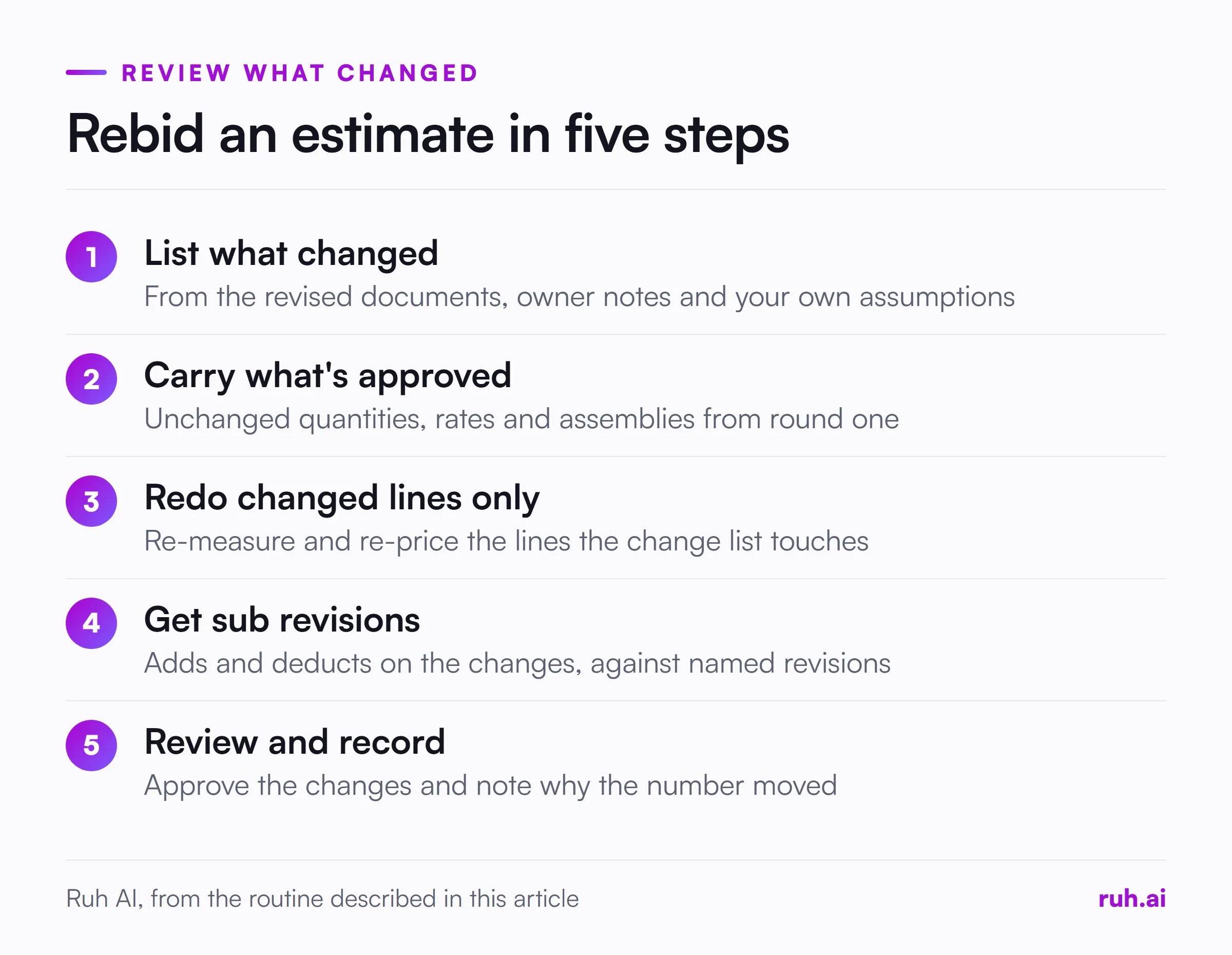
Every row on the right depends on one thing: the first estimate kept its sources. Our post on construction bid accuracy covers the habits that make an estimate checkable in the first place.
How Do You Separate What Changed From What Didn't?
Separate what changed by building a written change list from the new documents before you touch a single number. Every later step, from re-measuring to sub revisions, works from that list.
Start with three sources:
- The revised documents. Compare every reissued sheet and spec section against the round-one set, clouded or not. Read the addendum narrative too, because answers to questions change scope without changing a drawing.
- The owner's or GC's change notes. A value engineering list, a scope reduction memo or a revised bid form lists the changes outright.
- Your own round-one notes. Check whether the exclusions and assumptions you made in round one still hold.
Write each change as one line: what changed, where, and which estimate lines it touches. A change list with ten lines on it is a re-bid you can finish. A stack of reissued sheets is a new estimate.
How Do You Update Subcontractor Bid Revisions?
Update subcontractor bid revisions by sending each sub the change list for their trade and asking them to price only the changes, against named document revisions, instead of re-quoting the whole scope. You get answers faster, and the comparison with round one stays clean.
Four rules keep sub revisions under control:
- Send the changes, not the set. Give each sub the lines from your change list that touch their trade, with the sheet and revision numbers.
- Record what each quote is based on. Every quote should name the documents and revision it priced. A quote dated before the latest revision may not include it.
- Ask for adds and deducts separately. A single revised total hides what moved. Separate lines let you check each change.
- Re-confirm exclusions. A sub's round-one exclusions can quietly become a gap if the scope moved into them.
If a sub won't price the changes in time, carry the gap openly as a labelled allowance. Never leave their line at the round-one number and hope.
Why Build a Rate Book From Prices Your Team Already Confirmed?
A rate book built from prices your team confirmed lets a re-bid carry every unchanged rate without re-checking it, because each rate already shows where it came from and who approved it. Without one, every line gets priced again from memory.
Each rate book line needs the rate, its unit, the date, the source and the person who confirmed it. On a re-bid, the estimator only reviews rates that have aged past their review date or that the changes touch.
Our post on building a unit cost database for contractors walks through the fields and how to fill them from old bids.
How Do Versioned Assemblies Help a Revised Line?
Versioned assemblies let a revised line show exactly where it came from: which assembly, which version, and what changed between rounds. A reviewer can see that a wall type moved from version 2 to version 3 instead of guessing why its price changed.
An assembly bundles the materials, labour and production for a repeatable piece of work, such as a partition type or a door package. If a revision creates a new version instead of overwriting the old one, the round-one estimate keeps its version, and the round-two estimate uses the new one. The difference between rounds becomes visible line by line.
Why Should a Missing Price Never Hide as a Zero?
A missing price should never hide as a zero, because a blank line on a re-bid reads as "no cost" and goes out in the number. Re-bids are exposed to it, because added scope is the newest and least priced part of the estimate.
Carry every unpriced item as a labelled allowance, with a short note on why it's unpriced and who is chasing it. The labelled line keeps the gap visible to whoever reviews and approves the number.
Worked Example: A Re-Bid Where 9 of 120 Lines Change
A re-bid usually touches far fewer lines than the first estimate, as this illustrative example shows with every assumption stated inline. Redo it with your own estimate.
A round-one estimate for a small commercial building has 120 lines and an illustrative total of $1,250,000. The owner sends it back for round two with three changes:
- Delete the entry canopy. The round-one canopy line was $38,000, so the change is minus $38,000.
- Swap the floor finish on 8,000 square feet. Round one carried $6.00 per square foot, the new finish is $4.50, so 8,000 x ($6.00 minus $4.50) = 8,000 x $1.50 = minus $12,000.
- Add 2 doors. At an illustrative $1,850 per installed door, 2 x $1,850 = plus $3,700.
The net change is minus $38,000 minus $12,000 plus $3,700 = minus $46,300. The round-two total is $1,250,000 minus $46,300 = $1,203,700.
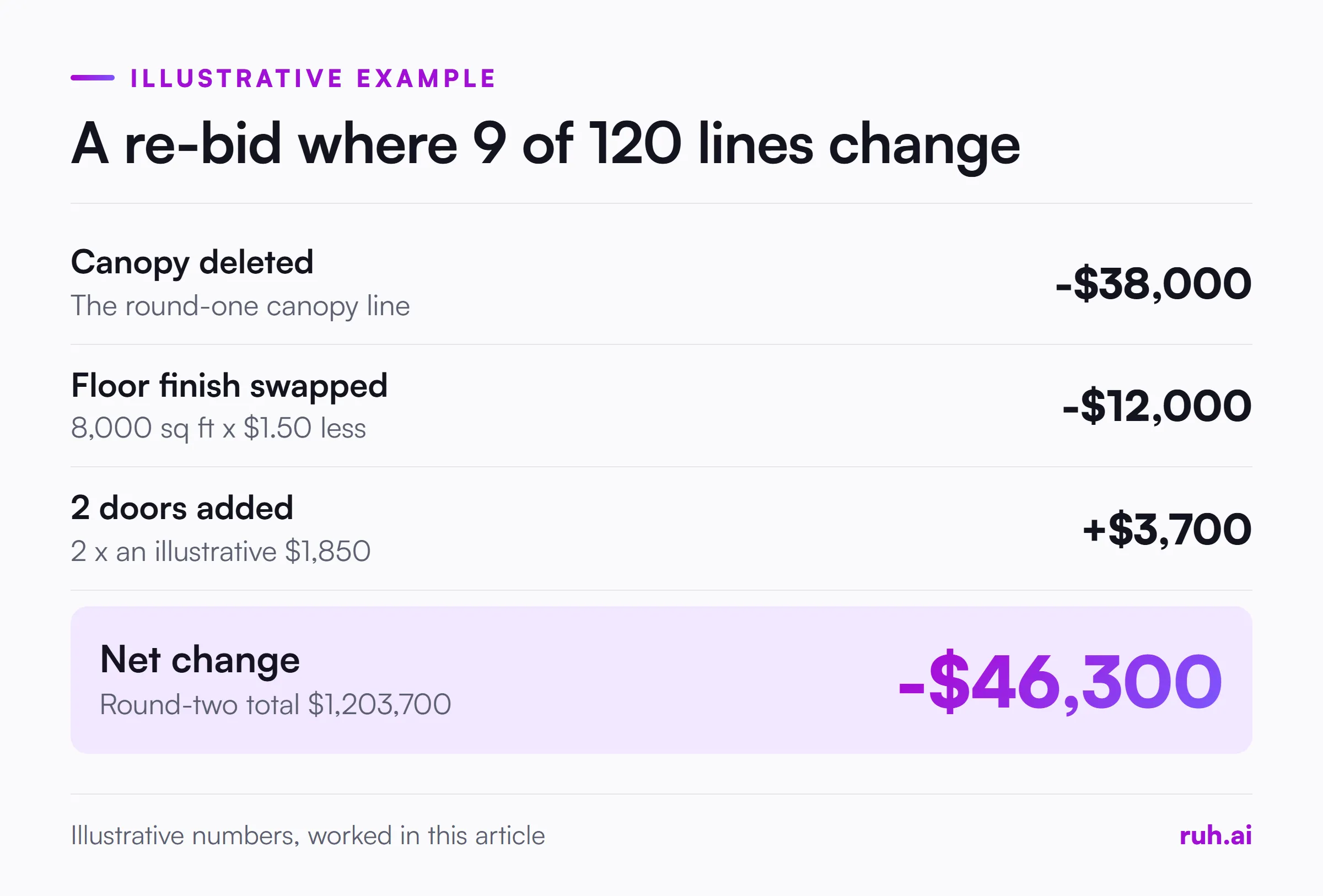
Those three changes touch 9 of the 120 lines: the canopy and its steel, foundations and electrical, the floor finish and its prep, and the doors, frames and hardware. The other 111 lines carry over as approved. Re-measuring and re-pricing all 120 would spend most of the round on work that didn't move.
Re-Bid Checklist for Estimators and Precon Teams
Run this before the round-two number goes out:
- A written change list exists, built from the revised documents, the owner's notes and your round-one assumptions.
- Every change on the list points to the estimate lines it touches.
- Unchanged quantities, rates and assemblies are carried from round one, not re-entered.
- Changed sheets were re-measured, and the old measurements replaced.
- Rates past their review date were checked, even on unchanged lines.
- Each sub priced only the changes for their trade, against named document revisions.
- Sub exclusions from round one were re-checked against the new scope.
- Every unpriced item is a labelled allowance, never a zero.
- General conditions reflect the new duration and value.
- The estimate records why the number moved between rounds, line by line.
What Estimators Get Wrong About Re-Bids
Four positions on re-bids, argued as our view, not as data.
Starting a fresh file is the most expensive habit in estimating. It feels cleaner. It throws away every approval from round one and guarantees the same hours get spent again.
Round-one sub quotes are not safe to carry. They were priced against round-one documents. Carry them only after the sub confirms the changes, or carry the difference as a labelled allowance.
Checking everything equally is checking nothing well. Put the review time into the changed lines and the rates that have aged, then sweep the rest.
The number moving is not the story, the reason is. If the estimate can't show why round two differs from round one, the next round starts from confusion.
The Honest Assessment: What Still Falls Short
Reuse only works if round one was built to be reused. An estimate kept as totals in a spreadsheet, with no link from quantities to sheets or rates to sources, can't carry forward cleanly, and the first re-bid after you change habits will still be slow.
Big design changes break the shortcut too. When an owner swaps a structural system or rearranges a floor plan, most lines move, and a re-bid becomes a new estimate whatever your tools are. A change list will tell you that early, which is still worth knowing.
Subs are the other limit. You can send a clean change list, but you can't make a sub reply faster, and a late sub revision is still a gap on bid day.
How Ruh Fits
Ruh AI's Estimating Agent prices from your company's own rate book and history. The rate book is built from prices your people confirmed, so an unchanged rate on a re-bid comes from a source your team already checked.
Your company keeps its own assemblies, and edits create a new version while a budget line keeps the version it was built from. A trade with nothing priced gets a labelled allowance line, never a silent zero, and a missing price blocks approval.
Your estimator approves every scope line before Ruh measures it, can edit every quantity and price, and each stage is approved before the next one opens. Ruh AI's Takeoff Agent reads the drawing PDFs and measures them. Ruh works with your stack, built per customer.
Frequently Asked Questions
Q: How do you rebid a construction estimate quickly? A: Build a written change list from the revised documents first, carry every unchanged quantity, rate and assembly from round one, and re-measure and re-price only the lines the changes touch. Then have subs price only their changes and review the changed lines first.
Q: Why do construction projects get rebid? A: Usually because the scope, documents or budget changed: the owner trimmed scope, an addendum revised the drawings, every bid came in high, or a GC sent the job out again. On federal sealed bids, FAR 14.404-1 lists the reasons an invitation can be cancelled and re-solicited.
Q: How do you handle subcontractor bid revisions? A: Send each sub the changes that touch their trade, with sheet and revision numbers, and ask for adds and deducts against named documents. Re-check their exclusions, and carry any sub who can't reply in time as a labelled allowance.
Q: Should you start a new estimate file for a re-bid? A: No. Copy the round-one estimate so its approved quantities, rates and assemblies carry over, then change only the lines the change list touches. A fresh file throws away every approval and repeats the hours.
Q: How do you show what changed between bid rounds? A: Record the reason on every changed line, keep assemblies versioned so a revised line shows its old and new version, and keep the change list with the estimate. Anyone reviewing round two can then see why the number moved.
Q: What if a re-bid adds scope with no price yet? A: Carry it as a labelled allowance with a note on why it's unpriced and who is chasing it. Never leave it blank, because a blank line goes out in the number as zero.
See how Ruh prices from your own rate book and approved lines on the construction estimating software page.