Labor is the line that separates estimators who keep their jobs from those who do not. Material prices arrive as quotes you can hold a vendor to; labor is a forecast of how fast a crew will work on a site that does not exist yet. This guide walks the mechanics: labor units, the jump from a bare wage to a fully burdened rate, crew composition, productivity factors, and why labor risk behaves nothing like material risk.
Why is labor the hardest cost to estimate?
When you price 161 cubic yards of concrete, the quantity is fixed by the drawings and the price is fixed by a supplier quote. Labor has neither anchor. The same wall framed by the same crew can take 20 percent longer in February than in September, longer again if the floor below is congested with other trades, and longer still in the back half of a 60 hour week when fatigue sets in. You are estimating human output under conditions you cannot fully predict, which is why two competent estimators can price identical drawings and land thousands of dollars apart on labor alone.
The discipline that tames this is the labor unit. Get the units right and the rest is arithmetic you can defend in a bid review.
What is a labor unit and where does it come from?
A labor unit is the number of labor hours it takes to install one unit of work. It is the bridge between your unit cost and your quantity takeoff. A few examples in common trades, all illustrative rather than gospel:
- Hang and finish drywall: roughly 0.012 to 0.020 labor hours per square foot, depending on ceiling height and detail.
- Install branch conduit: roughly 0.05 to 0.10 labor hours per linear foot, depending on size and routing.
- Set CMU block: roughly 0.10 to 0.14 labor hours per block for a standard 8 inch unit.
The number you carry should come from one of three places, in order of trust.
First, your own production history. This is the gold standard. If your crews tracked 0.015 hours per square foot on the last three drywall jobs of this type, that is your number, because it already bakes in how your people actually work.
Second, published reference data. Commercial cost references publish labor units by line item. They are useful when you have no history for a scope, but they describe an industry average crew, not yours, so adjust before you trust.
Third, a first-principles build-up. For unusual scopes with no history and no reference, you reason it out: a crew of two sets a known quantity in an eight hour day under normal conditions, which implies the hours per unit. Document the assumption so it can be challenged.
The trap is reaching for published data when you have your own history sitting in last year's job-cost reports. Your data already reflects your crews, your supervision, and your typical site conditions. Borrowed averages do not.
Worked example 1: hours from a labor unit
Take an interior partition package: 8,400 square feet of hung and finished drywall. Your own history says 0.015 labor hours per square foot for this assembly type.
Labor hours: 8,400 sf x 0.015 hr/sf = 126 labor hours.
That is the raw quantity of work. To turn it into a crew duration, divide by crew size. A taper-and-hanger crew of 3 working 8 hour days delivers 24 crew hours per day.
Calendar duration: 126 labor hours / 24 crew hours per day = 5.25 days, carried as 6 days.
Notice the two outputs. The 126 hours feeds the cost (hours times rate); the 6 days feeds the schedule and, through the schedule, your general conditions. One labor unit, applied once, drives both the price and the time on site. That is why the unit is worth getting right.
Bare wage versus fully burdened rate
The wage you pay a worker is not what that worker costs you. The bare wage is the hourly rate on the paycheck. The fully burdened labor rate adds every cost that rides on top of employing that person: payroll taxes, insurance, and benefits. Estimators who price labor at the bare wage lose money on every hour, quietly, all year.
The burden splits into categories you can build up line by line:
- Statutory payroll taxes: the employer share of Social Security and Medicare, plus federal and state unemployment insurance.
- Workers compensation insurance: priced as a rate per 100 dollars of payroll, and it varies enormously by trade. Roofers and steel erectors carry far higher rates than electricians or finish carpenters.
- General liability insurance: a smaller per-payroll-dollar load.
- Benefits: health coverage, retirement contributions, and on prevailing-wage or union work, the fringe package defined by the wage determination.
Worked example 2: building a burdened rate
Start with an illustrative bare wage of 35.00 dollars per hour for a journeyman in a trade with a moderate workers comp class. Build the burden up, component by component:
- Bare wage: 35.00 dollars per hour (the base).
- FICA, the employer Social Security and Medicare share at 7.65 percent of wage: 35.00 x 0.0765 = 2.68 dollars.
- Federal and state unemployment, illustrative 2.5 percent of wage: 35.00 x 0.025 = 0.88 dollars.
- Workers compensation, illustrative 9.00 dollars per 100 dollars of payroll: 35.00 x 0.09 = 3.15 dollars.
- General liability, illustrative 1.2 percent of wage: 35.00 x 0.012 = 0.42 dollars.
- Benefits (health plus retirement), illustrative fixed load: 6.50 dollars.
Sum the burden additions: 2.68 + 0.88 + 3.15 + 0.42 + 6.50 = 13.63 dollars. The fully burdened rate is therefore 35.00 + 13.63 = 48.63 dollars per hour. That burden of 13.63 dollars on a 35.00 dollar wage is about 39 percent (13.63 / 35.00 = 0.389), which is a burden multiplier of 1.39.
Now connect it to example 1. Those 126 labor hours at the bare wage would read 126 x 35.00 = 4,410 dollars, which is the wrong number. At the fully burdened rate: 126 x 48.63 = 6,127 dollars. The 1,717 dollar gap is real cost that the bare-wage estimator simply forgot to charge for. Carry the wrong rate across every labor line in a large bid and the forgotten cost runs into six figures.
Two cautions on burden. First, workers comp rates swing hard by trade, so a single blended burden multiplier across all crews will overcharge your low-risk trades and undercharge your high-risk ones. Price burden by trade where the dollars justify it. Second, prevailing-wage and union jobs replace your benefit assumption with a published fringe rate, so read the wage determination rather than guessing.
How do crew composition and productivity factors change the hours?
Labor units assume a specific crew mix, and the mix matters as much as the headcount. A masonry crew of one mason plus one tender behaves differently from two masons, because the tender does not lay block but keeps the mason productive. When you pull a labor unit from any source, confirm the crew it assumes before you apply it.
Compute the blended crew rate from the burdened rate of each role. Take a five person crew of one foreman at 58.00 dollars per hour burdened, three journeymen at 48.63 dollars per hour burdened, and one apprentice at 34.00 dollars per hour burdened. Total per crew hour: 58.00 + (3 x 48.63) + 34.00 = 237.89 dollars, which is a blended 47.58 dollars per person-hour (237.89 / 5). Apply the blended rate to the labor hours from your takeoff and you have a crew cost that reflects who is actually on the wall, not an idealized average worker. This is the same logic that powers assembly estimating, where a whole crew and its output get bundled into one priced line.
A labor unit describes output under normal conditions, and real jobs are rarely normal. Four factors routinely push productivity off the baseline:
- Weather and temperature. Cold, heat, wind, and rain all slow trades, especially exterior work. Bulky cold-weather clothing alone cuts manual productivity.
- Height and access. Work above roughly the second floor takes longer per unit because material handling and access (scaffold, lifts, hoisting) eat hours that ground-floor work does not.
- Congestion and stacking of trades. When too many crews share a floor, they slow each other down. A schedule that stacks six trades into one zone will not deliver any of their published labor units.
- Overtime and fatigue. Extended hours look productive on paper but degrade per-hour output. A sustained 60 hour week does not deliver 50 percent more than a 40 hour week, because the marginal hours are the tired ones, and error and rework rates climb.
You handle these by adjusting the labor unit, not by quietly padding the wage. If congestion will realistically cost 15 percent, carry 0.015 x 1.15 = 0.01725 hours per square foot and write down why. An adjustment you can name survives a bid review; padding buried in a rate does not.
How does labor risk differ from material risk?
Material risk is mostly a price-and-timing problem. A lumber quote might expire, or a long-lead switchgear order might slip, but the quantity you need is fixed by the drawings and a quote locks the unit price for its validity window. You can transfer much of that risk by getting firm quotes and buying out early.
Labor risk is structural and stays on your books. You own the productivity assumption from bid day to closeout. If the crew runs at 0.018 hours per square foot against your 0.015 estimate, that 20 percent overrun is pure margin erosion with no vendor to invoice. Nobody quotes you a guaranteed production rate. This asymmetry is why seasoned estimators spend their review time on labor: a material miss is usually a known, bounded number, while a labor miss compounds silently across every hour the crew is on site. For the full picture of how labor sits alongside the other cost buckets, see how to estimate construction costs.
Practical guardrails: keep your production history current and segmented by assembly type, price burden by trade rather than as one blended number, name every productivity adjustment as its own factor, and reconcile estimated hours against actual hours on every closed job so next year's units get sharper.
Where AI fits, and where it stops
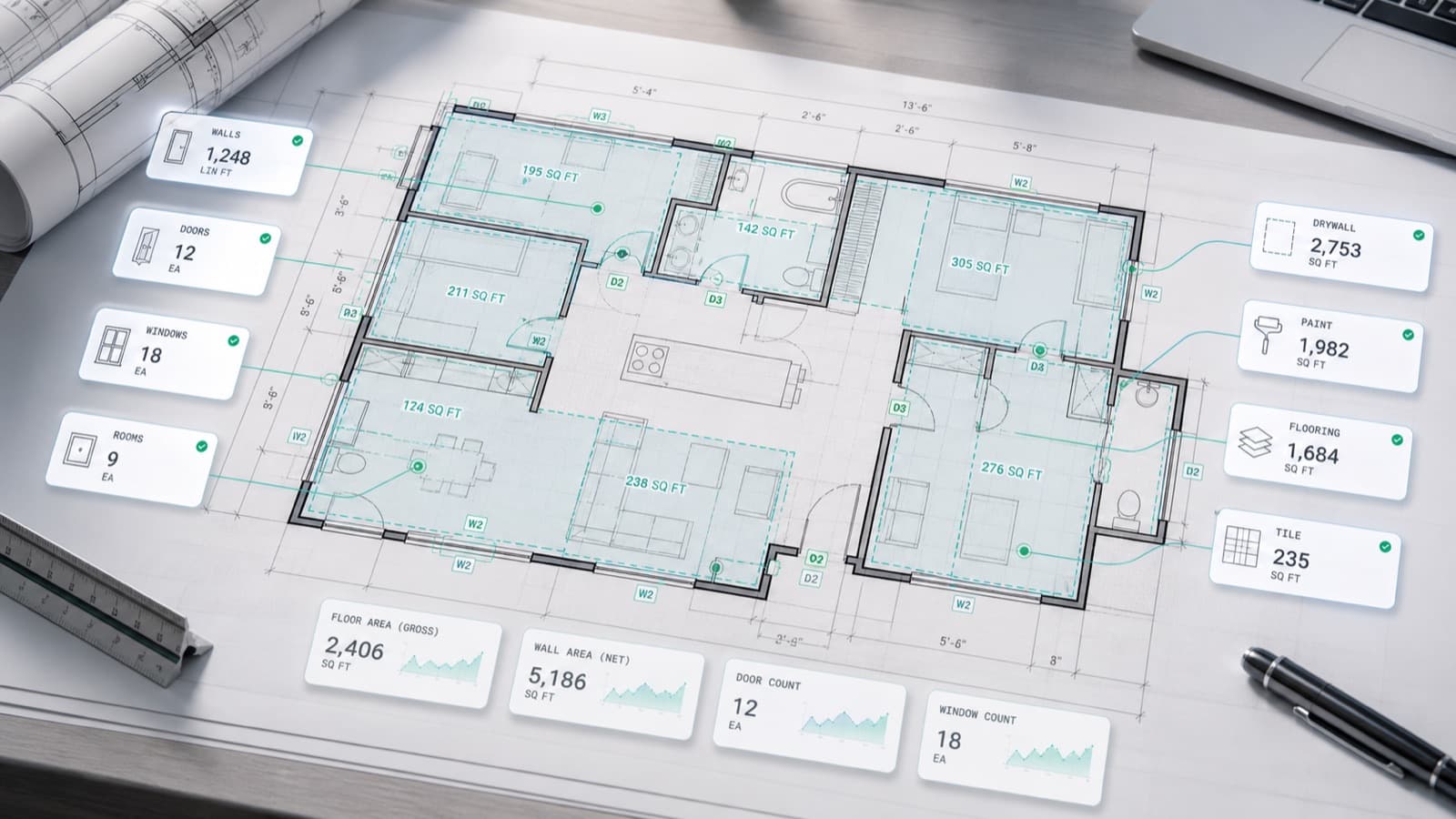
Tools like Ruh take the mechanical weight off this process. Ruh reads the drawings, performs the takeoff, and prices each line against the contractor's own price book, including the labor units and burdened rates the team has already validated, so the estimate arrives drafted rather than blank. What it does not do is decide that this job will run hot because three trades are stacked on level 2 in January. That judgment, and the final sign-off, stay with the estimator. The machine measures and prices; the human reads the site and owns the number.
Labor estimating rewards memory more than any other part of the bid. The estimator who tracks real hours against estimated hours, job after job, slowly builds a set of labor units that fit their crews like a glove, and that library is worth more than any published reference or clever tool. Start that feedback loop now, keep your burden honest and trade-specific, and treat every productivity adjustment as a decision you can defend out loud. Do that and labor stops being the line that scares you and becomes the one you price with the most confidence.
Try Ruh on a real bid. 100% money-back guarantee if you are not satisfied.*
*Scoped delivery, terms apply. Read the guarantee terms
Frequently asked questions
How do you calculate labor cost in construction?+
Multiply the quantity of work from your takeoff by a labor unit (hours per unit) to get total labor hours, then multiply those hours by your fully burdened labor rate. For example, 8,400 square feet of drywall at 0.015 hours per square foot is 126 labor hours, and 126 hours at a 48.63 dollar burdened rate is about 6,127 dollars.
What is a fully burdened labor rate?+
It is the bare hourly wage plus every cost of employing that worker: the employer share of payroll taxes (FICA and unemployment), workers compensation insurance, general liability, and benefits. On an illustrative 35.00 dollar wage the burden often adds 35 to 45 percent, landing the burdened rate near 48 to 50 dollars per hour. Pricing labor at the bare wage understates cost on every hour.
What is a labor unit and where do you get it?+
A labor unit is the number of labor hours to install one unit of work, such as 0.015 hours per square foot of drywall. The best source is your own production history from past jobs, because it reflects your crews. Published cost references work when you lack history, but they describe an average crew, so adjust them to your conditions.
Why is labor harder to estimate than material?+
Material quantities are fixed by the drawings and prices are locked by vendor quotes, so much of the risk can be transferred by buying out early. Labor is a forecast of human productivity under site conditions you cannot fully predict, and no one guarantees you a production rate. A labor overrun is pure margin erosion with no vendor to invoice, which is why estimators scrutinize labor most.
How do productivity factors affect a labor estimate?+
Weather, working height, trade congestion, and overtime fatigue all slow crews below the baseline a labor unit assumes. Handle them by adjusting the labor unit explicitly rather than padding the wage. For example, if congestion will cost 15 percent, carry 0.015 x 1.15 = 0.01725 hours per square foot and document the reason so it survives a bid review.
Still pricing in a spreadsheet? Your price book, automated end to end. Your estimator signs off.
See it runTerms used in this guide
Figures on this page are illustrative. Construction estimates depend on project-specific conditions, source documents, market pricing, and professional judgment. Ruh's AI assists the estimator and does not replace professional review: your team reviews, validates, and approves every estimate, bid, and pricing decision.