
100% money-backBook a walkthrough

Construction glossary · Estimating concepts

What is unit cost in construction?

Unit cost in construction is the cost to furnish and install one measured unit of a work item, expressed in dollars per unit such as $/cy for concrete, $/sf for drywall, or $/lf for pipe. Estimators multiply a unit cost by the takeoff quantity to price each line item, then sum those extensions to build the estimate. A complete unit cost typically rolls up labor, material, and equipment for that scope, and sometimes markup depending on how the price book is set up.

Updated June 2026 · Reviewed by the Ruh construction team

Stated as $ per unitQuantity x rate = line totalBundles labor + material + equip

What makes up a unit cost

Material + labor ~75%Equip + OH&P ~25%All-in cost to install one unit

Estimating estimating concepts scope this week? Watch Ruh take off a real plan in 30 minutes.

Book a walkthrough
Definition

Unit cost is the workhorse number in estimating. It lives in your price book or cost database as the dollars it takes to put one unit of work in place, and it shows up everywhere downstream: estimate line items, unit price bid schedules, schedules of values, change order pricing, and pay applications on unit price contracts. Estimators build and maintain unit costs, project managers use them to price change orders, and owners use them to evaluate bids on unit price work like sitework and utilities. The most common mistake a new estimator makes is grabbing a bare material price and treating it as all-in, which leaves labor, equipment, waste, and taxes on the table. The second is pulling a unit cost from a national database and applying it without adjusting for location, crew productivity, access, quantity, or schedule. A $480/cy footing pour in open sitework is not a $480/cy pour on a tight urban infill site with pump time and limited staging. Know what each unit cost includes, where it came from, and what conditions it assumed before you apply it.

How it is measured

Unit costs are expressed as dollars per unit of measure: $/cy for concrete and excavation, $/sf for slabs, drywall, and flooring, $/lf for footings, pipe, and curb, $/ea for doors and fixtures, $/ton for asphalt and structural steel. They appear in internal price books, historical cost reports, commercial cost databases, sub and vendor quotes, and the bid schedule on unit price contracts. To apply one, the estimator performs a quantity takeoff in the same unit of measure, multiplies quantity by unit cost to get the extension, and confirms the basis: bare cost versus all-in, what trades and equipment are included, and whether overhead and profit are inside the number or added later. Mixed units (a $/sf quantity priced against a $/cy cost) are a classic source of estimate busts.

Worked example

Worked example

Price a 24,000 sf cast-in-place slab on grade, 6 in thick, using illustrative US numbers. First convert the takeoff to the unit of measure the cost carries. Volume: 24,000 sf x 0.5 ft = 12,000 cf. Divide by 27 cf/cy: 12,000 / 27 = 444 cy. Add a 5% waste factor: 444 cy x 1.05 = 467 cy. Build the all-in unit cost: $175/cy ready-mix material, $80/cy place-and-finish labor, $30/cy pump and equipment, for $285/cy total. Extend it: 467 cy x $285/cy = $133,095. As a sanity check, convert back to the drawing unit: $133,095 / 24,000 sf = $5.55/sf, which you can compare against your historical $/sf range for 6 in slabs. If the historical range and the built-up number disagree, dig into the assumptions before the bid goes out.

100%

Try Ruh on a real bid. 100% money-back guarantee if you are not satisfied.*

*Scoped delivery, terms apply. Read the guarantee terms

Start with a walkthrough
How Ruh handles it

How Ruh handles unit cost

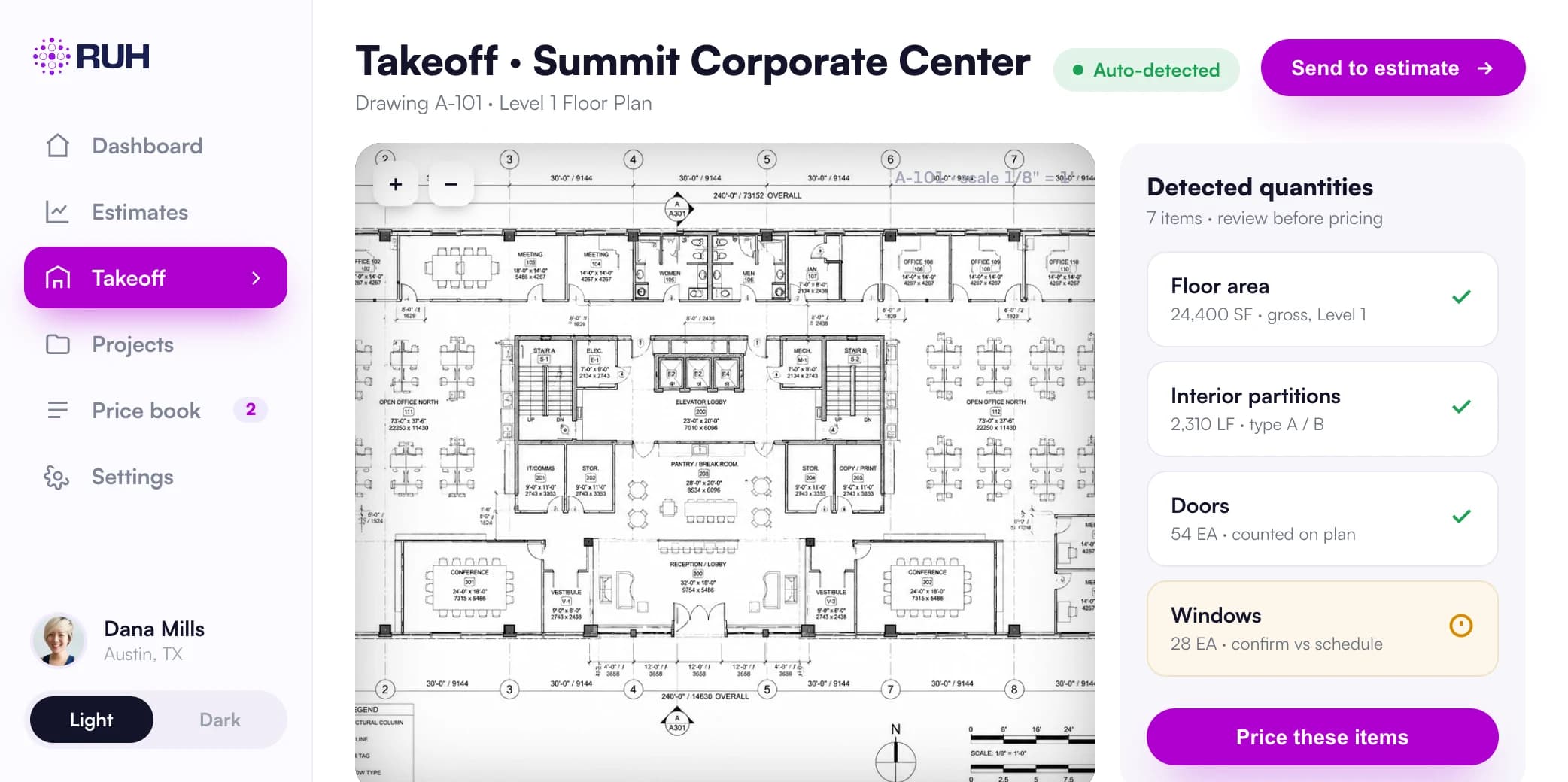
Ruh reads the contractor's drawings, performs the takeoff, and prices each measured quantity against the contractor's own price book, meaning their real unit costs rather than generic database averages. It extends quantity times unit cost into a line-item draft estimate, keeping units of measure consistent between takeoff and pricing. The estimator then reviews the draft, adjusts unit costs for job conditions like access, schedule, and quantity, and signs off, so professional judgment stays in control of the final number.

See construction estimating software

Unit cost: frequently asked questions

What is the difference between unit cost and unit price?+

Unit cost is what it costs you to perform one unit of work, typically labor, material, and equipment. Unit price is what you charge for it, which is unit cost plus overhead, profit, and sometimes contingency or bond. On unit price contracts the bid schedule shows unit prices, and the contractor's margin lives in the spread between the two.

Where do unit costs come from?+

The best source is your own historical job cost data, because it reflects your crews, your market, and your actual productivity. Commercial cost databases and published references are useful starting points but assume average conditions and need location and condition adjustments. Sub and vendor quotes provide current market pricing for scopes you do not self-perform.

Why does the same work item have different unit costs on different jobs?+

Productivity drives most of the difference. Site access, crew experience, weather, repetition, and quantity all move the labor portion of a unit cost. Small quantities also carry mobilization and setup over fewer units, so a 20 cy pour will usually run a higher $/cy than a 400 cy pour of the same mix.

Still measuring by hand? Your next takeoff can run while you review this one.

See it on your plans

Related terms

Keep going: read the full guide or explore construction estimating software.

The Estimating concepts estimating cheat sheet
Every unit, waste factor, and conversion on one page. Free PDF.

See Ruh price a bid from your own drawings.

AI takeoff and estimating on your price book, your estimator signs off.

Figures on this page are illustrative. Construction estimates depend on project-specific conditions, source documents, market pricing, and professional judgment. Ruh's AI assists the estimator and does not replace professional review: your team reviews, validates, and approves every estimate, bid, and pricing decision.
Unit cost in construction estimating | Ruh AI