100% money-backBook a walkthrough

Construction glossary · Estimating concepts

What is overhead and profit in construction?

Overhead and profit (O&P) is the markup a contractor adds to the direct cost of construction work to cover business operating expenses and earn a return for taking on the project's risk. Overhead recovers indirect costs such as office staff, rent, insurance, and estimating, while profit is what remains after all costs are paid. A common illustrative structure in US commercial work is 10 percent overhead plus 10 percent profit added to direct cost.

Updated June 2026 · Reviewed by the Ruh construction team

O&P = overhead + profitCommon add 10% + 5%Applied to direct cost

Overhead and profit split

Overhead 10%Profit 5%Common 10 + 5 added over direct cost

Estimating estimating concepts scope this week? Watch Ruh take off a real plan in 30 minutes.

Book a walkthrough
Definition

Overhead and profit is where a bid stops being a cost estimate and becomes a price. Overhead splits into two buckets: jobsite overhead (general conditions such as supervision, temporary facilities, and dumpsters, priced as direct line items) and home office overhead (G&A costs such as rent, office staff, insurance, and estimating, recovered as a percentage). Profit is what the company keeps after every cost is paid. You will see O&P in the bid summary as markup lines, in cost-plus and GMP contracts as a stated fee, in change order clauses that cap allowable percentages, and in pay applications baked into the schedule of values. New estimators make three common mistakes: treating markup and margin as the same number, burying general conditions inside the overhead percentage and double counting them, and copying a competitor's percentage instead of calculating what their own company needs to recover its annual overhead. The percentage is a business decision, but it has to be grounded in your real books.

How it is measured

O&P is expressed as a percentage of direct cost and appears as one or two dollar lines at the bottom of the bid summary, after the labor, material, equipment, and subcontractor totals. Many contractors carry separate percentages, for example overhead applied to direct cost and profit applied to the marked-up subtotal. On change orders, the contract usually caps O&P, with illustrative caps like 15 percent on self-performed work and 5 percent on subcontracted work. The overhead percentage itself comes from the company's books: divide annual home office overhead by expected annual volume to get the minimum recovery rate. Profit is set by management based on risk, backlog, and market conditions.

Worked example · live calculator

Apply O and P to your cost

Live calculator
Cost$500,000
20% markupprice $600,000
Actual margin16.67%
100%

Try Ruh on a real bid. 100% money-back guarantee if you are not satisfied.*

*Scoped delivery, terms apply. Read the guarantee terms

Start with a walkthrough
How Ruh handles it

How Ruh handles overhead and profit

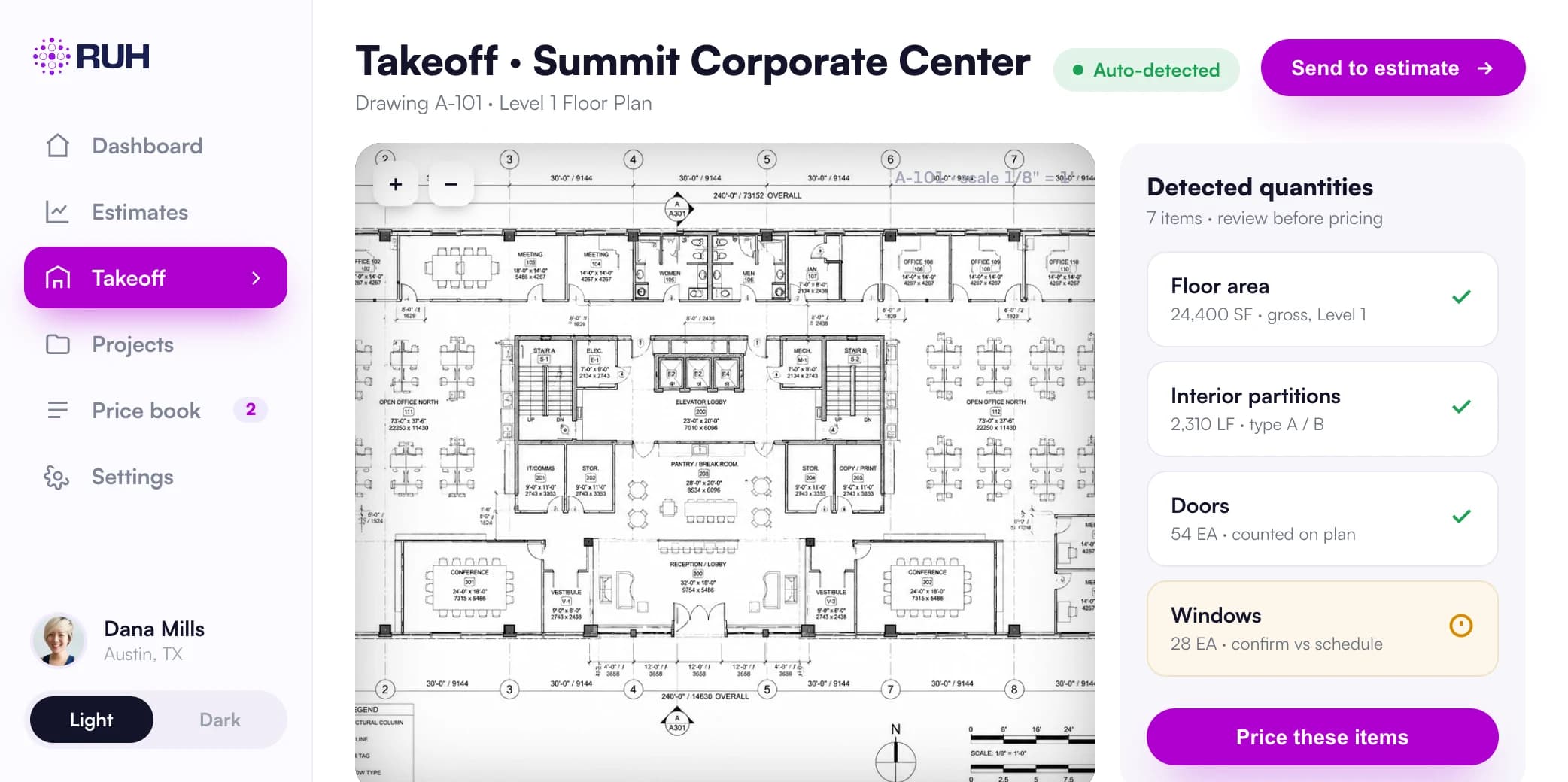
Ruh reads the drawings, performs the takeoff, and prices quantities against your own price book, so the draft estimate reflects your true direct costs before any markup is applied. Overhead and profit stay under the estimator's control: you review the line items, confirm quantities and unit costs, then apply your company's O&P structure at the bid summary before signing off. Clean, consistent direct costs make the markup decision sharper, because you are applying O&P to a cost basis you trust.

See construction estimating software

Overhead and profit: frequently asked questions

Is overhead and profit the same as markup?+

Markup is the broader term for anything added to direct cost, and O&P is usually the largest part of it. The trap is confusing markup with margin: a 20 percent markup on cost produces roughly a 16.7 percent margin on the selling price. If management asks for a 10 percent profit margin and you simply add 10 percent to cost, you have underpriced the job.

What is a typical overhead and profit percentage in commercial construction?+

There is no single standard, and the right number depends on your company's annual overhead, volume, trade, and how competitive the bid market is. The 10 and 10 structure is a common reference point in conversation, but real percentages vary widely by company size and project type. Calculate your overhead recovery rate from your own financials before deciding what to carry.

How does O&P work on change orders?+

Most commercial contracts include a clause that caps the markup a contractor may add to change order work, often with different percentages for self-performed versus subcontracted scope. Read that clause before pricing your first change order, because the allowable O&P may be lower than what you carried in the base bid. Tiered markups also apply down the chain, with the GC adding a smaller percentage on top of a subcontractor's marked-up price.

Still measuring by hand? Your next takeoff can run while you review this one.

See it on your plans

Related terms

Keep going: read the full guide or explore construction estimating software.

The Estimating concepts estimating cheat sheet
Every unit, waste factor, and conversion on one page. Free PDF.

See Ruh price a bid from your own drawings.

AI takeoff and estimating on your price book, your estimator signs off.

Figures on this page are illustrative. Construction estimates depend on project-specific conditions, source documents, market pricing, and professional judgment. Ruh's AI assists the estimator and does not replace professional review: your team reviews, validates, and approves every estimate, bid, and pricing decision.
Overhead and profit (O&P) in construction | Ruh AI