Construction glossary · Estimating concepts
What is assembly estimating in construction?
Assembly estimating is a method where the components of a building system are priced together as one unit instead of as separate line items. A partition assembly priced per linear foot, for example, already includes the metal studs, drywall on both sides, insulation, tape, and paint. It contrasts with unit cost estimating, where each of those items is taken off and priced individually.
Updated June 2026 · Reviewed by the Ruh construction team
An assembly bundles many items
Estimating estimating concepts scope this week? Watch Ruh take off a real plan in 30 minutes.
Book a walkthroughAssembly estimating groups the components of a building system into one priced unit. Instead of carrying separate lines for metal studs, drywall, insulation, tape, and paint, the estimator carries one partition assembly at a cost per linear foot. Assemblies usually map to UniFormat system codes (exterior walls, interior partitions, roofing) rather than MasterFormat trade divisions, which is why you see them in conceptual and design development estimates before the drawings are complete enough for a full quantity takeoff. General contractor preconstruction teams lean on assemblies for early budgets, and many subcontractors build their own assemblies for repetitive scope they install the same way on every job. The mistake new estimators make is treating an assembly as a black box. Every assembly carries assumptions: stud gauge and spacing, wall height, number of drywall layers, finish level. If the project differs from those assumptions and you do not adjust the rate, you misprice the work. The second common mistake is double counting, pricing an item inside an assembly and then again as a standalone line.
Assemblies are priced in the unit that matches how the system is measured on the drawings: dollars per linear foot for walls and footings, dollars per square foot for floor, roof, and ceiling systems, and dollars per each for doors, fixtures, and equipment connections. The estimator measures the system quantity from the plans (wall lengths from floor plans, areas from architectural sheets) and multiplies by the assembly rate. Under the hood, the rate is built from unit costs: each component's material and labor cost per its own unit, converted to the assembly's unit and summed. In published cost data such as RSMeans, assemblies appear under UniFormat headings. In a contractor's own system, they live in the price book or assembly library, tied to historical costs.
Worked example
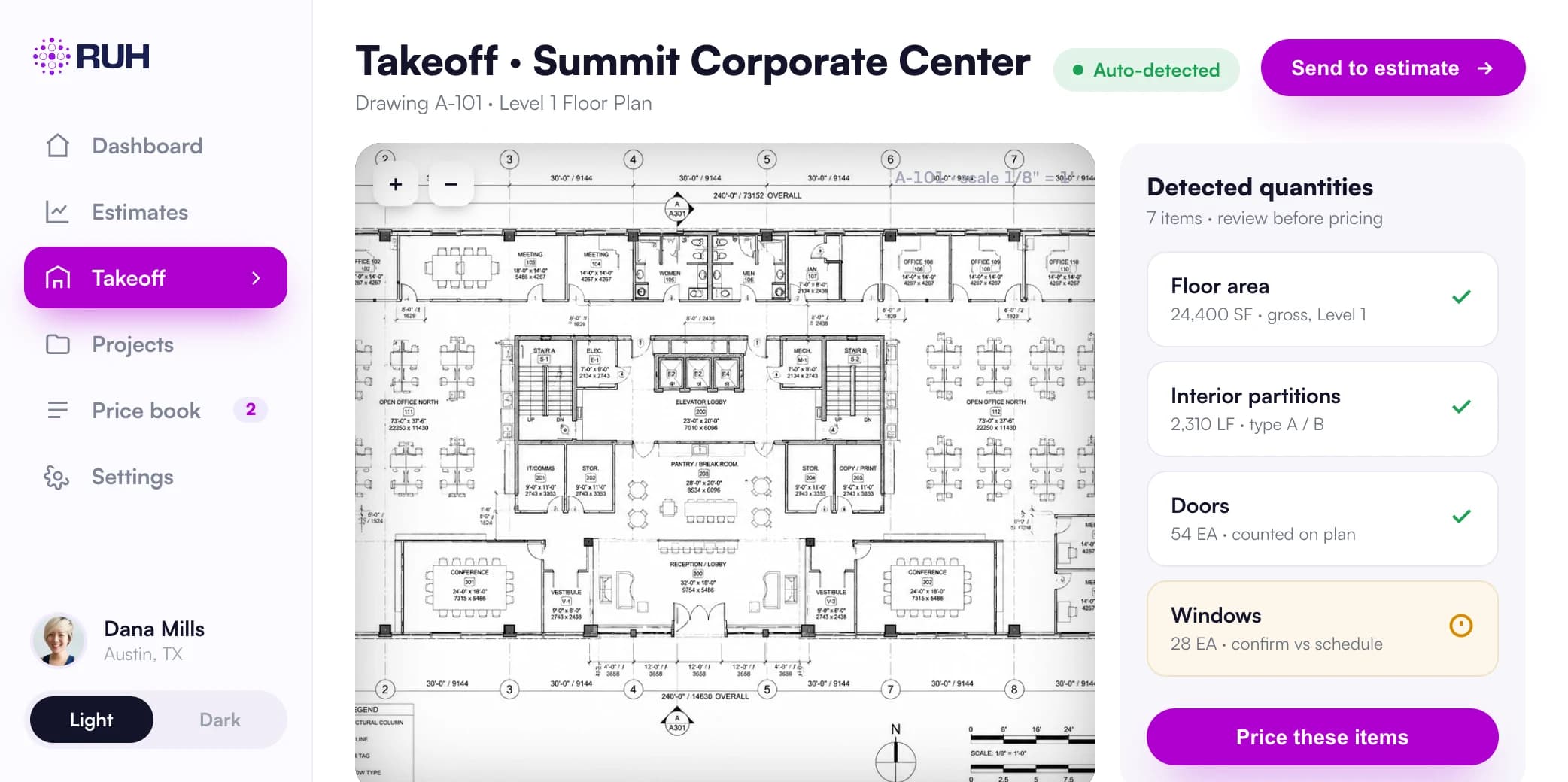
Price an interior partition assembly per linear foot. The wall is 10 ft high with 3 5/8 inch metal studs at 16 inches on center, one layer of 5/8 inch drywall each side, sound batts, and a level 4 finish with paint. Each linear foot of wall gives 10 sf of area per side, or 20 sf for two-sided items. Using illustrative US commercial unit costs: framing at $4.00 per sf times 10 sf equals $40.00, drywall hung and finished at $3.20 per sf times 20 sf equals $64.00, sound batts at $1.50 per sf times 10 sf equals $15.00, and paint at $1.10 per sf times 20 sf equals $22.00. The assembly totals $40.00 plus $64.00 plus $15.00 plus $22.00, or $141.00 per linear foot. A floor plan showing 240 lf of this partition type then prices out at 240 lf times $141.00 per lf, or $33,840.
Try Ruh on a real bid. 100% money-back guarantee if you are not satisfied.*
*Scoped delivery, terms apply. Read the guarantee terms
How Ruh handles assembly estimating
Ruh reads the floor plans, measures each partition and system type, and prices the takeoff against the contractor's own price book, so assembly rates roll up from the contractor's real unit costs instead of generic published data. The draft estimate shows both the assembly rollup and the component lines underneath it, so nothing is a black box. The estimator reviews the assumptions, adjusts anything project specific, and signs off.
See construction estimating softwareAssembly estimating: frequently asked questions
What is the difference between assembly estimating and unit cost estimating?+
Unit cost estimating prices every item separately from a detailed quantity takeoff, which takes longer but gives the most control at bid time. Assembly estimating bundles those items into system level prices, trading some precision for speed, which suits early budgets and repetitive scope. The two are connected: a good assembly is a set of unit costs rolled up, so you can drill back down to the detail when the design firms up.
When should I use assembly estimating instead of a detailed takeoff?+
Use assemblies when the drawings are not complete enough to count individual items, typically schematic design and design development budgets. They also work well for pricing repetitive scope quickly, such as standard partition types or repeated bathroom layouts. At hard bid, most estimators shift to a detailed unit cost takeoff because the margin for error shrinks.
Where do assembly costs come from?+
Two main sources: published cost databases such as RSMeans assemblies, and the contractor's own job cost history. Published data needs location and wage adjustments plus a careful read of exactly what each assembly includes. Assemblies built from your own history are more reliable because they reflect your crews, your suppliers, and your market.
Still measuring by hand? Your next takeoff can run while you review this one.
See it on your plansRelated terms
Keep going: read the full guide or explore construction estimating software.
See Ruh price a bid from your own drawings.
AI takeoff and estimating on your price book, your estimator signs off.
Figures on this page are illustrative. Construction estimates depend on project-specific conditions, source documents, market pricing, and professional judgment. Ruh's AI assists the estimator and does not replace professional review: your team reviews, validates, and approves every estimate, bid, and pricing decision.