

100% money-backBook a walkthrough

Construction glossary · MEP

What is diffuser in construction?

A diffuser in construction is the finished air outlet, usually ceiling mounted, that distributes supply air from the ductwork into a room in a controlled pattern. Diffusers, registers, and grilles are counted each (ea) in the takeoff, with the count pulled from the reflected ceiling plan and verified against the mechanical air device schedule. Each count carries an assembly behind it: the device, the flex duct runout, the balancing damper, and the labor to set and connect it.

Updated June 2026 · Reviewed by the Ruh construction team

Delivers supply air to roomCounted from the RCPSized in inches (e.g. 24x24)

How diffusers are counted

+ 24 more36 EASupply diffuserreflected ceiling plan

Estimating mep scope this week? Watch Ruh take off a real plan in 30 minutes.

Book a walkthrough
Definition

A diffuser is the last piece of the air distribution chain, and on the documents it lives in two places at once: the reflected ceiling plan (RCP) shows where every device sits in the ceiling grid alongside lights and sprinkler heads, and the mechanical plan tags each one (CD-1, RG-1) with a CFM and neck size that points to the air device schedule listing manufacturer, model, size, and finish. The sheet metal contractor typically furnishes and installs them, coordinating with the acoustical ceiling contractor on grid layout. The vocabulary matters at bid time: a diffuser supplies air in a spread pattern, a register is a grille with an integral damper, and a grille is a bare face, usually return or exhaust. New estimators count only the mechanical plan and miss the conflicts the RCP reveals, or count the device alone and forget the assembly behind it: the flex duct runout, the spin-in tap with balancing damper, and the supports. The architect's RCP and the engineer's plan disagree on real jobs, and the takeoff should flag those conflicts rather than silently picking one set of documents.

How it is measured

Air devices are counted each (ea), broken out by schedule tag, because a 24x24 lay-in diffuser, a sidewall register, and a linear slot diffuser carry very different costs. The count comes off the RCP or the mechanical plan, cross checked against each other and against the air device schedule. Neck size, mounting type (lay-in grid versus hard ceiling, which adds framing labor), and finish drive unit cost. Most estimators price the diffuser as an assembly: device, flex duct runout, spin-in fitting with balancing damper, and the labor to hang, connect, and seal it, so the each count quietly carries lf of flex behind it. Linear slot diffusers are the exception, taken off in lf of active slot rather than ea.

Worked example

Worked example

Take a 9,000 sf office floor. The RCP shows 36 supply diffusers tagged CD-1 (24x24 lay-in) and 14 return grilles tagged RG-1. Sanity check the count first: 9,000 sf / 36 = 250 sf per diffuser, a normal density for open office, so the count is plausible. Price the supply side as assemblies at illustrative rates: 36 diffusers x $145 installed = $5,220, plus the flex runouts, 36 x 6 lf of 8 in flex = 216 lf x $4 per lf = $864. Returns are simpler because a plenum return needs no flex: 14 grilles x $95 = $1,330. The air device package totals $5,220 + $864 + $1,330 = $7,414. Miss the flex and damper assemblies and the line drops by roughly 12 percent ($864 of $7,414) while still looking complete on paper.

100%

Try Ruh on a real bid. 100% money-back guarantee if you are not satisfied.*

*Scoped delivery, terms apply. Read the guarantee terms

Start with a walkthrough
How Ruh handles it

How Ruh handles diffuser

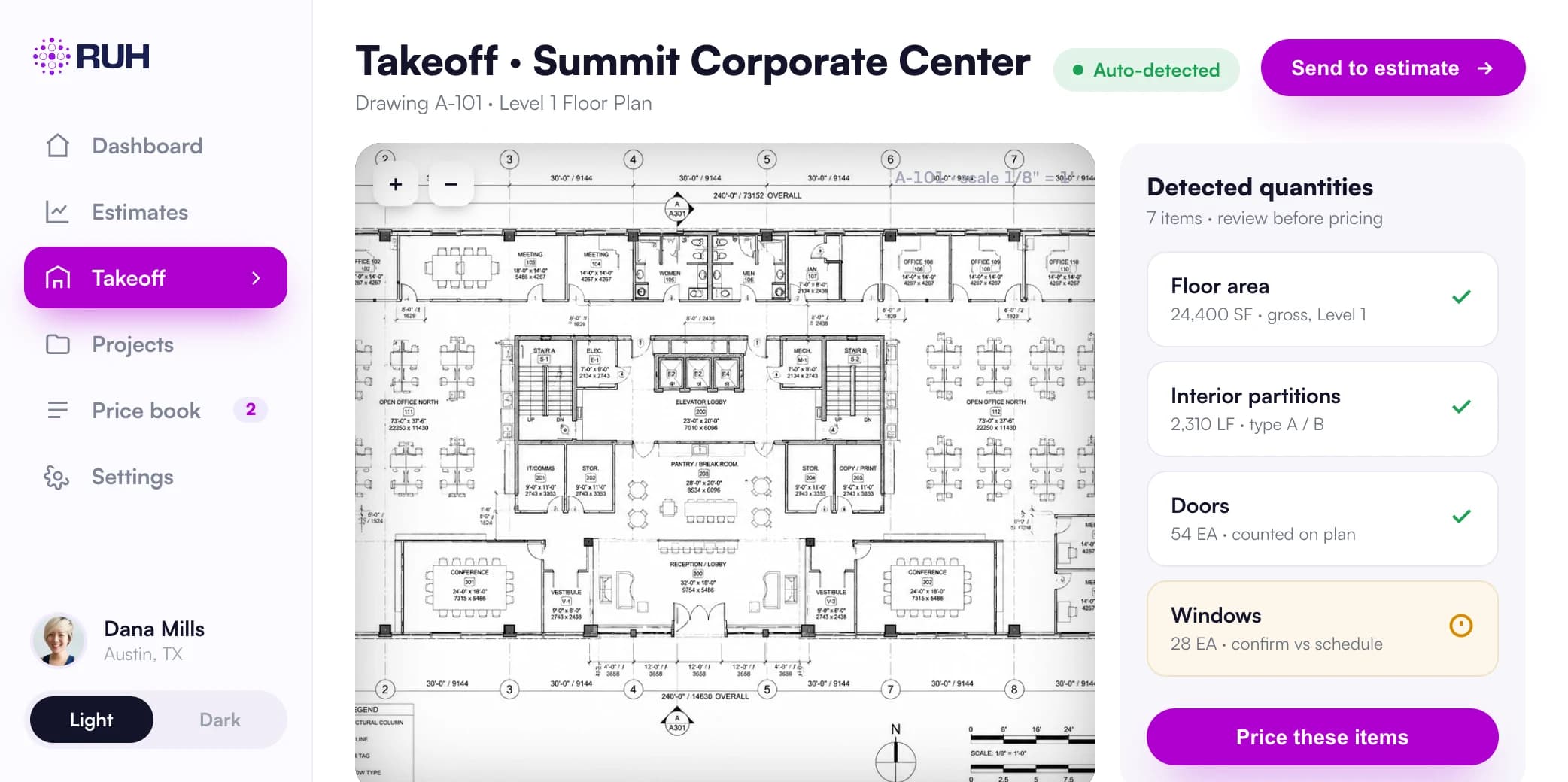
Ruh counts air devices by schedule tag from the contractor's drawings and pairs each count with its flex and damper assembly so nothing rides in for free. The counts are priced on the contractor's own price book, and the estimator cross checks them against the RCP and the air device schedule before sign off.

See AI construction takeoff and estimating software

Diffuser: frequently asked questions

What is the difference between a diffuser, a register, and a grille?+

A diffuser is a supply outlet engineered to spread air in a pattern, typically the square lay-in cones you see in office ceilings. A register is a grille with an integral damper behind the face, common for sidewall and floor supply. A grille is a bare slotted or louvered face with no damper, used mostly for return and exhaust. Estimators keep them on separate lines because the unit costs and the assemblies behind them differ.

Do you count diffusers from the RCP or the mechanical plans?+

Both, and the cross check is the point. The reflected ceiling plan governs where devices land in the ceiling and is where the architect coordinates them with lights and sprinklers; the mechanical plan and air device schedule govern type, neck size, and CFM. On real jobs the two disagree, and a count that silently picks one set of documents inherits its errors. Count from one, verify against the other, and flag conflicts for an RFI.

What does the installed cost of a diffuser include?+

More than the device. A typical supply diffuser assembly carries the diffuser itself, a spin-in fitting at the trunk with a balancing damper, a run of flex duct (commonly 4 to 8 ft), straps or supports, sealant, and the labor to set it in the grid and connect it. Returns are usually cheaper because plenum returns need no flex runout. Pricing the bare device and skipping the assembly is one of the quietest ways to underbid the air distribution scope.

Still measuring by hand? Your next takeoff can run while you review this one.

See it on your plans

Related terms

Keep going: read the full guide or explore AI construction takeoff and estimating software.

The MEP estimating cheat sheet
Every unit, waste factor, and conversion on one page. Free PDF.

See Ruh price a bid from your own drawings.

AI takeoff and estimating on your price book, your estimator signs off.

Figures on this page are illustrative. Construction estimates depend on project-specific conditions, source documents, market pricing, and professional judgment. Ruh's AI assists the estimator and does not replace professional review: your team reviews, validates, and approves every estimate, bid, and pricing decision.