100% money-backBook a walkthrough

Construction glossary · Steel and structural

What is gusset plate in construction?

A gusset plate is a flat steel plate that connects a brace to a beam, column, or truss chord, transferring the brace force into the main frame. It appears at every brace work point in braced frames and at truss panel points. Estimators count gusset plates each from the connection details and roll their weight into the connection or fabrication allowance on the steel tonnage.

Updated June 2026 · Reviewed by the Ruh construction team

Joins multiple membersCommon at braced framesConnected by bolts or welds

Gusset plate at a connection

Brace memberGusset plateBeam / column1/2 in platebolt/weld pattern

Estimating steel and structural scope this week? Watch Ruh take off a real plan in 30 minutes.

Book a walkthrough
Definition

Gusset plates are the workhorse connection element of braced frames: a flat plate, commonly 1/2 in to 1 in thick, welded or bolted at the intersection of a brace with a beam and column, or at the panel points of a truss. On the bid set they live in the S-series connection details and braced frame elevations, but on many commercial jobs connection design is delegated, so the bid drawings show only brace forces and the fabricator's engineer sizes the gussets later on the shop drawings. The fabricator cuts and shop welds the plates, the erector makes the field bolted or field welded brace connections, and the GC's estimator rarely prices them line by line. New estimators trip over gussets in three ways: hunting for plate sizes that are not on the drawings yet, carrying a connection allowance that is too thin for a brace heavy or seismic job where gussets get large, and double counting connection material that the fabricator's quote already includes.

How it is measured

Gusset plates are counted each from the braced frame elevations and connection details, then converted to weight: plan dimensions give the square footage, and steel plate weighs 40.8 lb per sf per inch of thickness. The piece count and weight rarely stand as their own estimate line. Instead the tonnage rolls into a connection and fabrication allowance, typically carried as a percent adder on the main member tonnage from the takeoff. The right adder is judgment: light bracing on a small building needs less, heavy seismic bracing with thick oversized gussets needs more. When connection design is delegated and no sizes exist at bid time, estimators assume representative plate sizes per work point, compute the weight, and check that the percent allowance covers it.

Worked example

Worked example

A two story braced frame package shows 28 gusset plates, each detailed at 30 in x 30 in x 3/4 in. Step 1, area per plate: 30 in x 30 in = 900 sq in, and 900 / 144 = 6.25 sf. Step 2, weight per plate: steel plate weighs 40.8 lb per sf per inch of thickness, so 6.25 sf x 40.8 lb x 0.75 in = 191.25 lb. Step 3, total weight: 28 plates x 191.25 lb = 5,355 lb, and 5,355 / 2,000 = 2.6775 tons, carried as 2.7 tons. Step 4, sanity check the allowance: if main member tonnage is 90 tons, gussets alone are 2.7 / 90 = 3 percent, so a total connection allowance under 3 percent is too thin on this job. At an illustrative fabricated and erected price of $4,800 per ton, 2.7 tons x $4,800 = $12,960.

100%

Try Ruh on a real bid. 100% money-back guarantee if you are not satisfied.*

*Scoped delivery, terms apply. Read the guarantee terms

Start with a walkthrough
How Ruh handles it

How Ruh handles gusset plate

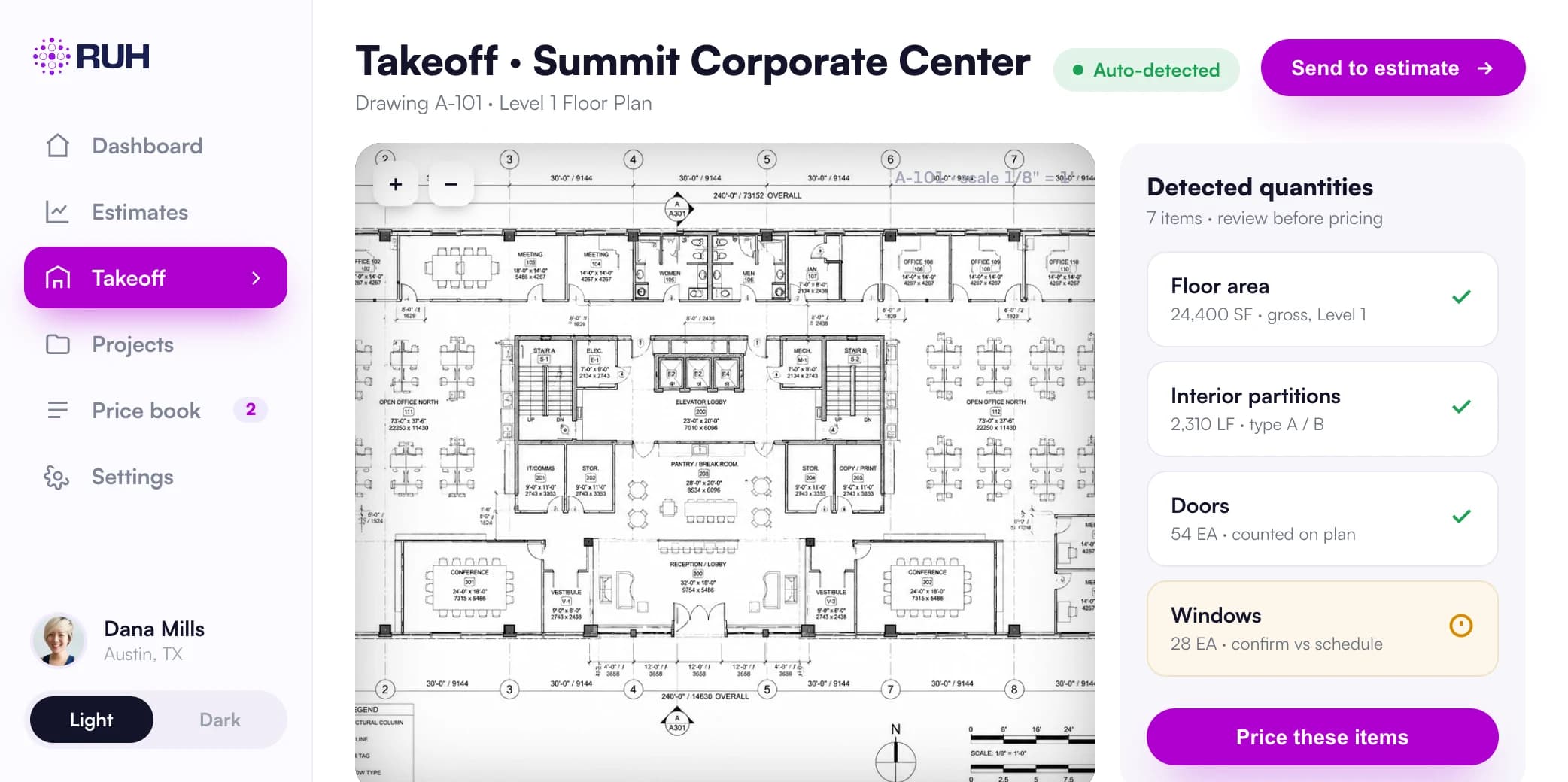
Ruh reads the structural drawings, picks the gusset plates off the braced frame elevations and connection details, and converts counts and plate sizes into weight the same way an estimator would. It prices the resulting tonnage and connection allowance against the contractor's own price book, so the numbers reflect their real fabrication and erection costs. The estimator reviews the counts, adjusts the allowance percent, and signs off before the bid goes out.

See construction estimating software

Gusset plate: frequently asked questions

Are gusset plate sizes shown on the bid drawings?+

Often not. On delegated connection design jobs, the engineer of record shows brace forces and typical details, and the fabricator's engineer sizes the actual gussets during shop drawing production. At bid time the estimator either assumes representative plate sizes per work point or carries a percent connection allowance on the main steel tonnage and verifies it against the brace count.

How do I estimate gusset plate weight when no sizes are detailed?+

Assume a plan size and thickness per work point based on the brace size and system, then apply the plate formula: square feet x 40.8 lb per inch of thickness. Sum the plates, convert to tons, and compare against your percent adder on main member tonnage. Seismic braced frames in particular run thick, oversized gussets, so the adder that worked on a wind governed job can be badly thin.

Are gusset plates shop welded or field installed?+

Most commonly the gusset is shop welded to the beam or column, and the brace is then field bolted or field welded to the gusset during erection. The split matters to the estimate: shop welding lands in the fabricator's price per ton, while field bolting or field welding shows up in erection labor, and seismic field welds with demand critical requirements cost noticeably more hours.

Still measuring by hand? Your next takeoff can run while you review this one.

See it on your plans

Related terms

Keep going: read the full guide or explore construction estimating software.

The Steel and structural estimating cheat sheet
Every unit, waste factor, and conversion on one page. Free PDF.

See Ruh price a bid from your own drawings.

AI takeoff and estimating on your price book, your estimator signs off.

Figures on this page are illustrative. Construction estimates depend on project-specific conditions, source documents, market pricing, and professional judgment. Ruh's AI assists the estimator and does not replace professional review: your team reviews, validates, and approves every estimate, bid, and pricing decision.