100% money-backBook a walkthrough

Construction glossary · Units of measure

What is LF (linear foot) in construction?

A linear foot (LF) is a length measurement equal to 12 inches, measured in a straight line along the run of the work with no regard for width or height. In construction estimating, LF is the standard unit for anything that runs in lengths, such as baseboard, pipe, conduit, curb and gutter, strip footings, and fencing. Estimators measure the run, deduct openings where the material stops, and add waste before pricing per LF.

Updated June 2026 · Reviewed by the Ruh construction team

1 LF = 12 inches of runIgnores width & heightPriced as $/LF installedUsed for trim, pipe, curb

What a linear foot measures

length only1 ft run1 LF120 ft of base trim = 120 LF

Estimating units of measure scope this week? Watch Ruh take off a real plan in 30 minutes.

Book a walkthrough
Definition

LF stands for linear foot, a straight-line length measurement used to quantify anything that runs in a line rather than covers an area. You will see it on drawings and in specs for baseboard and trim, pipe and conduit, strip footings, grade beams, curb and gutter, guardrail, fencing, joint sealant, and wall framing measured by wall length. It shows up in unit price contracts and bid schedules (curb at a price per LF), in subcontractor quotes, and on pay apps where progress is billed by LF installed. Estimators, project managers, and field engineers all live in this unit. New estimators trip up in a few predictable ways: confusing LF with square feet on items that have a meaningful width (countertops, wide gutters), forgetting to deduct openings when converting wall perimeters to trim lengths, skipping waste for cuts and stock lengths, and mixing LF with board feet on lumber pricing. The fix is to always ask what the unit price actually covers and measure the run the same way the bidder will.

How it is measured

Linear feet are measured along the run of the work with an architect's scale, a measuring wheel in the field, or digital takeoff software. On plans, you measure the printed length at the drawing scale (a 1/4 inch = 1 ft plan means 1 inch of paper equals 4 ft) and verify the scale against a dimensioned string before trusting it. Quantities land on bid forms and schedules of values as LF line items, and specs often state stock lengths (16 ft baseboard, 20 ft pipe sticks) that drive waste. To quantify, trace each run once, keep runs separate where pricing differs (pipe risers versus mains), deduct openings where the material stops, then add a waste factor, commonly 5% to 10%, before pricing.

Worked example

Worked example

Take baseboard for two offices. Room A is 14 ft by 12 ft, so the perimeter is 2 x (14 + 12) = 52 LF. Room B is 10 ft by 10 ft, so 2 x (10 + 10) = 40 LF. Gross total: 52 + 40 = 92 LF. Now deduct openings where base does not run: three 3 ft door openings = 9 LF, leaving 92 - 9 = 83 LF net. Add 10% waste for cuts, corners, and stock lengths: 83 x 1.10 = 91.3, round up to 92 LF. If the material comes in 16 ft sticks, that is 92 / 16 = 5.75, so you order 6 sticks. At an illustrative installed cost of $6.50 per LF, the line item is 92 LF x $6.50 = $598. Same logic scales to a whole floor plate, just with more rooms and more door deducts.

100%

Try Ruh on a real bid. 100% money-back guarantee if you are not satisfied.*

*Scoped delivery, terms apply. Read the guarantee terms

Start with a walkthrough
How Ruh handles it

How Ruh handles LF (linear foot)

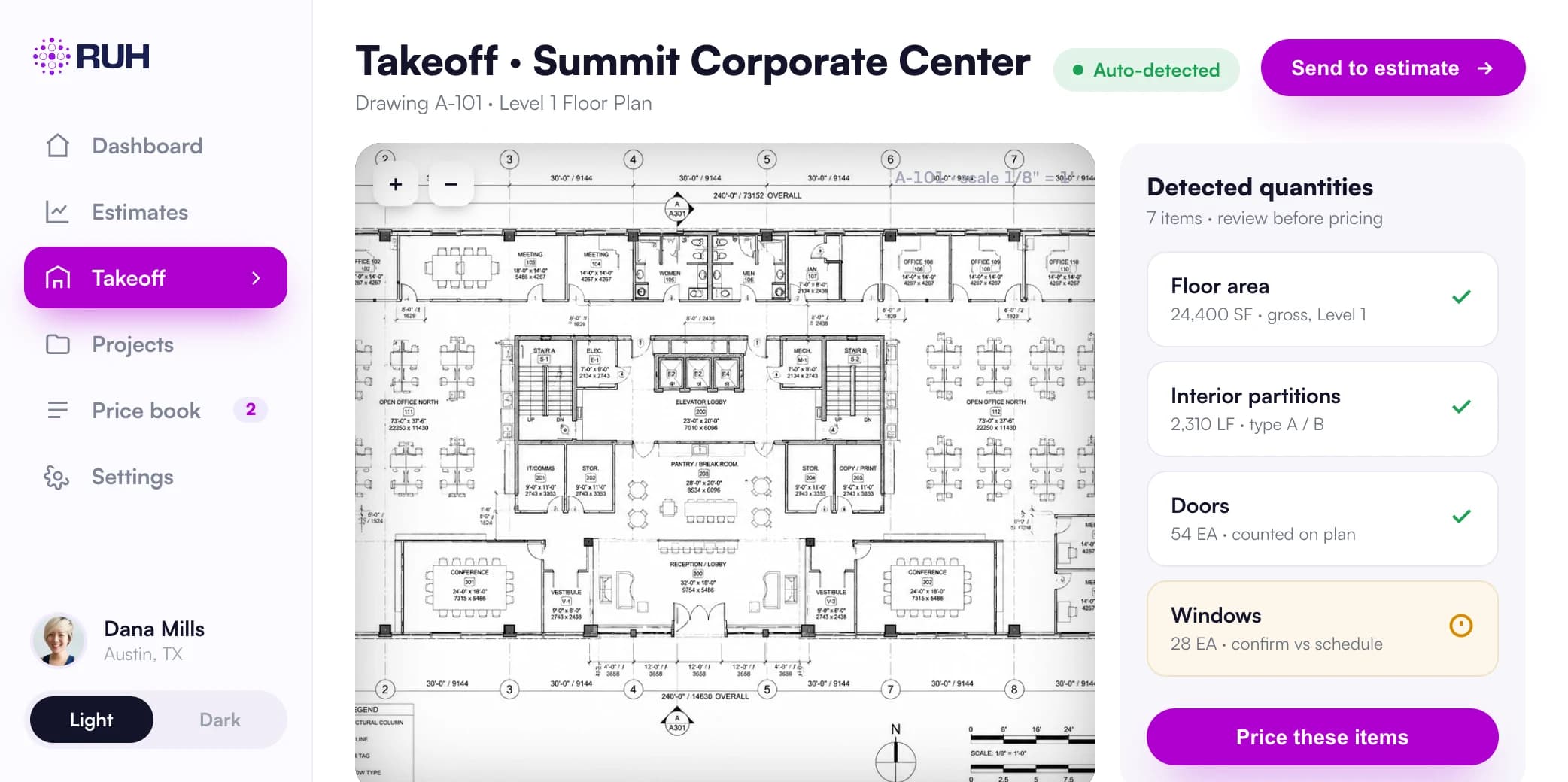
Ruh reads the floor plans, traces wall runs and room perimeters, and returns baseboard, trim, and other linear items as LF quantities with openings already deducted. It prices each run against the contractor's own price book, so the cost per LF reflects their real numbers rather than a generic database. The estimator gets a line-item draft to review, adjust waste factors, and sign off before anything goes into the bid.

See AI construction takeoff and estimating software

LF (linear foot): frequently asked questions

Is a linear foot the same as a regular foot?+

Yes. A linear foot is exactly 12 inches, the same as a standard foot. The word linear just signals you are measuring length only, ignoring the material's width and thickness. A 10 ft piece of 4 inch base and a 10 ft piece of 6 inch base are both 10 LF.

How do I convert square feet to linear feet?+

Divide the square footage by the material width in feet. For example, 120 sf of a product 6 inches (0.5 ft) wide works out to 120 / 0.5 = 240 LF. Without a known width there is no conversion, which is why mixing the two units on a bid form is a classic takeoff error.

How much waste should I add to a linear foot takeoff?+

Most estimators carry 5% to 10% on linear items, with the high end for trim work that has lots of corners and short runs. Stock length matters too: if base comes in 16 ft sticks and your average wall is 9 ft, you will burn more material in offcuts. Check your own historical usage rather than leaning on a rule of thumb.

Still measuring by hand? Your next takeoff can run while you review this one.

See it on your plans

Related terms

Keep going: read the full guide or explore AI construction takeoff and estimating software.

The Units of measure estimating cheat sheet
Every unit, waste factor, and conversion on one page. Free PDF.

See Ruh price a bid from your own drawings.

AI takeoff and estimating on your price book, your estimator signs off.

Figures on this page are illustrative. Construction estimates depend on project-specific conditions, source documents, market pricing, and professional judgment. Ruh's AI assists the estimator and does not replace professional review: your team reviews, validates, and approves every estimate, bid, and pricing decision.
LF (linear foot) in construction explained | Ruh AI