


Quick Answer
An electrical material list is the complete list of parts needed to build the electrical scope, every box, ring, device, plate, fitting, strap and conductor by size and type, built from the takeoff's counts and lengths so it can be priced and then purchased without missing small parts. Below are the difference between a takeoff and a material list, how assemblies turn counts into parts, what conduit and wire runs add, how to set waste by material type, how to organize the list for pricing and buying, the items most often missed, a worked example and our view on what estimators get wrong.
What you'll find below:
- Why a takeoff and an electrical material list are different documents
- How one receptacle becomes seven parts, and 140 receptacles become 980
- What conduit and wire runs add beyond their length
- Waste set by material type, compared with one blanket percentage
- The items electrical material lists miss most often
- A review checklist before the list goes out for quotes
What Is the Difference Between a Takeoff and a Material List?
A takeoff counts devices and measures runs, while an electrical material list turns those counts and lengths into every part a supplier has to deliver. The takeoff says 140 duplex receptacles. The material list says 140 boxes, 140 plaster rings, 140 devices, 140 plates, the connectors, the cable or conduit to each one and the wire by size and color.
The takeoff is for knowing the scope. The material list is for pricing it and buying it. Overruns on electrical work often start in the gap between the two, where small parts get forgotten, double counted or left to someone's memory.
A material list built from a takeoff is only as good as the takeoff under it. Our guide on how to estimate electrical work covers getting counts and lengths right first.
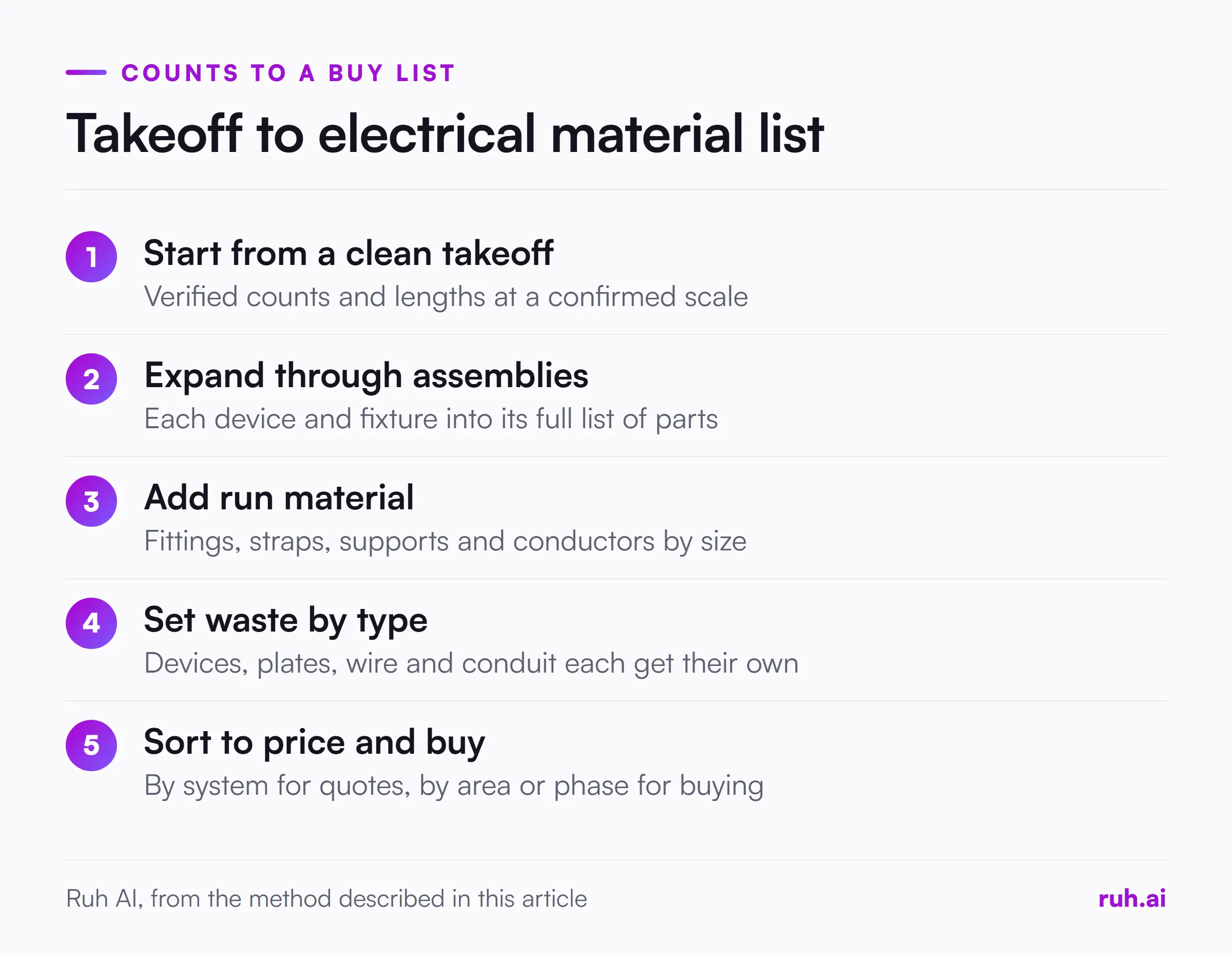
How Do Assemblies Turn Counts Into Parts?
Assemblies turn counts into parts by defining, once, every component that goes with one counted item, so each receptacle, switch or fixture in the takeoff expands into its full list of parts automatically. An assembly is a recipe for one installed unit. Our glossary entry on assembly estimating covers the idea in general.
A typical duplex receptacle assembly, as an example, includes:
- A device box
- A plaster ring or mud ring
- The receptacle
- A cover plate
- Two cable or conduit connectors
- A ground pigtail
Switches, fixtures, data outlets and equipment connections each get their own assembly. Once they exist, the material list stops depending on who builds it.
What Do Conduit and Wire Runs Add Beyond Their Length?
Conduit and wire runs add fittings, couplings, straps, supports and conductors by size and color, none of which the measured length shows. A run measured at 100 feet is also a set of couplings, connectors, elbows and straps along that length.
For each run type, the material list needs:
- Conduit or cable by type and size, with the measured length.
- Fittings: couplings, connectors and elbows, by size.
- Supports: straps, hangers and rod, at the spacing your specs and code require.
- Conductors: each size and color, by run, including grounds and neutrals.
- Pull boxes and junction boxes where the run needs them.
Feeders and gear need the same treatment. Our panel schedule guide covers reading feeders and breakers from the schedules.
Which Items Should Be Flagged Before Pricing?
Flag gear, specialty fixtures and anything with a long lead time before the material list goes out for pricing, because these items set the schedule as much as the price. Switchgear, panelboards, transformers and some lighting packages can take far longer to arrive than wire and boxes.
Mark each long-lead item on the list, get a supplier quote with a lead time, and note it in the estimate. Our post on the lighting fixture schedule covers checking a fixture package quote row by row.
How Should You Set Waste on an Electrical Material List?
Set waste by material type, not as one blanket percentage, because devices, plates, wire and conduit are lost, cut and damaged at very different rates. A blanket percentage over-orders some items and still runs short on others.
Devices rarely go to waste, but wire is cut to length on every run. Plates crack. Conduit gets cut and offcuts pile up. Set a waste factor for each material group from your own job history, and apply it to that group only.
How Do You Organize the List for Pricing and Purchasing?
Organize the material list by system, area or phase, so it can be priced as a whole and bought in the order the job needs it. One long list sorted by part number suits nobody.
For pricing, group by system (power, lighting, low voltage, gear) so a supplier can quote each package. For purchasing, group by area or phase, so material arrives when the crew needs it and not all on day one. The same list can carry both groupings as columns.
How Do You Keep Assemblies Consistent From Job to Job?
Keep assemblies consistent by owning them as company standards: one master set, a named person who updates it, and a version note whenever a part changes. Consistent assemblies are what make every material list start complete.
Three habits keep them that way:
- Start each job from the master set, then change only what the job's specs require, such as a different box depth or a specified connector type.
- Record each change as a new version, so an older estimate still shows the assembly it was built from and nobody wonders why two jobs priced the same item differently.
- Feed field lessons back in. When a crew finds a part the assembly missed, add it to the master set, not just to the current job's list.
A master set that nobody owns drifts into five personal versions within a year. One that someone owns gets better on every job.
Worked Example: 140 Receptacles to a Buy List
A worked example shows how assemblies and waste by type change the order, using illustrative numbers only. Redo it with your own assemblies and waste factors.
The takeoff shows 140 duplex receptacles, about 6,000 feet of wire and 2,000 feet of conduit.
Assemblies: each receptacle assembly has 7 parts (box, ring, device, plate, 2 connectors and a ground pigtail). 140 x 7 = 980 parts from one line in the takeoff.
Waste by material type, with illustrative factors:
| Material | Takeoff quantity | Waste | Order quantity |
|---|---|---|---|
| Devices | 140 | 2% | 143 |
| Plates | 140 | 5% | 147 |
| Wire | 6,000 ft | 10% | 6,600 ft |
| Conduit | 2,000 ft | 5% | 2,100 ft |
Devices: 140 x 1.02 = 142.8, rounded up to 143. Plates: 140 x 1.05 = 147. Wire: 6,000 x 1.10 = 6,600 feet. Conduit: 2,000 x 1.05 = 2,100 feet.
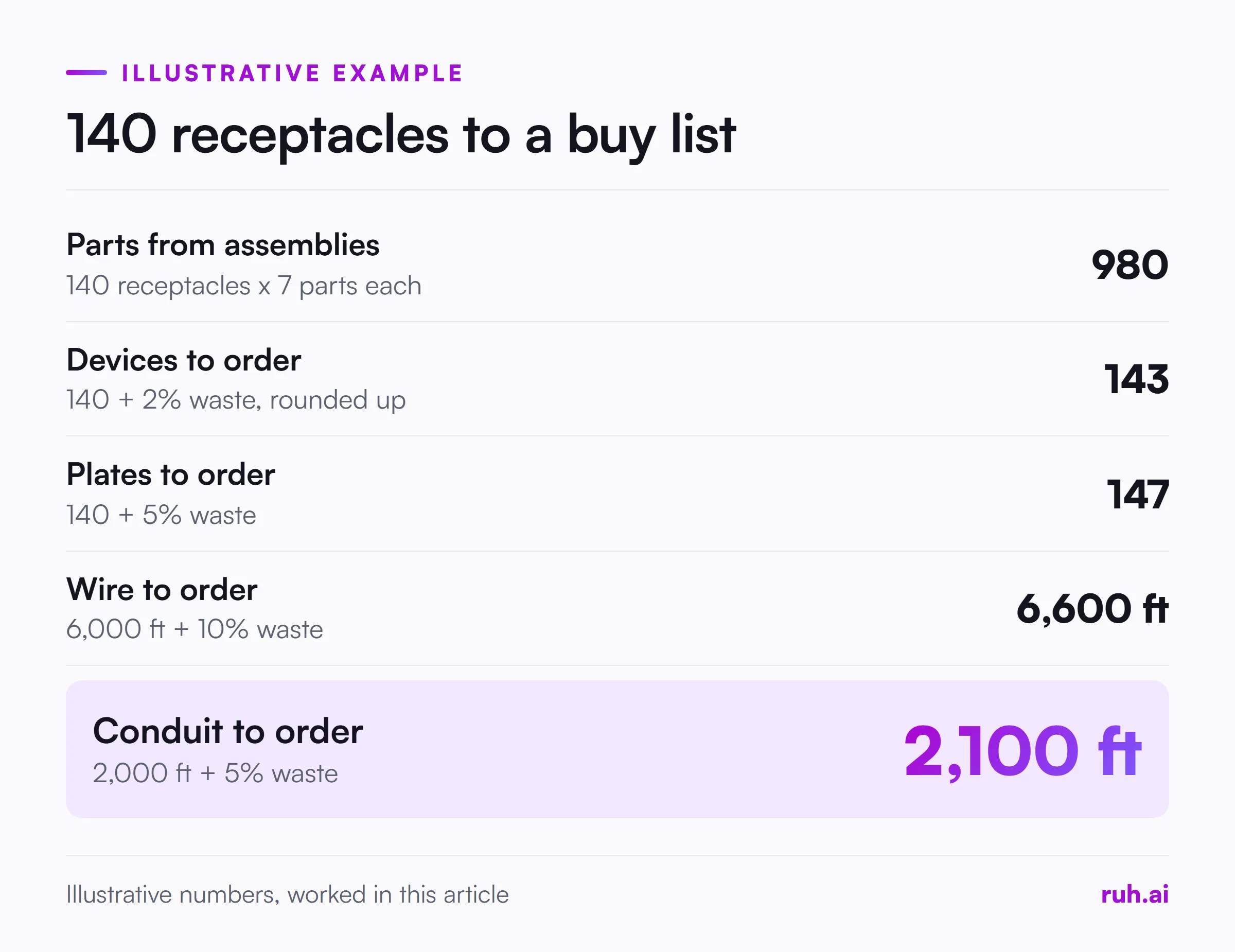
A blanket 10% on everything orders 154 devices and 154 plates, which is 11 more devices and 7 more plates than you need, plus 2,200 feet of conduit, 100 feet more. On a single floor it's small. Across a job and every material group, the blanket factor buys material that never gets installed, while tighter-than-needed items still run short.
What Do Electrical Material Lists Commonly Miss?
Electrical material lists commonly miss items that aren't counted devices or measured runs: temporary power, spare capacity, hangers and supports, labels and items furnished by others. Each one is real material or a real exclusion.
The misses to check for:
| Item | Why it's missed | Where to look |
|---|---|---|
| Temporary power | It's priced as a lump, not as parts | Our guide on temporary power construction costs |
| Spare conduits and capacity | Specified for the future, not drawn as runs | Specs and general notes |
| Hangers, rod and supports | Not shown on plans | Specs, details, code spacing |
| Labels and identification | A closeout item in the specs | Electrical spec sections |
| Fire-stopping at penetrations | Sometimes electrical scope, sometimes another trade's | Specs and the scope split |
| Items furnished by others | Owner or another trade buys them | Bid form, specs, schedule remarks |
Material List Review Checklist
Run this before the material list goes out for quotes:
- The takeoff under the list has verified counts and lengths measured at a confirmed scale.
- Every counted device and fixture has an assembly.
- Every run has fittings, supports and conductors by size and color.
- Gear and long-lead items are flagged with lead times.
- Waste is set by material type, not as one blanket percentage.
- The list is grouped by system for pricing and by area or phase for buying.
- Temporary power, spare capacity, supports and labels are included or excluded in writing.
- Items furnished by others are marked install-only.
- Any material without a price is a labelled allowance, never a zero.
- The list matches the estimate, so what you buy is what you priced.
What Estimators Get Wrong About Electrical Material Lists
Four positions on electrical material lists, argued as our view, not as data.
The takeoff is not the buy list. Sending a supplier a takeoff and hoping they fill in the small parts is how jobs run out of connectors in week two.
Assemblies are a company asset. A material list that depends on one person's habits leaves with that person. A standard assembly doesn't.
Blanket waste is a guess dressed as a policy. Set waste where the material is actually lost.
The list you buy from should match the list you priced. If purchasing rebuilds the list from scratch, the estimate and the job drift apart.
The Honest Assessment: What Still Falls Short
A material list is only as complete as the drawings under it. Bid sets miss details, and some supports, fittings and boxes only become clear in the field.
Assemblies also need upkeep. When a spec calls for a different box or connector, the standard assembly has to change for that job, or the list will be complete and wrong. And supplier substitutions at quote time can change the parts, so the list needs a second check against the quote.
How Ruh Fits
Ruh AI's Estimating Agent carries your takeoff quantities into a priced estimate using your company's own rate book and assemblies. Your company keeps its own assemblies, edits create a new version, and a budget line keeps the version it was built from. Any trade with nothing priced gets a labelled allowance line instead of a silent zero.
A person on your team approves every scope line, your team can edit every quantity and price, and a person on your team approves the budget before it moves on. Ruh AI's Takeoff Agent reads the drawing PDFs and won't give a length or area for a sheet with no scale. Ruh works with your stack, built per customer.
Frequently Asked Questions
Q: What is an electrical material list? A: It is the complete list of parts needed to build the electrical scope, including every box, ring, device, plate, fitting, strap and conductor by size and type. It is built from the takeoff's counts and lengths and used for pricing and purchasing.
Q: What is the difference between an electrical takeoff and a material list? A: A takeoff counts devices and measures runs. A material list turns those counts and lengths into every part a supplier delivers, such as the boxes, rings, plates, connectors, fittings and wire behind each device and run.
Q: How do you make an electrical material list from a takeoff? A: Expand each counted device and fixture through a standard assembly, add fittings, supports and conductors for every run, set waste by material type, and sort the list by system for pricing and by area or phase for purchasing.
Q: What waste factor should you use for electrical materials? A: Use a separate factor for each material group, set from your own job history. Wire, which is cut on every run, usually needs more than devices. A single blanket percentage over-orders some items and still runs short on others.
Q: What items are commonly missed on an electrical material list? A: Temporary power, spare conduits and capacity, hangers and supports, labels and identification, fire-stopping at penetrations, and items furnished by others. Each one should be either included or excluded in writing.
Q: Should the material list match the estimate? A: Yes. If purchasing rebuilds the list separately, what gets bought can drift from what was priced. Building both from the same takeoff and assemblies keeps them aligned.
See how Ruh prices your takeoff from your own rate book on the construction estimating software page.