

Quick Answer
Temporary power in construction is the electrical service, distribution and lighting a site runs on before the permanent system is energized, and pricing it means separating the service install, the distribution, the monthly running cost, relocations and removal into their own lines. Below are what temporary power covers and who pays for what, how to size the service, the service options compared, the OSHA rules that shape distribution, a worked estimate that shows how a lump-sum allowance falls short, a checklist and our view on what estimators get wrong.
What you'll find below:
- What temporary power covers, and the contract questions to answer first
- The loads that size a temporary service on a construction site
- Utility drop, generator or both, compared side by side
- The OSHA rules on temporary wiring and GFCI protection that shape distribution
- A worked estimate where a $30,000 allowance comes out $16,000 short
- A temporary power checklist to run on every bid
What Does Temporary Power Cover on a Construction Job?
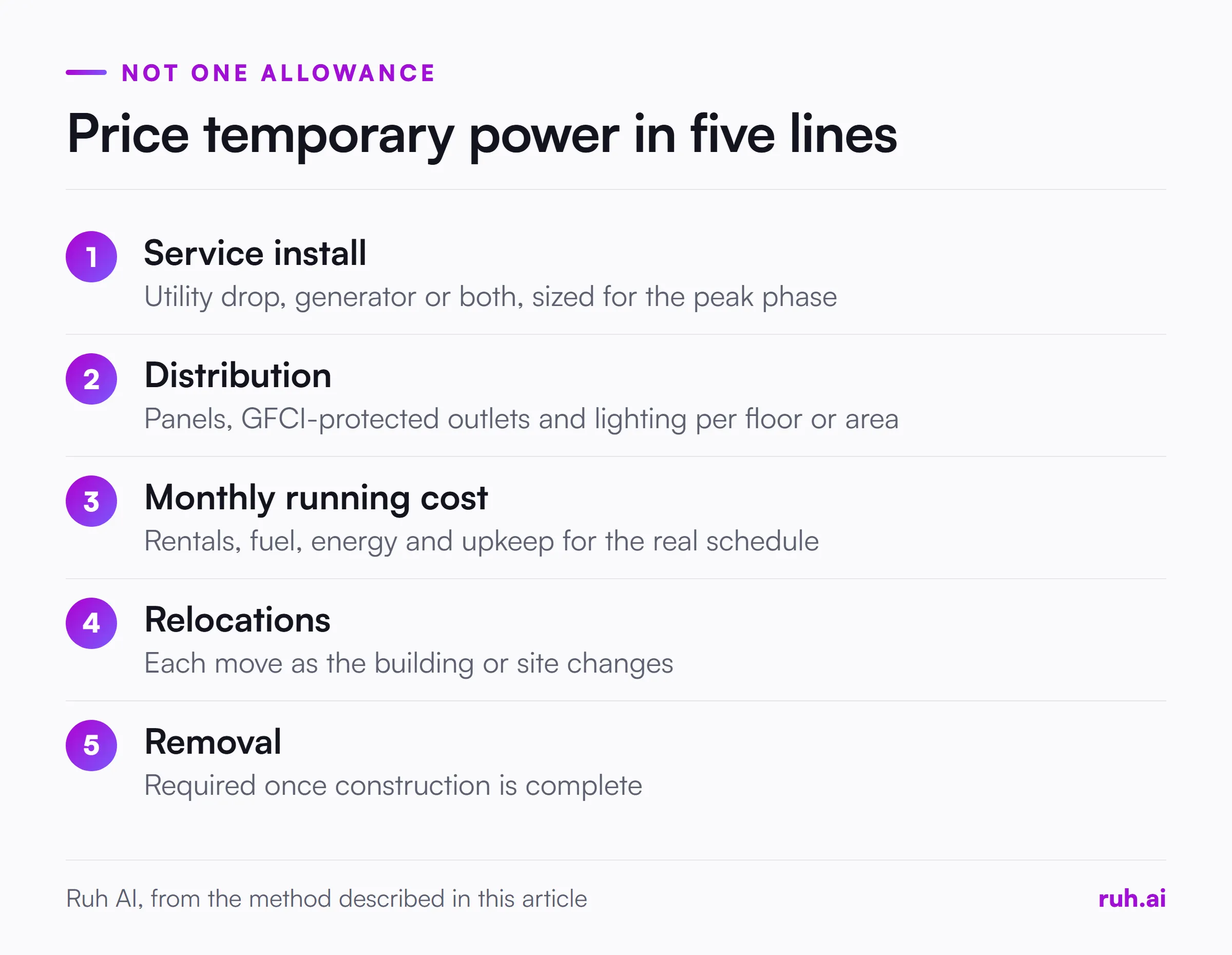
Temporary power covers everything the site needs for electricity until the permanent service is energized: the temporary service, the distribution to each work area, temporary lighting, the monthly cost of running it, any relocations as the job changes, and its removal. It looks like one line in the estimate, but it is five or six.
It is easy to underbid because it is spread across the schedule. The service goes in at the start, distribution grows floor by floor, monthly costs run for as long as the job does, and removal happens at the end. A single round number can't track any of that.
Temporary power is part of the job's general conditions on many projects, which is why it sits between the GC's costs and the electrical subcontractor's scope.
Who Pays for What? Read the Documents First
Read the specs, the general conditions and the bid form before pricing temporary power, because they decide who installs it, who pays the utility fees and who pays for the energy used. The split changes from job to job, and getting it wrong prices scope you don't own or misses scope you do.
The questions to answer from the documents:
- Who installs the temporary service? The electrical subcontractor, the GC or the utility.
- Who pays the utility's connection fees? The owner, the GC or the electrical sub, depending on the contract.
- Who pays for the energy used? A monthly bill that can run for the whole job.
- Who provides temporary lighting, and to what level? The specs set the lighting required in work areas and stairs on most jobs.
- Who supplies power to other trades' equipment? Cranes, hoists, welders and heaters are sometimes another party's cost.
- Who removes it, and when? Removal is scope, and its timing affects other trades.
How Do You Size a Temporary Service?
Size a temporary service from the loads the site will actually run: site trailers, tower cranes, hoists, welders, temporary heat, dewatering pumps and lighting, at the phase when the most of them run at once. The biggest load is rarely at the start of the job.
List each load with its phase and how long it runs. A tower crane needs power for months in the middle of the job. Temporary heat runs in winter. Dewatering runs during excavation. The service has to carry the peak, and the monthly cost has to follow the whole curve.
The loads to list for a temporary service, and what to ask about each:
| Load | When it runs | What to ask |
|---|---|---|
| Site trailers and offices | The whole job | How many, and are they the GC's or yours to power |
| Tower crane | Structure phase | Whether the crane supplier needs its own service |
| Hoists and lifts | Structure through finishes | How many, and on which floors |
| Welders | Steel and mechanical phases | Which trades bring their own generators |
| Temporary heat | Cold months | Electric or fuel-fired, and who supplies it |
| Dewatering pumps | Excavation and foundations | Duration and whether pumps run around the clock |
| Temporary lighting | The whole job, floor by floor | Required levels in work areas and stairs |
| Hand tools and chargers | The whole job | Receptacle count per floor or area |
Read the table against the schedule. Two loads that never run at the same time don't both count toward the peak, but they both count toward the monthly cost.
Which Temporary Service Option Fits the Job?
Choose between a utility drop, a generator or a mix by comparing lead time, monthly cost and how the site's needs change by phase. Many jobs start on a generator and move to a utility drop once it's connected.
Temporary service options compared:
| Option | Strengths | Weaknesses | Best for |
|---|---|---|---|
| Utility drop | Lower running cost once connected, no fuel deliveries | Utility lead time, connection fees, a fixed location | Longer jobs with steady loads |
| Generator | Fast to start, can move with the work | Rental, fuel and service every month, noise limits | Early phases, remote sites, short jobs |
| Generator then utility | Starts work early, then lowers running cost | Two setups to price, and a changeover | Jobs where the utility drop arrives after start |
What Do OSHA's Rules Mean for Temporary Distribution?
OSHA's construction electrical rules require temporary wiring to come out as soon as construction is complete and require ground-fault protection on temporary receptacles, so both removal and protection belong in the estimate. These are rules, not options.
OSHA's 29 CFR 1926.405(a)(2) allows temporary wiring of a class less than permanent wiring, but says it shall be removed immediately upon completion of construction or the purpose it was installed for. The same section says temporary feeders shall originate in a distribution center. Removal is required, so it is a line in the estimate, not an afterthought.
OSHA's 29 CFR 1926.404(b)(1) requires employers to protect workers on construction sites with either ground-fault circuit interrupters or an assured equipment grounding conductor program. Where GFCIs are used, every 120 volt, single-phase, 15 and 20 amp receptacle outlet on site that isn't part of the permanent wiring and is used by employees needs approved GFCI protection, with an exception for small insulated generators up to 5 kW.
In practice that means pricing GFCI-protected spider boxes or cord sets for every work area, the distribution panels that feed them, and temporary lighting by floor or area.
How Do You Price the Monthly Running Cost?
Price the monthly running cost by listing everything that recurs, such as generator or equipment rental, fuel, energy use, inspections and maintenance, and multiplying by the realistic duration of the job, not the hoped-for one. This line grows most when schedules slip.
Tie the duration to the schedule in the bid documents, then ask whether that schedule is realistic. If the documents don't settle who pays for energy, say in the proposal what you have and haven't included.
Why Do Relocations and Removal Get Left Out?
Relocations and removal get left out because they happen after the estimator has stopped thinking about temporary power, in the middle and at the end of the job. Both are real costs with crews, equipment and coordination.
Relocations happen when the building or site changes: a service moved to clear a foundation, distribution moved off a floor being finished, or a generator moved for access. Removal happens once permanent power is energized, and OSHA requires temporary wiring to come out then. Price each as its own line.
Worked Example: Line by Line vs One Allowance
Pricing temporary power line by line shows what a single allowance hides, as this illustrative example shows with every assumption stated inline. Redo it with your own job's numbers.
A four-floor building with a 14-month schedule, priced with illustrative numbers:
- Temporary service install: $6,500
- Distribution, 4 floors x $2,200 = $8,800
- Monthly running cost, $1,800 x 14 months = $25,200
- One relocation: $3,000
- Removal: $2,500
- Total: $6,500 + $8,800 + $25,200 + $3,000 + $2,500 = $46,000
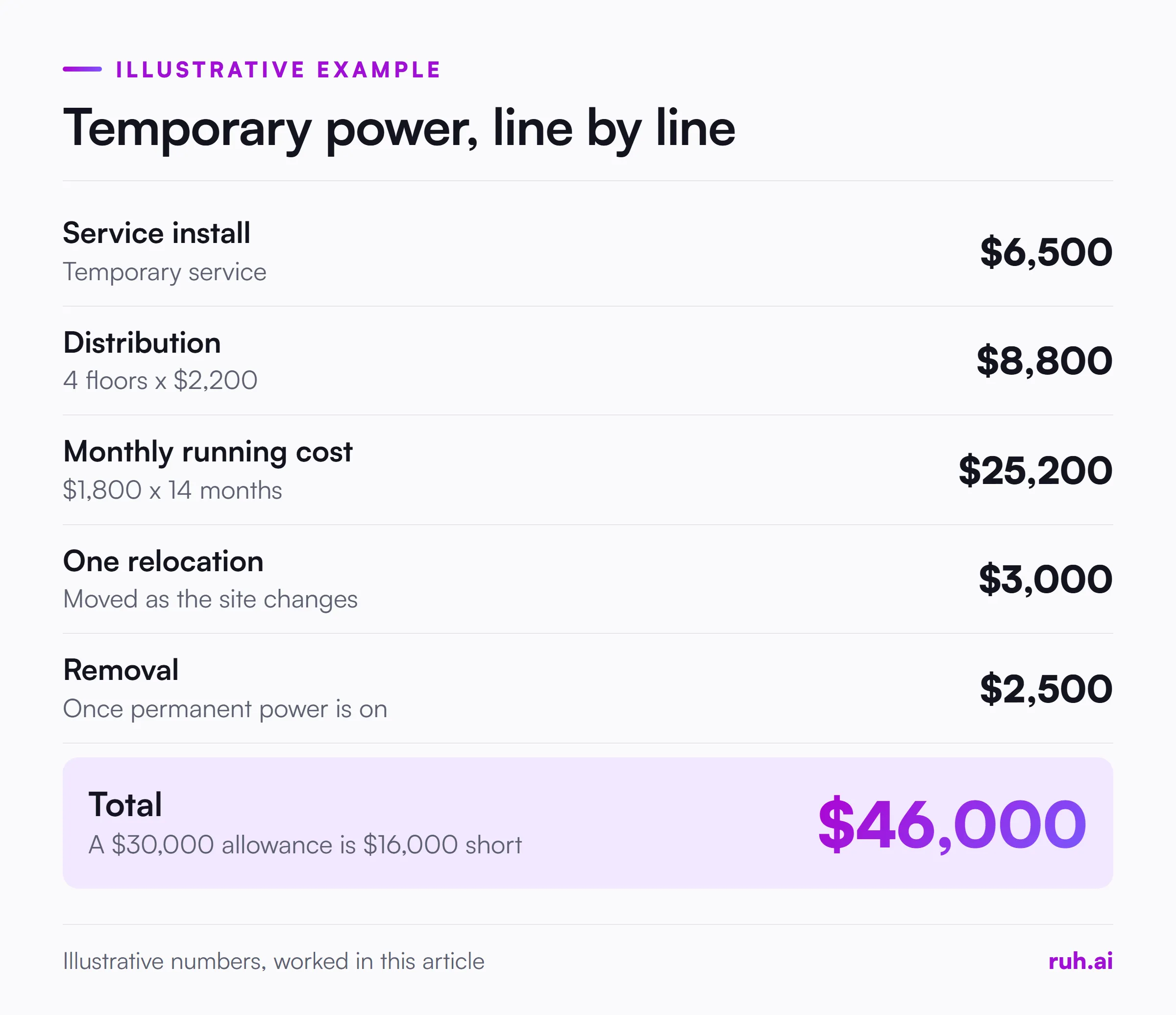
A single $30,000 allowance looks reasonable until it's broken down: it is $16,000 short. If the schedule slips by 3 months, the running cost adds 3 x $1,800 = $5,400, the total reaches $51,400, and the gap grows to $21,400.
Temporary Power Checklist
Run this before temporary power goes into the bid:
- The specs, general conditions and bid form say who installs, who pays fees and who pays for energy.
- Every load is listed with its phase and duration.
- The service option fits the phases, including any generator-to-utility changeover.
- Distribution is priced per floor or area, with GFCI protection or an assured grounding program.
- Temporary lighting meets the level the specs require.
- The monthly running cost uses a realistic duration.
- Each expected relocation is its own line.
- Removal is its own line, timed to when permanent power is energized.
- Power for other trades' equipment is priced or excluded in writing.
- Anything unpriced is a labelled allowance, never a zero.
What Estimators Get Wrong About Temporary Power
Four positions on temporary power, argued as our view, not as data.
A round number is a guess, not an allowance. An allowance should be built from lines you can explain. A lump sum hides which part ran over.
Duration is the real price. The service install is small next to the months of running cost, so the schedule matters more than the hardware.
Removal is not free. It takes a crew and coordination, and OSHA requires it.
"Someone else's scope" needs to be in writing. If the documents don't say who pays for energy or other trades' power, the proposal should.
The Honest Assessment: What Still Falls Short
Temporary power depends on a schedule that changes after the bid. A slip of a few months moves the running cost more than any careful line item can predict.
Utility lead times are also hard to know at bid time, so a job planned on a utility drop can end up on generators for longer than planned. And the split between GC and electrical sub varies enough that two bids for the same job can price very different scopes.
How Ruh Fits
Ruh AI's Estimating Agent prices each line of the estimate from your company's own rate book and history. If a trade has no price yet, it puts in a labelled allowance line instead of a silent zero.
A person on your team approves every scope line, your team can edit every quantity and price, and a person on your team approves the budget before it moves on. Ruh AI's Takeoff Agent reads the drawing PDFs and won't give a length or area for a sheet with no scale. Ruh works with your stack, built per customer. For the rest of the electrical estimate, see our guide on how to estimate electrical work.
Frequently Asked Questions
Q: What is temporary power in construction? A: It is the electrical service, distribution and lighting a construction site runs on before the permanent system is energized. It covers the temporary service, distribution to work areas, temporary lighting, monthly running costs, relocations and removal.
Q: Who pays for temporary power on a construction site? A: It depends on the contract. The specs, general conditions and bid form decide who installs the service, who pays the utility's connection fees and who pays for energy. Read them before pricing, and state your assumptions in the proposal.
Q: How do you estimate temporary power costs? A: Price it line by line: the service install, distribution per floor or area, the monthly running cost for a realistic duration, each relocation and removal. Avoid a single lump sum, because it hides which part runs over.
Q: Does temporary power on construction sites need GFCI protection? A: OSHA's 29 CFR 1926.404(b)(1) requires either GFCIs or an assured equipment grounding conductor program. Where GFCIs are used, temporary 120 volt, single-phase, 15 and 20 amp receptacles used by employees need GFCI protection.
Q: When does temporary wiring have to be removed? A: OSHA's 29 CFR 1926.405(a)(2) says temporary wiring shall be removed immediately upon completion of construction or the purpose it was installed for. Price removal as its own line, timed to when permanent power is energized.
Q: Is a generator or a utility drop better for temporary power? A: A generator starts fast and moves with the work, but costs rental and fuel every month. A utility drop costs less to run once connected but has lead time and connection fees. Many jobs start on a generator and switch to the utility.
See how Ruh prices your takeoff from your own rate book on the construction estimating software page.