
Quick Answer
A panel schedule is the table on an electrical drawing that lists everything about one panelboard, its voltage, phase, bus rating, main type and enclosure, plus every circuit it feeds with breaker poles, amps and load, so it tells an estimator exactly which panel, breakers and circuits to price. Below are a field-by-field guide to the panel schedule header, how to read the circuit grid, how to price the panelboard, breakers, feeders and branch circuits, the items panel schedules leave out, a worked panel count with the arithmetic shown, a cross-check checklist and our view on what estimators get wrong.
What you'll find below:
- The ten header fields on a panel schedule, and how each one changes the price
- How to count breakers by poles and amps without double counting
- Where feeders come from, and why the panel schedule alone can't price them
- Eight items panel schedules commonly leave out
- A worked count of a 42-space panel, and the $87 a two-pole miscount costs
- A cross-check checklist to run before the number goes out
What Is an Electrical Panel Schedule?
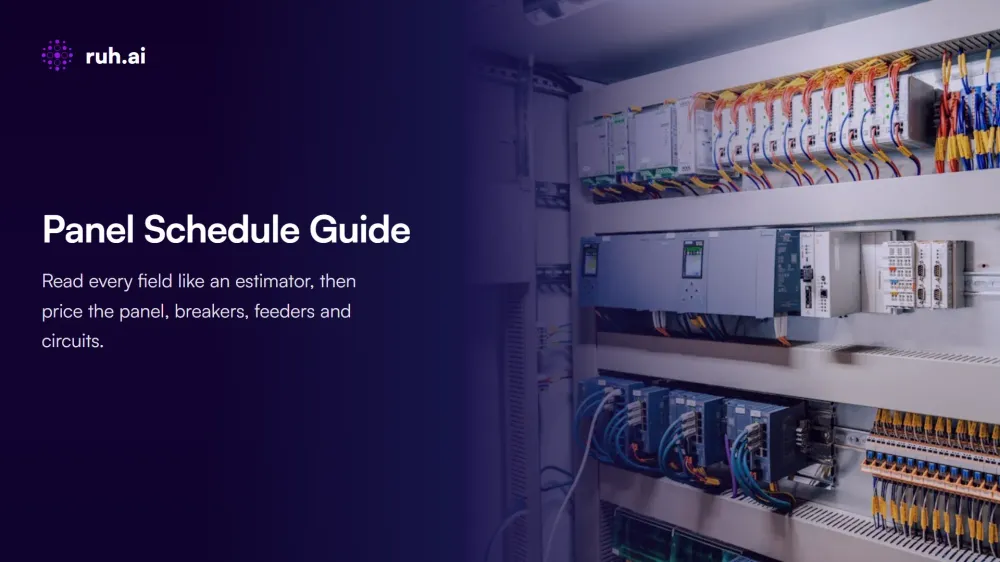
An electrical panel schedule is a table, usually on the electrical schedules sheet or beside the floor plan, that describes one panelboard and every circuit it serves. There is one schedule per panel, so a building with twelve panels has twelve schedules to read and price.
The schedule has two parts. The header describes the panel itself: its name, location, electrical system, bus rating, main type, fault rating and enclosure. The circuit grid below it lists each circuit by number, with a description, the breaker's poles and amps, and the connected load.
The panel schedule never stands alone. The riser diagram or one-line shows where each panel is fed from, and the floor plans show where its circuits go. An estimator reads all three together, because each one answers a question the others leave open.
How Do You Read the Panel Schedule Header?
Read the panel schedule header first, because it defines the panelboard you are pricing: its electrical system, bus size, main type, fault rating and enclosure. Every field in it changes the price of the panel, and some change the price of every breaker in it too.
The ten header fields, and how each one affects the estimate:
| Header field | What it tells you | How it changes the price |
|---|---|---|
| Panel name | The tag used on plans and the riser, such as LP-1 or HP-2A | Ties the schedule to its feeder and location |
| Location | Room or area where the panel sits | Sets access, mounting height and how far the feeder runs |
| Voltage | For example 208Y/120V or 480Y/277V | Changes panel, breaker and fixture types |
| Phase and wire | Single or three phase, three or four wire | Changes the panel interior and the feeder conductor count |
| Bus rating | The amp rating of the bus bars | Sets the panel size and cost |
| Main type | Main breaker or main lugs only (MLO) | A main breaker adds cost, and MLO relies on protection upstream |
| AIC rating | The fault current the breakers must interrupt | Higher ratings cost more, for every breaker in the panel |
| Spaces | Total breaker spaces in the panel | Sets the panel interior size |
| Mounting | Flush or surface | Flush adds wall work and coordination |
| Enclosure | Indoor or outdoor type | Outdoor and wet-location enclosures cost more |
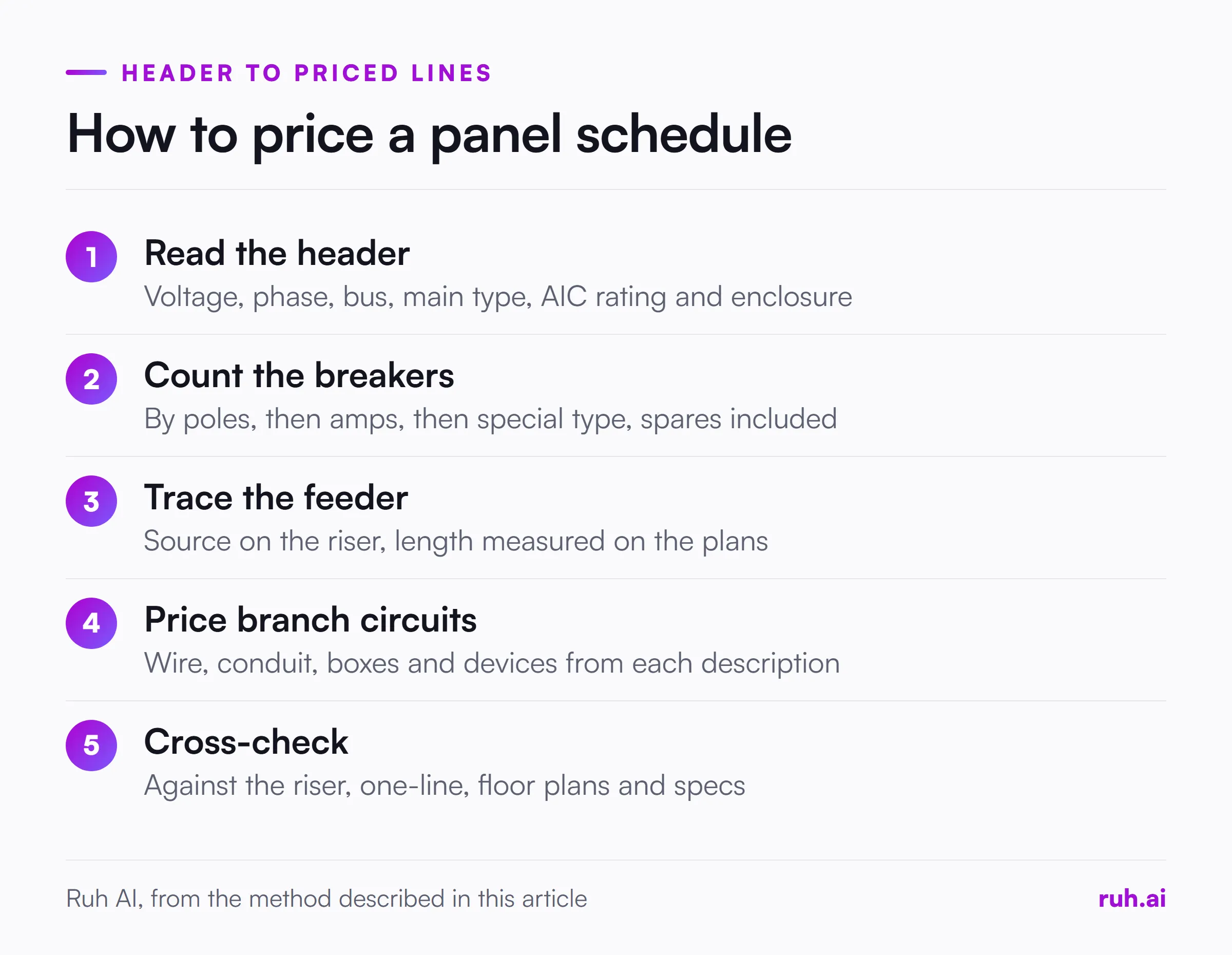
A header that says "MLO" with no main breaker isn't an error. It means protection sits upstream, and the upstream device belongs to whoever prices the source panel.
How Do You Read the Circuit Grid?
Read the circuit grid row by row, recording each circuit's number, description, breaker poles, breaker amps and connected load. The grid is usually laid out with odd circuit numbers on the left and even on the right, matching how breakers sit in the panel.
Three things in the grid catch estimators out:
- Multi-pole breakers take more than one row. A two-pole breaker occupies two circuit numbers, and a three-pole breaker takes three. Count it once, as the multi-pole breaker it is.
- "Spare" and "space" mean different things. A spare is a breaker that is installed but not connected. A space is an empty position with no breaker. Spares get priced, spaces don't.
- Descriptions are scope. "Receptacles, Room 104" or "RTU-2" tells you what each circuit feeds, and the description is what turns a breaker count into branch circuit scope.
How Do You Price the Panelboard Itself?
Price the panelboard from its header: voltage, phase and wire, bus rating, main type, number of spaces, fault rating and enclosure, with mounting as a labor item. Those fields together are what a supplier needs to quote the panel.
Ask for a supplier quote on panels and gear, listing each panel by its header. Panelboard pricing depends on the manufacturer and the configuration, so a dated quote beats a number from memory.
Labor for setting the panel, terminating the feeder and making up the interior comes from your labor units. Our post on NECA labor units covers how to turn those units into hours and dollars with your own job history.
How Do You Count and Price Breakers?
Count circuit breakers by poles and amps, then by special type, and price each group as its own line. A single-pole 20 amp breaker, a two-pole 30 amp breaker and a GFCI breaker are three different items, even if they sit side by side.
Group breakers like this before pricing:
- By poles: single, two and three pole.
- By amps: each rating as its own group.
- By type: standard, GFCI, AFCI, shunt trip and any breaker with a higher fault rating than the panel's standard.
- Spares: counted with the breakers they match.
The AIC rating from the header applies to every breaker in the panel. Unless the engineer has used a series-rated combination, a panel with a high fault rating needs breakers rated to match, so missing that field misprices every line under it.
How Do You Price Feeders From a Panel Schedule?
Price feeders by finding the panel's source on the riser diagram or one-line, reading the feeder size, then measuring the route between the two panels on the floor plans. The panel schedule tells you the panel needs a feeder. It rarely tells you how long it is.
For each feeder, record:
- The source: which panel or switchboard feeds it, from the riser or one-line.
- The size: conductor size and count, and the conduit, from the feeder schedule or riser notes.
- The route: measured on the plans, including vertical rises between floors.
- The terminations: at both ends, with the breaker in the source panel priced with that panel.
The scale on every sheet you measure a feeder on has to be confirmed first. Our guide on how to estimate electrical work covers scale, measuring runs and adjusting labor for job conditions.
How Do Branch Circuits Become Wire, Conduit and Devices?
Branch circuits become priced scope by tracing each circuit's description to the floor plan, then measuring its home run back to the panel and counting the boxes and devices on it. The circuit grid gives you the count of circuits. The plans give you what each one costs.
Group branch circuits by type, such as receptacle circuits, lighting circuits and equipment circuits, because each type uses different wire sizes, devices and labor. Equipment circuits often need a disconnect or a connection detail that sits on another sheet.
What Do Panel Schedules Leave Out?
Panel schedules leave out anything that isn't a breaker or a panel field, so items such as surge protection, directory cards and feed-through lugs have to be found elsewhere in the set. Read the specs and the riser alongside the schedule to catch them.
Eight items panel schedules commonly leave out, and where to find them:
| Item | Why it gets missed | Where to look |
|---|---|---|
| Surge protective device | Often specified, rarely drawn on the schedule | Panelboard spec section, riser notes |
| Feed-through or sub-feed lugs | A panel feeding another panel downstream | Riser diagram |
| Double-section panels | Large panels shown as one schedule | Spaces count and the panel spec |
| Typed directory cards | A closeout item in the spec | Panelboard spec section |
| Breaker locks and handle ties | Required for certain circuits | Specs, equipment schedules |
| Spare conduits from flush panels | Stubbed out for future use | Spec or general notes |
| Equipment disconnects | Fed from the panel but shown on the mechanical sheets | Mechanical equipment schedules |
| Changes since the last issue | Revised loads or added circuits | Revision clouds and the addendum narrative |
Worked Example: Counting and Pricing One Panel
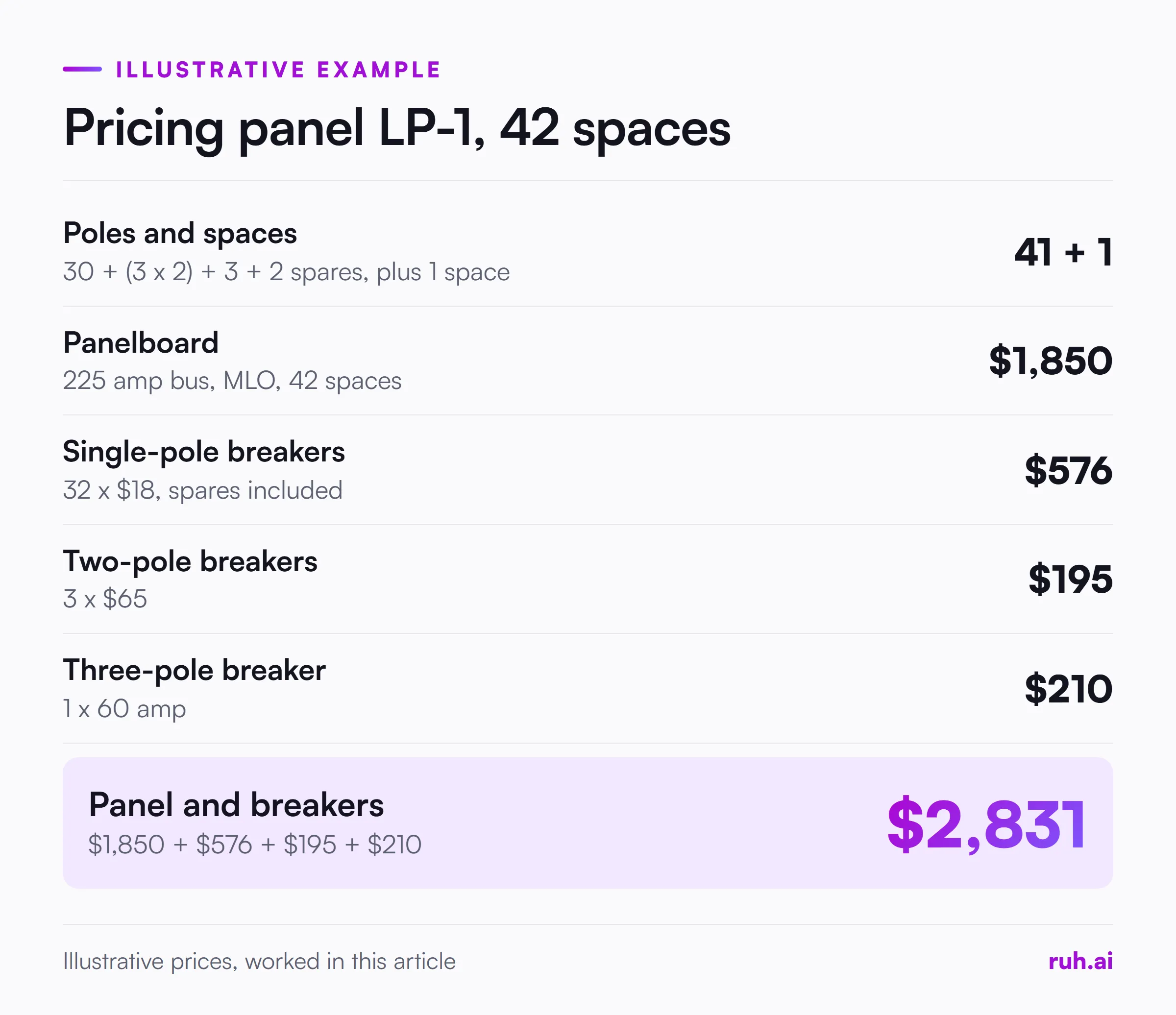
A worked example shows how one panel schedule becomes priced lines, using illustrative numbers only, including every price. Redo it with your own schedule and supplier quotes.
Panel LP-1 is 208Y/120V, three phase, four wire, with a 225 amp bus, main lugs only and 42 spaces. Its circuit grid shows:
- 30 single-pole 20 amp circuits
- 3 two-pole 30 amp circuits
- 1 three-pole 60 amp circuit
- 2 spare single-pole 20 amp breakers
- 1 space
Pole count: 30 + (3 x 2) + 3 + 2 = 41 poles, plus 1 space = 42, which matches the header.
Priced with illustrative numbers:
- Panelboard, 225 amp, MLO, 42 spaces: $1,850
- Single-pole 20 amp breakers, 30 plus 2 spares: 32 x $18 = $576
- Two-pole 30 amp breakers: 3 x $65 = $195
- Three-pole 60 amp breaker: $210
- Panel and breakers: $1,850 + $576 + $195 + $210 = $2,831
Now count the two-pole breakers wrong, as six single-pole breakers, because they take six rows in the grid. The breakers come to (32 + 6) x $18 = $684 instead of $576 + $195 = $771, and the panel prices at $2,744, which is $87 short on one panel. Across a building with a dozen panels, the same habit repeats on every one.
Panel Schedule Cross-Check Checklist
Run this before the number goes out:
- Every panel on the riser has a schedule, and every schedule has a panel on the riser.
- The pole count plus spaces matches the spaces in the header.
- Multi-pole breakers are counted once, as multi-pole breakers.
- Spares are priced, and spaces are not.
- The AIC rating, or the series rating if the engineer used one, is applied to every breaker in the panel.
- Special breakers (GFCI, AFCI, shunt trip) are separate lines.
- Every feeder's source, size and measured length is recorded.
- Equipment circuits are checked against the mechanical schedules for disconnects.
- The panelboard spec has been read for surge protection, lugs and closeout items.
- Revisions and addenda since the last issue have been checked against every schedule.
What Electrical Estimators Get Wrong About Panel Schedules
Four positions on panel schedules, argued as our view, not as data.
The header is not decoration. Estimators who jump to the circuit grid miss the AIC rating, the enclosure and the main type, which change the price of everything below them.
A row is not a breaker. Counting rows instead of breakers is the most common way to misprice multi-pole circuits.
The schedule is not the scope. Feeders, disconnects and surge protection live on other sheets. A panel schedule priced alone is a partial estimate.
Panels deserve a quote, not a guess. A dated supplier quote on the gear protects the bid more than any rule of thumb.
The Honest Assessment: What Still Falls Short
Panel schedules at bid time are rarely final. Loads change, circuits get added and spares are left undefined until coordination, so the schedule you price may not be the one that gets installed.
Gear pricing and lead times move between bid and buyout, and a panel quote holds only as long as the supplier says it does. And no checklist replaces reading the panelboard spec, where many of the items that schedules leave out are hiding.
How Ruh Fits
Ruh AI's Estimating Agent carries counted quantities into a priced estimate, pricing each line from your company's own rate book and history. Your company keeps its own assemblies, and a trade with nothing priced gets a labelled allowance line, never a silent zero.
Your team can edit every quantity and price, and an approver on your team signs off each stage before the next one opens. Ruh AI's Takeoff Agent reads the drawing PDFs and won't give a length or area for a sheet with no scale. Ruh works with your stack, built per customer.
Frequently Asked Questions
Q: What is a panel schedule in electrical drawings? A: A panel schedule is a table describing one panelboard and every circuit it feeds. The header gives the panel's voltage, phase, bus rating, main type, fault rating and enclosure, and the grid lists each circuit with its breaker poles, amps and load.
Q: How do you read an electrical panel schedule? A: Start with the header to define the panel, then read the circuit grid row by row, recording each circuit's number, description, breaker poles and amps. Count multi-pole breakers once, and check the riser to see where the panel is fed from.
Q: What does MLO mean on a panel schedule? A: MLO means main lugs only. The panel has no main breaker, so its protection sits upstream in the source panel or switchboard. The feeder lands directly on the lugs.
Q: What is the difference between a spare and a space on a panel schedule? A: A spare is a breaker that is installed but not connected to a circuit. A space is an empty breaker position with no breaker. Spares are priced as breakers, and spaces are not priced.
Q: How do you price breakers from a panel schedule? A: Group breakers by poles, then by amps, then by special type such as GFCI, AFCI or shunt trip, and price each group as its own line. Apply the panel's AIC rating to every breaker unless a series rating is specified, and include spares.
Q: Does a panel schedule show the feeder length? A: No. The schedule shows the panel needs a feeder, but the source is on the riser or one-line and the length has to be measured on the floor plans, including any vertical rise between floors.
See how Ruh prices your takeoff from your own rate book on the construction estimating software page.