


Quick Answer
To estimate electrical work, turn a drawing set into a priced bid by counting devices and fixtures, measuring conduit and wire, applying labor units adjusted for job conditions, pricing materials from current supplier quotes, and adding overhead and margin, so every line traces to a source. Below are the six cost buckets every electrical estimate covers, the ten steps from drawings to bid, a table for adjusting labor units to real job conditions, a worked estimate with labor, materials, overhead and margin in the open, a final review checklist and our view on what electrical estimators get wrong.
What you'll find below:
- The six cost buckets an electrical estimate has to cover
- Ten steps from the first sheet to a priced bid
- Eight job conditions that change labor units, and how to adjust for each
- A worked tenant fit-out estimate, from 142 labor hours to a $40,872.50 bid
- Why a 12% margin and a 12% markup give different prices
- A final review checklist for electrical estimates
What Does an Electrical Estimate Have to Cover?
An electrical estimate has to cover six cost buckets: materials, labor, equipment, job costs such as permits and temporary power, overhead, and profit. Missing a whole bucket loses more money than any counting error, so name all six before you count anything.
The six cost buckets in an electrical estimate:
| Bucket | What goes in it | Where the number comes from |
|---|---|---|
| Materials | Devices, fixtures, conduit, wire, boxes, fittings, gear | Your takeoff quantities times current supplier pricing |
| Labor | Installation hours for every item | Labor units times quantities, adjusted for job conditions |
| Equipment | Lifts, benders, pullers, trenching | Your rental rates or owned-equipment rates for the duration |
| Job costs | Permits, temporary power, testing, supervision | The job's schedule and the authority having jurisdiction |
| Overhead | Office, insurance, vehicles, admin | Your company's overhead rate |
| Profit | The margin you need to keep | Your target margin, applied correctly |
Each bucket gets its own section below. Electrical estimating gets easier to check when the buckets stay separate until the end.
Steps 1 to 5: From Drawings to Organized Quantities
The first five steps turn the drawing set into a clean list of quantities: review the set, confirm the scale, count devices, measure runs and organize the results. Our guide on how to bid electrical as a subcontractor covers reading the drawings and getting quantities right in detail, so here is the short version.
- Review the drawing set and specs first. Read the electrical sheets, panel schedules, fixture schedules, riser diagrams and the electrical spec sections before you count anything. Note what's yours and what belongs to another trade.
- Confirm the scale on every sheet. A reduced print or an enlarged plan with no scale bar turns every length into a guess. Count on those sheets, and wait on lengths until the scale is confirmed.
- Count devices and fixtures. Receptacles, switches, lighting fixtures by type, panels, disconnects and low-voltage devices, checked against the schedules.
- Measure conduit and wire. Branch circuits, feeders, vertical drops and a waste allowance you can explain.
- Organize quantities by system, floor or area. An estimate grouped this way can be checked by someone else and reused on the next bid.
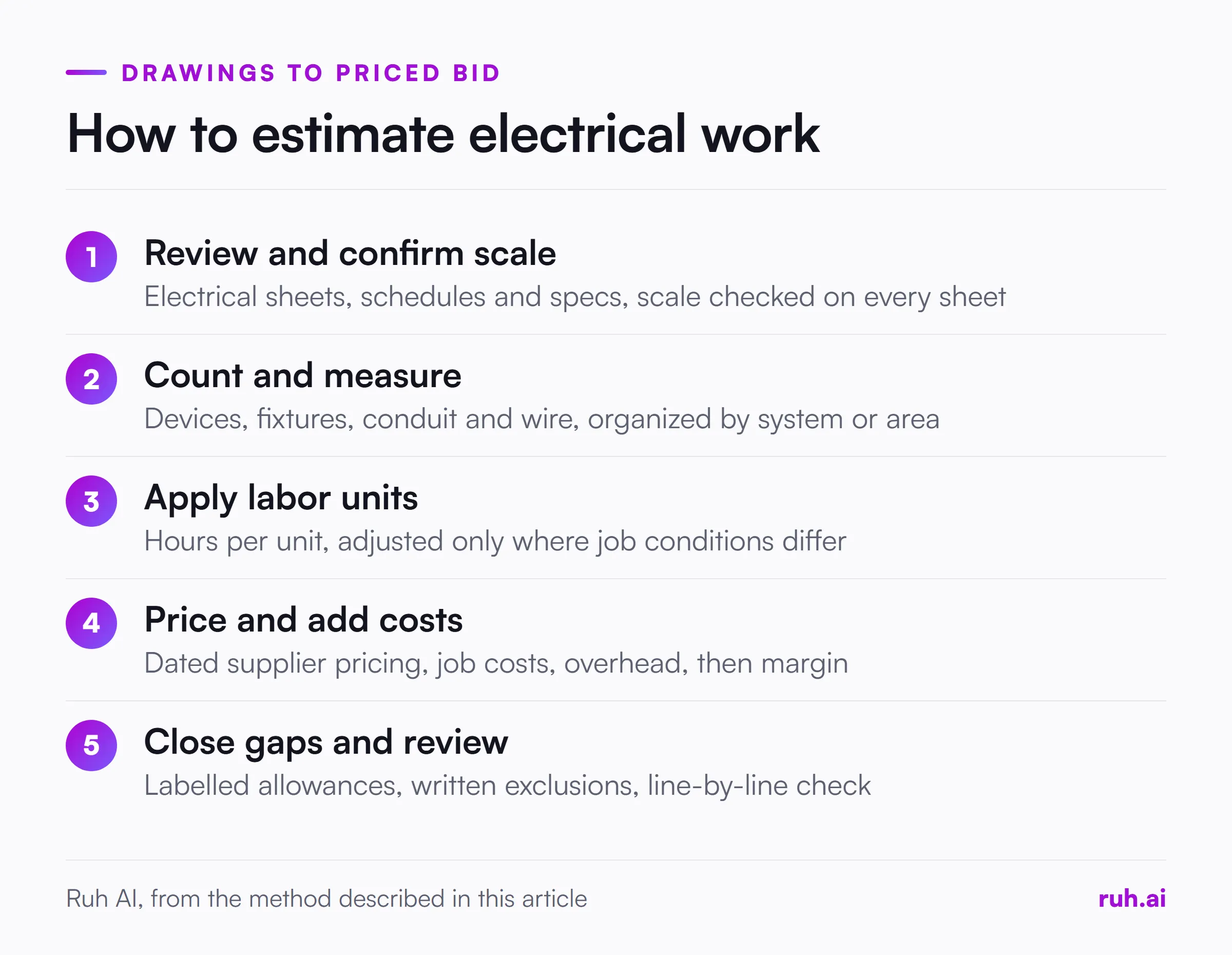
Everything after step 5 is where an electrical estimate is won or lost: labor, pricing, overhead and the final review.
Step 6: How Do You Apply Labor Units to Electrical Work?
Apply labor units by multiplying each quantity by the hours it takes to install one unit, then adjusting those hours for the real conditions of the job. A labor unit is a standard installation time, such as hours per device or hours per 100 feet of conduit, under normal conditions.
Labor units come from two places. Published manuals, such as NECA's Manual of Labor Units, give a starting point built across many jobs. Your own job history tells you how your crews actually perform. The strongest estimates start from one and correct it with the other.
The adjustment is where most electrical labor goes wrong. A labor unit assumes standard conditions, and almost no job has them all. These eight conditions change labor most often:
| Condition | Why it changes labor | How to adjust |
|---|---|---|
| Working height | Lifts and ladders slow every task overhead | Apply a factor to the overhead items only, not the whole estimate |
| Access | Tight ceilings, finished spaces and long carries add time | Adjust by area, where access is actually poor |
| Existing construction | Renovation means fishing walls, demo and surprises | Price existing-building work separately from new work |
| Occupied building | Work around tenants, noise limits and protection | Add for the occupied areas and the hours you can work |
| Phasing | Several mobilizations instead of one | Add setup time per phase |
| Outdoor or weather exposure | Site work slows in cold, heat and rain | Adjust the exterior items by season |
| Congestion | Crowded ceilings with other trades | Adjust the areas the coordination drawings show as tight |
| Repetition | Identical floors or units get faster | Reduce units on repeated work, once you've seen it pay off |
Write the reason next to every adjustment. A factor with no note is a number nobody can defend in a bid review.
Step 7: How Do You Price Electrical Materials?
Price electrical materials from your own current supplier quotes and recent purchase history, dated, rather than from memory or an old price sheet. Copper wire, gear and lighting packages move often enough that a price without a date is a risk.
Four habits keep material pricing honest:
- Get quotes for the big packages. Lighting fixture packages, switchgear and panels are usually quoted by a supplier for the job. Note the quote date and how long it holds.
- Price commodity items from a dated rate book. Devices, boxes, fittings and conduit come from your company's current pricing, with the date and source on each rate.
- Watch lead times on gear. A price is only useful if the gear arrives in time. Note long lead items on the estimate.
- Carry the quote's exclusions. If a fixture quote excludes lamps or controls, that gap belongs on your estimate, not in the supplier's fine print.
Step 8: How Do You Add Job Costs, Overhead and Margin?
Add job costs as their own lines, then overhead as a percentage of cost, then profit as a margin on the selling price, in that order. Mixing them hides where the money is.
Job costs are specific to the job: permits, temporary power, testing, supervision, equipment rental and cleanup. Price each one from the schedule. A job with a long duration carries more supervision and more temporary power than its quantities suggest.
Overhead covers what the company spends to exist: office, insurance, vehicles and admin. Use your own overhead rate, worked out from your books.
Profit is where a common mistake lives. A margin is a share of the selling price. A markup is a share of cost. The same percentage gives two different prices, as the worked example below shows.
Step 9: How Do You Handle Gaps in an Electrical Estimate?
Handle gaps by carrying every unpriced item as a labelled allowance and listing every exclusion, so nothing hides as a zero. A blank line goes out in the number as no cost.
Common gaps in electrical work include a fixture type with no quote yet, utility work the owner hasn't defined, fire alarm or low-voltage scope that may belong to another contractor, and specialty systems shown on another trade's sheets. Write each one as either an allowance with a note on who is chasing it, or an exclusion stated plainly in the proposal.
Step 10: How Do You Review an Electrical Estimate Before It Goes Out?
Review an electrical estimate line by line against the drawings, the quotes and the conditions you adjusted for, with a second person where you can. The review is what makes the number defensible. Use the checklist below every time.
Worked Example: A Tenant Fit-Out From Labor Hours to Bid
A worked estimate shows how labor, materials, overhead and margin stack up, using illustrative numbers only, including labor units invented for the arithmetic and not taken from any published manual. Redo it with your own quantities, units and rates.
A small tenant fit-out has 60 receptacles, 40 light fixtures and 1,200 feet of branch conduit. Using illustrative labor units:
- Receptacles: 60 x 0.5 hours = 30 hours
- Fixtures: 40 x 1.0 hours = 40 hours
- Conduit: 1,200 feet at 6 hours per 100 feet = 12 x 6 = 72 hours
- Base labor: 30 + 40 + 72 = 142 hours
The ceiling is 14 feet, so fixtures and conduit are overhead work. An illustrative 15% height factor applies to those two items only: (40 + 72) x 0.15 = 16.8 hours. Adjusted labor is 142 + 16.8 = 158.8 hours.
At an illustrative loaded labor rate of $85 per hour, labor costs 158.8 x $85 = $13,498. Add illustrative materials of $18,000 from supplier quotes and $1,200 of equipment and temporary power. Job cost is $13,498 + $18,000 + $1,200 = $32,698.
Overhead at an illustrative 10% adds $3,269.80, for a cost of $35,967.80.
For a 12% margin, divide by 0.88: $35,967.80 / 0.88 = $40,872.50. A 12% markup instead gives $35,967.80 x 1.12 = $40,283.94, which is $588.56 less and only a 10.7% margin.
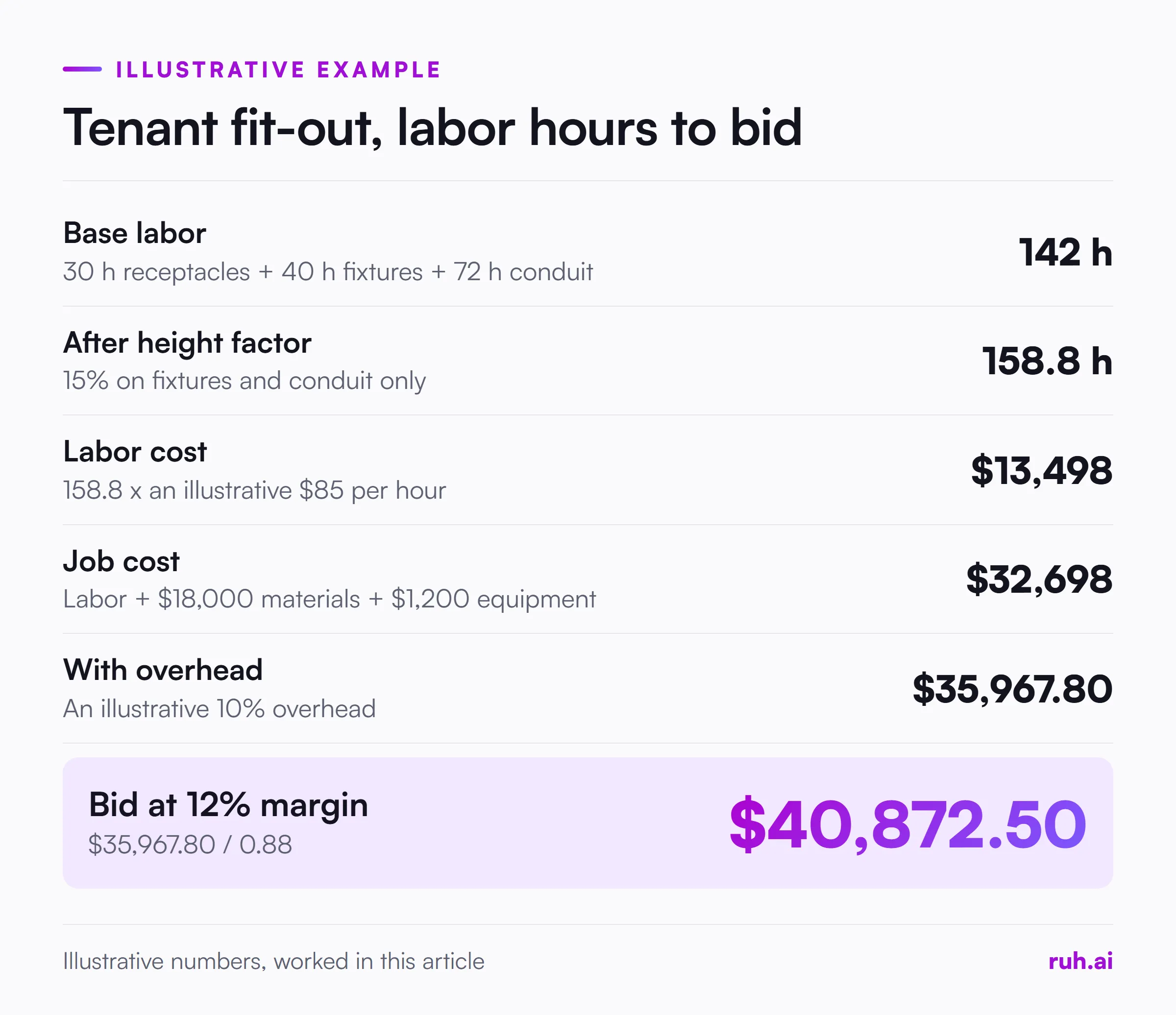
The height factor added 16.8 hours, about $1,428 of labor at the illustrative rate (16.8 x $85). Applied to all 142 hours instead, it would have added 21.3 hours (142 x 0.15) and charged height time to 30 hours of receptacle work done at hand height.
Final Review Checklist for Electrical Estimates
Run this before the number goes out:
- Every sheet's scale was confirmed before any length was taken.
- Device and fixture counts match the panel and fixture schedules.
- Every conduit and wire run has a waste allowance you can explain.
- Labor units start from a known source, and every adjustment has a written reason.
- Height and access factors apply only to the items they affect.
- Every material price has a date and a source, and supplier quotes are still valid.
- Quote exclusions are carried on the estimate.
- Job costs, overhead and margin are separate lines, and margin is applied to the selling price.
- Every unpriced item is a labelled allowance, and every exclusion is written down.
- A second person has reviewed the estimate, or at least the largest twenty lines.
Common Electrical Estimating Mistakes
The mistakes that cost electrical contractors most, and how to catch them:
| Mistake | What it does to the bid | How to catch it |
|---|---|---|
| Measuring on an unscaled sheet | Wrong lengths on every run from that sheet | Confirm scale before measuring, every sheet |
| Counting from the plan only | Devices shown only on schedules or details get missed | Reconcile counts against every schedule |
| Unadjusted labor units | Labor priced for conditions the job doesn't have | Adjust per condition, with a reason |
| Factor on the whole estimate | Overhead factor inflates items installed at floor level | Apply factors only to the items they affect |
| Old material prices | Copper and gear priced at last quarter's rates | Date every rate and check it before use |
| Markup used as margin | The bid keeps less profit than intended | Divide cost by one minus the margin |
What Electrical Estimators Get Wrong
Four positions on electrical estimating, argued as our view, not as data.
Speed is not the skill. The estimators who win consistently aren't faster at arithmetic. They can show where every number came from when the GC or owner asks.
A labor manual is a starting point, not an answer. Published units are built across many jobs. Your crews, your market and this job's conditions decide what the hours really are.
Small items lose more bids than big ones. A missed receptacle on a reflected ceiling plan or a fixture type that quietly priced at zero does more damage than a slightly high price on gear.
An allowance is not a weakness. Writing "allowance, fixture type F7, quote pending" looks less polished than a clean number. It is far more honest, and it protects the bid.
The Honest Assessment: What Still Falls Short
No estimating method removes judgment from labor. Adjustment factors are informed guesses until your own job history backs them up, and many contractors don't track installed hours closely enough to correct their units.
Drawings are often incomplete at bid time. Low-voltage, fire alarm and utility scope can be unclear until late, and the best answer is a clear allowance or exclusion, not a confident number.
Material prices can also move between bid and buyout. A dated quote protects you only for as long as it holds.
Where AI Fits in Electrical Estimating
AI fits in electrical estimating as the tool that counts, measures and prices the first pass, while the estimator decides and approves. Our posts on AI agents in electrical estimating and on how AI reads electrical plans explain the details, so this section stays short.
How Ruh Fits
Ruh AI's Estimating Agent carries takeoff quantities into a priced estimate built on your company's own rate book and history. Your company keeps its own assemblies, and edits create a new version while a budget line keeps the version it was built from.
Any trade with nothing priced gets a labelled allowance line, never a silent zero, and a missing price blocks approval. Ruh AI's Takeoff Agent reads the drawing PDFs and won't give a length or area for a sheet with no scale.
Your estimator approves every scope line before Ruh measures it, can edit every quantity and price, and each stage is approved before the next one opens. Ruh works with your stack, built per customer.
Frequently Asked Questions
Q: How do you estimate electrical work? A: Review the drawings and specs, confirm the scale, count devices and fixtures, measure conduit and wire, apply labor units adjusted for job conditions, price materials from current quotes, then add job costs, overhead and margin. Finish with a line-by-line review.
Q: What are labor units in electrical estimating? A: A labor unit is the standard time to install one unit of work, such as one device or 100 feet of conduit, under normal conditions. Estimators multiply quantities by labor units, then adjust for height, access, existing construction and other job conditions.
Q: How do you price electrical materials for a bid? A: Get supplier quotes for big packages such as fixtures and gear, and price commodity items from a dated company rate book. Note each quote's date, how long it holds and what it excludes, and watch lead times on gear.
Q: What is the difference between markup and margin in electrical estimating? A: Markup is a percentage of cost, and margin is a percentage of the selling price. A 12% markup on $35,967.80 of cost gives $40,283.94, a 10.7% margin. For a true 12% margin, divide cost by 0.88 to get $40,872.50.
Q: How do you handle unknown scope in an electrical estimate? A: Carry it as a labelled allowance with a note on who is chasing the answer, or list it as an exclusion in the proposal. Never leave an unpriced item blank, because a blank line goes out in the number as zero.
Q: Should labor factors apply to the whole electrical estimate? A: No. Apply each factor only to the items it affects. A height factor belongs on fixtures and overhead conduit, not on floor boxes or panel work at floor level. Applying it everywhere inflates the bid.
See how Ruh prices your takeoff from your own rate book on the construction estimating software page.