
100% money-backBook a walkthrough

Construction glossary · Process and contract terms

What is change order in construction?

A change order is a written amendment to a construction contract that changes the scope of work, the contract price, the schedule, or all three after the contract is signed. Once executed by both parties it becomes part of the contract, and its value is carried on the pay application as an approved change. On commercial projects it is the formal mechanism for pricing and getting paid for work that was not in the original bid.

Updated June 2026 · Reviewed by the Ruh construction team

CO = change orderAdjusts price &/or scheduleNeeds signatures before work

How a change order is approved

Change identifiedContractor prices itOwner/architect reviewCO signedContract value adjustedFormal modification to scope, price, or time

Estimating process and contract terms scope this week? Watch Ruh take off a real plan in 30 minutes.

Book a walkthrough
Definition

A change order (CO) is the contract document that adjusts scope, price, or time after award. It typically starts with a revised drawing issue, an RFI answer that adds work, an owner request, or a differing site condition. The paper trail usually runs: change order request (COR) with quantity and cost backup, architect and owner review, negotiation, then an executed CO that amends the contract sum and contract time. Once signed, the CO value flows into the schedule of values and appears on pay applications as an approved change. Estimators price the COR by taking off the delta between the current drawings and the revision, applying unit costs, and applying markup per the contract's changes clause. Common rookie mistakes: pricing only the added material and forgetting demolition or rework of in-place work, missing the schedule impact, applying standard bid markups when the contract caps CO markup at a lower percentage, and letting crews start on a verbal approval with no signed paper. A CO is not a construction change directive, which orders work to proceed before price is agreed.

How it is measured

A change order is priced in dollars ($) and time (calendar days added to the contract). The backup quantifies the delta in the same units as the base estimate: SF of drywall, LF of pipe, CY of concrete, labor hours. Those quantities get unit costs, then markup per the contract's changes clause, commonly a stated percentage for overhead and profit on self-performed work and a smaller percentage on subcontracted work. On the documents side, COs are numbered sequentially (CO #001, CO #002), tied to revision clouds and delta tags on the drawings, and carried on the pay application (AIA G702 shows net change by change orders against the original contract sum). Estimators keep a running CO log so the current contract value is always the original sum plus approved changes.

Worked example

Worked example

Revised drawings add a 60 LF interior partition, 10 ft tall, so 600 SF of metal stud and drywall finished both sides. Pricing the COR with illustrative US numbers: material at $3.20 per SF gives 600 SF x $3.20 = $1,920. Labor at 0.06 hours per SF gives 600 SF x 0.06 = 36 hours, and 36 hours x $62 per hour fully burdened = $2,232. Direct cost is $1,920 + $2,232 = $4,152. The contract's changes clause allows 15% overhead and profit on self-performed work: $4,152 x 0.15 = $622.80, bringing the subtotal to $4,774.80. Bond and insurance at 1.5% adds $4,774.80 x 0.015 = $71.62. Total change order request: $4,846.42, submitted as $4,846 with 2 calendar days added. One check before it goes out: if the revision also deletes 20 LF of wall already framed, add the demo labor, net the credit for unbuilt work, and apply the same markup terms to both sides.

100%

Try Ruh on a real bid. 100% money-back guarantee if you are not satisfied.*

*Scoped delivery, terms apply. Read the guarantee terms

Start with a walkthrough
How Ruh handles it

How Ruh handles change order

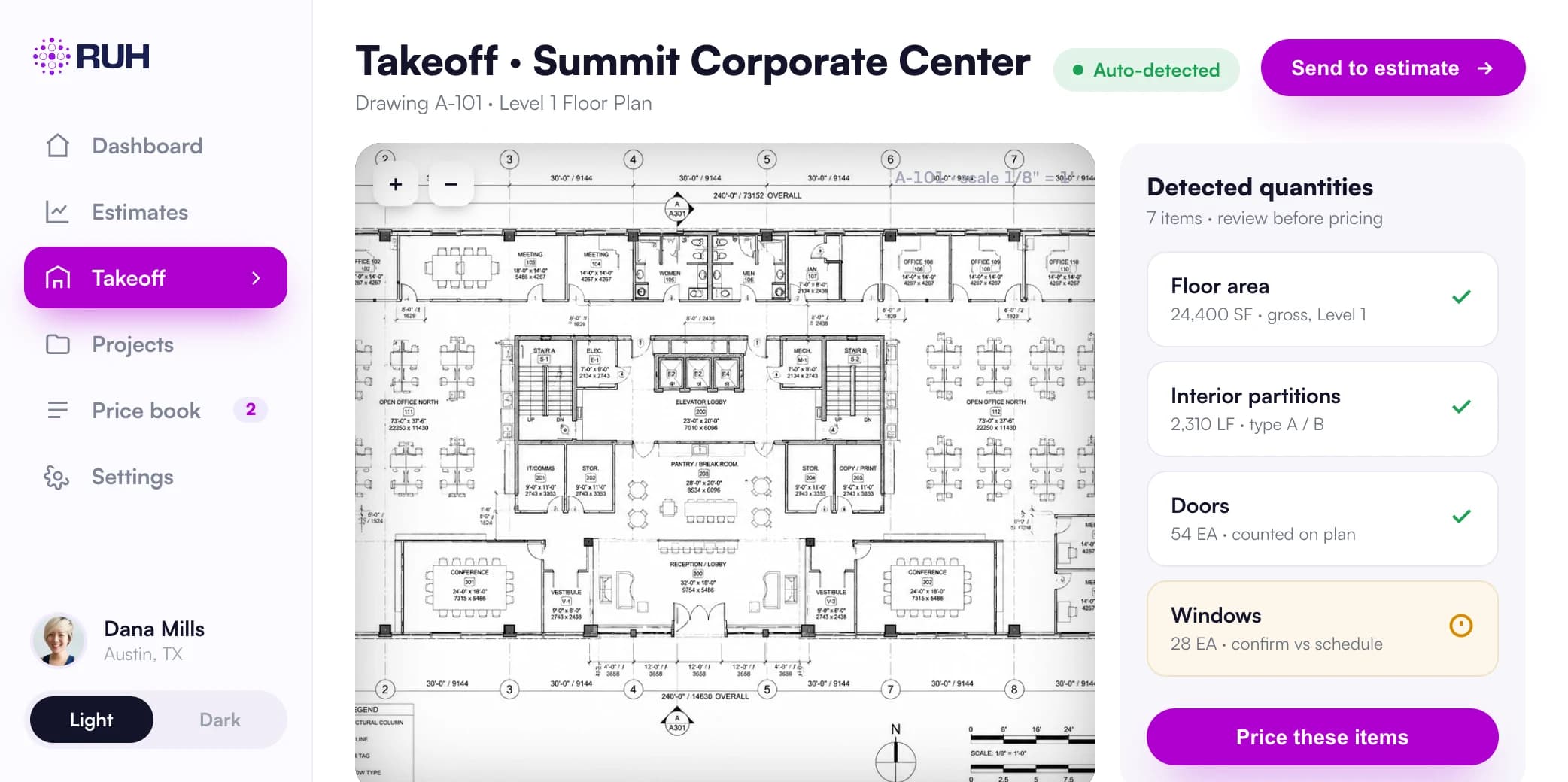
When a revision hits, Ruh reads the new drawings, runs the takeoff on the changed scope, and prices the delta quantities against the contractor's own price book, so the change order request starts as a line-item draft instead of a blank sheet. The estimator reviews the quantities, applies the contract's markup and credit terms, and signs off, because contract interpretation and negotiation stay with the human.

See construction invoice and pay app software

Change order: frequently asked questions

What is the difference between a change order and a construction change directive?+

A change order is a signed agreement on scope, price, and time before the changed work is billed. A construction change directive (CCD) orders the contractor to proceed even though price or time is not yet agreed, with cost resolved later, often through tracked time and material. CCDs keep the job moving during a pricing dispute, but they shift more documentation burden onto the contractor.

What is a typical markup on a change order?+

The contract's changes clause controls it, so read that clause before pricing anything. On US commercial work it is typical to see allowed overhead and profit in the range of 5% to 15% on self-performed work, with a lower allowed percentage on subcontracted work, but these are negotiated contract terms, not market rules. Some contracts also cap the total combined markup when multiple tiers each add a percentage.

What happens if a contractor does the work without a signed change order?+

The contractor takes on real payment risk, because most contracts require written authorization before changed work is compensable. Recovery through the claims or disputes process is sometimes possible, but it is slow, uncertain, and expensive. Standard practice is to submit the change order request with backup, get a signature or at least a written directive, and document everything (daily reports, photos, time and material tickets) if work must proceed before execution.

Still measuring by hand? Your next takeoff can run while you review this one.

See it on your plans

Related terms

Keep going: read the full guide or explore construction invoice and pay app software.

The Process and contract terms estimating cheat sheet
Every unit, waste factor, and conversion on one page. Free PDF.

See Ruh price a bid from your own drawings.

AI takeoff and estimating on your price book, your estimator signs off.

Figures on this page are illustrative. Construction estimates depend on project-specific conditions, source documents, market pricing, and professional judgment. Ruh's AI assists the estimator and does not replace professional review: your team reviews, validates, and approves every estimate, bid, and pricing decision.
Change order in construction: process and pricing | Ruh AI