100% money-backBook a walkthrough

Construction glossary · Envelope and finishes

What is door hardware sets in construction?

A door hardware set, or hardware group, is the complete bundle of finish hardware for a single door opening: hinges, lockset or latchset, closer, exit device, stops, seals, and any specialty items, listed together under a set number in the hardware schedule. Each door in the door schedule is assigned a hardware set number, so the estimator prices hardware by counting how many openings carry each set. The takeoff is a count of openings grouped by hardware set, read straight off the door schedule.

Updated June 2026 · Reviewed by the Ruh construction team

Spec ref Div 08 71 00Set covers 1 openingTypical items hinges, lock, closerCount by HW set number

Hardware set selection from door schedule

Read door scheduleAssign HW set per functionList hinges/lock/closerAdd stops/seals/protectionTotal by set countEach set = full per-opening package

Estimating envelope and finishes scope this week? Watch Ruh take off a real plan in 30 minutes.

Book a walkthrough
Definition

Door hardware sets, also called hardware groups or heading sets, organize finish hardware by the opening it serves. Rather than pricing every hinge and lock loose, the hardware schedule (prepared by the hardware consultant or supplier) defines numbered sets, each listing the full bundle for one door type: butt hinges, the lockset or latchset or exit device, closer, kick plate, wall or floor stop, gasketing and bottom seal, threshold, and any electrified or specialty components. The door schedule then assigns a set number to every opening. The estimator's job is to count openings by set number and price each set, so the scope is a count problem driven by the schedules, not a measurement problem. Function matters: a classroom lock, a storeroom lock, and a panic exit device are different price points, and electrified hardware (electric strikes, access control prep) carries both hardware and a coordination cost with the electrical and security trades. Common misses: pricing a single average set across all doors, missing fire-rated openings that force specific listed hardware, and overlooking specialty sets that appear on only one or two openings.

How it is measured

Door hardware is measured as a count (each, ea) of openings grouped by hardware set number. The estimator reads the door schedule, which lists every opening with its door number, type, rating, and assigned hardware set, and tallies how many openings carry each set. The hardware schedule (or hardware groups list) defines what each set contains, which sets the unit price per set. Fire rating and door function (classroom, storeroom, privacy, exit) are confirmed on the door schedule because they change the set and its cost. Electrified sets are flagged for coordination with electrical and security. The result is a line per set: quantity of openings times the price of that set, summed across all sets, plus any keying and installation labor priced separately.

Worked example

Worked example

Take a door schedule with 30 openings assigned across four hardware sets. Counting by set: Set 1 (passage, single office doors) appears on 14 openings; Set 2 (classroom lock) on 8 openings; Set 3 (storeroom lock, back-of-house) on 5 openings; Set 4 (panic exit device, rated egress doors) on 3 openings. Check the total: 14 + 8 + 5 + 3 = 30, matching the schedule, so no opening is unaccounted for. Price each set illustratively, hardware only: Set 1 at $280/set x 14 = $3,920; Set 2 at $520/set x 8 = $4,160; Set 3 at $610/set x 5 = $3,050; Set 4 at $1,250/set x 3 = $3,750. Hardware subtotal $3,920 + $4,160 + $3,050 + $3,750 = $14,880, before keying and installation labor. Every count traces to a set number on the door schedule.

100%

Try Ruh on a real bid. 100% money-back guarantee if you are not satisfied.*

*Scoped delivery, terms apply. Read the guarantee terms

Start with a walkthrough
How Ruh handles it

How Ruh handles door hardware sets

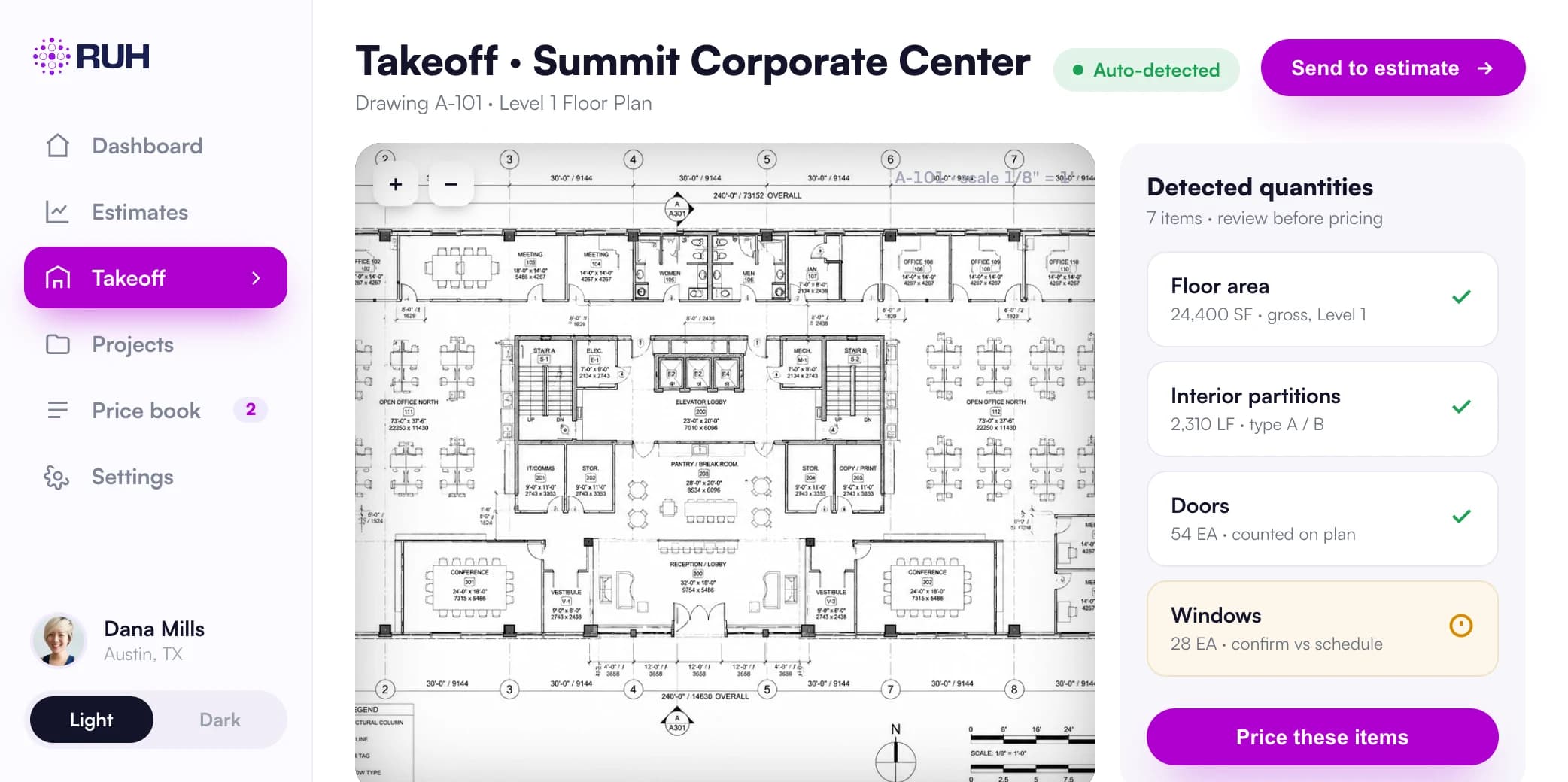
Ruh reads the door schedule and the hardware schedule, counts the openings by hardware set number, and matches each set to its contents and rating. It prices each set against the contractor's own price book, extends quantity of openings times set price, and returns a line-item draft with keying and install labor broken out. The estimator reviews the set counts, confirms fire-rated and electrified openings, and signs off.

See construction estimating software

Door hardware sets: frequently asked questions

What is in a door hardware set?+

A set is the full finish hardware bundle for one opening: hinges, the lockset or latchset or exit device, a closer where required, kick or armor plate, wall or floor stop, gasketing and bottom seal, threshold, and any electrified or specialty items. The hardware schedule lists the exact contents per set number, and the door schedule assigns a set to each opening, so the bundle, not the loose piece, is the unit you price.

How do I count hardware sets from the door schedule?+

Read the hardware set number assigned to each opening on the door schedule and tally how many openings carry each set. The result is a count of openings per set. Always reconcile the per-set counts back to the total number of doors on the schedule, so a 30 door schedule that sums to 30 across all sets confirms nothing was missed.

Why do hardware sets cost different amounts?+

Function and rating drive the price. A passage set with no lock is far cheaper than a classroom or storeroom lock, and both are well under a panic exit device on a rated egress door. Electrified hardware adds electric strikes or access control prep plus coordination with the electrical and security trades. Fire-rated openings also require specific listed hardware, which is why each set is priced on its own.

Still measuring by hand? Your next takeoff can run while you review this one.

See it on your plans

Related terms

Keep going: read the full guide or explore construction estimating software.

The Envelope and finishes estimating cheat sheet
Every unit, waste factor, and conversion on one page. Free PDF.

See Ruh price a bid from your own drawings.

AI takeoff and estimating on your price book, your estimator signs off.

Figures on this page are illustrative. Construction estimates depend on project-specific conditions, source documents, market pricing, and professional judgment. Ruh's AI assists the estimator and does not replace professional review: your team reviews, validates, and approves every estimate, bid, and pricing decision.