Construction glossary · Units of measure
What is LS (lump sum) in construction?
LS (lump sum) is a unit of measure on construction bid forms and estimates that prices an entire scope of work as one fixed amount with a quantity of 1, rather than a rate multiplied by a measured quantity. The single price covers everything needed to complete that scope and does not change if the work consumes more labor or material than planned. It is the opposite of a unit price item, where payment equals the bid rate times the quantity actually installed and measured.
Updated June 2026 · Reviewed by the Ruh construction team
A lump sum rolls many costs into one price
Estimating units of measure scope this week? Watch Ruh take off a real plan in 30 minutes.
Book a walkthroughLump sum, abbreviated LS, shows up in the unit column of owner bid schedules, schedules of values, and subcontractor quotes that read "furnish and install complete, 1 LS." Classic LS items are mobilization, traffic control, demolition, and most of Division 01 general requirements. Public heavy civil bid forms routinely mix LS lines with unit price lines on the same schedule, so an estimator has to know which payment rules govern each line. The defining feature is risk allocation: on an LS item the bidder owns quantity risk, because payment stays flat no matter what the work actually takes. New estimators make the same mistakes with it. They carry an LS figure with no quantity buildup behind it, so nobody can check the number or update it when an addendum changes the design. They double-count scope that appears in both an LS line and a unit-priced line. And they plug a sub's LS quote without reading the scope letter, then find the exclusions at buyout.
The unit is LS (some forms use JOB or 1 EA) and the quantity column always reads 1. There is no field measurement for payment; LS items are billed by percent complete or by the milestones spelled out in the measurement and payment section of the specs. Pricing one still requires a real takeoff underneath: counts, areas, crew hours, equipment days, and quotes rolled up into a single figure. Keep that buildup attached to the LS line in the estimate file so the number can be checked, escalated, or revised when the scope changes. Treat LS as a presentation format on the bid form, not a license to skip the quantities.
Worked example
A bid schedule lists mobilization as 1 LS. Build it from the parts, using illustrative pricing: 4 lowboy moves × $1,200 per move = $4,800, temporary office and utility hookups = $7,500, and 80 labor hours × $70 per hour = $5,600. The buildup totals $4,800 + $7,500 + $5,600 = $17,900, carried on the form as 1 LS at $17,900. Now compare a unit price line on the same schedule: structural excavation, 2,000 CY × $18 per CY = $36,000. If the measured quantity grows to 2,300 CY, payment is remeasured to 2,300 CY × $18 per CY = $41,400, and the owner pays the $5,400 increase. If mobilization needs a fifth lowboy move, the LS price stays $17,900 and the extra $1,200 comes out of your fee. Same bid form, two different risk rules.
Try Ruh on a real bid. 100% money-back guarantee if you are not satisfied.*
*Scoped delivery, terms apply. Read the guarantee terms
How Ruh handles LS (lump sum)
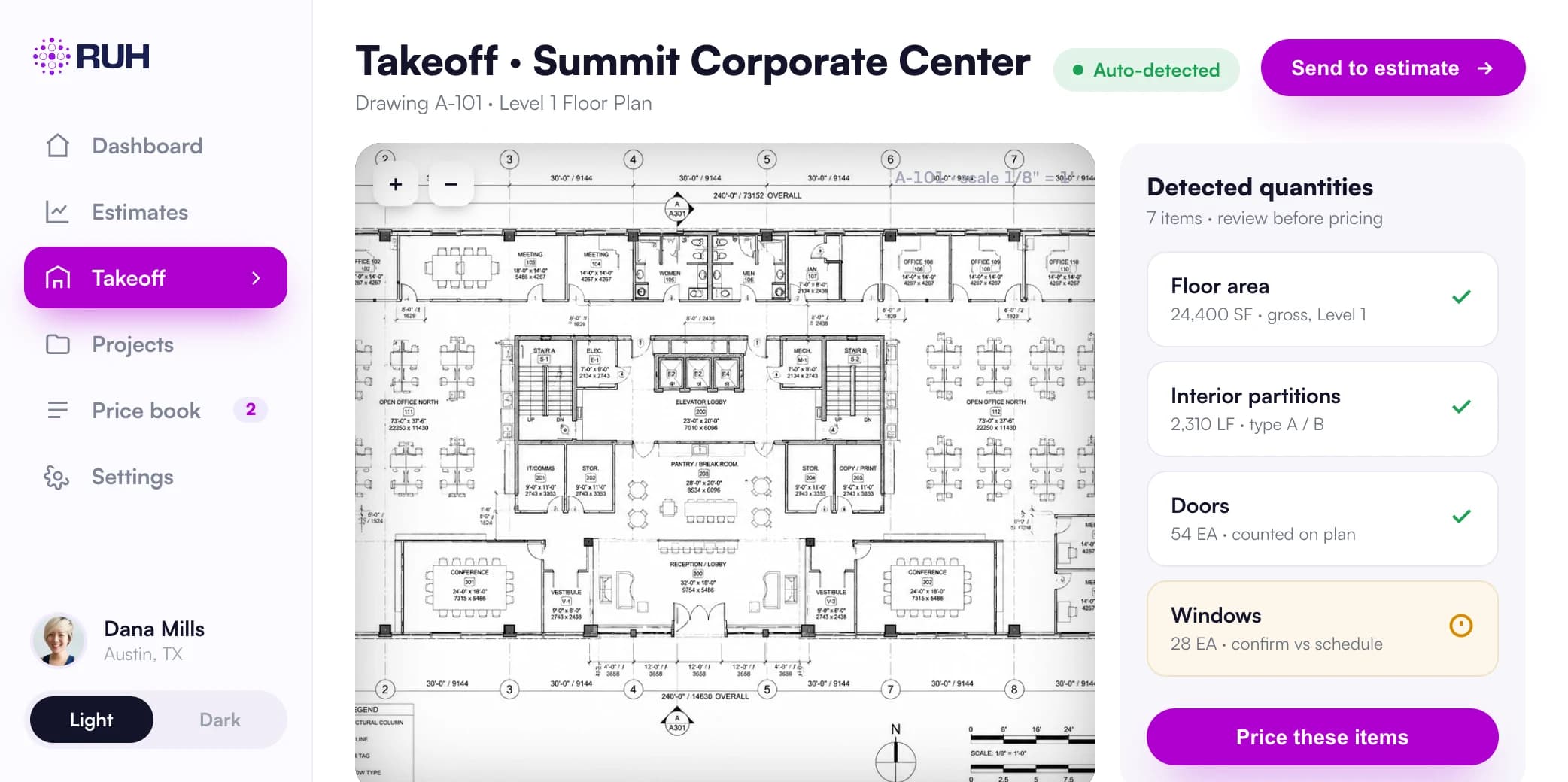
Ruh reads the drawings, performs the takeoff, and prices quantities against the contractor's own price book, so an LS line in the draft estimate arrives with its quantity buildup attached instead of as a bare plug number. When the bid form calls for 1 LS mobilization, the estimator sees the components behind the figure, adjusts them, and signs off knowing exactly what the lump sum covers. The judgment call on how much quantity risk to carry in an LS price stays with the estimator.
See AI construction takeoff and estimating softwareLS (lump sum): frequently asked questions
What is the difference between lump sum and unit price in construction?+
The difference is who carries quantity risk. On a unit price item the owner remeasures actual installed quantities and pays the bid rate against them, so overruns raise the contract value and underruns lower it. On a lump sum item the contractor holds the price regardless of the quantities consumed, and only a change in scope, by change order, moves the number. Owners lean on unit pricing where quantities are uncertain, like earthwork and utilities, and on lump sum where the scope is well defined.
Is an LS line item the same as a lump sum contract?+
No. A lump sum contract fixes the price for an entire project, while an LS line item is one line on a bid schedule priced as a single figure. The two mix freely: a unit price heavy civil contract almost always carries mobilization as an LS item, and a lump sum building contract still gets broken into a schedule of values for billing. Check the measurement and payment specs to see which rules govern each line.
How do you bill a lump sum item on a pay application?+
By percent complete against a schedule of values, not by field measurement. The contractor breaks the LS amount into components on the SOV, claims a percentage each month, and the architect or owner reviews it. Many public specs also cap early mobilization payments at set milestones to limit front-loading, so read the payment clause before you build the billing breakdown.
Still measuring by hand? Your next takeoff can run while you review this one.
See it on your plansRelated terms
Keep going: read the full guide or explore AI construction takeoff and estimating software.
See Ruh price a bid from your own drawings.
AI takeoff and estimating on your price book, your estimator signs off.
Figures on this page are illustrative. Construction estimates depend on project-specific conditions, source documents, market pricing, and professional judgment. Ruh's AI assists the estimator and does not replace professional review: your team reviews, validates, and approves every estimate, bid, and pricing decision.