

100% money-backBook a walkthrough

Construction glossary · Units of measure

What is kip in construction?

A kip is a unit of force used in US structural engineering equal to 1,000 pounds, short for kilopound. Column loads, beam reactions, and connection capacities on structural drawings are stated in kips, so a column carrying 150 kips is carrying 150,000 pounds, which is 75 short tons.

Updated June 2026 · Reviewed by the Ruh construction team

1 kip = 1,000 lbMeans kilopoundUsed for steel loads & reactions

Where a kip sits on the load scale

1 lb100 lb1 kip = 1,000 lb10 kip100 kip1 kip = 1,000 lb

Estimating units of measure scope this week? Watch Ruh take off a real plan in 30 minutes.

Book a walkthrough
Definition

Kips live on the structural sheets: column schedules list axial loads in kips, beam schedules give end reactions in kips, and the general structural notes state design capacities in kips or in ksi (kips per square inch) for material stresses. Engineers use kips because structural forces in pounds produce unwieldy numbers; 1,250 kips reads far cleaner than 1,250,000 lb. Estimators meet kips when pricing work that depends on load: steel connections priced by reaction, shoring and reshoring sized by post capacity, crane picks checked against chart capacity, and baseplates or anchors selected by load rating. The common rookie confusion is between kips (force), ksi (stress, kips per square inch), and klf (line load, kips per linear foot). Mixing them up leads to wrong shoring counts or undersized rigging, which is why the unit deserves a careful read even though it never appears in a quantity column by itself.

How it is measured

Kips are read from the structural documents rather than measured in a takeoff. The estimator pulls reactions and axial loads from schedules and applies them to means and methods decisions: how many shoring posts, what crane class, which connection category. Conversions are simple: 1 kip = 1,000 lb, 2 kips = 1 short ton, and a klf line load times the span in feet gives total kips on the member.

Worked example

Worked example

A reshore plan must carry a slab load of 150 kips across one bay. Each post is rated at 25 kips of safe working capacity. Posts required: 150 / 25 = 6 posts minimum, before layout and spacing rules. Cross-check in tons for the rigging plan: 150 kips x 1,000 = 150,000 lb, and 150,000 / 2,000 = 75 tons. If the engineer instead gives a line load of 1.5 klf on a 40 ft beam, the total is 1.5 x 40 = 60 kips, or 30 tons.

100%

Try Ruh on a real bid. 100% money-back guarantee if you are not satisfied.*

*Scoped delivery, terms apply. Read the guarantee terms

Start with a walkthrough
How Ruh handles it

How Ruh handles kip

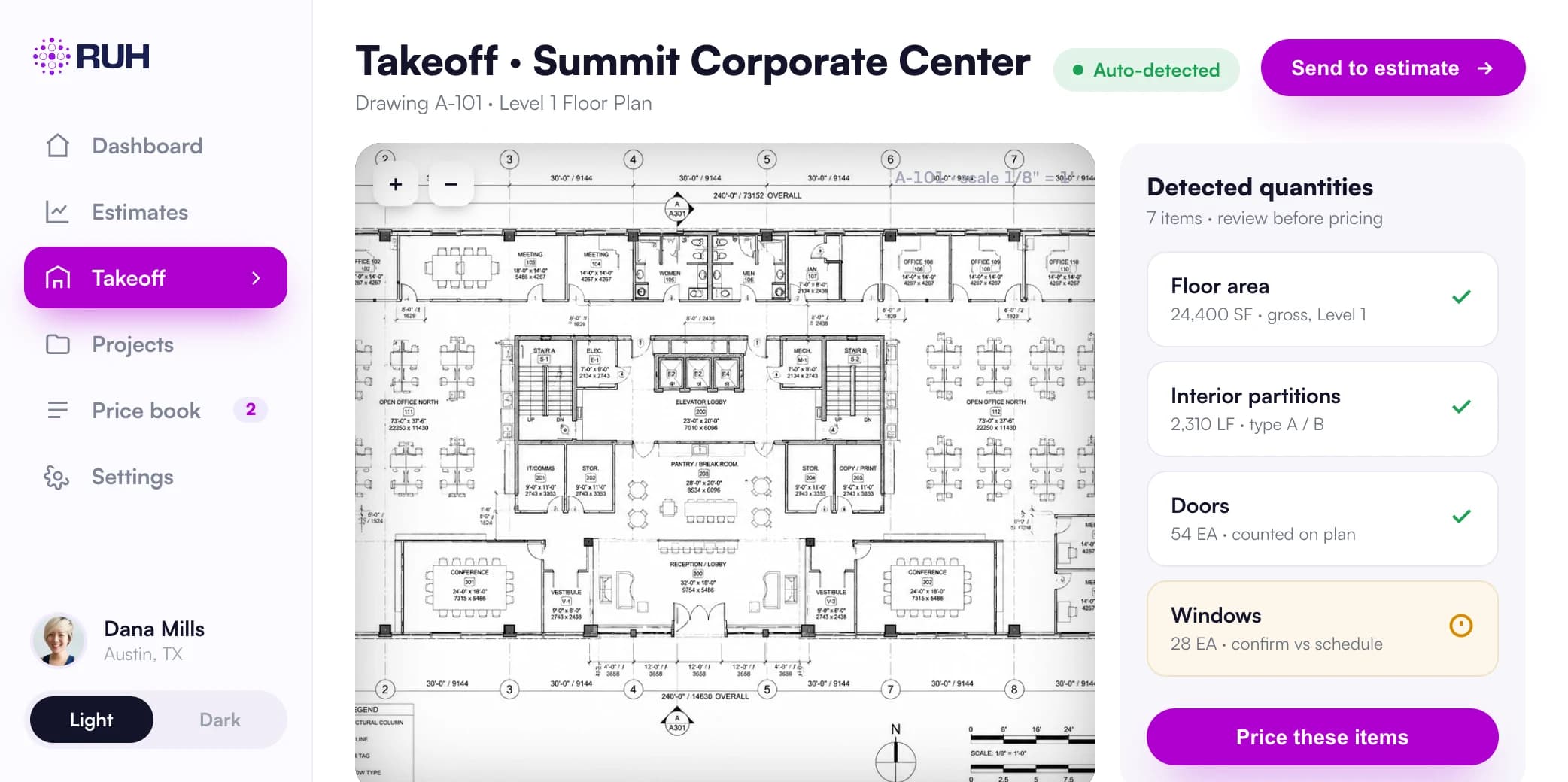
Ruh reads the structural schedules along with the rest of your drawing set, so load-driven scope like shoring, connections, and heavy rigging carries the right context into the estimate. Quantities get priced against your own price book, and your estimator reviews any line where loads drive the means and methods before sign-off.

See AI construction takeoff and estimating software

Kip: frequently asked questions

How many pounds is a kip?+

One kip is exactly 1,000 pounds. The name is a contraction of kilopound, and it exists purely to keep structural numbers readable.

What is the difference between kips and ksi?+

Kips measure force while ksi measures stress, which is force spread over area: kips per square inch. A36 steel, for example, has a 36 ksi yield strength, meaning each square inch of cross-section can carry 36 kips before yielding.

How do kips convert to tons?+

Divide by 2. One short ton is 2,000 pounds, so 2 kips equal 1 ton and a 150 kip column load is 75 tons. Metric conversions differ: 1 kip is about 4.45 kilonewtons.

Still measuring by hand? Your next takeoff can run while you review this one.

See it on your plans

Related terms

Keep going: read the full guide or explore AI construction takeoff and estimating software.

The Units of measure estimating cheat sheet
Every unit, waste factor, and conversion on one page. Free PDF.

See Ruh price a bid from your own drawings.

AI takeoff and estimating on your price book, your estimator signs off.

Figures on this page are illustrative. Construction estimates depend on project-specific conditions, source documents, market pricing, and professional judgment. Ruh's AI assists the estimator and does not replace professional review: your team reviews, validates, and approves every estimate, bid, and pricing decision.