
Try Ruh on a real bid. 100% money-back guarantee if you are not satisfied.*
*Scoped delivery, terms apply. Read the guarantee terms
Catch basin: frequently asked questions
What is the difference between a catch basin and a manhole?+
A catch basin collects surface water through an open grate and holds a sump below its outlet pipe to trap sediment. A manhole is an access structure with a solid cover, placed so crews can enter the pipe network for inspection and maintenance, and it does not take surface flow. They are counted the same way in a takeoff, each by depth class, but they carry different castings, details, and unit prices.
How is catch basin depth measured for estimating?+
Subtract the lowest invert elevation from the rim elevation shown on the utility plan or structure schedule, then add the sump depth from the project detail. That total vertical dimension determines how many precast sections the structure needs and how much trench excavation and backfill it carries. Estimators group the results into depth classes, commonly 2 ft steps, because that is how precast suppliers and utility subs quote.
What is included in the installed price of a catch basin?+
Typically the structure excavation, bedding, the precast base and riser sections, grade rings, the frame and grate, backfill, and final adjustment to grade after paving. The connecting storm pipe is not included; it is a separate lf takeoff. Watch the frame and grate spec closely, because a traffic rated curb inlet casting prices very differently than a pedestrian flat grate, even on structures with identical depth.
Is a catch base the same as a catch basin?+
Yes. "Catch base" is an informal rendering of the same structure; drainage suppliers, precast manufacturers, and civil drawings all catalogue and label it as a catch basin. If a plan note, a supplier quote, or a sub's proposal says catch base, read it as the grate-and-sump inlet structure described here and take it off the same way, each by depth class.
Do catch basins need cleaning?+
Yes, because the sump only keeps working while there is room left in it. Sediment, grit, and trash accumulate in the dead space below the outlet invert, and once the sump fills, solids start passing straight through to the storm line. How well a basin performs over time depends on the size of the sump, whether the outlet is hooded, and how often it is cleaned out, so periodic cleanout is a maintenance line item rather than an optional one. Cleaning is an owner or facilities cost after turnover, not part of the installed structure price a takeoff carries.
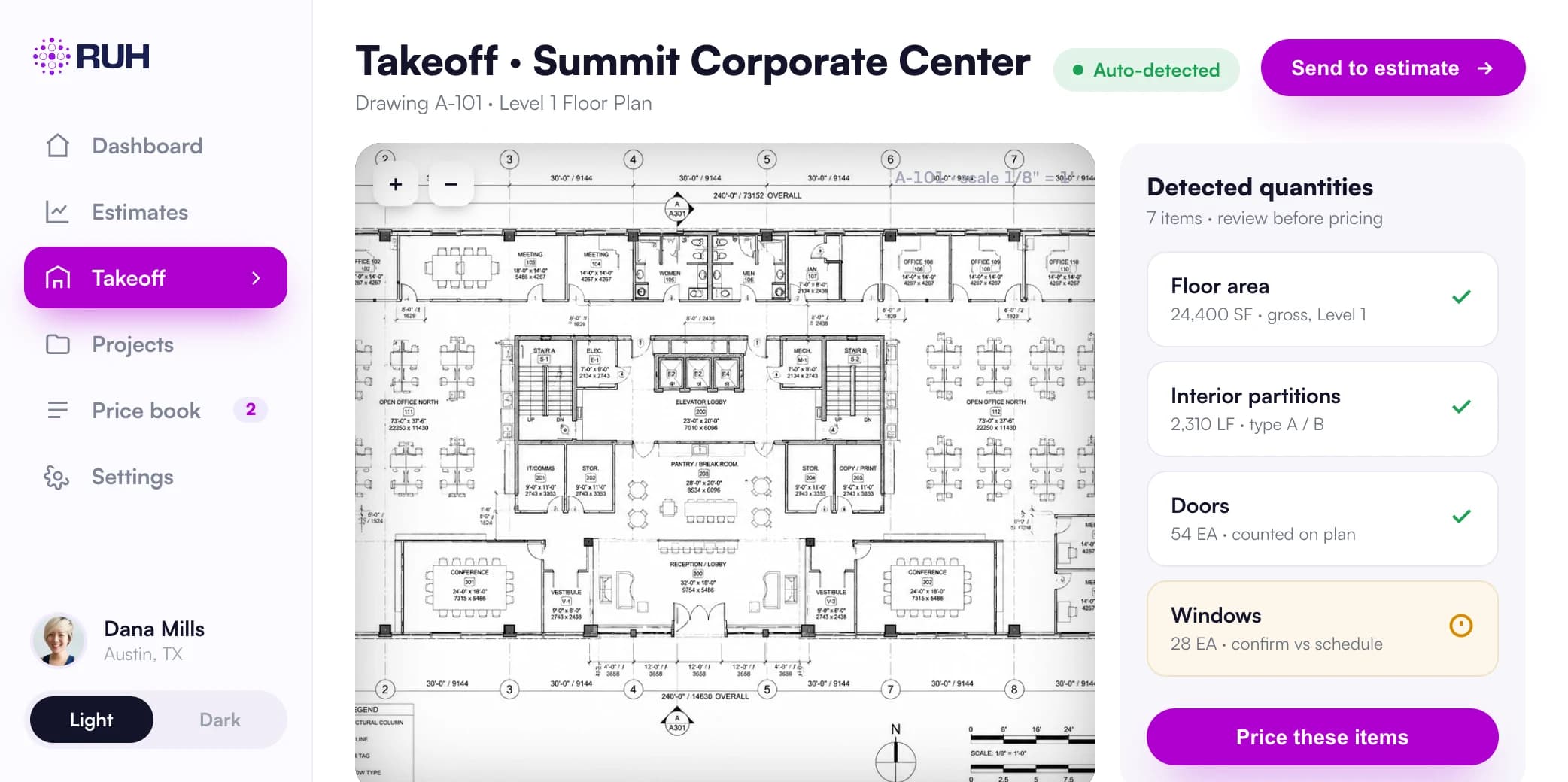
Still measuring by hand? Your next takeoff can run while you review this one.
See it on your plansRelated terms
Keep going: read the full guide or explore AI construction takeoff and estimating software.
Figures on this page are illustrative. Construction estimates depend on project-specific conditions, source documents, market pricing, and professional judgment. Ruh's AI assists the estimator and does not replace professional review: your team reviews, validates, and approves every estimate, bid, and pricing decision.